
CFP International Association for Dialogue Analysis 2017 (Italy)

Dialogue, interaction and culture: Multidisciplinary perspectives on language use in everyday life
International Association for Dialogue Analysis (IADA) Conference
Bologna, Italy, 11-14 October 2017

The 2017 International Association for Dialogue Analysis (IADA) conference will be held from October 11-14, 2017 at the University of Bologna (Department of Education) and is sponsored by the School of Psychology and Education, the FAM (Fondazione Alma Mater), and the International Association for Dialogue Analysis.

The conference focuses on the role of dialogue or interaction in displaying, maintaining, creating yet also defying the crucial dimensions of the world we live in. This process is particularly at play – although not necessarily noticed – in everyday life. Rather than a context, this phenomenological notion indicates the obvious, routine, quasi-natural quality of most human practices taking place in ordinary as well as institutional contexts. Quoting a well-known formula by John Heritage (1984) yet applying it beyond the micro-level of the hic et nunc discursive environment, we propose to conceive dialogue as “context shaped and context renewing”. Overcoming the “interactional reductionism” (Levinson, 2005) implied in focusing solely on the emergent properties of language use, as well as any simplistic return to sociocultural, psychological an even material determinism, dialogue and interaction are seen as an “intermediate variable” (Ibidem) or faits d’interface (Descola, 2016) connecting the micro-order of everyday life and the macro-order of shared culture and social structure. As Rommetveit put it forty years ago, dialogue is “the skeleton” or “the architecture of intersubjectivity” (1976).

The conference welcomes empirical and methodological papers from different disciplinary perspectives that focus on dialogue and interaction as carriers of, and tools for culture, social organization, moral horizons, identities and change. Theoretical papers are more than welcome insofar as they provide some empirical illustration of the paper’s theoretical point(s).

The conference includes but it is not limited to, the following sub themes:
*   Dialogue and Health (e.g. dialogue as therapy; dialogue in clinical settings; medical interaction; dialogue in multilingual-multicultural healthcare contexts; dialogue in social work).
*   Dialogue, Justice and Social Change (e.g. dialogue in policing including interrogations, citizen calls; criminal, civil and administrative law; transidioma and asylum; intercultural institutional talk; social conflicts and Alternative Dispute Resolution practices; family and social mediation; restorative justice).
*   Dialogue and Materiality (e.g. inter-objectivity; Actor-Network-Theory; things as dialogic entities; humans and non-humans interaction; socio-semiotics; dialogue and technologically saturated environment; the object’s affordances and the user’s agenda).
*   Dialogue and Organization (e.g. dialogue as an organizing phenomenon; leadership and dialogue; expert-novice interaction; authority and power in organizational communication).
*   Dialogue, Socialization and Education (e.g. dialogue in friendship and peer culture; family everyday talk; language socialization; classroom talk; dialogue in everyday school-life; assessment as a dialogic practice; teachers-parents conference; L2 learning activities; coaching and training).
*   Dialogue, Text and Language (e.g. dialogue as text; dialogue in literary texts, CMC and audiovisual texts; text and reader dialogue; textual representations of dialogues; dialogue in advertising, advertising as dialogue; dialogue in propaganda and political speech; grammar, lexicon and cultural norms in everyday talk).

Deadline: 30 November 2016.

SUBMISSION
We invite extended abstracts (500 to 700 words) or full papers of a maximum of 30 pages, including references. Any citation style is permitted (e.g., MLA, APA, Chicago). Submission opens on June 30th 2016, and closes on November 30th 2016 at 23:59 local time in Italy. Notification of acceptance in March 2017.

Contacts:
For any inquiry concerning the extended abstract/paper submission please contact:
paper.iadaconference2017[at]unibo.it

For any inquiry concerning the conference organization please contact:
info.iadaconference2017[at]unibo.it

CFP IMéRA Fellowships (France)

IMéRA : Call for applications 2017-2018
Application deadline: Friday, 18 November, 2016 – 23:59
IMéRA: Laboratory for Cross-disciplinary Exploration

A foundation of Aix-Marseille University, IMéRA is an Institute for Advanced Study, a unique research centre where both emerging and top-level scientists can take advantage of residence schemes to carry out innovative research projects.

IMéRA is specifically aimed at fostering cross-disciplinary projects. It receives scientists and artists of all disciplines (in residence between 3 and 10 months), as well as a few cross-disciplinary teams with joint projects for short stays (2 to 4 weeks).

Research undertaken at the Institute is meant to develop interaction within social science, within science, between social science and hard, experimental and health sciences, and links between art and science. The Institute thus contributes to the emergence and development of world-class cross-disciplinary research approaches on Aix-Marseille University ground and grooms young researchers for such approaches. IMéRA also enthusiastically welcomes projects bearing on Mediterranean territories or submitted by researchers from the Mediterranean rim.

In their applications, candidates should clearly demonstrate their interest in cross-disciplinary projects on the basis of their research or itineraries, by:

  • providing a list of already experienced cross-disciplinary collaborations or of publications calling for such collaboration schemes; or
  • proposing to start one such collaboration and specifying its characteristics; or
  • detailing expected contributions from cross-fertilisation of their own research program with perspectives and intellectual resources of other disciplines.

IMéRA gives preference to high-aspiring research projects conducive to inter-disciplinary collaboration on complex science issues or major society challenges. Residents carry out their research in connection with Aix-Marseille University (AMU) teams and laboratories or with partner bodies. It is compulsory to include a letter of interest by an Aix-Marseille University researcher to the application.

SCHEDULE
Deadline: 18 November 2016 (this date included)
Duration of residences: 5 or 10 months
Residence periods (to be chosen by the candidates, several choices are possible)

WHO CAN QUALIFY
This call is open to scientists with official status and artists of all disciplines, both junior and senior.

Applications must be in English or French.
Candidates must submit their applications EXCLUSIVELY on IMéRA’s website 

For further information, contact: pascale.hurtado[at]univ-amu.fr

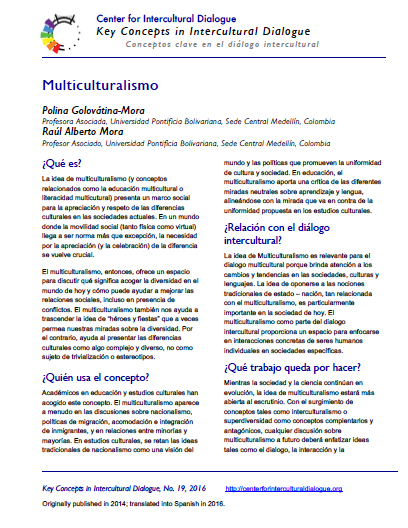
Key Concept #19: Multiculturalism Translated into Spanish

Key Concepts in ICDContinuing translations of Key Concepts in Intercultural Dialogue, today I am posting KC19: Multiculturalism, written by Polina Golovátina-Mora and Raúl Alberto Mora and first published in English in 2014, and which Gloria Gutiérrez has now translated into Spanish.

As always, all Key Concepts are available as free PDFs; just click on the thumbnail to download. Lists of Key Concepts organized chronologically by publication date and number, alphabetically by concept, and by languages into which they have been translated, are available, as is a page of acknowledgments with the names of all authors, translators, and reviewers.

KC19 Multiculturalism_SpanishGolovátina-Mora, P., & Mora, R. A. (2016). Multiculturalismo. (G. Gutiérrez trans). Key Concepts in Intercultural Dialogue, 19. Available from:
https://centerforinterculturaldialogue.org/wp-content/uploads/2016/10/kc19-multiculturalism_spanish.pdf

If you are interested in translating one of the Key Concepts, please contact me for approval first because dozens are currently in process. As always, if there is a concept you think should be written up as one of the Key Concepts, whether in English or any other language, propose it. If you are new to CID, please provide a brief resume. This opportunity is open to masters students and above, on the assumption that some familiarity with academic conventions generally, and discussion of intercultural dialogue specifically, are useful.

Wendy Leeds-Hurwitz, Director
Center for Intercultural Dialogue


Creative Commons License
This work is licensed under a Creative Commons Attribution-NonCommercial-NoDerivatives 4.0 International License.

National U of Singapore 4 Job Ads

Position 1: Full/Associate Professor in Health Communication, Culture, and Critical Theory at National University of Singapore

The Department of Communications and New Media at the National University of Singapore (NUS) seeks to hire a tenured Full/Associate Professor with research and teaching specialization in Health Communication, Culture, and Critical Theory. In particular, we are looking for a scholar with expertise in research and teaching interests in one or more of the following areas: culture-centered approach, culture and health communication, cultural studies of health, critical health communication theory, health inequalities, health and social justice, health narratives, health communication campaigns, provider patient communication, public policy and health, social change communication, community-driven participatory research, health and globalization, health advocacy, and/or health activism. The successful candidate will be an internationally recognized scholar, approaching the study of health communication processes and practices through interpretive and/or critical perspectives. Candidates must have a Ph.D., extensive teaching experience, globally recognized research achievements anchored in a stellar publication record, proven administrative experience, and leadership qualities

Position 2. Full/Associate Professor in New Media Studies at National University of Singapore

The Department of Communications and New Media (CNM) at the National University of Singapore seeks to hire a tenured Full/Associate Professor with research and teaching specialization in New Media Studies. We are seeking a scholar  with expertise in one or more of the following broad areas: 1) Social media –computer-mediated communication, social and semantic network analysis, big data and computational methods, interaction design and analysis, digital risks and privacy, socially-mediated relationships, and/or social media and cities. 2) Critical theory and new media – ICTD, digital rhetoric and digital humanities, political economy of new media, postcolonial theories of new media, new media mobilities, digital Marxist theory, digital activism. 3) Digital culture – cultural flows, digital ethnography, mobile media use, digital mobilities, digital literacies, cultural studies of new media, performance studies and new media, new media policies and regulations, digital ethics. The successful candidate will be an internationally recognized scholar, approaching the study of health communication processes and practices through interpretive and/or critical perspectives. Candidates must have a Ph.D., extensive teaching experience, globally recognized research achievements anchored in a stellar publication record, proven administrative experience, and leadership qualities.

The Department, a part of the globally ranked Faculty of Arts and Social Sciences at NUS, offers degree programs at the undergraduate, masters and doctoral levels, and is ranked among the top global Communication and Media Studies departments.

For positions 1 or 2, please submit:
1.      a letter of interest;
2.      an updated curriculum vitae (including education, employment history, public and professional service, honors and awards, and a complete list of publications);
3.      a list of six referees (with affiliations and particulars)
4.      a statement of research
5.      analysis of research impact
6.      Five key publications
7.      Teaching philosophy and feedback evidence
to Gayathri Dorairaju at  CNMCAREER[at]NUS.EDU.SG  ..STATE THE EXACT POST YOU WISH TO BE CONSIDERED FOR.

The search committee will start reviewing the file on 01 December 2016 and the search will continue until the position is filled.

***

Position 3. Tenured Associate or Full Professor in the Political Economy of the Middle East  at National University of Singapore

The Faculty of Arts and Social Sciences (FASS) and the Middle East Institute (MEI) at the National University of Singapore (NUS) invite applications for a tenured Associate or Full Professorship in the Political Economy of the Middle East. Advanced Assistant Professors are also welcome to apply. The successful candidate will be jointly appointed by the FASS and MEI with tenure, a reduced teaching load in the most relevant FASS department (e.g. political science, economics, sociology, history, geography, communications and new media), and the opportunity to lead a research cluster in MEI. Expertise in the relations between business and politics, and their ramifications in the wider society, is especially welcome. A transnational connective or comparative dimension, with knowledge of two or more countries, regions or languages in the Middle East and Asia would be a distinct advantage. Related interests in rentier state economies, authoritarian rule, social movements, democratization, party politics, religious revivalism, comparative fundamentalisms, and digital media are also welcome.

Position 4. Open Rank up to Tenured Full Professor in Middle East-Asia Studies  at National University of Singapore

The Faculty of Arts and Social Sciences (FASS) and the Middle East Institute (MEI) at the National University of Singapore (NUS) invite applications for a Professorship in Middle East-Asia Studies at any rank. The successful candidate will be jointly appointed by the FASS and MEI with tenure, a reduced teaching load in the most relevant FASS department (see list on http://www.fas.nus.edu.sg/aboutus/departments.html), and the opportunity to lead a research cluster in MEI. We are interested in scholars whose work connects the Middle East with any other part of Asia, in any field or discipline (e.g., history, geography, anthropology, literature, sociology, economics, religion, communications and new media). Knowledge of two or more countries, regions or languages in the Middle East and Asia would be a distinct advantage.

NUS is a leading university in Asia which provides rich resources and opportunities for research, competitive remuneration and generous benefits, including housing and medical coverage. The university is looking to strengthen Middle East expertise across the FASS departments, and to create a distinctive Middle East Institute in Asia through three such senior appointments: in Political Economy, Legal Pluralism and Middle East-Asia Studies.

For positions 3 or 4, please send a cover letter, CV, two sample publications, three referee names, research and teaching statements by 30 November 2016 to:

Chair, Middle East Political Economy Search Committee c/o Ms Pui-Yoke BUN, Dean’s Office, Faculty of Arts and Social Science, National University of Singapore, Shaw Foundation Building, 5 Arts Link, Singapore 117570
Email: mes_sc[at]nus.edu.sg

Lancaster U Job Ad: Intercultural Communication

Lecturer in Intercultural Communication
Lancaster University Linguistics & English Language
Closing Date:   Sunday 27 November 2016
Reference:  A1694

The Department seeks to appoint a Lecturer in Intercultural Communication. You will have a PhD (or award within 12 months) and relevant research and teaching experience in Intercultural Communication.

You will join a large group of internationally renowned linguists that includes specialists in: English Language study, Corpus Linguistics, Discourse Studies, Forensic Linguistics, Sociolinguistics, Cognitive Linguistics, Psycholinguistics, Literacy Research and Second Language Teaching, Learning and Assessment.

You will pursue research and publications at a level appropriate for a strong submission to the next Research Excellence Framework and will be expected to supervise undergraduate and postgraduate students.  You will develop new modules and programmes in Intercultural Communication, particularly at postgraduate level.

This is an indefinite post beginning around 1 February 2017.

Informal enquiries can be made to Professor Elena Semino, Head of Department: e.semino[at]lancaster.ac.uk

Durham U Job Ad: Intercultural Education

Senior Lecturer, Durham University – School of Education
Closes: 20th November 2016

The School of Education seeks to appoint an outstanding candidate at Senior Lecturer (Associate Professor) level. We welcome applications from exceptional scholars with research and teaching interests in the broad field of Education; experience of research and teaching in Intercultural Education would be advantageous.

This post offers an exciting opportunity to make a major contribution to the development of the School of Education’s research and teaching and the successful candidate will contribute to the teaching of our undergraduate and/or postgraduate programmes. The successful candidate must also be able to contribute to research activity in a School that is recognised internationally for its research excellence.

CFP Journal of Hate Studies

Call for Guest Editing Proposals – Journal of Hate Studies

The Journal of Hate Studies, published by Gonzaga University’s Institute for Hate Studies, is currently seeking proposals for a guest-edited, themed issue to be published in Fall 2017.

The Institute for Hate Studies’ mission, in alignment with Gonzaga University’s Jesuit identity, involves undertaking activities aimed at promoting reconciliation and overcoming hate. The Journal is peer-reviewed and publishes interdisciplinary work that scrutinizes the roots and prevalence of hate in the contemporary world. First established in the year 2001 and credited with publishing foundational work within the field of Hate Studies, the Journal has international distribution and welcomes contributions from various disciplines. Articles published in the journal examine hate in any of its manifestations (e.g. racism, misogyny, antisemitism, homophobia, religious intolerance, ethnic violence, anti-immigrant animus); consider how hate is institutionalized, maintained, or perpetrated through culture, organizations, policies, politics, media, discourses, and epistemologies; and develop, adapt, or refine the methods used for understanding or overcoming hate.

For its 2017 issue, the Journal seeks proposals that address a particular theme, which may be approached using different theoretical frameworks or methodologies. Possible themes include, but are not limited to:
– Hate and politics.
– Race and violence.
– Immigration and hostility.
– Digital technologies and hate.
– Bullying and anti-bullying campaigns.
– Hate speech.
– Hate and international conflicts.
– Intercultural violence and hate.
– Hate and trauma.
– Covert and subtle forms of hate.
– Campaigns and strategies to confront hate.
– Hate in global and transnational contexts.
– Hate, civil society, and social movements.
– Hate and the media.
– Hate in historical contexts.

To submit a proposal, please send a 1,500-word rationale explaining the theme and outlining the scope of the guest-edited issue, listing possible subtopics to be addressed, and indicating possible peer-reviewers. Please attach a short bio listing relevant publications and editing experience. The deadline for submissions is November 14, 2016.

The guest editor will be appointed by the Journal’s Editorial Board and will be expected to oversee the preparation of the 2017 issue of the Journal, recommending articles, working with contributors and peer-reviewers, and communicating with the Editorial Board.

For inquiries, please contact Dr. Kristine Hoover, Director of the Institute for Hate Studies (e-mail: hoover[at]gonzaga.edu) or Dr. Claudia Bucciferro, Chair of the Editorial Board (e-mail: bucciferro[at]gonzaga.edu). Please submit your proposal through the Journal’s website or send it directly to bucciferro[at]gonzaga.edu.

CFP Journal of Language & Discrimination

The new Journal of Language and Discrimination will be launched in 2017 with Equinox.

Discrimination is an important research topic in a large number of diverse but related fields, including linguistics, law, anthropology, sociology and psychology. This complex, multidisciplinary research topic often has a strong focus and concern with language. The new Journal of Language and Discrimination aims to bring together a multidisciplinary synergy of approaches on discrimination as a complex linguistic and non-linguistic phenomenon. In bringing together different research strands that focus on discrimination, the journal hopes to serve as a catalyst for innovation and play a pivotal role in establishing interdisciplinary language and discrimination research worldwide.

Discrimination is often intimately linked to language. Verbal exchanges may be seen to embody discriminatory uses of language, and linguistic features often play an important role in reproducing, maintaining or subverting systems of discrimination. An alleged discriminatory event may, for instance, be played out discursively in legal rulings, print and broadcast media and social media, creating a complex picture of linguistic patterns and discourse strategies.

Analysing the linguistic strategies of such an event allows for a more comprehensive understanding of discrimination and the actors involved, and goes some way towards understanding the impact of discriminatory incidents in context and in society more generally. There is a struggle over language about whose meaning of a term is accepted or who gets to name someone in a particular way, whose perspective is authorised, and it is this struggle over language which will be investigated: the process of naming an event as discriminatory and having that naming authorised, or challenged; the effects of discrimination on individuals and groups; resistance to discrimination.

The journal focuses on the shaping effect of language in situations of discrimination, but will also comprise research on language ideology and language-focused discrimination; i.e. discrimination towards a language, or towards users of a particular language variety. The Journal of Language and Discrimination will be able to provide a unique platform to broadcast the diversity and interdisciplinarity of research on language and discrimination, whilst maintaining a unifying focus. As such, it will allow for the development of new understandings and new approaches to the study of language and discrimination.

The editors of JLAD invite papers that reflect the diversity of possible approaches in relation to language and discrimination. The aim is to include work with a wide array of approaches that reflect the diversity and recent developments of research on language and discrimination.

Topics may include but are not limited to:
– Reflections on the research that has been done on discrimination in your field, and the direction in which research could or should develop
– Discussions on broadening the field versus constraining academic subject areas
– Consideration of definitions of discrimination, and the benefit, and disadvantages of using this term for our research
– Theoretical and methodological considerations in interdisciplinary research
– Case studies from different fields that relate to language and discrimination
– Qualitative analyses on language and discrimination

Editors:
Isabelle van der Bom, Sheffield Hallam University
Sara Mills, Sheffield Hallam University
Laura Paterson, Lancaster University

Submission procedure:
Please see the website for all the details on how to publish in the Journal of Language and Discrimination and don’t hesitate to contact one of the editors for more information on the Journal.

Publication and Frequency
Two issues per volume year, May and November (from 2017)

American U Beirut Job Ad: World Literature, Global Film & Visual Culture

Assistant Professor in World Literature and Global Film and Visual Culture
American University of Beirut – The Department of English
Closes: 1st November 2016

The Department of English at the American University of Beirut is seeking to fill a faculty position in world literature and global film and visual culture to begin August 15, 2017.

Candidates with research interests in cross-cultural dialogues and digital practices are encouraged to apply. We particularly invite applicants with research expertise in non-Western literary and visual traditions related to South and/or East Asia, South America, Africa, and/or the MENA region. Candidates will contribute to the BA and MA degrees in literature and the minor in film and visual culture.

AUB faculty engage in research, teaching, and service. The new hire is expected to teach at the undergraduate and graduate levels and to participate in the collegial governance of the Department and University.

The position is at the assistant professor level. The appointment is for an initial period of four years with opportunities for renewal and advancement. The usual teaching load is not more than 5 courses a year. Applicants must have completed their PhD by August 2017. The language of instruction is English.

To apply, send a cover letter, a CV, a writing sample, a sample syllabus, and arrange for three letters of reference to be sent directly to:
Nadia Maria El Cheikh, Dean
Faculty of Arts and Sciences
American University of Beirut
c/o 3 Dag Hammarskjold Plaza, 8th Floor
New York, NY 10017-2303, USA

Or
Nadia Maria El Cheikh, Dean
Faculty of Arts and Sciences
American University of Beirut
P.O. Box 11-0236, Riad El-Solh
Beirut 1107 2020, Lebanon

Electronic submissions are highly encouraged and may be sent to as_dean[at]aub.edu.lb

For full consideration, all application documents should arrive by November 1, 2016.

The American University of Beirut is an Equal Opportunity Employer.