Literature for Intercultural Awareness: A “Key to Perception”?

Guest Posts

Literature for Intercultural Awareness: A “Key to Perception”?
Guest Post by Michael Steppat

It has been said that literary works can benefit and advance intercultural understanding. For instance, Mazi-Leskovar maintains that “literature should alert readers to all those who are in one way or another different from the readers themselves. Literature thus encourages inter- and intracultural awareness” (2010, p. 10); “multicultural literature remains one of the sources through which issues related to intercultural communicative competence can be successfully addressed” (2006, p. 278). Wasikiewicz-Firlej (2012) explains that “works of literature enable the reader to observe the world from multifarious perspectives and cherish the diversity of individual perception. The power of literature lies in its unique ability to deeply involve the reader both at a cognitive, as well as emotional level.” Taking Japanese writer Haruki Murakami as an example, Kuryleva and Boeva have found: “The overwhelming majority of the writer’s literary heroes, placed into alien cultural environments, become the participants of intercultural communication” (2010, p. 171). This is not only a feature of recent literature, however. In the very beginning of western literary culture, Homer’s Iliad culminates in a Book 24 which poignantly depicts the furtive (and rather desperate) visit of Trojan ruler Priam in the quarters of the Greek enemy, at risk of his life.

Of course it is more recent developments that are especially relevant for us today. We owe to Edward T. Hall an insight into sources of knowledge that bring to light the concealed snags of what we like to take for granted, what culture “hides” from its own members. In The Hidden Dimension, Hall illustrates this with the desirability of using literary artifacts as “a key to perception”: from fictional works of different cultural origins one may gain data on the experience and perception of spatial distance as “a significant cultural factor” (1966/1982, pp. 94ff.). Some time after this, communication scholar John C. Condon suggested: “The potential of literature and film for our understanding of intercultural relations is considerable, and can be explored both through the analysis of cultural patterns expressed in the works, and in the analysis of intercultural themes, of conflicts and resolutions by the characters in novels, biographies and films” (1986, p. 153). It is hence not surprising that Patrice Buzzanell, studying intercultural adaptation, should develop an argument about career design processes partly by calling attention to narrative fiction, viz. Lionel Shriver’s novel The Post-Birthday World (2012, pp. 85, 91-92): by bricolage, the same set of skills and abilities “can be channeled into different career paths.”

Download the entire post as a PDF.

Michael Steppat Profile

ProfilesMichael Steppat has been Chair of Literature in English at the University of Bayreuth, Germany, where he also served as Academic Dean of the Faculty of Linguistics and Literary Studies for many years until he achieved Emeritus status in 2015.

Michael Steppat

He also holds a Professorial position of honor in Moscow from the Russian Federation’s Ministry of Higher Education and Science, having been coordinator of a cooperation network of five universities and becoming moderator of a research seminar at Moscow City University. In recent years he has been appointed regular visiting professor and external advising faculty member at Shanghai International Studies University, as well as visiting professor at Fu Jen Catholic University, Taipei (Taiwan); in earlier years he was invited as visiting professor at institutions in the UK and the USA. After receiving his Ph.D. from the University of Münster (Germany) and later his ‘Habilitation’ both from there and from the Free University of Berlin, he was a Fulbright scholar at the University of Texas at Austin, then research professor at Arizona State University. He has repeatedly been awarded the Myra and Charlton Hinman Fellowship of Amherst College and the Folger Shakespeare Library, Washington DC. To move in a new direction, he developed an internationally cooperative graduate program of Intercultural Anglophone Studies.

His book publications include Americanisms: Discourses of Exception, Exclusion, Exchange (2009); editions of several Renaissance Latin dramas (1991); Chances of Mischief: Variations of Fortune in Spenser (1990); co-editorship of the New Variorum edition of Shakespeare’s Antony and Cleopatra (1990); The Critical Reception of Shakespeare’s Antony and Cleopatra (1980); and a monograph on the early work of St. Augustine of Hippo (1980). Thus one research interest has been in the constructions of Orientalism in early modern literature. A collaborative volume on Writing Identity: The Construction of National Identity in American Literature (Moscow Region University Press, 2016) extends the research focus to identity discourses in American culture. As appointed member of the Modern Language Association of America’s editorial team for the International New Variorum Shakespeare, he continues to edit assigned plays. Spurred by an invitation from the London School of Economics and Social Science in 2011 to organize a workshop, based on the cooperative graduate program, Steppat has increasingly devoted attention to intercultural studies in connection with literature. The chief research interest in this regard is extending intercultural scrutiny of literature as well as film beyond historical comparison, and toward a processual or interactive notion of culture as practice and meeting ground. Imaginative representation of migrant situations and cultural minorities is especially pertinent in exploring the fertile terrain where literary and intercultural study discover each other.

In 2012 Steppat became Primary Investigator in a Bavarian government-sponsored Sino-German cooperative program on “Identity and Intercultural Communication: Perspectives on America”, which has enabled a symposium, the delivering of papers, and the conducting of workshops on intercultural literary study at various international institutions and conferences. The program has widened to considering Intercultural Communication as a resource for literary research. Connections between the range of research interests keep emerging, sometimes in unanticipated ways. Steppat has produced three volumes on Literature and Interculturality in the Intercultural Research book series, of which he is a co-editor (Shanghai Foreign Language Education Press, 2019). He has been appointed a member of the national Cluster of Excellence “Africa Multiple”. Apart from theoretical and conceptual orientations, major focal areas in this context are diasporic discourses, representations of cross-cultural identities, as well as variations of cross-cultural transfer. A key concern is to understand difficult meanings in the artifacts we study not as a mental act but rather as a social practice and a communicative achievement.


Work for CID:

Michael Steppat wrote the guest post, Literature for Intercultural Awareness: A “Key to Perception”? He has also served as a reviewer for translations into German.

KC81: Dialogue as a Space of Relationship by Maria Flora Mangano

Key Concepts in ICDThe next issue of Key Concepts in intercultural Dialogue is now available. The goal is to expand the concepts available to discussions of intercultural dialogue. Click on the thumbnail to download the PDF. Lists organized chronologically by publication date and numberalphabetically by concept in English, and by languages into which they have been translated, are available, as is a page of acknowledgments with the names of all authors, translators, and reviewers.

KC81 Dialogue as a Space of RelationshipMangano, M. F. (2017). Dialogue as a space of relationship. Key Concepts in Intercultural Dialogue, 81. Available from:
https://centerforinterculturaldialogue.org/wp-content/uploads/2017/05/kc81-dialogue-as-space-of-relationship.pdf

The Center for Intercultural Dialogue publishes a series of short briefs describing Key Concepts in Intercultural Dialogue. Different people, working in different countries and disciplines, use different vocabulary to describe their interests, yet these terms overlap. Our goal is to provide some of the assumptions and history attached to each concept for those unfamiliar with it. As there are other concepts you would like to see included, send an email to the series editor, Wendy Leeds-Hurwitz. If there are concepts you would like to prepare, provide a brief explanation of why you think the concept is central to the study of intercultural dialogue, and why you are the obvious person to write up that concept.

Wendy Leeds-Hurwitz, Director
Center for Intercultural Dialogue


Creative Commons License
This work is licensed under a Creative Commons Attribution-NonCommercial-NoDerivatives 4.0 International License.

CFP Argumentation & Language (Switzerland)

The second edition of the conference “Argumentation & Language” will take place from 7 to 9 of February 2018 at USI – Università della Svizzera italiana in Lugano, Switzerland.

Building on the success of the first ARGAGE conference, held at the University of Lausanne in 2015, the goal of the conference is to further explore the intersections of argumentative and language practices. Scholars are therefore invited to submit proposals dealing with the interrelations between language (its units, its levels, its functions and modes of processing) and the way argumentation functions. Contributions must be related to at least one of the following five research axes:

1. Argumentation in spoken interaction
2.  Semantics and argumentation
3.  Argumentative indicators
4. Corpora annotation and argumentation
5. Rhetorical devices

Priority will be given to proposals that make their methods and analytical categories explicit and that privilege the description of empirical data collected in corpora or empirically. Submissions will be evaluated on the basis of anonymized abstracts.

Types of contributions

Individual presentation
The deadline for submission is 30 June 2017.

Panel
Panel proposals can be submitted until 30 April 2017.

Stockholm U PhD Studentship: Bilingualism (Sweden)

FellowshipsPHD Student in Bilingualism  at the Department of Swedish Language and Multilingualism, Stockholm University
Closing date: 18 April 2017

The Centre for Research on Bilingualism provides a broad base of theoretical and practical research with the aim of increasing understanding and awareness of bilingualism. The Centre is a cross-linguistic and interdisciplinary unit within the Faculty of Humanities Language Sciences Section at Stockholm University. Research at the Centre forms a significant part of Stockholm University’s leading research area “Bilingualism and Second Language Acquisition”.

Research areas include bilingualism and second language acquisition, multilingualism and diversity, bilingualism in the family, bilingual education, Swedish as a second language for children and adults, young people’s languages and language use in multilingual contexts, second and foreign language teaching, L1 attrition and reactivation in bilinguals, language maintenance and language shift, language ideology, language policy, and multilingualism and education in developing countries. In sum, the Centre’s research covers the sociolinguistic, pragmatic, structural, psycholinguistic, cognitive and neurolinguistic aspects of bilingualism. For more information, see: www.biling.su.se/english.

As a PhD student at the Faculty of Humanities you have the opportunity to participate in the Faculty’s Doctoral School, which offers themes and courses characterised by interdisciplinarity and cooperation across subjects. The Doctoral School also gives you the chance to improve the quality of your education thanks to the interchange provided by the community of PhD students from other subjects and departments.

Project description
The Centre for Research on Bilingualism announces 1–2 places in the PhD program in Bilingualism. The Centre encourages applications in the areas of the Sociolinguistics of multilingualism and diversity and Psycho-/Neurolinguistics (including EEG or Eye-tracking).

Save

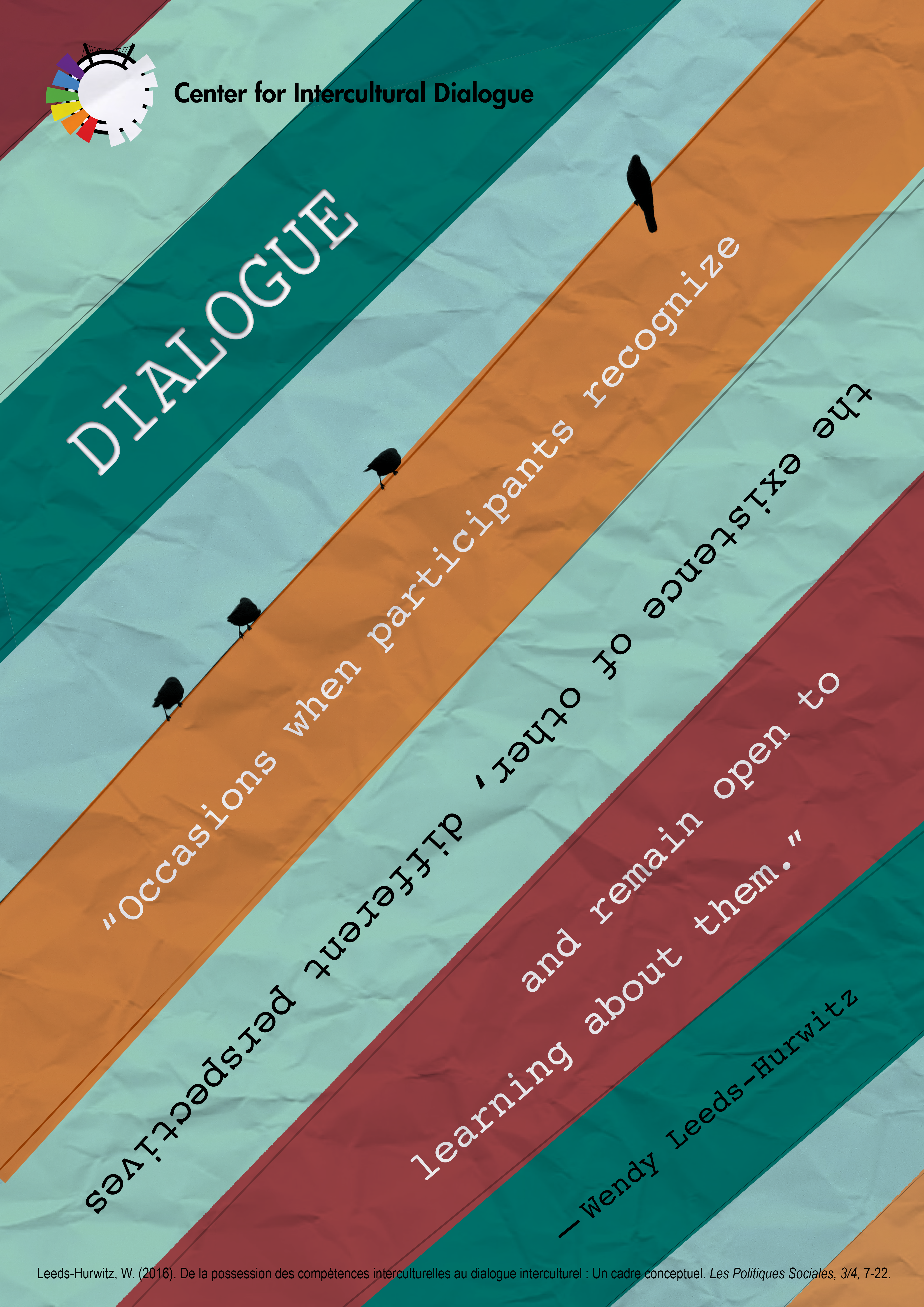
Quote of the Day: Communication as a Miracle of Translation

Intercultural Dialogue QuotesOccasionally when I read, a quote related to intercultural dialogue strikes me as particularly noteworthy for being insightful, concise, beautifully written, and/or original. One example is provided below. Given the translations I have been publishing, not to mention the state of the world these days, it seems particularly apropos.

“Every act of communication is a miracle of translation.” (p. vii)

• Liu, K. (2016). The paper menagerie and other stories. London: Saga Press.

If you have quotes you would like to see posted, submit them for consideration to intercult.dialogue@[at]gmail.com

Wendy Leeds-Hurwitz, Director
Center for Intercultural Dialogue

CFP European Television and Nations (Romania)

Call for proposals
European television and nations: Between centers and peripheries, 1950-1980
9-10 November 2017, Bucharest, Romania

Since the end of the 2000s, research into television history has
revealed different realities depending on the country (Bignell & Fickers
2008, see also Socialist Television Studies). Far from being limited
to the development of main television (British, German, or French), the
European television landscape seems to have been configured along a
number of dividing lines: the classical divisions (East / West, public
service / commercial TV) overlapped with new dichotomies (North / South (Bourdon 2011), democratic / authoritarian systems (Goddard 2013)).

In order to evaluate the relevance of these taxonomies and to account
for different dynamics which were thus created, our symposium aims at
exploring the less known history of the television referred to here as
peripheral in relation to pre-existing television models (continuing
Wallerstein’s world economy theory, 1974). The symposium is meant to
explore the attraction, imitation and diffusion of practice and content
between central and/or peripheral television. Particular attention will
be given to the period of emergence and development of television
institutions and to the established or presumed relationships between
television operators and national construction.

We are welcoming contributions which will analyze the influence,
convergence or opposition between European television, from different
perspectives:
-television techniques (introduction of color TV, modes of transmission
and recording etc.);
-institutional organization (regulation of relations between political
authorities and public television, recruitment of staff etc.);
-formation or practice of television professionals;
-design of broadcast schedules;
-circulation and possible adaptation of the program formats (fiction or
non-fiction);
-dissemination of national or international content;
-reception of programs by trans-border audiences.

Contributions may also address methodological issues or the problem of
access to television archives, in so far as these issues form the basis
of future research.

Lecturers:
Prof. Jérôme Bourdon, University of Tel Aviv
Géraldine Poels, responsible for scientific development, INA, Paris

The abstracts, in French or English, up to 250 words, are to be sent to
the following e-mail addresses: anne.roekens@unamur.be, romina.surugiu@fjsc.ro, amatei25@yahoo.com, by 10 April 2017. The languages of the symposium will be French and English.

Participation fee: 50 euros.

Organized by CEREFREA Villa Noël and the Faculty of Journalism and Mass Communication of the University of Bucharest within the trilateral Belgium(Wallonie)-Bulgarian-Romanian project “Television and nations in the European semi-periphery: Establishing a national identity through television (1958-1980)”

Key Concept #37: Dialogic Listening Translated into Italian

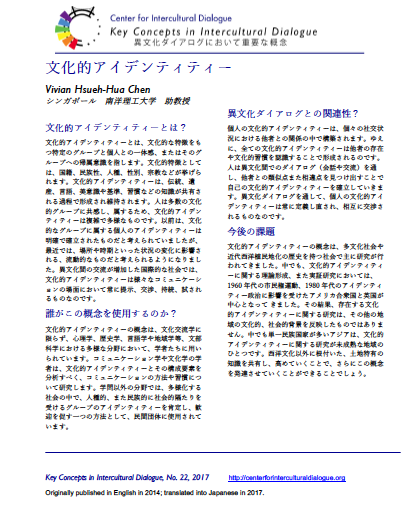
Key Concepts in ICDContinuing translations of Key Concepts in Intercultural Dialogue, today I am posting KC37: Dialogic Listening, which Robyn Penman wrote in English in 2014 and which Maria Flora Mangano has translated into Italian, with the help of Paola Giorgis.

As always, all Key Concepts are available as free PDFs; just click on the thumbnail to download. Lists of Key Concepts organized chronologically by publication date and number, alphabetically by concept, and by languages into which they have been translated, are available, as is a page of acknowledgments with the names of all authors, translators, and reviewers.

KC37 Dialogic Listening_ItalianPenman, R. (2017). Ascolto dialogico. (M. F. Mangano with P. Giorgis, Trans.). Key Concepts in Intercultural Dialogue, 37. Available from: https://centerforinterculturaldialogue.org/wp-content/uploads/2017/03/kc37-dialogic-listening_italian.pdf

If you are interested in translating one of the Key Concepts, please contact me for approval first because dozens are currently in process. As always, if there is a concept you think should be written up as one of the Key Concepts, whether in English or any other language, propose it. If you are new to CID, please provide a brief resume. This opportunity is open to masters students and above, on the assumption that some familiarity with academic conventions generally, and discussion of intercultural dialogue specifically, are useful.

Wendy Leeds-Hurwitz, Director
Center for Intercultural Dialogue


Creative Commons License
This work is licensed under a Creative Commons Attribution-NonCommercial-NoDerivatives 4.0 International License.

Arab Master in Democracy and Human Rights (Lebanon)

Graduate StudyThe Arab Master in Democracy and Human Rights is a unique programme designed to meet the needs of students, professionals and experts who want to deepen their knowledge and develop their skills in the field of democratic governance and human rights in the Middle East and North Africa. It is part of the Global Campus of Regional masters in Human Rights and Democracy supported by the European Union.

Our aim is to support the next generation of experts, academics and practitioners and to give them the practical experience needed for building up their professional career and academic activities.

The Arab Master in Democracy and Human Rights is supported by a growing network of partner universities from the region and beyond. The partnership is composed of the following academic institutions:

  • Saint Joseph University (Lebanon) as the coordinating University (Lebanon),
  • Birzeit University (Palestine),
  • International University of Rabat (Morocco),
  • University of Carthage (Tunisia)

The University of Jordan (Jordan) and the University of Cairo (Egypt) are currently in the process of joining ARMA.

EWHA-KACA Research Award

EWHA-KACA RESEARCH AWARD

Ewha Womans University, Division of Communication and Media (EWHA) and The Korean American Communication Association (KACA) jointly award outstanding research proposals focusing on Korea-related communication and/or media studies. A total of $3,500 will be awarded to the winning recipient(s). Ideally, one or two faculty-led projects (faculty as a PI) will be competitively selected to receive up to $3,500. The half of the award will be distributed at the beginning of the award cycle (August 2017) and the remaining half will be distributed at the completion of the study within two years (August 2019). The research findings should be presented at one of the KACA research sessions at NCA, ICA, or AEJMC in 2018 or 2019.

All material must be submitted electronically to the Award Committee Chair, Dr. Joonghwa Lee, by April 15, 2017 at 11:59pm EST.

RESEARCH TOPIC

Any topic that advances Korea-related communication and/or media research is eligible for the award. Proposals must emphasize contributions to relevant research streams and the Korean society in general. All methods, whether qualitative or quantitative, are welcomed.

ELIGIBILITY

Any full-time faculty member who is currently teaching, researching or studying communication or media in North America, Korea, or elsewhere is eligible to apply. To be considered for the award, the PI should be a KACA member as of April 15, 2017. In other words, an applicant should be a KACA member at the time of a proposal submission. Members of the KACA Executive Committee (2015-2017) are not eligible to apply. NOTE: EACH SUBMITTER/AUTHOR IS LIMITED TO ONE PROPOSAL.