Lauren Mark Profile

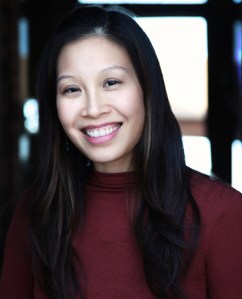
ProfilesLauren Mark is a doctoral student and Graduate Teaching Associate at the Hugh Downs School of Human Communication at Arizona State University. Lauren is currently researching the possibility of bringing Asian epistemologies to Western contexts.
Lauren Mark

She is a certified Civil Dialogue Facilitator and holds an M.Ed in Educational Organization, Leadership and Policy, an M.A. in Dance, and a B.A. in English Literature and French. Prior to joining Hugh Downs, Lauren worked as a co-founder and project manager of two cross-cultural learning organizations in Taipei, Taiwan – Becoming, 緣創an intercultural development platform, and the East West Culture Project. Lauren has also worked as a translator and interpreter in Taiwan and Israel across a variety of business and artistic sectors.Rooted in her experiences in the field, Lauren’s general research interests focus on identity shifts in acculturation. Her studies focus on the intersection of ethnic, linguistic and performative factors in acculturation, as well as how local cultures influence people’s ways of being.

Pedagogically, Lauren explores innovative means to bring embodied self-reflexivity to classroom contexts, within courses such as Communication and Creativity, Intercultural Communication, and Identity, Performance, and Communication. Her work in this arena began with her thesis work, Visible Histories, in which she explored how the sharing of embodied reminiscence and the collective physical reconstruction of memories served as a meeting ground for multiple generations exploring the art of dance. Lauren continues to experiment with ways that purposeful nonverbal communication can enhance reflexivity and promote collective care. This is an extension of her previous work in Taiwan, where she managed creative interdisciplinary labs and choreographed works that tested the boundaries between audience and performers.

Publications:

Mark, L. (2019). An Exploratory study of part time minorities: Finding home as a minority member. Journal of Intercultural Communication Research, 3. doi: 10.1080/17475759.2019.1602071

Wells, T., Mark, L., and Sandoval, J. (2019). Affect, space and the everyday: A reconsideration of waste in academic inquiry. Taboo: The Journal of Culture and Education. Special Ed. Waste. [Manuscript accepted].

Ray, C. D., Floyd, K., Mongeau, P. A., Mark, L., Shufford, K. N., & Niess, L. C. (2019). Planning improves vocal fluency and appearance of concern when communicating emotional support. Communication Research Reports, 36, 57-66. doi: 10.1080/08824096.2018.1560251

Brezis, R. S., Singhal, N., Daley, T., Barua, M., Piggot, J., Chollera, S., Mark, L., & Weisner, T. (2016). Self- and other-descriptions by individuals with autism spectrum disorder in Los Angeles and New Delhi: Bridging cross-cultural psychology and neurodiversity. Culture and Brain, 4(2), 113-133.


Work for CID:
Lauren Mark wrote Constructing Intercultural Dialogues #7: When the East Meets the Middle East.


The Art of Being Human

Intercultural PedagogyDr. Michael Wesch, who teaches Anthropology at Kansas State University, is opening up his online course, ANTH 101, to everyone, as an experiment in pedagogy. Having distilled the basic insights of anthropologists into 10 lessons (starting with People are different), he’s developed 10 challenges, including Other Encounters). He has also drafted a new book as companion to the course, The Art of Being Human, which is being shared in digital format through the course site.

Given that his research focus is on the effects of social media and digital technology on global society, it probably makes sense that he is currently exploring how best to use an online course to share information even beyond his own university. The class begins June 5, 2017.

Wesch has posted a description of the course, and the ways in which others may choose to use some of his content, in a post to Savage Minds.

Save

Migration, Language and Dialogue

Guest PostsMigration, Language and Dialogue
by Gabriel Furmuzachi

Migration brings with it, no doubt about it, important changes in the lives of those who chose to leave. Identity is one these fundamental changes. One needs to find one’s place and one’s self in a new environment without the benefit of a tradition and without the support of one’s family, history and language. As an immigrant, one becomes another, one’s identity has to be reassessed, built up from scratch. We are not talking here about personal identity in the sense analytic philosophy considers it. Instead, our understanding of identity relies on narratives: we come to understand ourselves and our place in the world through stories we tell or are told about ourselves. The fabric of these stories gets torn once we decide or are forced to leave. We should strive to mend it and we think one can only do this dialogically. These are the issues we will try to discuss here.

We are going to quickly follow three accounts of immigrant lives. Then we will attempt to make sense of them by appealing to a couple of philosophical concepts, namely dialogue and cosmopolitanism, which we consider to be viable solutions to the difficulties brought about by migration.

The first account we’ll talk about is the one from Strangers to Ourselves by Julia Kristeva, the second, from Eva Hoffman’s autobiographical novel Lost in Translation and the third focusing on the immigrant stories documented by the Haitian/American writer Edwidge Danticat in her Create Dangerously: The Immigrant Writer at Work.

Read the full essay.

Save

Save

Save

Save

Lisle Global Seed Grant Program

GrantsLisle International offers a Global Seed Grant Program to support innovative projects which further the mission and goals of Lisle — improving intercultural understanding by bringing people of diverse backgrounds together to share, work together, and learn from one another.  Grants of $500 to $3,000 are available to innovative projects that match our mission. These are quite competitive, but seem appropriate for many of the projects of interest to followers of CID.

  • June 15, 2017:  Deadline to submit Request to Apply.
  • August 15, 2017:  Deadline to submit a Completed Application Form.


Save

Save

Save

Save

Save

CFP 20th International Congress of Linguists (South Africa)

ConferencesCall for abstracts
20th International Congress of Linguists, 2-6 July, 2018, Cape Town, South Africa

Authors can now submit abstracts against any of the workshops or individual topics (i.e. “paper sessions”).

24 July 2017: Deadline for abstract submission
31 October 2017: Notification of abstract acceptance

The Congress is held every five years, and is meant to showcase current developments in Linguistics. The Congress will run over five days, have a plenary panel on linguistics in South Africa, nine plenary speakers covering a range of major sub-fields, 10 paper sessions each with its own focus speaker, up to 30 workshops, and several poster sessions. While speakers and topics are drawn from a wide international pool, ICL 20 will take the additional opportunity of showcasing African language research. It will also cover applied linguistic areas of research of vital importance to the African continent and the 21st century at large, with a special extended session on Multilingualism, Education, Policy and Development, and a 2 day workshop on New directions in World Englishes research.


Save

CFP Future of Media & Communication Research (China)

ConferencesFuture of Media and Communication Research: Media Ecology and Big Data, 2017 International Conference
November 19-21, 2017, Fuxuan Hotel, Fudan University – Shanghai,  P. R. China

Deadline: June 19, 2017

Organized jointly by Fudan Information and Communication Research Center & Fudan Journalism School, Fudan University, China
and the Institute for International Journalism (IIJ) in the E. W. Scripps School of Journalism, Ohio University, USA

The international conference on Future of Media and Communication Research: Media Ecology and Big Data welcomes abstracts that deal with original quantitative or qualitative research related to any sub-themes listed under the Submissions page. The abstracts that are submitted to the conference will be blind reviewed by a panel of scholars put together by the scientific research committee from Fudan University, China and Ohio University, USA.

The official language of presentations at the conference is primarily English.

In the age of new technology and big data, the media landscape in China and around the world is changing rapidly with the rise of social media and digital media. The media ecology brings various new topics for the media industry, academics and scholars. Areas being explored at all institutional/organizational sectors of media include—but not limited to—media convergence, the use of big data, and audience engagement. This program will be of interest to academics, industry and other interested stakeholders who are working with digital technology, media or mass communication to ideate and present new approaches to addressing or exploring these important topics. Also, developing an updated curriculum with social/digital media literary and big data analytics is becoming an interesting topic in communication education.

We welcome research papers on seven sub-themes to discuss new media and big data: new communication research paradigm; media industry change; news production and data journalism; media use and engagement; computational social science and communication research; health communication; and big data and communication education. We are looking forward to receiving abstracts for potential vibrant research presentations at this international conference and to welcoming you in Shanghai, China.

Save

CFP Othering & Belonging

Publication OpportunitiesOthering & Belonging is a new journal published by the Haas Institute for a Fair and Inclusive Society at the University of California, Berkeley to investigate and challenge social cleavages and hierarchies based on differential power, privilege, and access to resources.

Call for Submissions

“For its second and future issues, Othering & Belonging seeks written, audio, and video submissions – research essays and briefs, conceptual or theoretical essays, critical commentaries and reflections, photo-essays, interviews, video clips, and more. No written articles will be accepted that are over 10,000 words in length, and pieces under 5,000 words are highly preferable.

For Issue 2 we welcome work that considers what we mean by Othering and Belonging, the mechanisms by which they become manifest across contexts, why it matters, and how we can engender more Belonging in ourselves, our families, our communities, our societies, and our planet.

For more information, see the Editors’ Introduction about who we are and what we publish.”

Save

Save

Save

Study of CID Social Media Followers

About CIDFrom October 2016 to March 2017, Min He conducted research to learn about the social media subscribers of the Center for Intercultural Dialogue. As CID aims to establish connections between scholars active in intercultural communication, understanding the large follower base is important.

The study is based on those subscribers for whom enough details could be obtained, amounting to 967 individuals out of the total of 2802 followers CID had across all social media platforms as of January 11, 2017 when data collection stopped and analysis began. LinkedIn, Facebook and Twitter were the three major resources for data collection, as they provide the greatest amount of detail about subscribers, either individually (LinkedIn) or as a group (Facebook and Twitter).

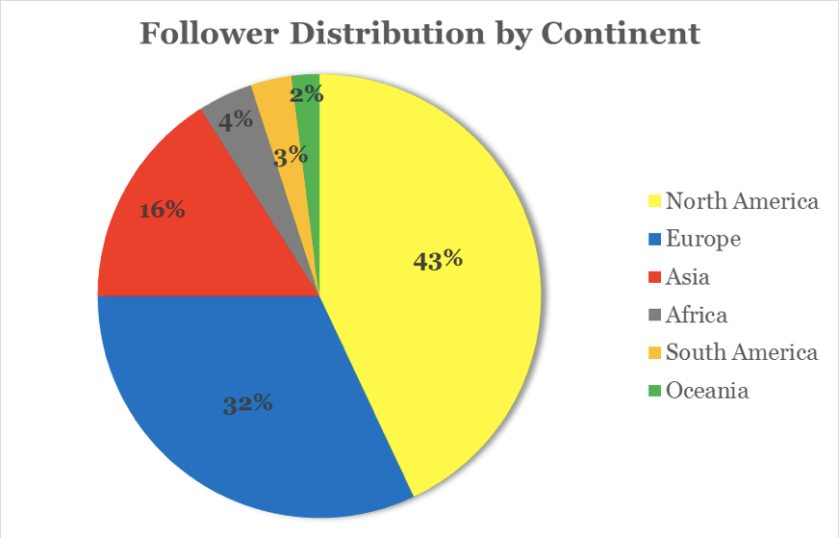
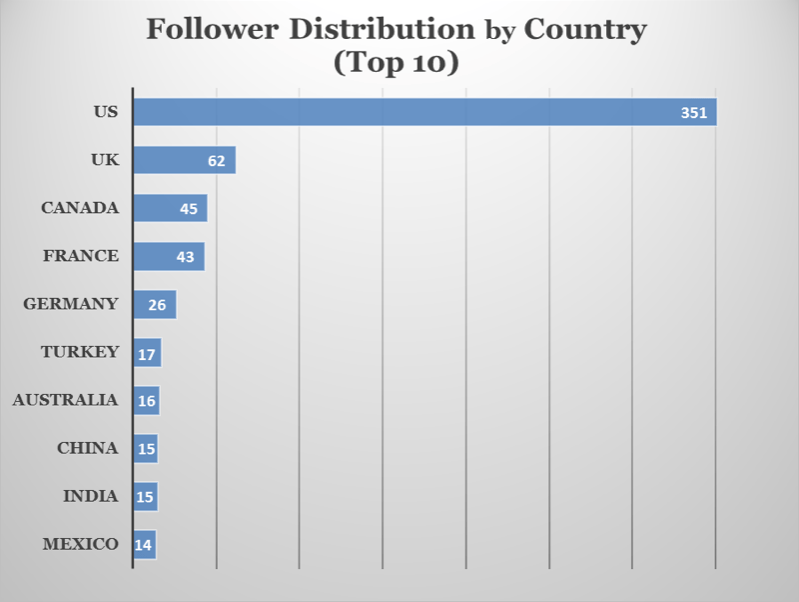
The results of the study show that CID has social media subscribers across the globe. The largest single group is based in the USA, but the majority of followers is based in other countries, as the charts below illustrate. The data represent the 967 followers’ countries of residence: in many cases their respective countries of origin are different.

CID subscribers by continent


CID subscribers by country

As CID especially aims at serving scholars, it is not surprising that most followers in the subset have substantial education: almost three quarters have completed a master’s degree, and almost 40% a Ph.D.

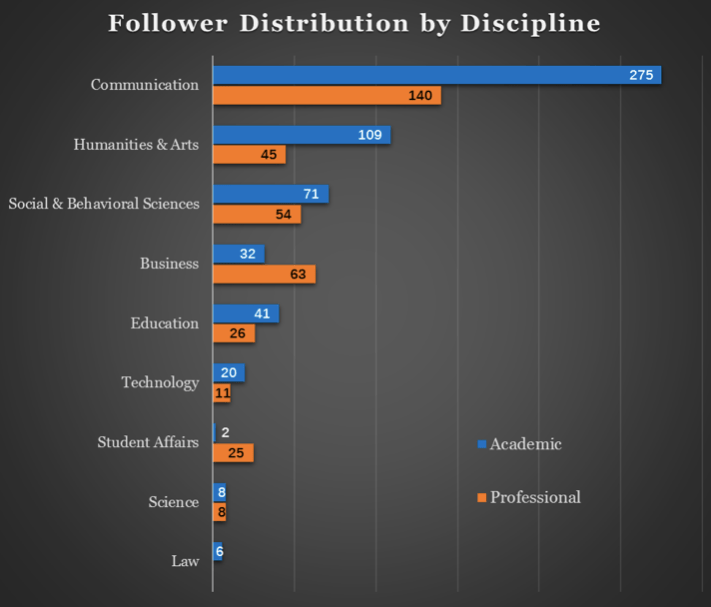
Not surprisingly, the majority of the followers in the subset are based within academia (58%), with most of the rest being professionals of various sorts (37%). For either group, most persons are active in the discipline of Communication. The following charts show the exact distribution.

CID followers by discipline

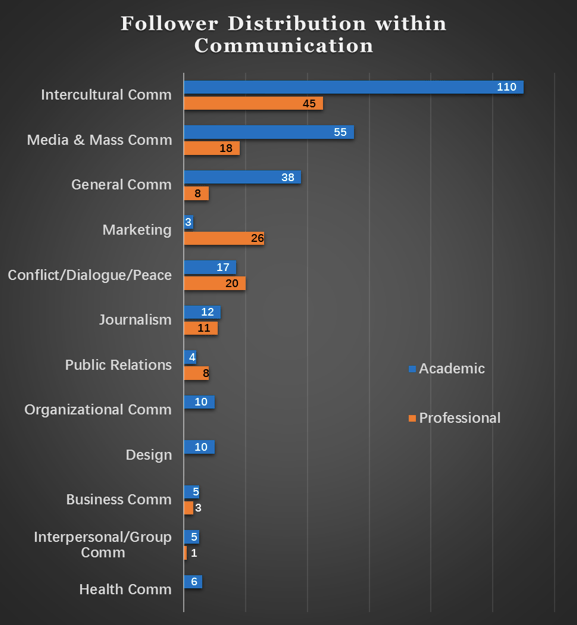
Within Communication, the single largest specialization is Intercultural Communication, for obvious reasons.

CID subscribers within Communication

In conclusion, the study shows that the followers of CID form a large and varied group of persons engaged with intercultural dialogue on different levels. As the CID embraces diversity and integrates multicultural members drawn from around the world into a single network, it builds a borderless online community for scholars and practitioners alike. To that end, the CID LinkedIn group has proven particularly appropriate for helping to establish connections.

CFP Media, Democracy & Political Power

Publication OpportunitiesCall For Papers
Revista Comunicação & Sociedade [Communication & Society Journal] Special Issue “Media, democracy and political power: between the right to communication and hegemony in public agenda” V. 41, n. 3 (Sept-Dec 2017), to be published in December, 2017
Dossier Editor: Dr. Magali do Nascimento Cunha
Full paper submissions due: July 30, 2017

The close relationship between media, democracy and political power in the second decade of the 21st century is the object of this thematic volume of Communication & Society. This proposal is motivated by the observation of the movements that shake up contemporary political contexts in the world and in Brazil, with significant advances in the occupation of the political sphere by conservative and ultraconservative leaders, parties and movements. These advances are represented in the election of Donald Trump as President of the United States, in polarized elections in Europe and in the seizure of power in Brazil through the impeachment process of Dilma Rousseff. At the same time, popular movements, including those of social minorities, are reconfiguring in reaction to the conservative revitalization. In all these contexts it is observed that traditional media and digital media occupy a prominent place in the mediation of the processes involved, either in the reverberation of prevailing discourses or in the critical expression to them, both in alliances with powers in progress and in oppositionist divergences, in actions of support, confrontation or negotiation.

This special issue will be bilingual, in Portuguese and English.

CFP Conference in Sociolinguistics ‘Multimodal & Mediated Discourse Analysis’ (Hong Kong)

Conferences2nd HKU PhD Conference in Sociolinguistics:
Multimodal and Mediated Discourse Analysis
University of Hong Kong
28-29 September 2017

This conference aims to put Hong Kong and international postgraduate researchers into a dialogue around their current work on all aspects of Sociolinguistics and Discourse Analysis with a special focus on Multimodality and Mediation. The conference will include plenary lectures and workshops with two leading scholars in the fields of Multimodality and Mediated Discourse Analysis.

All registered participants will have their conference fees waived. All meals on the two days of the conference will be provided free of charge. The organizers cannot offer any funding towards travel or accommodation. For participants from outside of Hong Kong, a limited number of rooms at the HKU Guesthouse (Robert Black College) will be available at preferential rates on first come first served basis.

Keynote Speakers

Professor Rodney Jones, University of Reading, UK
Professor David Machin, Örebro University, Sweden