U Oxford: Research Fellowship in Peace Studies (UK)

Fellowships

The Levin Junior Research Fellowship in Peace Studies, University of Oxford, Oxford, UK. Deadline: 7 April 2025.

This Junior Research Fellowship (JRF) at Lady Margaret Hall (LMH) is intended as a career development post for an early career academic. It provides a three-year opportunity to develop independent research alongside gaining some experience and training in tutorial teaching. The successful applicant will be provided with a mentor, who will offer career guidance and general advice.

The person appointed would be expected to conduct significant research and teaching in the field of non-violent conflict resolution, broadly defined. They would be expected to undertake research that will have a substantial empirical component in the field. The research should have practical as well as academic impact in their subject area, and that will inform policymaking of the professionals working in the area. The person appointed will be expected to undertake up to three hours a week of undergraduate tutorial teaching in International Relations (for LMH during the three 8-week terms). S/he will help with the organisation and promotion of teaching and research in International Relations at LMH and will play a full role in the intellectual and social life of the College. The College would also encourage the Research Fellow to engage with the academic activities of the Department of Politics and International Relations.
ICD Exercise #7: Anti-Bias Advocacy

ICD Exercises

The next ICD Exercise is now available. Ifeoma Onyebuchi, Stellina Ibrahim, and Favour Ilolo have designed an exercise for anti-bias advocacy.

This exercise engages participants in recognising how biases shape interactions and contribute to exclusion or discrimination. Using Bias Jenga, an interactive activity, participants will visually experience how biases accumulate and destabilise social and professional structures. The exercise introduces practical advocacy techniques such as active listening, challenging stereotypes, and promoting inclusive language. Through reflection and discussion, participants will learn how to effectively address biases and advocate for more equitable and welcoming environments.

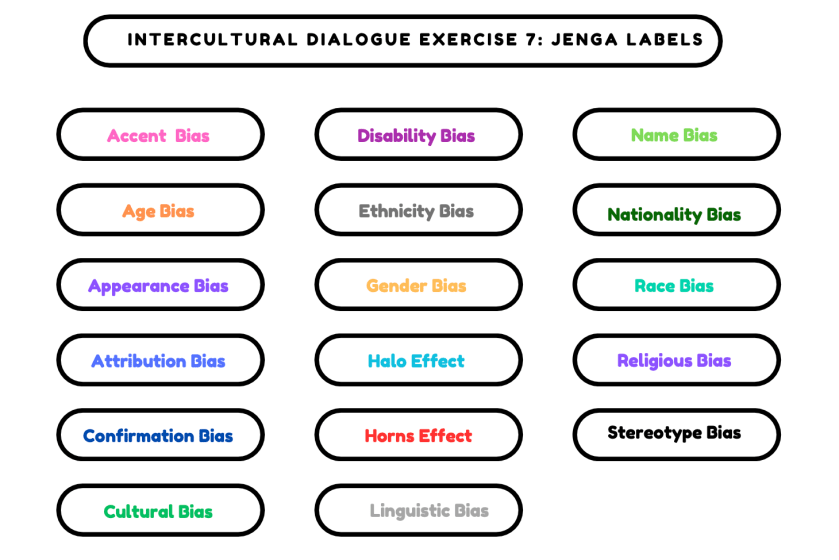
Jenga labels for ICD Exercise 7

The heart of the exercise uses Jenga blocks, labeled with the names of multiple types of potential bias, as a prompt for group discussion. Once the Jenga tower has been constructed, participants take turns pulling out a Jenga block. If they pull a labelled block, they read the bias aloud and discuss:

• How does this bias affect individuals in real life?
• How does it impact workplace culture or social interactions?
• How can this bias be addressed or challenged?

As with prior publications, ICD Exercises are available as free PDFs; just click on the thumbnail to download the Jenga labels, and on the link in the citation to download the exercise itself.

Onyebuchi, I., Ibrahim, S., & Ilolo, F. (2025). Anti-bias advocacy. Intercultural Dialogue Exercises, 7. Available from: https://centerforinterculturaldialogue.org/wp-content/uploads/2025/03/icd-ex-7-anti-bias-advocacy.pdf

If you have an exercise you’ve used that works, and you would like to share it, please submit it. All authors will be asked to answer the same set of questions, and to make the exercises available for others to use, thus these are being published with a Creative Commons license (as is the case for all CID publications). If you are new to CID, please provide a brief resume. This opportunity is open to masters students and above, on the assumption that some familiarity with academic conventions generally, and discussion of intercultural dialogue specifically, are useful.


This work is licensed under a Creative Commons Attribution-NonCommercial-NoDerivatives 4.0 International License.       Wendy Leeds-Hurwitz Director Center for Intercultural Dialogue

Missouri Southern State U: Executive Director of International Education (USA)

“JobExecutive Director of International Education, Missouri Southern State University, Joplin, MO, USA. Deadline: 26 April 2025.

Reporting to the President, the Executive Director of International Education will provide strategic leadership for the development, implementation, and evaluation of the institution’s international education initiatives. This role involves overseeing international partnerships, study abroad programs, global engagement, and cross-cultural initiatives, while ensuring alignment with institutional goals and objectives. The Executive Director will also play a key role in fostering global awareness in an academic environment, supporting faculty, staff, and students in their international endeavors.

U Mass Amherst: Assistant Director of Global Launch (USA)

“JobAssistant Director of Global Launch, International Programs, University of Massachusetts at Amherst, MA. Deadline: 18 May 2025.

The Assistant Director of Global Launch provides leadership and oversight for the UMass Amherst Global Launch programs. The Assistant Director leads recruitment, enrollment and program development and management in consultation with the Executive Director of Global Education, and student support and success initiatives with the Director of Student Success Academic Programs.

Africa Institute, Global Studies U: Fellowships (UAE)

Fellowships

Fellowships, The Africa Institute, Global Studies University, Sharjah, UAE, 2025-26. Deadline: varies by program (see below).

The Africa Institute, Global Studies University, Sharjah offers three fellowship opportunities for scholars, writers, and translators engaged in Africa and African diaspora studies.

      • Restitution and Reparation Fellowship (Deadline: April 1, 2025) – Supported by Open Society Foundations, this program fosters research on African art restitution and cultural heritage.

      • Tejumola Olaniyan Creative Writers-in-Residence (Deadline: April 17, 2025) – A three-month residency in Sharjah, UAE, offering a 50,000 AED grant for writers exploring Africa and its diaspora.

      • Global Africa Translation Fellowship (Deadline: April 17, 2025) – Grants of up to $5,000 for translations of African works into English or Arabic.

U Amsterdam: Studentship in Argumentation, Identity and the Public Sphere (Netherlands)

“Studentships“

PhD Studentship in Argumentation, Identity and the Public Sphere, University of Amsterdam, Netherlands. Deadline: 14 April 2025.

The Amsterdam Center for Language and Communication (ACLC) currently has a vacant PhD position as part of the project Expressing Identity in Public Discourse through Argumentation led by principal investigator Dr. M.H. (Menno) Reijven. The ACLC prioritises diversity (taken in a holistic sense, e.g., ethnicity, social and/or linguistic background, gender, sexuality) and is committed to creating an inclusive research environment. They are seeking a talented colleague who can communicate well with the different ACLC research groups, develop interdisciplinary projects, and contribute to research-based teaching. The ACLC is one of the five Research Schools within the Amsterdam Institute for Humanities Research (AIHR). Researchers in the capacity group of Speech Communication, Argumentation Theory and Rhetoric at the ACLC investigate argumentative discourse across a wide variety of contexts, as well as the linguistic and cognitive processes behind argumentation and persuasion. The PhD student is expected to collaborate with other researchers on argumentation within the research school as well.

UNESCO: Intercultural Dialogue for Conflict Transformation (France but Online)

Events

Intercultural Dialogue for Conflict Transformation Briefs Series, UNESCO, Paris, France, 1 April 2025, 3-4:30 pm (Online).

In an era where geopolitical power struggles disrupt traditional peacebuilding, where identity and misinformation fuel divisions, and where trust in institutions is eroding, UNESCO’s Intercultural Dialogue for Conflict Transformation briefs series presents an adaptable, culturally grounded, and people-centered approach to peacebuilding. With 89% of conflicts worldwide occurring in countries with limited capacity for intercultural dialogue, this series takes an essential first step in examining dialogue as a powerful practice for preventing conflict, fostering reconciliation, reimagining transitional justice, and strengthening social cohesion.

Through actionable recommendations, each brief in this series provides practitioners, policymakers, and civil society with the essential guidance needed to tailor and embed intercultural dialogue in their respective contexts, thereby making peace processes more inclusive, locally led, and sustainable.

Join for an engaging 90-minute online event, where keynote speakers and expert panelists-including the authors of the briefs-will unpack key recommendations and engage in an insightful conversation on how dialogue can foster a more peaceful, cohesive, and just world.

LSE Fellow in Early Modern International History (UK)

FellowshipsFellow in Early Modern International History, London School of Economics and Political Science, London, UK. Deadline: 4 April 2025.

The Department of International History at LSE invites applications for an LSE Fellow in the academic session to commence in September 2025 with expertise in the following areas: Early Modern International History; Historical Methods and Historiography. This expertise will enable the Fellow to teach the following courses at undergraduate level: HY118 Faith, Power and Revolution: Europe and the Wider World, c.1500-c.1800; HY120 Historical Approaches to the Modern World.

The postholder will contribute to the scholarship and intellectual life of the School by conducting teaching and research which will enhance the School’s reputation as a research-led teaching institution, with appropriate mentoring from the Department. They will be expected to participate in teaching for up to a maximum of six classroom contact hours per week. They will have time to undertake research and will be expected to participate in the administrative and social activities of the Department.

The postholder will have completed or be close to completing a PhD in Early Modern International History by the post start date and will have relevant teaching experience. The successful candidate will have expertise in early modern International History and a particular interest in teaching historical methodology and historiography; A developing research record in the field; Excellent communication and presentation skills and the ability to work in close partnership with fellow teachers, as well as on a one-on-one basis with students and in small groups, and to provide effective support, as necessary.The ability to supervise and mark dissertations and assessments at both undergraduate and postgraduate level is also required. Previous use of Virtual Learning Environment would be desirable.

Fergal Lenehan Profile

Profiles

Fergal Lenehan is adjunct Professor (ausserplanmäßger Professor) at the Friedrich-Schiller-University of Jena, in Germany. He received a BA and an MA from University College Dublin, Ireland, and a PhD from the University of Leipzig, Germany.

Fergal LenehanHe also completed the German Habilitation – the formal, second PhD which allows you to officially become a Professor – at the Friedrich-Schiller-University of Jena. He is also journalistically active and has written for the Dublin Review of Books and The Currency, among other publications.

He has had a varied research profile, but intercultural questions have remained central. He has written a monograph on the intellectual history of the European idea, Intellectuals and Europe: Imagining a Europe of the Regions in Twentieth Century Germany, Britain and Ireland (2014), and a monograph on German depictions of Ireland, Stereotypes, Ideology and Foreign Correspondents: German Media Representations of Ireland, 1946-2010 (2016).

In recent years, he has been a central figure in the research co-operative ReDICo: Researching Digital Interculturality Co-operatively. As part of ReDICo he has been co-editor of a number of open-access publications dealing, theoretically and empirically, with the topic of digital interculturality. These include a special issue of the journal Interculture Journal on Cyber-Utopia / Dystopia? Digital Interculturality between Cosmopolitan and Authoritarian Currents (2022), and the edited volumes: Language and Interculturality in the Digital World (2024), Lifewide Learning in Postdigital Societies (2024), and Reimagining Digital Cosmopolitanism (2025). He is also co-editor, with Luisa Conti, Roman Lietz and Milene Mendes de Oliviera, of the book series Studies in Digital Interculturality. ReDICo has also developed educasts, a podcast series, and the scholarly platform, the ReDICo-Hub. He recently published the article Examining realised and unrealised contacts: theoretical thoughts on digital interculturality (2024) in the journal Language and Intercultural Communication.

Work for CID:

Fergal Lenehan has written a guest post for the Center, The Need for a Cosmopolitan Perspective, as well as writing KC114: Digital cosmopolitanism, and then translating it into German.

U Manchester: International Business (UK)

“JobLecturer or Senior Lecturer in International Business, University of Manchester, Manchester, England, UK. Deadline: 14 April 2025.

Applications are invited for the post of Lecturer/Senior Lecturer in International Business at Alliance Manchester Business School. The successful candidate is expected to conduct research at the highest level, publish it in top-tier journals, attract research funding, teach at Undergraduate and/or Postgraduate levels in International Business and related subject areas, and where suitable take on leadership roles.

The post is based within the International Business Research group, which is composed of internationally renowned researchers. The research conducted by successful candidates will complement existing areas of expertise and specialism of the group, which currently include global market and non-market strategies, innovation-technology-knowledge, sustainable development and emerging markets, global corporate governance, and IB and institutional environments. The Alliance Manchester Business School is home to numerous research institutes, it facilitates and promotes cross-disciplinary research.