New Website Launched: Cosmopolis2045

Applied ICDNew website launched by CMM Institute: Cosmopolis2045.

What if a whole community treated relationships with other people as if they really mattered? What if a whole community took dialogue and deliberation seriously? And what if that community tried with all their hearts to bring about a better social world in all the myriad of ways we engage in communication with others in our world? These were the questions asked by a group of scholars and practitioners sponsored by the CMM Institute. The Cosmopolis2045 website is their answer.

The Cosmopolis2045 website depicts an imagined community set in the future (circa 2045) in which residents and leaders of the community have adopted a communication-centric view of how their own and other social worlds function. This website offers an intriguing look at a possible near future in which dialogue and deliberation are an integral part of everyday community events and are at the heart of city functioning. The website is also an information-rich resource for teaching classes on communication, especially cosmopolitan communication and for exploring the implications of a communication-centric view for a range of educational, legal, governance, and associated community practices.

CFP IICD of NCA 2019

ConferencesCall for submissions: International & Intercultural Communication Division, National Communication Association, November 14-17, 2019, Baltimore, Maryland. Deadline: March 27, 2019.

The International and Intercultural Communication Division of the National Communication Association invites submissions that examine communication in cultural, intercultural, and international contexts. Four kinds of submissions will be considered this year: (1) individual papers, (2) paper sessions, (3) panel discussions, and (4) performance sessions.

NCA’s convention theme is “Communication for Survival.” The theme invites us to engage in bold and cutting-edge approaches and perspectives in examining how communication plays important roles in survivals of various contexts. NCA Second Vice President Ono explains, “Communication for Survival can help inspire us to think about the quotidian ways communication improves lives, helping people build relationships, sustaining communities, changing society for the better, and providing peace of mind.” IICD invites rigorous and engaging submissions that examine various aspects of and topics related to communication for survival within international and intercultural contexts. Submissions that discuss international and intercultural communication research, teaching, practices, and service are strongly encouraged. The Division welcomes all theoretical perspectives and methodological approaches.

KC40 English as a Lingua Franca Translated into Greek

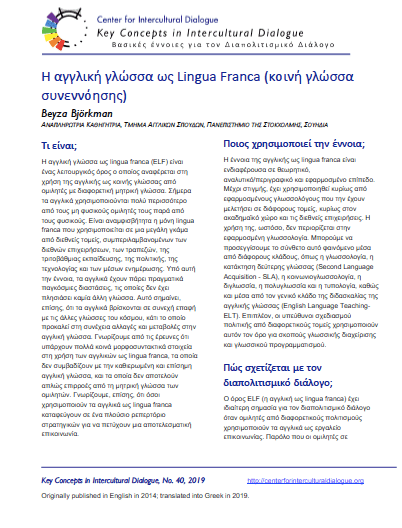
Key Concepts in ICDContinuing translations of Key Concepts in Intercultural Dialogue, today I am posting KC#40: English as a Lingua Franca, which Beyza Björkman wrote for publication in English in 2014, and which Anastasia Karakitsou has now translated into Greek.

As always, all Key Concepts are available as free PDFs; just click on the thumbnail to download. Lists of Key Concepts organized chronologically by publication date and number, alphabetically by concept, and by languages into which they have been translated, are available, as is a page of acknowledgments with the names of all authors, translators, and reviewers.

KC40 ELF_GreekBjörkman, B. (2019). English as a lingua franca [Greek]. (A. Karakitsou, trans). Key Concepts in Intercultural Dialogue, 40. Available from:
https://centerforinterculturaldialogue.org/wp-content/uploads/2019/02/kc40-ce95lf_greek.pdf

If you are interested in translating one of the Key Concepts, please contact me for approval first because dozens are currently in process. As always, if there is a concept you think should be written up as one of the Key Concepts, whether in English or any other language, propose it. If you are new to CID, please provide a brief resume. This opportunity is open to masters students and above, on the assumption that some familiarity with academic conventions generally, and discussion of intercultural dialogue specifically, are useful.

Wendy Leeds-Hurwitz, Director
Center for Intercultural Dialogue


Creative Commons License
This work is licensed under a Creative Commons Attribution-NonCommercial-NoDerivatives 4.0 International License.

Canterbury Christ Church U: Dean of International (UK)

“JobDean of International, Canterbury Christ Church University, Canterbury, England, UK. Deadline: 15 March 2019.

Canterbury Christ Church University is a modern, dynamic University with some 17,000 students across two major campuses in Kent and at partner institutions in Greece, Hong Kong and Sri Lanka. The University is now seeking to appoint to the newly created, cross-institutional role of Dean of International. Reporting to the Deputy Vice-Chancellor, the Dean will provide academic leadership across the University to achieve significant increases in inbound recruitment of international students in priority subject areas, and to establish a focused set of international strategic partnerships to underpin both inbound recruitment and transnational activity. The successful candidate will also play a leading role in driving internationalisation of the curriculum and academic portfolio, and in promoting student and staff mobility and exchange. They will sit on the University’s senior leadership group.

Penn State: Director Global Programs (USA)

“JobDirector of Global Programs, Pennsylvania State Abington, PA. Deadline: Open until filled (posted 2/15/19).

The Pennsylvania State University seeks a scholar-administrator for the position of Director for the Office of Global Programs at Penn State Abington. The Penn State Abington College is home to nearly 4,000 students and more than 320 faculty. Penn State Abington is the University’s most diverse location with more than 50% of the population identifying as a minority and over 14% as international students.

The Office of Global Programs is at the intersection of International Student Services and Education Abroad on the Penn State Abington campus, and represents this college within a network of international education professionals across the University. The Director acts in the capacity of a senior international officer (SIO) for the campus and provides visionary leadership recognizing the profound connection of student success to the college’s global mission. The Director oversees a centralized office that provides education abroad and international student services for the Abington campus community and in collaboration with Penn State Global Programs. The Director is knowledgeable in the areas of immigration advising, programming, intercultural communication and global engagement development.

UNAOC Fellowships 2019

“Fellowships“Call for applications: United Nations Alliance of Civilizations (UNAOC) Fellowships. Deadline: March 10, 2019.

UNAOC has issued a Call for Applications for the 2019 edition of its Fellowship Programme. The Call is open to participants between 25 to 35 years old, from the Middle East, North Africa, Europe and North America, with a strong interest in intercultural exchanges. The theme of the Fellowship in 2019 is “The role  of women in peacemaking and conflict prevention”. Candidates must also be able to present professional achievements in these fields. The Call will lead to the selection of a group of 12 young leaders from Europe, North-America (EUNA) on one end, and a  group of 12 young leaders from the Middle East and North-Africa (MENA) on the other end. Participants from each geographic area will travel to their counterparts’ region for two weeks. Travel will be across June-July 2019 for EUNA participants, and across October-November 2019 for MENA participants.

Fairleigh Dickinson U Study Abroad in UK 2019

Study AbroadStudy Abroad in England: International Communication and Culture, Fairleigh Dickinson University’s Wroxton College, Oxfordshire, England, May 26 – June 7, 2019. Deadline: April 5, 2019.

MCOM 7002 / COMM 4070 International Communication and Culture is a 12-day seminar offered at Wroxton College each summer for graduate students in the MA in Communication and selected students from the BA in Communication Studies. The seminar consists of invited speakers, case studies, site visits, and leisure trips to London, Stratford, and Oxford.

The objective of the seminar is make students familiar with the cultural, historical, and political contexts in which professional and other interactions take place from a UK and European perspective. Students will also examine case studies conducted by UK media, advertising, and public relations practitioners which show how issues of culture, history, politics, and theory play out in actual corporate communication practice.

The 2019 course will take place from May 26 through June 7. Students completing the course receive three credits toward their degree. Students from the MBA program, the MA in Organizational Behavior, the BA in Communication Studies, and other universities and colleges may also register with permission of the course leader, Gary Radford.

Competition: Visual Representations of Multilingualism

AwardsCompetition for visual representations of multilingualism. Deadline: 29 March 2019.

BAAL (British Association for Applied Linguistics) is looking for applied linguists and visual artists to submit visual representations of multilingualism as part of an international competition.

This competition aims to provide a creative opportunity to explore new ways of representing multilingualism through visual means and to stimulate debate and raise awareness about innovative ways of thinking about multilingualism.

Multilingualism has often failed to be represented, or – when it has been represented – this has been done through the co-presence of a select number of languages. However, this raises the question of which languages are represented and why, while recent research about multilingual practices, for example translanguaging, has questioned traditional views of languages as discrete systems. This research has also highlighted the multilingual language user’s capacity to create an apparently seamless flow between named languages and language varieties to achieve effective and meaningful communication in everyday social interaction.

BAAL’s interests are in how applied linguists and artists represent these new ways of thinking about multilingualism creatively and visually and how these images communicate the message about dynamic multilingualism to the public. The competition is open to artists, designers and/or applied linguists working in a range of 2D practices, including, but not limited to: drawing, painting, illustration, graphic design, collage, digital, photography, etc. Sculptural/relief works presented in a 2D format will also be accepted.  Collaborations between artists and applied linguists, and submissions from students of all levels are particularly welcome.

CFP CALA 2020: Asian Text, Global Context (Malaysia)

ConferencesCall for papers: The (Annual) Conference on Asian Linguistic Anthropology: Asian Text, Global Context, University Putra Malaysia, Bintulu, Sarawak, Malaysia, February 5-8, 2020. Deadline: May 9, 2019.

The CALA 2020 calls for renewed interpretations of Asian texts, and asks that we seek new perspectives of these complex texts, in global contexts. These interpretations increase in significance as; return migration to Asia is now a salient factor in transnational flows; online texts and their textual modes now compete ever more enthusiastically to effect disjunctures in previously Western dominated technologies; ontological conceptions of life and social interaction now increasingly draw from Asian philosophies, sociocultural models, lifeworlds, and Asian urban anthropologies, thus producing interstices for new or revised textual and textualized semiotics; the entangled complexities and intersubjectivities of political, sociocultural, and religious practices and their constraints motivate engagements in interfaith dialogue, shifting ethnic demarcations, and sociopolitical interventions. Ultimately, the massive sets of Eastern demographics, and their expansive set of social dynamics, models, and praxis, continue to uniquely inform and complexify productions of Asian texts, in both local and in global contexts.

CID Video Competition: How do Social Media Influence Intercultural Dialogue?

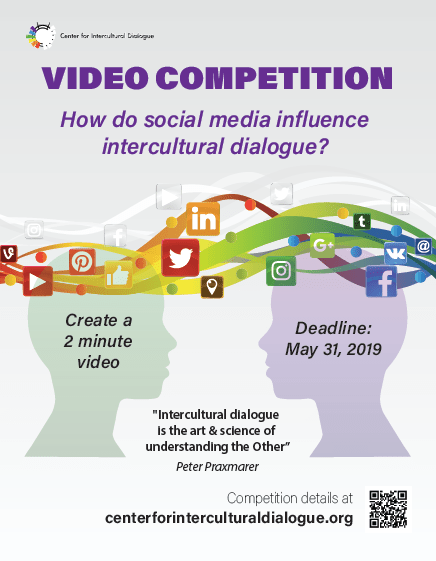
Job adsThe Center for Intercultural Dialogue announces its second annual video competition, open to students enrolled in any college or university during spring 2019. Final deadline is May 31, 2019, at midnight (east coast US time).
CID Video Competition 2019

What is intercultural dialogue (ICD)? It is “the art and science of understanding the Other.” ICD can include international, interracial, interethnic, and interfaith interactions, but it is always active (“a matter of what someone does”) rather than passive (“a matter of what someone knows”). Typically, people assume that ICD requires face-to-face interaction. This competition asks: “How do social media influence intercultural dialogue?”

**Entries must be between 30 seconds to 2 minutes in length, and may be submitted here until May 1-31, 2019.  Longer videos will be disqualified.

Faculty members are invited to discuss intercultural dialogue in a class, perhaps showing winning entries from 2018, and to suggest students produce videos as their responses. Students are encouraged to be creative, show off their knowledge and skills, and have fun with this topic

The top award winner will receive a $200 prize. All award-winning entries will be posted to the CID YouTube channel, and highlighted on the CID website, LinkedIn group, Facebook group, and Twitter feed, through posts describing the creators and highlighting each of their videos. Perhaps most important to student learning, all entries will be sent comments from the judges. Winning entries last year came from not only the USA, but also Italy, the UK, and Peru.

See our FAQ. resources, reflections by winning students last year, or contact Wendy Leeds-Hurwitz, CID Director, with any questions.

Competition Rules:

  1. Submissions will be evaluated based on originality, clarity, understanding of intercultural dialogue, effective use of technology, and overall impact.

  2. All part-time or full time undergraduate or graduate students (post-graduates for those outside the USA) currently enrolled at any university or college or community/ technical college/school, anywhere in the world are eligible. If high school students wish to join in, they are welcome as well. Students can work independently or in groups. Given the topic, incorporating more than one viewpoint may be particularly appropriate. Similarly, ensuring that at least someone in the group knows something about the idea of intercultural dialogue, and at least someone has created a video before, should be useful.

  3. Videos should be created by students, not edited and corrected ahead of time by their instructors. Students must submit videos themselves.

  4. In addition to a video, each entry must be accompanied by a completed brief information form about the creator(s). This will be used as a resource in contacting winners, and then in sharing information about them on the CID website and other social media at the end of the competition.

  5. By submitting your entry, you are attesting that you have the necessary authorization to use the images, audio, text, music, and any other content contained in your video. Please do not enter if you are in violation of, or uncertain of your rights to, any copyrights, patents, trademarks, video, music or other intellectual property. Consult your faculty advisor if you have any questions or doubts about the content of your entry. Applicants will be held fully liable under the law for any copyright or other intellectual property violations.

  6. Submissions found incomprehensible, inappropriate, or in violation of intellectual property rights for any reason in the sole judgment of CID will not be accepted into the competition.

  7. Entries will be accepted from May 1-31, 2019. CID is not responsible for any entry that is misdirected, corrupted, or not received by such date. Judging will occur in June, and winners will be announced in July.

  8. Funding for the first prize cash award is provided by the Broadcast Education Association (BEA), one of the members of CID’s parent organization, the Council of Communication Associations.