CID Video Competition: Last 5 days!

CID Video CompetitionThe CID video competition remains open, but just 5 days remain to the final deadline of May 31, 2019


CID Video Competition 2019

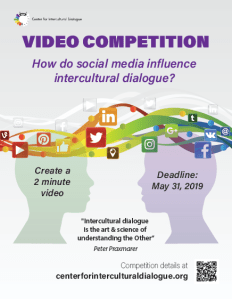
To enter, students must submit a video no longer than 2 minutes demonstrating their understanding of intercultural dialogue. Specifically, videos must answer the question: “How do social media influence intercultural dialogue?”

In preparing an entry, remember to think about the 2 major topics and their relationship. Winning videos must take both of these into account, not merely describe one or the other.

1) Intercultural dialogue is the term for what happens when people from different cultural backgrounds attempt to understand one other’s assumptions. Culture is a general term that includes all sorts of learned behavioral patterns. Intercultural communication can be international, interracial, interethnic, or interfaith. Intercultural dialogue is deliberate, active rather than passive. It is NOT the same as cultural analysis (understanding one culture), or cross-cultural analysis (comparing two different cultures).

2) Social media refers to any tool using the internet to help people communicate, nearly always when they are not in the same place at the same time. It includes such applications as Facebook, Twitter, Instagram, WeChat, WhatsApp, and Tumblr, among others. You can limit your consideration to any one of these, or consider several. But don’t just describe social media and how they work! The question you must answer is how the social media you choose to address influence intercultural dialogue. That means, what changes when people of different cultural backgrounds try to understand one another when they are not even face-to-face? What gets harder? What becomes easier?

If you have questions, see previously published competition rules, FAQ, and resources. See last year’s winning videos. See the reflection by one winning team on creating their video. Or send an email with a question. When you’re ready to submit an entry, click here.

Wendy Leeds-Hurwitz, Director
Center for Intercultural Dialogue

Lancaster U: Research Associate Cinema Memory & Digital Archive (UK)

“JobResearch Associate post on Cinema Memory and the Digital Archive: 1930s Britain and Beyond, University of Lancaster/Stirling University, UK. Deadline: 5 June 2019.

We are seeking to appoint a Research Associate in Film Studies, Media Studies, English, History or a related discipline in the Humanities and Social Sciences to work on the AHRC-funded project ‘Cinema Memory and the Digital Archive: 1930s Britain and Beyond’ (CMDA). This is a 35-month full-time post.

The project team is Annette Kuhn (QMUL), Richard Rushton (Lancaster University), and Sarah Neely (Stirling University), and the project is based at Lancaster University. Among other things, CMDA will properly organise and store, as well as develop a website for, the ‘Cinema Culture in 1930s Britain’ archive currently stored at Lancaster University Library. The project also involves a number of research and public engagement events relating to archives, cinema memory, and audience research.

U Macau: Instructor in Communication (China)

“JobVisiting Senior Instructor in Communication: Video Production and Public Communication, University of Macau, Macau, China. Deadline: Open until filled, posted May 16, 2019.

The Department of Communication of the Faculty of Social Sciences invites applications for the position of Visiting Senior Instructor, intended to contribute to teaching needs in two specific areas: (1) video production and (2) public communication.

The Department of Communication currently offers broad-based curricula leading to Bachelor’s, Master’s and Doctoral degrees. They cover various areas of communication studies (communication theory, intercultural communication, organizational communication, communication skills); vocationally-oriented public communication (public relations, advertising, event planning); media studies and journalism (journalism writing and publication, mass media, new media, digital culture); cultural studies (cultural and critical theory, cinema, popular culture); and communication and creative cultural industries (video production, film making, animation, photography, design). The Department of Communication has a diverse student body drawn from Macao, Mainland China, and other parts of the world.

Open U: English Language/Applied Linguistics (UK)

“JobStaff Tutor, English Language and Applied Linguistics, School of Languages and Applied Linguistics, The Open University, UK and home based. Deadline: 14 June 2019.

This is an exciting opportunity to join a vibrant, multilingual and multicultural School which offers part-time distance study in Languages and Applied Linguistics to students from across the UK and beyond. Subject areas currently include modern languages (Chinese, French, German, Italian and Spanish), English language studies, English for academic purposes, applied linguistics and translation studies.

Staff Tutors play an important role in the maintenance and development of teaching material and are vital to manage the successful delivery of all teaching in the School. As a Staff Tutor specialising in English Language and Applied Linguistics you will lead and manage a team of highly qualified part-time Associate Lecturers (ALs) tutoring students enrolled on a range of modules. As their academic manager, you will select, train, develop and supervise ALs. You will report to the School’s Associate Head (Student Experience). You will work at a distance with the Faculty’s Student Support Team in Nottingham and contribute to ensure the smooth running of tuition.

Georgetown U: Program Coordinator, Center for Intercultural Education/Development (USA)

“JobProgram Coordinator, Center for Intercultural Education and Development, Georgetown University, Washington, DC. Deadline: Open until filled, posted May 10, 2019.

The Gateway Program Unit designs and implements educational exchange programs for international clients (universities, private companies, and governmental organizations) which are usually one to six weeks in length.

The Program Coordinator is responsible for developing, managing and implementing an growing number of short-term, executive programs. The Program Coordinator works with the Manager of Gateway Program and the Academic Director in the design and preparation of the program. During the implementation phase, he/she provides on-going support to international students to ensure that the group receives an excellent training experience while in the United States. The Program Coordinator also creates content and maintains the website as well as ensures that CIED’s promotional materials are up to date and in stock.

CFP Speaking Across Communication Subfields in JOC

“Publication
Call for Papers: Journal of Communication Special Issue: Speaking Across Communication Subfields. Deadline: July 15, 2019.

Guest Editors: Keren Tenenboim-Weinblatt (Hebrew University of Jerusalem) & Chul-joo “CJ” Lee (Seoul National University)

With the rapid growth and development of the field of Communication, it has also become increasingly fragmented, while its subfields – as represented by ICA’s various divisions and interest groups – have become increasingly self-contained. Researchers within the different subfields speak to each other in numerous forums and publications and in ever-growing levels of precision and sophistication, but are often oblivious to related developments in other subfields. Similarly, conceptual, analytical and empirical contributions are discussed in relation to the state-of-the-art within a specific subfield, but often fail to be developed into broader theoretical frameworks. The result is a multiplicity of theoretical, conceptual and empirical fragments, whose interrelationships and relevance for a range of communication processes remain to be established.

In this special issue, editors look for rigorous, original and creative contributions that speak across multiple subfields of communication. All theoretical approaches as well as methods of scholarly inquiry are welcome, and we are open to various formats and foci: The papers can be based on an empirical study, integrate a series of empirical pieces, thereby proposing a new theory or model, or be primarily theoretical. Their focus can be a specific theory, a specific concept or a set of related concepts, a communication phenomenon that can be better accounted for using a cross-disciplinary perspective, or any other focus that fits the purpose of the special issue. In all forms, the papers should make substantial, original contributions to theoretical consolidation and explicitly discuss the relevance and implications of their research to different subfields.

Glasgow U MSc Applied Linguistics Scholarships

“Studentships“
Applied Linguistics Scholarships, School of Critical Studies, University of Glasgow, UK. Deadline: 17 June 2019.

University of Glasgow is offering a number of scholarships exclusively for study on their new MSc in Applied Linguistics for academic years 2019-2020 and 2020-2021. The awards are £10k forinternational students and £5k for UK/EU students.  All awards are for tuition fee discount, and do not completely cover the costs.

Alfred Fried Photography Award (Austria)

Awards
Call for entries: Alfred Fried Photography Award for images of “what does peace look like?”. Deadline: June 2, 2019.

The Alfred Fried Photography Award recognizes and promotes photographers from all over the world whose pictures capture human efforts towards a peaceful world and the quest for beauty and goodness in our lives. The award goes to those photographs that best express the idea that our future lies in peaceful coexistence.

Those 14 years or younger can enter photos for the Children’s Peace Image of the Year.

The top five listed photographers will be awarded the Alfred Fried Photography Award Medal. The Peace Image of the Year will receive €10,000. The winning picture will be on display for one year at the Austrian Parliament and will be included in the permanent art collection of the Austrian Parliament. There is an award ceremony in Vienna and worldwide exhibitions as well.

NAMLE 2019 (USA)

Conferences
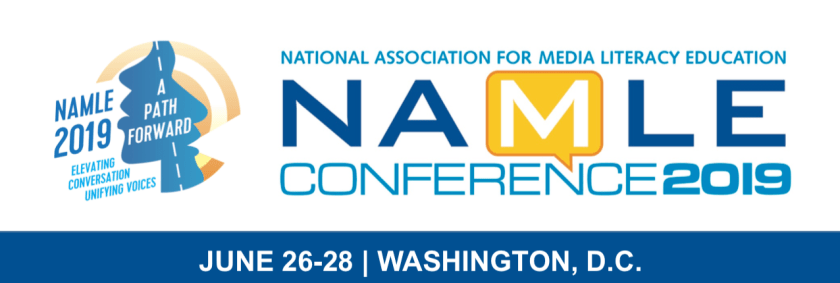
National Association for Media Literacy Education convention, June 26-28, 2019, Washington, DC. Registration now open.

Join media literacy educators and practitioners from around the world in D.C. this June for NAMLE’s 2019 Conference! This year’s theme is “A Path Forward: Elevating Conversation, Unifying Voices.” This three-day conference will be packed with tools and resources for educators, including:

* Curriculum + lesson plans
* Teaching demonstrations
* Digital tools
* Expert presentations
* Student voices
… and much more!

CID Video Competition: 1 1/2 Weeks Left to Submit!

CID Video CompetitionThe CID video competition is open. The first few dozen entries have already been submitted and the first judges have agreed to serve. Just 1 1/2 weeks remain to the final deadline of May 31, 2019

CID Video Competition 2019

To enter, students must submit a video no longer than 2 minutes demonstrating their understanding of intercultural dialogue. Specifically, videos must answer the question: “How do social media influence intercultural dialogue?”

As you prepare your entry, remember to think about the 2 major topics and their relationship. Winning videos must take both of these into account, not merely describe one or the other.

1) Intercultural dialogue is the term for what happens when people from different cultural backgrounds attempt to understand one other’s assumptions. Culture is a general term that includes all sorts of learned behavioral patterns. Intercultural communication can be international, interracial, interethnic, or interfaith. Intercultural dialogue is deliberate, active rather than passive. It is NOT the same as cultural analysis (understanding one culture), or cross-cultural analysis (comparing two different cultures).

2) Social media refers to any tool using the internet to help people communicate, nearly always when they are not in the same place at the same time. It includes such applications as Facebook, Twitter, Instagram, WeChat, WhatsApp, and Tumblr, among others. You can limit your consideration to any one of these, or consider several. But don’t just describe social media and how they work! The question you must answer is how the social media you choose to address influence intercultural dialogue. That means, what changes when people of different cultural backgrounds try to understand one another when they are not even face-to-face? What gets harder? What becomes easier?

If you have questions, see previously published competition rules, FAQ, and resources. See last year’s winning videos. See the reflection by one winning team on creating their video. Or send an email with a question. When you’re ready to submit an entry, click here.

Wendy Leeds-Hurwitz, Director
Center for Intercultural Dialogue