Midlands Graduate School PHD Studentships (England)

“Studentships“ESRC PhD Studentships in the Social Sciences in the Midlands Graduate School. Deadline: 22 January 2020.

The Midlands Graduate School is an accredited Economic and Social Research Council (ESRC) Doctoral Training Partnership (DTP). One of 14 such partnerships in the UK, the Midlands Graduate School is a collaboration between Aston University, University of Birmingham, University of Leicester, Loughborough University, University of Nottingham and University of Warwick.

The Midlands Graduate School is looking to recruit top quality social science PhD students to commence study in October 2020 across a range of subjects and interdisciplinary training pathways. Our ESRC studentships – covering fees, a maintenance stipend (subject to eligibility), and support for innovative research training – provide exceptional opportunities for high-achieving and motivated individuals, including opportunities for collaboration.

A Masters degree is not a prerequisite for applying to the Midlands Graduate School DTP, and a number of our studentship awards are specifically ring-fenced for students applying for funding straight from an undergraduate degree. 

The MGS offers 17 different training pathways, including Applied Linguistics, Communication & Media, and Political Science & International Relations, among others.

CFP Conflict Conference UT Austin (USA)

ConferencesCall for papers: 6th Annual Conflict Conference, April 10-11, 2020, Moody College of Communication, University of Texas Austin, TX, USA. Extended Deadline: January 31, 2020.

The Conflict Conference (TCC) will hold its 2020 conference at the University of Texas at Austin on April 10-11, 2020. TCC is a multidisciplinary annual conference promoting the study of conflict and conflict resolution, management, and transformation. Organizers invite papers, panel proposals, and posters on any relevant topic, such as apologies, advocacy, collaboration and cooperation, conflict management, conflict talk, dialogue and deliberation, dispute resolution, environmental disputes, forgiveness, mediation, negotiation, peace, political divisiveness, reconciliation, and restorative justice.

Topics on technologically mediated conflicts and ethics are also welcome. With a broad focus on conflict and peace studies in a variety of contexts, TCC encourages participants across disciplinary fields to submit. Work ranging from localized interpersonal conflicts to large-scale policy issues is encouraged. With several options for participation, TCC offers a breadth of perspectives that engenders productive dialogues for scholars and community members.

KC35 Media Ecology Translated into Hebrew

Key Concepts in ICDContinuing translations of Key Concepts in Intercultural Dialogue, today I am posting KC#35: Media Ecology, which Casey Man Kong Lum wrote for publication in English in 2014, and which Eva Berger has now translated into Hebrew.

As always, all Key Concepts are available as free PDFs; just click on the thumbnail to download. Lists of Key Concepts organized alphabetically by conceptchronologically by publication date and number, and by languages into which they have been translated, are available, as is a page of acknowledgments with the names of all authors, translators, and reviewers.
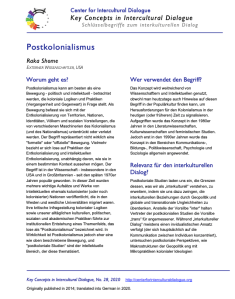
KCe35 Media Ecology_HebrewLum, C. M. K. (2019). Media ecology [Hebrew]. (E. Berger, trans). Key Concepts in Intercultural Dialogue, 35. Available from:
https://centerforinterculturaldialogue.org/wp-content/uploads/2019/11/kc35-media-ecology_hebrew.pdf

If you are interested in translating one of the Key Concepts, please contact me for approval first because dozens are currently in process. As always, if there is a concept you think should be written up as one of the Key Concepts, whether in English or any other language, propose it. If you are new to CID, please provide a brief resume. This opportunity is open to masters students and above, on the assumption that some familiarity with academic conventions generally, and discussion of intercultural dialogue specifically, are useful.

Wendy Leeds-Hurwitz, Director
Center for Intercultural Dialogue


Creative Commons License
This work is licensed under a Creative Commons Attribution-NonCommercial-NoDerivatives 4.0 International License.


Eastern Michigan U: Intercultural/Interracial Communication (USA)

“JobAssistant Professor in Intercultural and Interracial Communication, School of Communication, Media, and Theatre Arts, Eastern Michigan University, Ypsilanti, MI. Deadline: January 1, 2020.

The School of Communication, Media, and Theatre Arts at Eastern Michigan University is seeking candidates for a tenure-track assistant professor specializing in intercultural and interracial communication. The successful candidate will bring strong teaching and scholarly expertise in intercultural and interracial communication, and join a faculty committed to advocacy and social justice through the scholarship and pedagogy of effective communication in a variety of social, personal, and professional settings. In addition to teaching undergraduate intercultural and interracial communication courses, the appointment may also include teaching and developing undergraduate and graduate courses related to the candidate’s qualifications. The successful candidate will also be expected to engage in relevant scholarly work as well as department, university, and other professional service.

York U: Middle Eastern Diasporic Literatures & Cultures (Canada)

“JobAssistant Professor of Middle Eastern Diasporic Literatures and Cultures, English Department, York University, York, Ontario, Canada. Deadline: January 25, 2020.

The Department of English, in the Faculty of Liberal Arts & Professional Studies, invites applications for a tenure-track Professorial Stream appointment at the rank of Assistant Professor in Middle Eastern Diasporic Literatures and Cultures to commence July 1st 2020. We are particularly interested in candidates whose research can be situated within the fields of Postcolonial and World Literature in English within and across periods, genres, and regions. Interdisciplinary and intermedial approaches are especially welcome. Salary will be commensurate with qualifications and experience. All York University positions are subject to budgetary approval.

The successful candidate will have a PhD in English Literature or a related field with a specialization in Middle Eastern Diasporic Literatures and Cultures; a dynamic, substantial, and ongoing research portfolio; an innovative scholarly profile; and a track record of experience and demonstrable excellence in university teaching. We are particularly interested in candidates who engage Middle Eastern Diasporic Literatures and Cultures from a variety of global perspectives that may include but should not be limited to North America, with demonstrated expertise in theoretical and critical paradigms in Postcolonial and/or World Literature. The successful applicant will direct courses in World Literature and Postcolonial writing at all levels, contribute to curricular development in their area of specialization, and participate actively in the graduate program. The successful applicant shall be eligible for prompt appointment to the Faculty of Graduate Studies. Pedagogical innovation in such priority areas as experiential education and technology-enhanced learning is preferred.

Invite the World to Your Table (France)

Applied ICDInvite the world to your table/Invitez le monde à votre table CROUS, Dijon, France.

Centre régional des Œuvres Universitaires et Scolaires (CROUS) of Bourgogne-Franche-Comté in France organizes the event “Invite the world to your table.” It’s a wonderful invention: a cultural exchange lunch including international students enrolled in higher education and the inhabitants of Dijon, Besançon, Belfort, and Montbéliard. This event allows cultural exchanges around a meal between international students enrolled in higher education and inhabitants of Dijon and its surroundings.

How does it work? Inhabitants of Dijon invite one or more international students to their home for a Sunday meal. The purpose of these exchanges is for locals to discover a new culture, and for international students to learn more about French culture and gastronomy.

“Invite the world to your table” gives participants the opportunity to cross cultural boundaries. In a spirit of sharing and conviviality, the goal is to experiment with the gastronomy and the traditions of the participants but also to enrich everyone’s cultural knowledge.

Understanding Knowledge as a Global Commons

Director's ActivitiesLeeds-Hurwitz, W. (2019). Commentary: Moving (slowly) toward understanding knowledge as a global commons. Journal of Multicultural Discourses, 15. DOI: 10.1080/17447143.2019.1695806

My commentary article was invited as a response to “Power relations in global knowledge production: A cultural/critical approach” by Marton Demeter. Both articles are already available online, and will be in print within a few months. To give you the flavor of the article, let me quote the first and last paragraphs. If you then wish to read the entire commentary, 50 copies may be downloaded free using this link. If you are the 51st person or beyond and those copies are gone, you may send an email requesting a personal copy.

“Marton Demeter responds to the move to de-westernization . . . by asking whether the reality of practice in cultural discourse studies fits with the stated goal of acknowledging globalization by expanding what is accepted within academia (so that the US and Western Europe do not assume they will produce the research that scholars in other countries read, but instead that everyone will produce interesting work that everyone else will read). He examines journal publications, a central tool in the social construction of knowledge, looking in greatest detail at ‘diversities in editorial boards, diversities in science output and the network of collaboration’. He finds that editorial board diversity correlates with the home country of the authors (so that journals with mostly US/Western scholars on the editorial boards publish few articles by authors from other parts of the world, despite explicit statements taking this as a goal).”

. . .

“In sum, I do not argue with Demeter’s findings, and in fact wish he had been a bit more radical in his call for change. In addition to internationalizing editorial boards, authors, and research teams, I have suggested that we need to recognize and reward intercultural capital, expand international networks at all levels (including editors and peer reviewers specifically for journal publishing, but more broadly expanding international research collaborations), and consider how to use the available technology to ensure that knowledge will be free and accessible to all, calling on senior faculty and major universities to make the first move. I would summarize this set of options as moving towards a global knowledge commons, a phrase others have used, but which has not yet been widely adopted.”

Aarhus IAS Fellowships (Denmark)

Fellowships

AIAS-COFUND II Marie Skłodowska-Curie Fellowships, Aarhus Institute for Advanced Studies, Aarhus, Denmark. Deadline: 17 January 2020.

Up to 15 AIAS-COFUND fellowships are available for the most talented researchers from around the world and within all research disciplines and topics. The scheme is funded by the European Union’s Horizon 2020 Research and Innovation Programme under the Marie Skłodowska-Curie actions (grant agreement no 754513) and Aarhus University Research Foundation.

Two types of AIAS-COFUND II Fellowships are available:

  • AIAS-COFUND Junior Fellowships for postdoctoral researchers with a career experience of 2-10 years. Duration from 12-36 months.

  • AIAS-COFUND Senior Fellowships for researchers with a career experience of 10+ years. Duration from 6-18 months.

CFP Transnational Journalism History (USA)

ConferencesCall for Papers: Transnational Journalism History Conference, May 28-30, 2020, Augusta University, Georgia, USA. Deadline extended to  February 17, 2020.

The fifth annual conference on Transnational Journalism History is seeking papers that study historical transformations in journalism from a transnational perspective. Papers welcomed that discuss theoretical or methodological issues as well as empirical case studies from all parts of the world. Specifically, organizers invite contributions that consider:

– the transfer of norms, practices and textual conventions from one country/region to another and their consecutive adaptation in national contexts
– transnational networks of actors
– biographical studies of transnational agents such as journalists or publishers
– the transnational coverage of particular news stories
– transnational audiences
– the impact of (emerging) technologies on transnational journalism
– different media such as television, radio, newspapers or magazines, and the intersection between them
-theoretical perspectives/interpretations/applications of transnational journalism history

KC35 Media Ecology Translated into Japanese

Key Concepts in ICDContinuing translations of Key Concepts in Intercultural Dialogue, today I am posting KC#35: Media Ecology, which Casey Man Kong Lum wrote for publication in English in 2014, and which Atsushi Katayama has now translated into Japanese.

As always, all Key Concepts are available as free PDFs; just click on the thumbnail to download. Lists of Key Concepts organized alphabetically by conceptchronologically by publication date and number, and by languages into which they have been translated, are available, as is a page of acknowledgments with the names of all authors, translators, and reviewers.

KC35 Media Ecology_JapaneseLum, C. M. K. (2019). Media ecology [Japanese]. (A. Katayama, trans). Key Concepts in Intercultural Dialogue, 35. Available from:
https://centerforinterculturaldialogue.org/wp-content/uploads/2019/11/kc35-media-ecology_japanese.pdf

If you are interested in translating one of the Key Concepts, please contact me for approval first because dozens are currently in process. As always, if there is a concept you think should be written up as one of the Key Concepts, whether in English or any other language, propose it. If you are new to CID, please provide a brief resume. This opportunity is open to masters students and above, on the assumption that some familiarity with academic conventions generally, and discussion of intercultural dialogue specifically, are useful.

Wendy Leeds-Hurwitz, Director
Center for Intercultural Dialogue


Creative Commons License
This work is licensed under a Creative Commons Attribution-NonCommercial-NoDerivatives 4.0 International License.