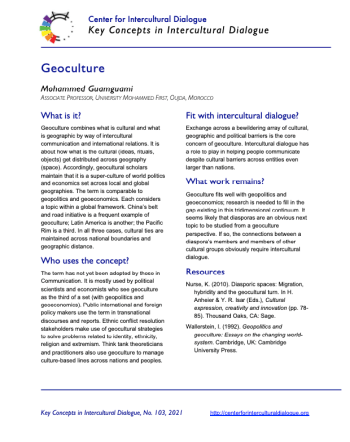
KC95 Transnational Media Translated into German

Key Concepts in ICDContinuing translations of Key Concepts in Intercultural Dialogue, today I am posting KC#95: Transnational media, which Suman Mishra wrote for publication in English in 2020, and which Marlena Pompino has now translated into German.

As always, all Key Concepts are available as free PDFs; just click on the thumbnail to download. Lists of Key Concepts organized chronologically by publication date and number, alphabetically by concept, and by languages into which they have been translated, are available, as is a page of acknowledgments with the names of all authors, translators, and reviewers.
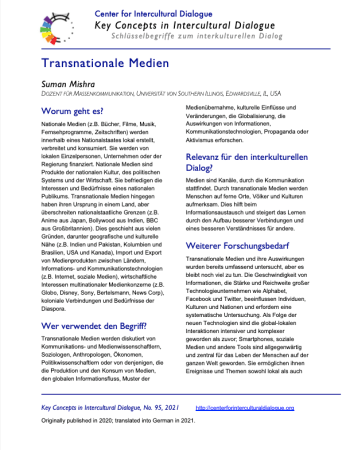
KC95 Transnational Media_GermanMishra, S. (2021). Transnationale medien. (M. Pompino, Trans.). Key Concepts in Intercultural Dialogue, 95. Available from: https://centerforinterculturaldialogue.org/wp-content/uploads/2021/05/kc95-transnational-media_german.pdf

If you are interested in translating one of the Key Concepts, please contact me for approval first because dozens are currently in process. As always, if there is a concept you think should be written up as one of the Key Concepts, whether in English or any other language, propose it. If you are new to CID, please provide a brief resume. This opportunity is open to masters students and above, on the assumption that some familiarity with academic conventions generally, and discussion of intercultural dialogue specifically, are useful.

Wendy Leeds-Hurwitz, Director
Center for Intercultural Dialogue


Creative Commons License
This work is licensed under a Creative Commons Attribution-NonCommercial-NoDerivatives 4.0 International License.

CIDOB: Research Fellow, Migration (Spain)

“JobResearch Fellow for the Whole-COMM project on Migrations, Barcelona Centre for International Affairs, Spain. Deadline: 27 June, 2021.

CIDOB (Barcelona Centre for International Affairs) opens a research fellow position for its area of Migrations, in particular for the Whole-COMM project with the possibility of working on other projects. The candidate will participate in the research related to the integration processes of recently arrived immigrants in small and medium-sized towns and rural areas. The Whole-COMM Project, funded by the European Commission through its H2020 programme, promotes scientific knowledge about the dynamics and causal mechanisms that influence the complex relationship between integration policies and Community cohesion. This is through a comparative approach between countries (8 EU and 2 non-EU) and between localities (40), and a mixed methodology that combines qualitative and quasi-experimental techniques, an attitude survey and a quantitative analysis on the impact of policies on social cohesion and immigrant integration trajectories.

CIDOB is an international affairs research centre that, through excellence and relevance, seeks to analyse the global issues that affect political, social and governance dynamics, from the international to the local. 

U Penn: Global Communication (USA)

“JobProfessor of Global Communication Studies, Annenberg School for Communication, University of Pennsylvania, Philadelphia, PA, USA. Deadline: September 30, 2021.

The Annenberg School for Communication at the University of Pennsylvania is seeking to fill a tenure-track faculty position in Global Communication Studies to begin the fall semester 2022. The search is for a productive researcher, engaged scholar, and committed teacher/mentor who studies cross-national, supranational, transnational and/or translocal theories and subjects, using qualitative and/or quantitative methods. Topics may include but are not limited to critical and/or comparative studies of media institutions, systems, and audiences as they relate to digital inequalities; diasporas; development; the uses and structural impacts of technologies; legal, economic and policy frameworks; journalism; the geopolitics of the popular; postcolonial and indigenous perspectives; and implications of communication infrastructures. This position is one of two hires reflect a desire to expand ASC’s footprint in global communication. Preference will be given to researchers whose work centers on the Global South.

KC5 Intercultural Communication Translated into French

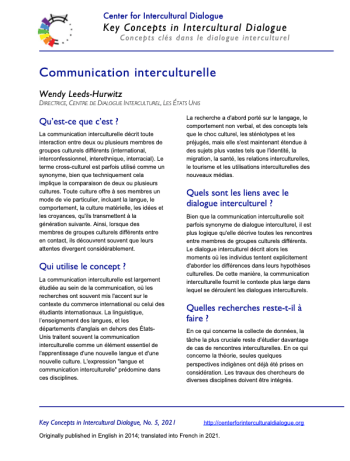
Key Concepts in ICDContinuing translations of Key Concepts in Intercultural Dialogue, today I am posting KC#5: Intercultural Communication, which I wrote for publication in English in 2014, and which Mohammed Guamguami has now translated into French.

As always, all Key Concepts are available as free PDFs; just click on the thumbnail to download. Lists of Key Concepts organized alphabetically by conceptchronologically by publication date and number, and by languages into which they have been translated, are available, as is a page of acknowledgments with the names of all authors, translators, and reviewers.


KC5 ICC_FrenchLeeds-Hurwitz, W. (2020). Communication interculturelle. (M. Guamguami, trans). Key Concepts in Intercultural Dialogue, 5. Retrieved from: https://centerforinterculturaldialogue.org/wp-content/uploads/2021/05/kc5-icc_french.pdf

If you are interested in translating one of the Key Concepts, please contact me for approval first because dozens are currently in process. As always, if there is a concept you think should be written up as one of the Key Concepts, whether in English or any other language, propose it. If you are new to CID, please provide a brief resume. This opportunity is open to masters students and above, on the assumption that some familiarity with academic conventions generally, and discussion of intercultural dialogue specifically, are useful.

Wendy Leeds-Hurwitz, Director
Center for Intercultural Dialogue


Creative Commons License
This work is licensed under a Creative Commons Attribution-NonCommercial-NoDerivatives 4.0 International License.

Success Stories of Refugees in Europe (UK but Online)

EventsSuccess Stories of Refugees in Europe: Celebrating the contributions of children and highly skilled adults, BAAL Multilingualism Special Interest Group and Newcastle University (Online), June 16, 2021, 10:00 am – 12:00 pm (BST).

Europe has experienced major waves of refugee immigration, which has led to over a million refugees and asylum seekers across EU countries to date. Children and adults have been equally affected and often placed in marginalised positions by their host communities who often failed to fully value their contributions. This event, which has been organised by the BAAL Multilingualism SIG and hosted by Newcastle University’s School of Education, Communication and Language Sciences, celebrates the linguistic and cultural contributions of refugees, both children and adults, in Europe. It will bring together researchers, practitioners and members of the public interested in current debates about refugee integration in Europe.

The event is free but registration is required.

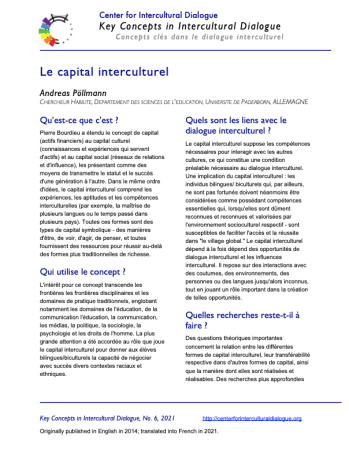
KC6 Intercultural Capital Translated into French

Key Concepts in ICDContinuing translations of Key Concepts in Intercultural Dialogue, today I am posting KC#6: Intercultural Capital, which Andreas Pöllmann wrote for publication in English in 2014, and which Mohammed Guamguami has now translated into French.

As always, all Key Concepts are available as free PDFs; just click on the thumbnail to download. Lists of Key Concepts organized chronologically by publication date and number, alphabetically by concept, and by languages into which they have been translated, are available, as is a page of acknowledgments with the names of all authors, translators, and reviewers.

KC6 Intercultural Capital_FrenchPöllmann, A. (2017). Le capital interculturel. (M. Guamguami, trans). Key Concepts in Intercultural Dialogue, 6. Available from:
https://centerforinterculturaldialogue.org/wp-content/uploads/2021/05/kc6-intercultural-capital_french.pdf

If you are interested in translating one of the Key Concepts, please contact me for approval first because dozens are currently in process. As always, if there is a concept you think should be written up as one of the Key Concepts, whether in English or any other language, propose it. If you are new to CID, please provide a brief resume. This opportunity is open to masters students and above, on the assumption that some familiarity with academic conventions generally, and discussion of intercultural dialogue specifically, are useful.

Wendy Leeds-Hurwitz, Director
Center for Intercultural Dialogue


Creative Commons License
This work is licensed under a Creative Commons Attribution-NonCommercial-NoDerivatives 4.0 International License.
CFP Researching Transculturally

“PublicationCall for Chapters: Researching Transculturally: Methodological Issues and Challenges, to be edited by Mabel Victoria (Edinburgh Napier University).
Deadline for abstract: 30 June, 2021.

Researchers often work in culturally and linguistic challenging contexts. They interact with research participants whose native language and sociocultural backgrounds are different to their own. They also conduct fieldwork in settings that are unfamiliar to them—constantly having to make decisions as minute as what to wear, how to greet people in a culturally appropriate manner, or whether taking photographs of place and people is taboo. There are a number of other challenges, such as differing roles and expectations, conflicting cultural values and world views, power relations, and culturally sensitive ethical practices.

There is very little practical guidance in the literature that can help qualitative researchers navigate the terrain of researching across cultures. This volume will present contributions from different researchers that provide the reader with an idea of the challenges and issues they faced while researching transculturally. Contributions will provide a behind-the- scenes perspective or narrative accounts that are not often written about as part of journal articles or monographs.

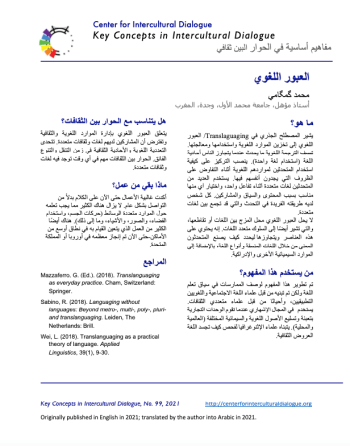
Key Concept #99: Translanguaging Translated into Arabic

Key Concepts in ICDContinuing translations of Key Concepts in Intercultural Dialogue, today I am posting KC#99: Translanguaging, originally written by Mohammed Guamguami for publication in 2021, and now translated by him into Arabic.

As always, all Key Concepts are available as free PDFs; just click on the thumbnail to download. Lists organized chronologically by publication date and numberalphabetically by concept in English, and by languages into which they have been translated, are available, as is a page of acknowledgments with the names of all authors, translators, and reviewers.

KC99 Translanguaging_ArabicGuamguami, M. (2021). Translanguaging [Arabic]. Key Concepts in Intercultural Dialogue, 99. Available from: https://centerforinterculturaldialogue.org/wp-content/uploads/2021/05/kc99-translanguaging_arabic.pdf

If you are interested in translating one of the Key Concepts, please contact me for approval first because dozens are currently in process. As always, if there is a concept you think should be written up as one of the Key Concepts, whether in English or any other language, propose it. If you are new to CID, please provide a brief resume. This opportunity is open to masters students and above, on the assumption that some familiarity with academic conventions generally, and discussion of intercultural dialogue specifically, are useful.

Wendy Leeds-Hurwitz, Director
Center for Intercultural Dialogue


Creative Commons License
This work is licensed under a Creative Commons Attribution-NonCommercial-NoDerivatives 4.0 International License.
Save

KC103 Geoculture

Key Concepts in ICDThe next issue of Key Concepts in intercultural Dialogue is now available. This is KC#103: Geoculture, by Mohammed Guamguami. Click on the thumbnail to download the PDF. Lists organized chronologically by publication date and numberalphabetically by concept in English, and by languages into which they have been translated, are available, as is a page of acknowledgments with the names of all authors, translators, and reviewers.


KC103 GeocultureGuamguami, M. (2021). Geoculture. Key Concepts in Intercultural Dialogue, 103. Available from: https://centerforinterculturaldialogue.org/wp-content/uploads/2021/05/kc103-geoculture.pdf

The Center for Intercultural Dialogue publishes a series of short briefs describing Key Concepts in Intercultural Dialogue. Different people, working in different countries and disciplines, use different vocabulary to describe their interests, yet these terms overlap. Our goal is to provide some of the assumptions and history attached to each concept for those unfamiliar with it. As there are other concepts you would like to see included, send an email to the series editor, Wendy Leeds-Hurwitz. If there are concepts you would like to prepare, provide a brief explanation of why you think the concept is central to the study of intercultural dialogue, and why you are the obvious person to write up that concept.


Creative Commons License
This work is licensed under a Creative Commons Attribution-NonCommercial-NoDerivatives 4.0 International License.
Durham U Postdoc: Muslim-Jewish Encounters (UK)

Postdocs

Postdoctoral Research Associate in Social Anthropology: Muslim-Jewish encounters, Durham University, Durham, UK. June 14, 2021.

Applications are invited for a Postdoctoral Research Associate in Social Anthropology with a particular emphasis on urban ethnography and inter-community encounters in the context of Muslim and Jewish populations. The post is part of the project ‘Muslim-Jewish encounter, diversity and distance in urban Europe (ENCOUNTERS)’, jointly funded by the ESRC, ANR and DFG. ENCOUNTERS is led by Dr Ben Gidley (Birkbeck) and brings together a multidisciplinary team of academics to explore intercultural, interethnic and interreligious interactions in European urban contexts, as exemplified in Muslim-Jewish relations, in and across two cities in each of France (Paris and Strasbourg), Germany (Berlin and Frankfurt) and the UK (London and Manchester). The Durham University part of the project is funded by the ESRC and is led by Prof Yulia Egorova, the Co-Investigator on the UK-based part of ENCOUNTERS.

The successful applicant will be expected to deliver ethnographic fieldwork in Manchester, to contribute to data analysis, to the production of outputs, and organisation of team meetings as required by the project.