Anagha Bhat-Behere Profile

ProfilesAnagha Bhat-Behere is Assistant Professor in the Department of Foreign Languages at Savitribai Phule Pune University in Pune, India.
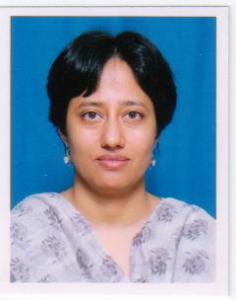
Anagha BhatWhile her Ph.D. is in Russian, her specializations are in Linguistics, Lexicology, Translation Studies, and Comparative Literature. She founded the journal  Kelyane Bhashantar, dedicated to direct translations from foreign languages into Marathi, and served as Chief Editor (2011-2016).

She has published several translations of Russian literary works into various Marathi periodicals, and compiled a first of its kind tri-lingual Marathi-Russian-German dictionary. In addition, she has published 4 books individually, 4 books as co-author and more than 14 articles in national and international journals.

Published books translated from Russian into Marathi or Marathi into Russian:

Bunin, I. (2003). Sukhadol {A. Bhat & C. Ramdas, Eds. & Trans.). Pune, India: Rohan Prakashan.

Bhat, A. (Ed. & Trans.). (2008). Ot Pushkina do Chekhova Pune, India: Manovikas Prakashan. [Collection of stories by Pushkin, Schedrin, Dostoevsky, Tolstoy, Chekhov into Marathi].

Lermontov, M. Y. (2011). Nayak eka pidhicha (A. Bhat, Trans.). Continental Prakashan. [Translation into Marathi]

Dragunsky, V. (2016). Denis chya goshti (part I,II, III) (A. Bhat, Trans.). Pune, India: Pioneer Prakashan. [Translation into Marathi]

Bhat, A. (Ed. & Trans.). (2017). Rasskazy [Collection of stories by various Soviet writers for children]. Pune, India: Chhatra Prabodhan Prakashan.

Gelasimov, A. (2020). Tahaan aani itar katha (A. Bhat, Trans.). Pune, India: Kalasakta. [Translation into Marathi]

Sathe, A. (2021). My journey to Russia (A. Bhat, Trans.) Pune, India: SPPU. [Translation into English and Russian]


Work for CID:

Anagha Bhat-Behere has served as a reviewer for Marathi.
CFP BAAL 2022: Innovation and Social Justice in Applied Linguistics (N Ireland & Online)

ConferencesCall for papers: British Association of Applied Linguistics: Innovation and Social Justice in Applied Linguistics, 1-3 September 2022, Queen’s University, Belfast, Northern Ireland (Hybrid format). Deadline: 31 March, 2022.

BAAL 2022 will be hosted by Queen’s University in Belfast, Northern Ireland. The conference’s theme Innovation and Social Justice in Applied Linguistics reflects an increasing interest in research that responds to real-world concerns within and beyond the field. In the face of a global health crisis and rising socio-racial awareness, this theme invites discussions around innovative and socially just practices in a field that is experiencing the multilingual, spatial, and social justice turn all at once. The current times are transformative and organizers hope that the conference theme will enable proposals from across disciplines and sub-disciplines of applied linguistics to stimulate conversations about the field’s responses to global turbulence and shifts. They also invite proposals to generate meaningful dialogue around current issues in language research.

The current plan is to hold the conference in-person with limited virtual options for participation. They will monitor the situation closely and reassess the situation in March 2022 and make a final decision as to whether the conference will be held in person or if it will have to move to an online format.

KC79 Social Cohesion Translated into Turkish

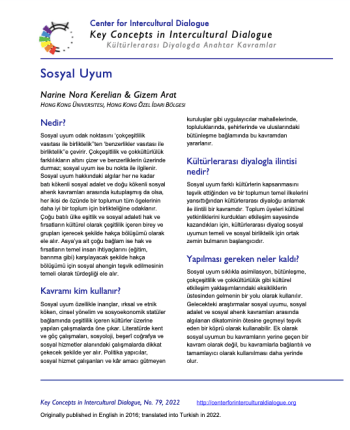
Key Concepts in ICDContinuing translations of Key Concepts in Intercultural Dialogue, today I am posting KC79: Social Cohesion, which Narine Nora Kerelian and Gizem Arat wrote for publication in English in 2016, and which Candost Aydın has now translated into Turkish.

As always, all Key Concepts are available as free PDFs; just click on the thumbnail to download. Lists of Key Concepts organized chronologically by publication date and number, alphabetically by concept, and by languages into which they have been translated, are available, as is a page of acknowledgments with the names of all authors, translators, and reviewers.

KC79 Social Cohesion_TurkishKerelian, N. N., & Arat, G. (2022). Social cohesion [Turkish]. (C. Aydın, Trans.). Key Concepts in Intercultural Dialogue, 79. Available from: https://centerforinterculturaldialogue.org/wp-content/uploads/2021/12/kc79-social-cohesion_turkish.pdf

If you are interested in translating one of the Key Concepts, please contact me for approval first because dozens are currently in process. As always, if there is a concept you think should be written up as one of the Key Concepts, whether in English or any other language, propose it. If you are new to CID, please provide a brief resume. This opportunity is open to masters students and above, on the assumption that some familiarity with academic conventions generally, and discussion of intercultural dialogue specifically, are useful.

Wendy Leeds-Hurwitz, Director
Center for Intercultural Dialogue


Creative Commons License
This work is licensed under a Creative Commons Attribution-NonCommercial-NoDerivatives 4.0 International License.

Migration Policy Institute: Communications Officer (USA)

“Job

Communications Officer, Migration Policy Institute (MPI), Washington, D.C. Deadline: February 28, 2022.

As Communications Officer, you will quickly make an impact. You will contribute to the Institute’s work by crafting press releases and social media campaigns, engaging with news organizations in Latin America and beyond, helping shape communications strategies, playing a key role in redesign of MPI’s website, editing short-form work, and assisting in the promotion of MPI’s public and private events, conferences, and webinars. While assignments will vary day to day, the successful candidate must be a creative, detail-oriented, quick, versatile professional who can prioritize between quick-turnaround projects and longer-term deliverables, working collaboratively with colleagues across the Institute yet also able to operate independently.

The Migration Policy Institute (MPI) is an independent, nonpartisan think tank that seeks to improve immigration and integration policies through authoritative research and analysis, opportunities for learning and dialogue, and the development of new ideas to address complex policy questions.

Conrad Grebel U College: Executive Director, The Ripple Effect Education (Canada)

“JobExecutive Director, The Ripple Effect Education, Conrad Grebel University College, Waterloo, Ontario, Canada. Deadline: 17 February 2022.

Reporting to the Board of Directors, The Ripple Effect Education (TREE) is seeking an Executive Direction to lead all aspects of the organization’s work. The role will operationalize TREE’s mission and vision, by leading programming, managing staff and volunteers, stewarding relationships with key partners, leading fundraising activities, and overseeing the administrative activities.

Since 2016, TREE has supported children, youth, and the adults who support them by equipping them with conflict resolution, social justice and peacemaking tools that allow them to support their peers with empathy and problem-solve equitably.

One to World: Coordinator of Global Classroom (USA)

“Job

Coordinator of Global Classroom, One to World, New York, NY, USA. Deadline: open until filled (posted 7 February 2022).


One To World, Inc. (OTW) is a not-for-profit membership organization whose mission is to foster intercultural understanding by creating face-to-face and virtual experiences among local communities, international students and Fulbright scholars. OTW’s flagship program, Global Classroom, selects and trains international college and university students and scholars to become volunteer facilitators known as “Global Guides.” With the support of the Global Classroom staff, Global Guides lead thematic, interactive and globally-focused workshops for K-12 students in the New York and New Jersey areas. OTW is seeking a Coordinator of Global Classroom. The Coordinator works with the Director of Global Classroom and a team of interns to deliver OTW’s Global Classroom program.

CFP The Role of Faith and Spirituality in Negotiation and Conflict Management

“PublicationCall for Papers: The Role of Faith and Spirituality in Negotiation and Conflict Management, Special issue of Negotiation and Conflict Management Research. Deadline: 1 May 2022.

Special issue editor: Bing Han, University of South Carolina at Aiken.

Spiritual experiences have profound influences on individual lives. A nation’s spiritual and religious traditions have significant political, psychological and social implications for its people. Conflicts can occur between individuals or groups with different faith and spiritual traditions, between individuals with and those without adherence to a faith, and between nations with different spiritual traditions and history. Within each spiritual tradition, prominent texts and figures lead the search for truth and for solutions to human problems including peace and conflict. Therefore, the role of faith and spirituality in negotiation and conflict management theory and practice merits further examination. In this special issue, negotiation and conflict researchers and practitioners should ask the question: How does the rich history and culture of a spiritual tradition contribute to negotiation and conflict management theory and practice?

The call for papers is focused on the important contributions of faith and spirituality to the field of negotiation and conflict management. Priorities will be given to manuscripts that create, test, or expand theory in negotiation and conflict management research. The editor welcomes thought-provoking manuscripts including empirical and theoretical original research employing various methodologies.


CID Poster #9: Strangers into Friends (reprise)

CID Posters(We are reprising the series of posters, because it has been several years since they were originally created, and they are much too wonderful to let them not be noticed by newcomers to the site!)

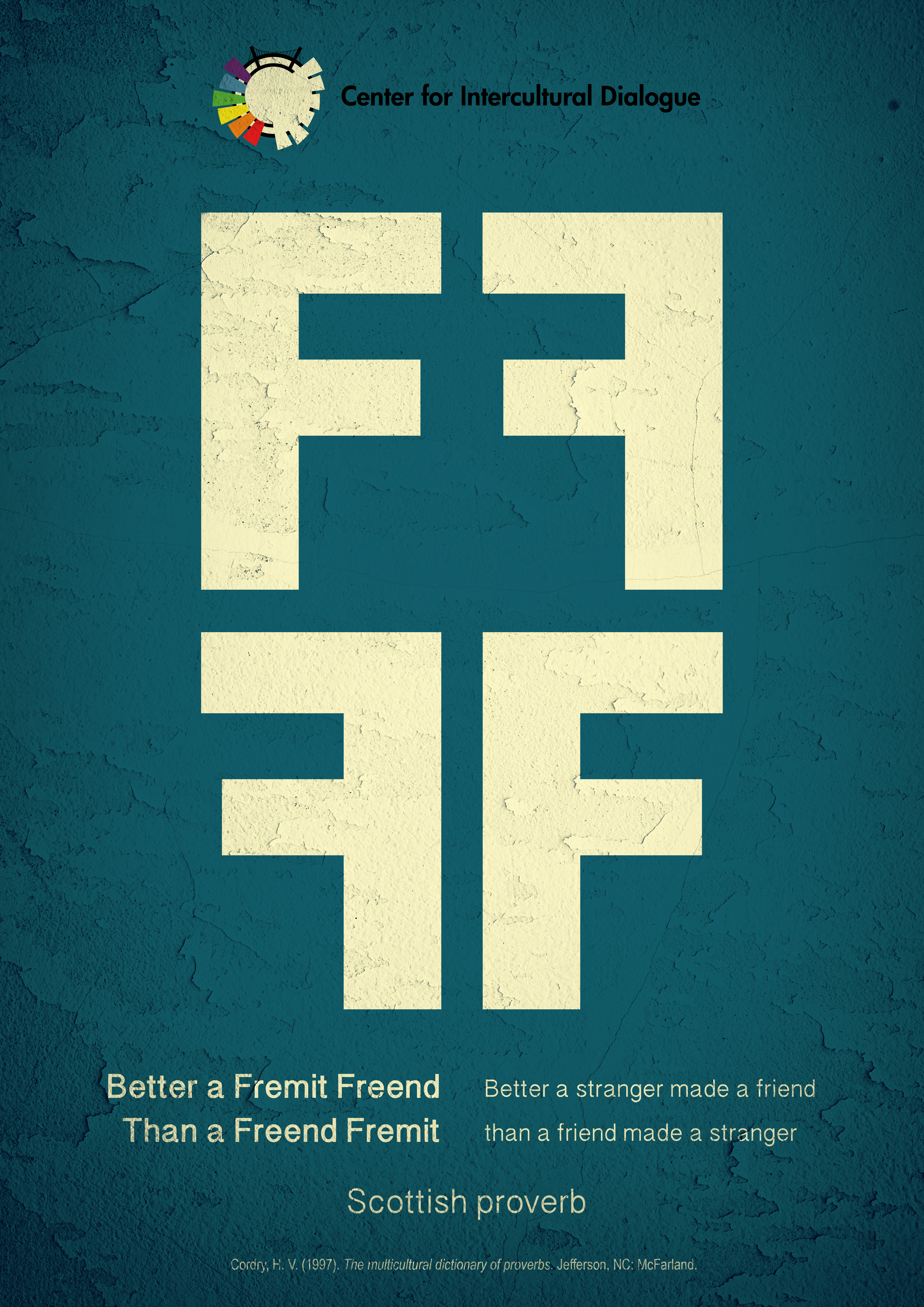
This is the last of the posters designed by Linda J. de Wit in her role as CID intern, and the first to illustrate a proverb. The relevance of proverbs for intercultural dialogue can be explained by a quote from Harold V. Cordry, who collected the one used here as well as many, many others: “For as my collection grew, I found myself increasingly fascinated by the striking similarity of proverbs from dissimilar cultures in different times and different places, and by the fundamental universality of human experience which the proverbs so clearly reflect.” (Cordry, H. V., 1997, The multicultural dictionary of proverbs, JeffersonNC: McFarland, p. ix.). My thanks to Prof. Wolfgang Mieder for recommending this book (as well as others) when asked about how to locate potentially relevant proverbs. The full citation to the book is also provided at the bottom of the poster.

Strangers into FriendsJust in case anyone wants to cite this poster, the following would be the recommended format:

Center for Intercultural Dialogue. (2017). Strangers into Friends. CID Posters, 9. Available from:
https://centerforinterculturaldialogue.org/wp-content/uploads/2017/08/friend-stranger.png

As with other series, CID Posters are available for free on the site; just click on the thumbnail to download a printable PDF. They may be downloaded, printed, and shared as is, without changes, without cost, so long as there is acknowledgment of the source.

As with other series, if you wish to contribute an original contribution, please send an email before starting any work to receive approval, to minimize inadvertent duplication, and to learn about technical requirements. As is the case with other CID Publications, posters should be created initially in English. Given that translations of the Key Concepts in Intercultural Dialogue have received so many views, anyone who wishes to translate their own poster into another language (or two) is invited to provide that as well. If you want to volunteer to translate someone else’s poster into a language in which you are fluent, send in a note before starting, to receive approval and to confirm no one else is working on the same one.

Wendy Leeds-Hurwitz
Director, Center for Intercultural Dialogue
intercult.dialogue AT gmail.com


Creative Commons License
This work is licensed under a Creative Commons Attribution-NonCommercial-NoDerivatives 4.0 International License.

Apurva Chaugule Profile

ProfilesApurva Chaugule is currently pursuing an Advanced Diploma in Japanese language at the Department of Foreign Languages (popularly known as Ranade Institute), at Savitribai Phule Pune University, in India.

Apurva ChauguleShe has passed the Japanese Language Proficiency Test at the N3 level. She completed her Bachelor’s degree in Mass Media, specializing in Advertising, at Ramanarain Ruia College, Mumbai, India.


Work for CID:

Apurva Chaugule co-translated KC17: Multilingualism into Marathi.