CFP International Conference on Human Rights: Youth in Asia (Japan)

ConferencesCall for submissions: International Conference on Human Rights: Youth in Asia, University of Tokyo, Komaba, Japan, March 2025. Deadline: 31 January 2025.

The 2025 International Conference on Human Rights: Youth in Asia (2025 ICHR) is co-organized by East Asia Young Scholars Association (EAYSA)Young Professionals in Foreign Policy (YPFP) Tokyo, and the Graduate Program on Human Security (HSP) and Research Center for Sustainable Peace (RCSP), the University of Tokyo. The ICHR positions Japan as a nexus for students and young scholars to express their ideas, exchange thoughts, and participate in the progressive development of the international human rights agenda. To this end, they invite academic submissions related to one or more of the following conference subthemes:

Contemporary Society

  • Technology and Human Rights
  • Climate Change and Humanitarian Action
  • Inequalities and Education
  • Gender and Conflict
  • Business and Human Rights

Democracy and Autocracy

  • Democratic Upheavals and Autocratization
  • Immigration and the Sustainability of Multiethnic Democracies
  • Refugees
  • Far-Right, Far-Left, and Polarization
  • Censorship and the Right to Express

They are particularly proud to encourage submissions from young scholars, studying Japanese human rights issues, and/or writing in the Japanese language! Detailed submission guidelines are now available here (English version, Japanese version). You may also review the Concept Note here: English version, Japanese version. Abstracts will be assessed in a double-blind review process on a rolling basis.

NOTE: The conference is free of charge to all presenters and participants.

CFP CARGC: 2025 Biennial Conference (USA)

ConferencesCall for submissions: The Center for Advance Research for Global Communication Fellows 2025  Biennial Conference: Unsettling Global Media and Communication Studies, University of Pennsylvania, Philadelphia, PA, USA, 10-11 April 2025. Deadline: 15 December 2024.

In April 2023, CARGC hosted the Fellows’ Symposium, centered around “Doing Global Communication and Media Studies.” Since then, the world has witnessed a surge in political violence, multiple genocides, media censorship, and a subsequent dependence on social media for news. During this time, student activists across college campuses raised awareness about what the United Nations and the International Court of Justice believe to be evidence of a genocide in Gaza. As the intersections of manufactured humanitarian and media crises continue to evolve, this symposium asks not what a global approach to media and communication can achieve today, but rather, what it should strive to accomplish. What are the conditions under which we produce knowledge in our field, and what are the outcomes of that production — is there a media scholarship crisis? This symposium reflects upon our tools and methodologies to rethink entrenched power structures and disrupt prevailing narratives of objectivity and neutrality.

This conference asks: historically, what has been the role of media and communication scholars in times of global crises? To what extent is the “political” — whether understood broadly or through specific contextualization — linked with the civic, ethical, elemental or epistemic underpinnings of global media scholarship? How can scholarly practices — methodologically and pedagogically — challenge and unsettle existing ideological frameworks? Certainly, media reporting on Palestine and the erasure of its people raises questions regarding the responsibilities of media studies scholars in and out of academic spaces. What broader insights can we glean from this crisis about the strengths and limitations of global media studies? Additionally, how can a critical analysis of these crises deepen our understanding of the historical, geographical, and future dimensions of the field?

CFP IAIR/IACCP 2025: Bridging Intercultural Divides in a Digitally Connected World (Australia)

ConferencesCall for submissions: Bridging Intercultural Divides in a Digitally Connected World, IAIR/IACCP, 28 June-1 July 2025, University of Queensland, Brisbane, Australia. Deadline: 6 December 2024.

The first joint meeting of the International Academy of Intercultural Relations (IAIR) and the International Association for Cross-Cultural Psychology (IACCP) invites the submission of abstracts for its 2025 conference. The conference  theme of “Bridging Intercultural Divides in a Digitally Connected World” highlights the importance of researchers and practitioners coming together across disciplines, traditions, and geographic regions to address issues of cultural diversity and intercultural relations in an increasing digitally connected, but also an increasingly divided world. A key objective of both IAIR and IACCP is to build trust and connection among diverse peoples, and this theme highlights how such relationships (and the broader research areas) are challenged, but also enabled by changes in the global sociocultural and technological context.

CFP Meth@Mig: Between Data and Dialogue: Focusing on Participants in Migration Research (Germany)

ConferencesCall for submissions: 4th Annual Meth@Mig Workshop: Between Data and Dialogue: Focusing on Participants in Migration Research, Chemnitz University of Technology, Chemnitz, Germany, 3-4 April 2025. Deadline: 8 December 2024.

In migration research, as in social research more generally, the role of participants is critical in shaping both the data collected and the knowledge generated from it. Depending on the methodological approach and research question, participants may be seen as mere providers of information, or be involved as more active contributors and co-creators of knowledge. How researchers engage with participants profoundly influences the results, ethical considerations, and validity of studies. This also holds true with respect to long-established qualitative, quantitative, and mixed-mode approaches, but also considering methods building on artificial intelligence (AI), machine learning, and digital behavioral data, where the continuum may run from the collection of digital traces of individuals that are not even aware of being studied to their voluntary, informed data donations.

Therefore, this workshop will focus on the role that participants may play in any stage of the research cycle, spanning from a project’s design phase to the dissemination of its results. This workshop aims to facilitate a discussion on how different methodologies influence the role of participants and gain insight into the ethical challenges that arise when involving or excluding them at different stages.

Possible topics that might be addressed include (without being limited to them):

  • Scientific Quality: How does the role of participants in research have an impact on overall scientific quality, including validity and reliability of the data and research results, and the rigor of data collection, analysis, or interpretation?

  • Ethical Considerations: What kind of complex ethical responsibilities (e.g., who is responsible for protecting participants and avoiding potential harm) and complex power relations (e.g., persistence of the power dynamics even though participants are actively involved in research) arise depending on the role of participants in research?

  • Practical Issues: What practical issues arise if participants have varying levels of engagement in the research process, including questions of dataset ownership, data management and protection, and entitlement to authorship of research outputs?

  • Impact of Methodological Innovation: What new complexities arise with the use of emerging methodologies and data sources?

Organizers welcome contributions from any methodological school or angle (e.g., qualitative, survey-based, mixed, relying on digital trace data) that critically explore the role of participants in research, examining the ethical and methodological implications of treating participants as data providers versus involving participants as active collaborators in the research process. A clear methodological focus is required for all contributions.

CFP GURT 2025: Language & Food (USA)

ConferencesCall for Papers: Georgetown University Round Table 2025: Language and Food, 28 February – 2 March 2025, Georgetown University, Washington D.C. Deadline: 18 November 2024.

Food and language are omnipresent and intertwined in everyday life. We use language to talk about food, and food terms have rich cultural histories and associations. Menus and food packaging labels not only provide windows on an item’s nature and quality, but also often signal association with identities such as ethnicity, region, or class. Mealtime has long been a privileged site for the study of language in use, as people talk while they eat, and while they cook. Parents use language to socialize their children into food preferences and practices; even among adults, the taste of food is collaboratively negotiated in interaction: think wine tasting, or dinner conversation. Children in school cafeterias and co-workers in workplace break rooms talk about food. People participate in online forums on topics such as gourmet cooking, veganism, and weight loss; they use language about food to portray themselves as certain kinds of people (gourmand, disciplined eater, environmentalist, picky eater, athlete). People post photos of food on Instagram, recipe videos on TikTok and Facebook, and restaurant reviews on Yelp. Food is a necessity and a luxury; it is intertwined with identities (e.g., cultural, gendered, socioeconomic, political, religious), relationships (e.g., parent-child, friend-friend, host-guest), and values (e.g., healthful eating, ethical eating), all of which are negotiated through language.

GURT 2025 will bring together diverse scholars whose work explores intersections between language and food. The conference will be inclusive of multiple approaches, including (but not limited to) interactional sociolinguistics, conversation analysis, critical discourse analysis, multimodal discourse analysis, ethnography of communication, cultural discourse analysis, narrative analysis, variation analysis, semiotics, systemic functional linguistics, historical linguistics, comparative linguistics, computational/corpus linguistics, and cognitive linguistics. We invite submissions that consider any aspect of food and language, including (but not limited to) menus, recipes, mealtime conversations, food-related online discussions, social media posts about food, food-related podcasts, food advertisements, and documentary and reality TV shows about food.

CFP Spanish in Society (UK)

ConferencesCall for Papers: Spanish in Society, International Association for the Study of Spanish in Society, The University of Bristol, England, UK, 5-6 June 2025. Deadline: 30 November 2024 (extended: 13 December 2024).

The International Association for the Study of Spanish in Society aims to promote the study of Spanish and the languages with which it is in contact through a focus on the study of sociolinguistics, sociology of language, discourse analysis, pragmatics, applied linguistics, intercultural communication, conversation analysis and anthropological linguistics. The eleventh conference will take place at the University of Bristol (UK) in June 2025, and will provide a moment for scholars in these areas to reflect on what issues face the study of Spanish (and related languages) in society. The event will bring various groups into dialogue, opening the floor to the innovative ways in which scholars can address contemporary research problems and questions and become actively involved in advancing the field of Hispanic sociolinguistics.

In addition to keynote presentations and thematic panels, the conference programme will include coffee breaks, extended lunch breaks, a closing reception and an evening meal (all of which are included in the registration fee) to allow for more informal networking opportunities for all atendees. Please note that we are planning to hold the conference in person, and there will be no hybrid alternatives offered.

CFP PhD Research about Translation (Spain)

ConferencesCall for Papers: International Conference on PhD Research about Translation, Universidad Complutense Madrid, Spain, 13-14 March 2025. Deadline: 15 October 2024.

This second edition of the conference continues focusing on doctoral research in the field of translation, as well as providing a forum for exchanging ideas and improving together. Part of the formative activities in the scope of the PhD programs in Literary Studies and Theoretical and Applied Linguistics, this event is organized by the PhD students of these programs. This conference is supported by the Department of Linguistics, and Arabic, Basque and East Asian Studies, the Department of Romance, French, Italian and Translation Studies, as well as the Vice-Deanery for Research and PhD Studies of the Faculty of Philology of the Complutense University. This encounter is geared towards PhD and Master students and the people who have recently defended their thesis (within the last three years). Speakers will have the opportunity to present one of their own Translation and Interpreting Studies monographs or literary translations published in the timeframe from 2023 to 2025 during the days of the conference. In addition to promoting current research in the field of translation, organizers want to offer a safe space for getting to know each other and learn from each other.

The conference welcomes contributions both in Spanish and English.

CFP ECA: Contemporary Problems, Creative Solutions (USA)

ConferencesCall for Papers and Panels: Intercultural Communication Interest Group, Eastern Communication Association, March 26-30, 2025, Buffalo, NY, USA. Deadline: 16 October 2024.

The Intercultural Communication Interest Group is requesting paper and panel submissions for the 116th Annual ECA Convention. The 2025 convention theme is Contemporary Problems, Creative Solutions, encouraging “submissions that interrogate the following:

  • How can Communication Studies scholarship, teaching, and practice provide creative solutions to contemporary societal, environmental, geopolitical, technological, and economic problems?
  • How can we best prepare undergraduate and graduate students to address these contemporary problems with creative solutions?
  • How can we extend Communication Studies scholarship, teaching, and practice to settings and situations outside our traditional contexts?

The Intercultural Communication Interest Group is devoted to the study and practice of representing, performing, and negotiating cultural identities in face-to-face interaction and mediated communication in cross-cultural and international contexts. The interest group welcomes submissions from scholars at all stages in their academic careers, especially those interested in integrating theory and practice in intercultural communication research.

As much of our work intersects with diverse voices and methodologies, organizers especially encourage proposals that can be co-sponsored by our colleagues in Voices of Diversity and Interpretation & Performance Studies. Some ideas for consideration include critical/cultural considerations, autoethnographic engagement, narrative methodological work, and performance pieces.

CFP Communication Institute of Greece Conferences 2025 (Greece)

Conferences

Call for papers: Two overlapping conferences, Communication Institute of Greece (COMinG), Athens, Greece. Deadline: 29 October 2024.

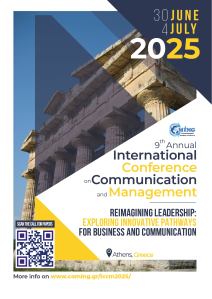
9th International Conference on Communication and Management by Communication Institute of GreeceThe 9th International Conference on Communication and Management (ICCM2025), Reimagining Leadership: Exploring Innovative Pathways For Business and Communication, 30 June – 4 July 2025,  in Athens, Greece.


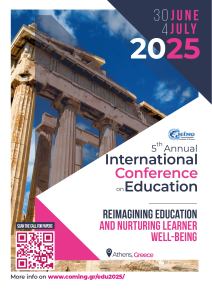
5th International Conference on Education - COMING EDU2025The 5th International Conference on Education (EDU2025), Reimagining Education and Nurturing Learner Wellbeing, 30 June – 04 July 2025, in Athens, Greece.

ICA25 Regional Hub Application

ConferencesCall for proposals: ICA25 Regional Hub Application. Deadline: 30 August 2024.

In conjunction with ICA’s 75th Annual Conference on 12-16 June 2025 in Denver, Colorado (USA), the organization welcomes proposals for ICA Regional Hubs worldwide to host events concurrent with the annual ICA conference.  While there is no substitute for an in-person experience at an ICA conference, they recognize that a significant and growing proportion of current and potential ICA membership resides in the Global South, making travel to in-person attendance inaccessible due to fiscal, political, environmental, health, and other hurdles.

In response to these concerns, ICA’s Regional Hubs Initiative offers a window into ICA – its community and scholarship. The Regional Hubs also provide communication scholars in various Regions around the world an opportunity to foster community and build intellectual networks. It reflects ICA’s commitment to welcome and support a broader global community of communication scholars. Since its inception at the virtual ICA 2021 and continuing at the hybrid conferences in ICA22, ICA23, and ICA24, each year, around 10 ICA Regional Hubs have been hosted.

Regional Hubs host sessions for regional submissions, with some Hubs receiving over 100 submissions, from which some were selected for oral presentation and others for posters. Most of the Hubs hosted themed workshops and invited lectures from local and global scholars, including some who joined from other Regional Hubs and others from the main ICA Conference location. Some Hubs live-streamed presentations and sessions from the primary conference location (Paris in 2022, Toronto in 2023, Gold Coast in 2024) and organized local panels to facilitate discussion around them. A few organized Blue Sky workshops or workshops on special topics such as scholarly publishing, submitting grants, and scholarship applications. Some Hubs live-streamed their locally-originated events on platforms such as Facebook and YouTube and often garnered considerable local media coverage. In some cases, the Hubs hosted those presenting papers selected for the ICA conference remotely from their locations. Finally, after the selection of Hubs, some Hubs collaborated on organizing joint Hub-to-Hub sessions.

In support of this initiative, ICA provides the opportunity to apply for modest financial support to host a Regional Hub. For instance, a university may want to propose a Regional Hub and invite the participation of local attendees from a city, region or country. Hosts are also encouraged to secure additional funding to complement support from ICA.