
Key Concept #36: Counter-Narrative by Raúl A. Mora

Key Concepts in ICDThe next issue of Key Concepts in intercultural Dialogue is now available. This is KC36: Counter-Narrative by Raúl Alberto Mora. As always, all Key Concepts are available as free PDFs; just click on the thumbnail to download. Lists organized  chronologically by publication date and numberalphabetically by concept in English, and by languages into which they have been translated, are available, as is a page of acknowledgments with the names of all authors, translators, and reviewers.
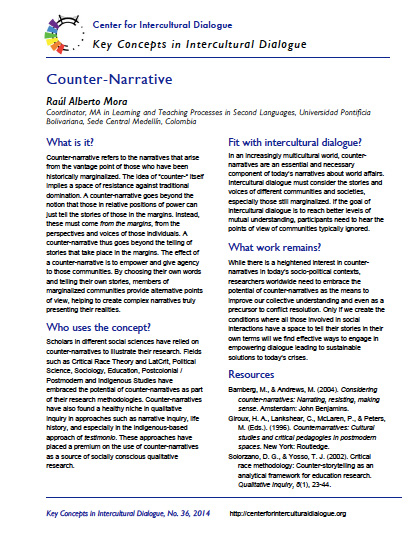
KC36-sm

Mora, R. A. (2014). Counter-narrative. Key Concepts in Intercultural Dialogue, 36. Available from:
https://centerforinterculturaldialogue.org/wp-content/uploads/2014/10/key-concept-counter-narrative.pdf

The Center for Intercultural Dialogue publishes a series of short briefs describing Key Concepts in intercultural Dialogue. Different people, working in different countries and disciplines, use different vocabulary to describe their interests, yet these terms overlap. Our goal is to provide some of the assumptions and history attached to each concept for those unfamiliar with it. As there are other concepts you would like to see included, send an email to the series editor, Wendy Leeds-Hurwitz. If there are concepts you would like to prepare, provide a brief explanation of why you think the concept is central to the study of intercultural dialogue, and why you are the obvious person to write up that concept.


Creative Commons License
This work is licensed under a Creative Commons Attribution-NonCommercial-NoDerivatives 4.0 International License.
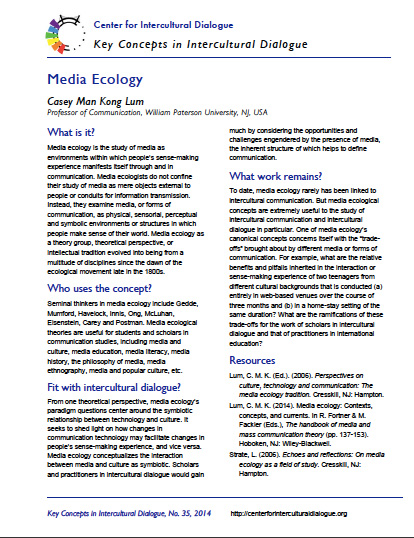
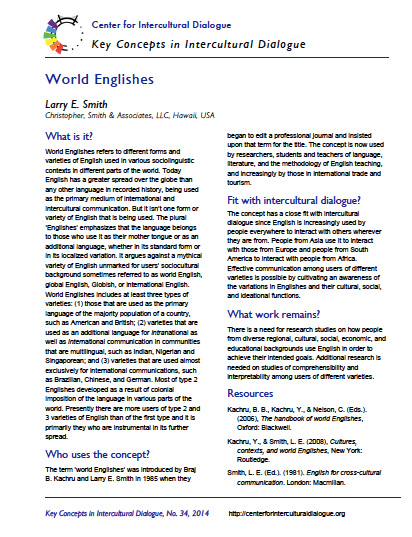
Key Concept #35: Media Ecology by Casey Man Kong Lum

Key Concepts in ICDThe next issue of Key Concepts in intercultural Dialogue is now available. This is  KC35: Media Ecology by Casey Man Kong Lum. As always, all Key Concepts are available as free PDFs; just click on the thumbnail to download. Lists organized  chronologically by publication date and numberalphabetically by concept in English, and by languages into which they have been translated, are available, as is a page of acknowledgments with the names of all authors, translators, and reviewers.

kc35-sm

Lum, C. M. K. (2019). Media ecology. Key Concepts in Intercultural Dialogue, 35. Available from: https://centerforinterculturaldialogue.org/wp-content/uploads/2019/11/kc35-media-ecology-rev.pdf

(NOTE: this was originally published in 2014, but revised in 2019 – the revised PDF is what is now available.)

The Center for Intercultural Dialogue publishes a series of short briefs describing Key Concepts in intercultural Dialogue. Different people, working in different countries and disciplines, use different vocabulary to describe their interests, yet these terms overlap. Our goal is to provide some of the assumptions and history attached to each concept for those unfamiliar with it. As there are other concepts you would like to see included, send an email to the series editor, Wendy Leeds-Hurwitz. If there are concepts you would like to prepare, provide a brief explanation of why you think the concept is central to the study of intercultural dialogue, and why you are the obvious person to write up that concept.


Creative Commons License
This work is licensed under a Creative Commons Attribution-NonCommercial-NoDerivatives 4.0 International License.
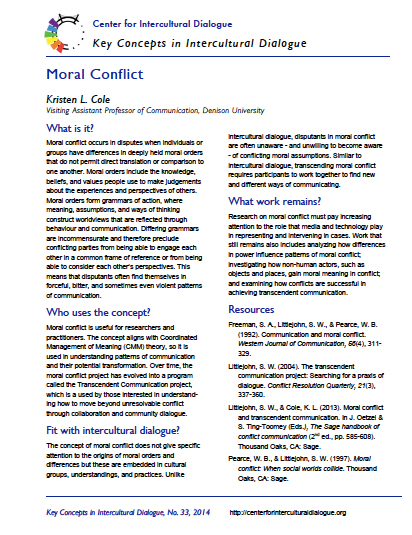
Key Concept #34: World Englishes by Larry E. Smith

Key Concepts in ICDThe next issue of Key Concepts in intercultural Dialogue is now available. This is KC34: World Englishes by Larry E. Smith. As always, all Key Concepts are available as free PDFs; just click on the thumbnail to download. Lists organized  chronologically by publication date and numberalphabetically by concept in English, and by languages into which they have been translated, are available, as is a page of acknowledgments with the names of all authors, translators, and reviewers.

kc34-sm

Smith, L.E. (2014). World Englishes. Key Concepts in Intercultural Dialogue, 34. Available from:
https://centerforinterculturaldialogue.org/wp-content/uploads/2014/09/key-concept-world-englishes.pdf

The Center for Intercultural Dialogue publishes a series of short briefs describing Key Concepts in intercultural Dialogue. Different people, working in different countries and disciplines, use different vocabulary to describe their interests, yet these terms overlap. Our goal is to provide some of the assumptions and history attached to each concept for those unfamiliar with it. As there are other concepts you would like to see included, send an email to the series editor, Wendy Leeds-Hurwitz. If there are concepts you would like to prepare, provide a brief explanation of why you think the concept is central to the study of intercultural dialogue, and why you are the obvious person to write up that concept.


Creative Commons License
This work is licensed under a Creative Commons Attribution-NonCommercial-NoDerivatives 4.0 International License.
Key Concept #33: Moral Conflict by Kristen Cole

Key Concepts in ICDThe next issue of Key Concepts in intercultural Dialogue is now available. This is KC33: Moral Conflict by Kristen Cole. As always, all Key Concepts are available as free PDFs; just click on the thumbnail to download. Lists organized  chronologically by publication date and numberalphabetically by concept in English, and by languages into which they have been translated, are available, as is a page of acknowledgments with the names of all authors, translators, and reviewers.

kc33-sm

Cole, K. (2014). Moral conflict. Key Concepts in Intercultural Dialogue, 33. Available from:
https://centerforinterculturaldialogue.org/wp-content/uploads/2018/04/kc33-moral-conflict.pdf

The Center for Intercultural Dialogue publishes a series of short briefs describing Key Concepts in intercultural Dialogue. Different people, working in different countries and disciplines, use different vocabulary to describe their interests, yet these terms overlap. Our goal is to provide some of the assumptions and history attached to each concept for those unfamiliar with it. As there are other concepts you would like to see included, send an email to the series editor, Wendy Leeds-Hurwitz. If there are concepts you would like to prepare, provide a brief explanation of why you think the concept is central to the study of intercultural dialogue, and why you are the obvious person to write up that concept.


Creative Commons License
This work is licensed under a Creative Commons Attribution-NonCommercial-NoDerivatives 4.0 International License.
Key Concept #31: Indigenous

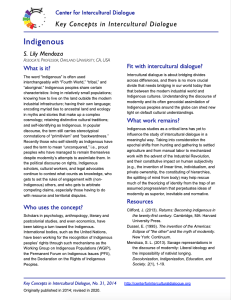
Key Concepts in ICDThe next issue of Key Concepts in intercultural Dialogue is now available. This is KC31: Indigenous by S. Lily Mendoza. [NOTE: this concept was updated in 2020, and the original 2014 version replaced.] As always, all Key Concepts are available as free PDFs; just click on the thumbnail to download. Lists organized  chronologically by publication date and numberalphabetically by concept in English, and by languages into which they have been translated, are available, as is a page of acknowledgments with the names of all authors, translators, and reviewers.

KC31 IndigenousMendoza, S. L. (2020). Indigenous. Key Concepts in Intercultural Dialogue, 31. Available from:
https://centerforinterculturaldialogue.org/wp-content/uploads/2020/10/kc31-indigenous_v2.pdf

The Center for Intercultural Dialogue publishes a series of short briefs describing Key Concepts in intercultural Dialogue. Different people, working in different countries and disciplines, use different vocabulary to describe their interests, yet these terms overlap. Our goal is to provide some of the assumptions and history attached to each concept for those unfamiliar with it. As there are other concepts you would like to see included, send an email to the series editor, Wendy Leeds-Hurwitz. If there are concepts you would like to prepare, provide a brief explanation of why you think the concept is central to the study of intercultural dialogue, and why you are the obvious person to write up that concept.


Creative Commons License
This work is licensed under a Creative Commons Attribution-NonCommercial-NoDerivatives 4.0 International License.
Key Concept #30: Critical Intercultural Communication by Rona Halualani

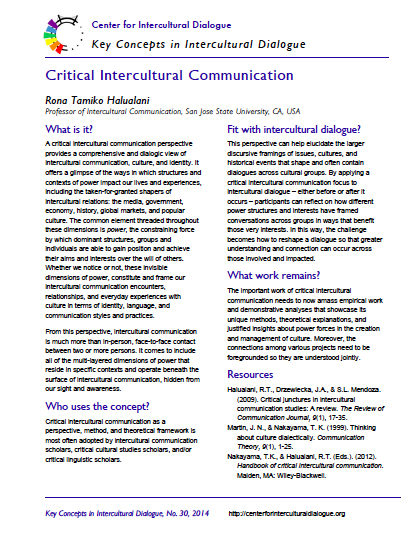
Key Concepts in ICDThe next issue of Key Concepts in intercultural Dialogue is now available. This is KC30: Critical Intercultural Communication by Rona Halualani. As always, all Key Concepts are available as free PDFs; just click on the thumbnail to download. Lists organized  chronologically by publication date and numberalphabetically by concept in English, and by languages into which they have been translated, are available, as is a page of acknowledgments with the names of all authors, translators, and reviewers.

kc30-sm

Halualani, R. (2014). Critical intercultural communication. Key Concepts in Intercultural Dialogue, 30. Available from:
https://centerforinterculturaldialogue.org/wp-content/uploads/2014/08/key-concept-critical-icc.pdf

The Center for Intercultural Dialogue publishes a series of short briefs describing Key Concepts in intercultural Dialogue. Different people, working in different countries and disciplines, use different vocabulary to describe their interests, yet these terms overlap. Our goal is to provide some of the assumptions and history attached to each concept for those unfamiliar with it. As there are other concepts you would like to see included, send an email to the series editor, Wendy Leeds-Hurwitz. If there are concepts you would like to prepare, provide a brief explanation of why you think the concept is central to the study of intercultural dialogue, and why you are the obvious person to write up that concept.


Creative Commons License
This work is licensed under a Creative Commons Attribution-NonCommercial-NoDerivatives 4.0 International License.
Key Concept #29: Dialogic Civility by Robyn Penman

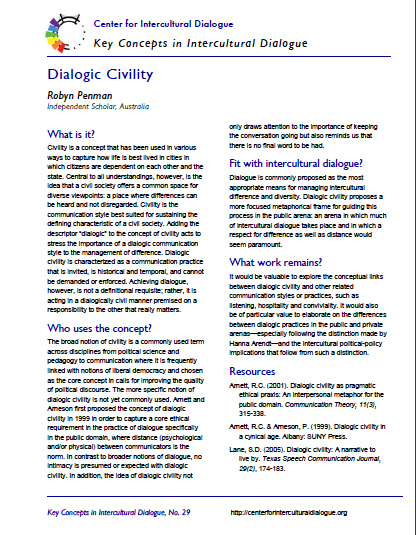
Key Concepts in ICDThe next issue of Key Concepts in intercultural Dialogue is now available. This is KC29: Dialogic Civility by Robyn Penman. As always, all Key Concepts are available as free PDFs; just click on the thumbnail to download. Lists organized  chronologically by publication date and numberalphabetically by concept in English, and by languages into which they have been translated, are available, as is a page of acknowledgments with the names of all authors, translators, and reviewers.

kc29-sm

Penman, R. (2014). Dialogic civility. Key Concepts in Intercultural Dialogue, 29. Available from:
https://centerforinterculturaldialogue.org/wp-content/uploads/2014/08/key-concept-dialogic-civility.pdf

The Center for Intercultural Dialogue publishes a series of short briefs describing Key Concepts in intercultural Dialogue. Different people, working in different countries and disciplines, use different vocabulary to describe their interests, yet these terms overlap. Our goal is to provide some of the assumptions and history attached to each concept for those unfamiliar with it. As there are other concepts you would like to see included, send an email to the series editor, Wendy Leeds-Hurwitz. If there are concepts you would like to prepare, provide a brief explanation of why you think the concept is central to the study of intercultural dialogue, and why you are the obvious person to write up that concept.


Creative Commons License
This work is licensed under a Creative Commons Attribution-NonCommercial-NoDerivatives 4.0 International License.
Key Concept #28: Postcolonialism by Raka Shome

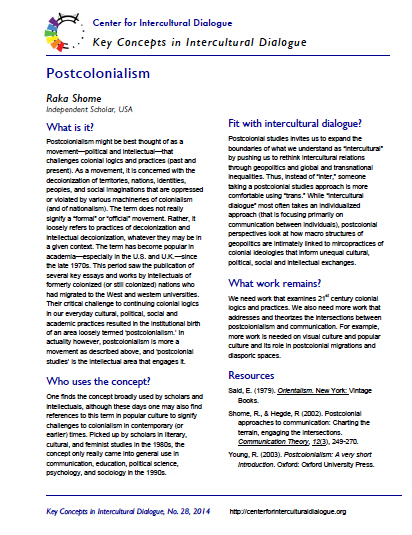
Key Concepts in ICDThe next issue of Key Concepts in intercultural Dialogue is now available. This is KC28: Postcolonialism by Raka Shome. As always, all Key Concepts are available as free PDFs; just click on the thumbnail to download. Lists organized  chronologically by publication date and numberalphabetically by concept in English, and by languages into which they have been translated, are available, as is a page of acknowledgments with the names of all authors, translators, and reviewers.

kc28-smShome, R. (2014). Postcolonialism. Key Concepts in Intercultural Dialogue, 28. Available from:
https://centerforinterculturaldialogue.org/wp-content/uploads/2014/08/key-concept-postcolonialism.pdf

The Center for Intercultural Dialogue publishes a series of short briefs describing Key Concepts in intercultural Dialogue. Different people, working in different countries and disciplines, use different vocabulary to describe their interests, yet these terms overlap. Our goal is to provide some of the assumptions and history attached to each concept for those unfamiliar with it. As there are other concepts you would like to see included, send an email to the series editor, Wendy Leeds-Hurwitz. If there are concepts you would like to prepare, provide a brief explanation of why you think the concept is central to the study of intercultural dialogue, and why you are the obvious person to write up that concept.


Creative Commons License
This work is licensed under a Creative Commons Attribution-NonCommercial-NoDerivatives 4.0 International License.

Key Concept #27: Globalization by Shiv Ganesh and Cynthia Stohl

Key Concepts in ICDThe next issue of Key Concepts in intercultural Dialogue is now available. This is KC27: Globalization by Shiv Ganesh and Cynthia Stohl. As always, all Key Concepts are available as free PDFs; just click on the thumbnail to download. Lists organized  chronologically by publication date and numberalphabetically by concept in English, and by languages into which they have been translated, are available, as is a page of acknowledgments with the names of all authors, translators, and reviewers.

kc27-smGanesh, S., & Stohl, C. (2014). Globalization. Key Concepts in Intercultural Dialogue, 27. Available from:
https://centerforinterculturaldialogue.org/wp-content/uploads/2014/08/key-concept-globalization.pdf

The Center for Intercultural Dialogue publishes a series of short briefs describing Key Concepts in intercultural Dialogue. Different people, working in different countries and disciplines, use different vocabulary to describe their interests, yet these terms overlap. Our goal is to provide some of the assumptions and history attached to each concept for those unfamiliar with it. As there are other concepts you would like to see included, send an email to the series editor, Wendy Leeds-Hurwitz. If there are concepts you would like to prepare, provide a brief explanation of why you think the concept is central to the study of intercultural dialogue, and why you are the obvious person to write up that concept.


Creative Commons License
This work is licensed under a Creative Commons Attribution-NonCommercial-NoDerivatives 4.0 International License.

Key Concept #26: Global-Local Dialectic by Jana Simonis

Key Concepts in ICDThe next issue of Key Concepts in intercultural Dialogue is now available. This is KC26: Global-Local Dialectic by Jana Simonis. As always, all Key Concepts are available as free PDFs; just click on the thumbnail to download. Lists organized  chronologically by publication date and numberalphabetically by concept in English, and by languages into which they have been translated, are available, as is a page of acknowledgments with the names of all authors, translators, and reviewers.

kc26-sm

Simonis, J. (2014). Global-local dialectic. Key Concepts in Intercultural Dialogue, 26. Available from:
https://centerforinterculturaldialogue.org/wp-content/uploads/2014/08/key-concept-global-local.pdf

The Center for Intercultural Dialogue publishes a series of short briefs describing Key Concepts in intercultural Dialogue. Different people, working in different countries and disciplines, use different vocabulary to describe their interests, yet these terms overlap. Our goal is to provide some of the assumptions and history attached to each concept for those unfamiliar with it. As there are other concepts you would like to see included, send an email to the series editor, Wendy Leeds-Hurwitz. If there are concepts you would like to prepare, provide a brief explanation of why you think the concept is central to the study of intercultural dialogue, and why you are the obvious person to write up that concept.


Creative Commons License
This work is licensed under a Creative Commons Attribution-NonCommercial-NoDerivatives 4.0 International License.