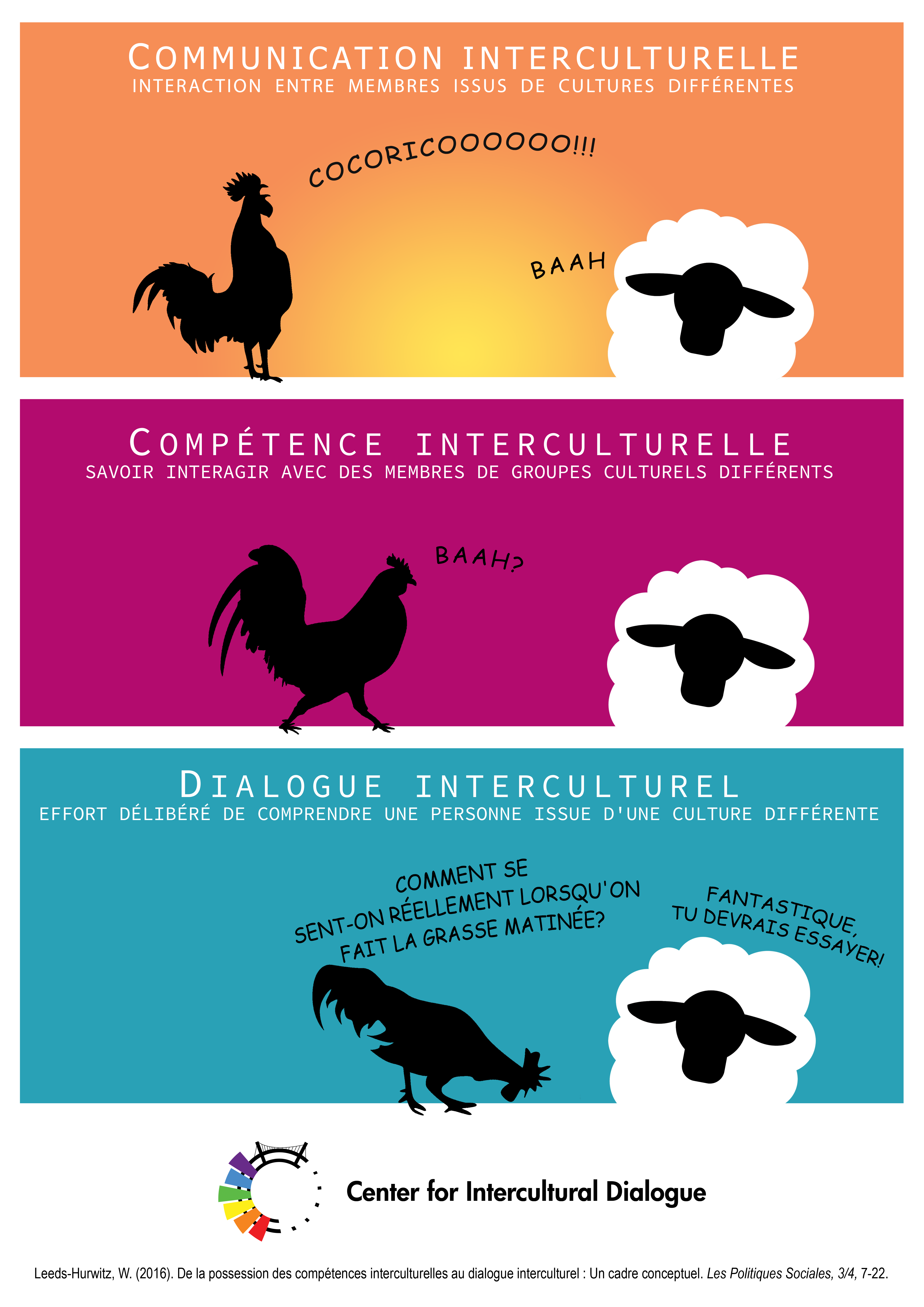
CID Poster 5: Communication as Culture Definition Translated into French

CID PostersFor this poster, Linda J. de Wit used the painting Winter Landscape with Ice Skaters, by Dutch painter Hendrick Avercamp, painted around 1608. It is on display in the Dutch national museum Rijksmuseum in Amsterdam, which has made many of its collection available online in high resolution and copyright free. The painting illustrates the quote not only because it shows social interaction, but also because ice skating is considered a typical example of Dutch culture (and recently has officially been named part of Dutch cultural heritage). The silhouettes are designs from vecteezy.com. The quote comes from the following book:

Leeds-Hurwitz, W. (1989). Communication in everyday life: A social interpretation. Norwood, NJ: Ablex.

The French translation was provided by Léonie Potvin, and the graphic design work necessary to revise was by Yan Qiu. Here then is CID Poster 5: Définition de la communication comme culture.

CID Poster 5: Communication as culture definition translated into French

Just in case anyone wants to cite this poster, the following would be the recommended format:

Center for Intercultural Dialogue. (2024). Définition de la communication comme culture [L. Potvin, trans.]. CID Posters, 5. Available from: https://centerforinterculturaldialogue.org/wp-content/uploads/2024/10/cid-poster-5-communication-french.png

As with other series, CID Posters are available for free on the site; just click on the thumbnail to download a printable PNG. They may be downloaded, printed, and shared as is, without changes, without cost, so long as there is acknowledgment of the source.

As with other CID Publications, if you wish to contribute an original contribution, please send an email before starting any work to receive approval, to minimize inadvertent duplication, and to learn about technical requirements. As is the case any series, posters should be created initially in English. If you want to volunteer to translate a poster into a language in which you are fluent, send in a note before starting, to receive approval and to confirm no one else is working on the same one.

Wendy Leeds-Hurwitz
Director, Center for Intercultural Dialogue
intercult.dialogue AT gmail.com


Creative Commons License
This work is licensed under a Creative Commons Attribution-NonCommercial-NoDerivatives 4.0 International License.

Gonzaga U: Study Abroad Advisor (USA)

“Job

Study Abroad Advisor, Center for Global Engagement, Gonzaga University, Spokane, WA, USA Deadline: 14 November 2024.

The Study Abroad Advisor works closely with the Study Abroad (SA) team to provide quality service to students interested in studying abroad and supports a streamlined experience for all stakeholders. This position primarily focuses on managing and monitoring enrollment in the Gonzaga in Florence (GIF) Study Abroad Programs and serves as the primary liaison between the student-facing staff in Florence and the SA Office. The advisor ensures the success and safety of the programs while also handling general advising duties.

CIEE: Associate Director, CIEE London (UK)

“Job

Associate Director, CIEE Study Abroad London, CIEE, London, UK. Deadline: 14 December 2024.

CIEE is a nonprofit study abroad and intercultural exchange organization that transforms lives and builds bridges between individuals and nations through study abroad and international exchange experiences that help people develop skills for living in a globally interdependent and culturally diverse world.

The Associate Director oversees, in collaboration with and under the supervision of the Centre Director, the planning and delivery of all CIEE programs. This comprises coordinating tasks among various team members; overseeing the implementation of guidelines and policies; monitoring logistics and operations; and supporting staff in charge of finance and admin team.

This position oversees, in collaboration with the Center Director and the Admin team, the financial, accounting and banking needs of the CIEE London programs, as defined below and in accordance with CIEE administrative policies. S/he works with Portland Financial Department to ensure the correct financial and accounting system controls and standards, and to ensure timely financial and accounting reports for management. This position also supports the Center Director in managing CIEE’s UK-wide identity including the UKVI sponsor license, the UKQAA and Companies House. S/he will also manage HR, payroll, contracts and legal processes, and s/he is equally responsible for the overhead budget and expenses at the Study Center.

CFP GURT 2025: Language & Food (USA)

ConferencesCall for Papers: Georgetown University Round Table 2025: Language and Food, 28 February – 2 March 2025, Georgetown University, Washington D.C. Deadline: 18 November 2024.

Food and language are omnipresent and intertwined in everyday life. We use language to talk about food, and food terms have rich cultural histories and associations. Menus and food packaging labels not only provide windows on an item’s nature and quality, but also often signal association with identities such as ethnicity, region, or class. Mealtime has long been a privileged site for the study of language in use, as people talk while they eat, and while they cook. Parents use language to socialize their children into food preferences and practices; even among adults, the taste of food is collaboratively negotiated in interaction: think wine tasting, or dinner conversation. Children in school cafeterias and co-workers in workplace break rooms talk about food. People participate in online forums on topics such as gourmet cooking, veganism, and weight loss; they use language about food to portray themselves as certain kinds of people (gourmand, disciplined eater, environmentalist, picky eater, athlete). People post photos of food on Instagram, recipe videos on TikTok and Facebook, and restaurant reviews on Yelp. Food is a necessity and a luxury; it is intertwined with identities (e.g., cultural, gendered, socioeconomic, political, religious), relationships (e.g., parent-child, friend-friend, host-guest), and values (e.g., healthful eating, ethical eating), all of which are negotiated through language.

GURT 2025 will bring together diverse scholars whose work explores intersections between language and food. The conference will be inclusive of multiple approaches, including (but not limited to) interactional sociolinguistics, conversation analysis, critical discourse analysis, multimodal discourse analysis, ethnography of communication, cultural discourse analysis, narrative analysis, variation analysis, semiotics, systemic functional linguistics, historical linguistics, comparative linguistics, computational/corpus linguistics, and cognitive linguistics. We invite submissions that consider any aspect of food and language, including (but not limited to) menus, recipes, mealtime conversations, food-related online discussions, social media posts about food, food-related podcasts, food advertisements, and documentary and reality TV shows about food.

KC25 Metacommunication Translated into Simplified Chinese

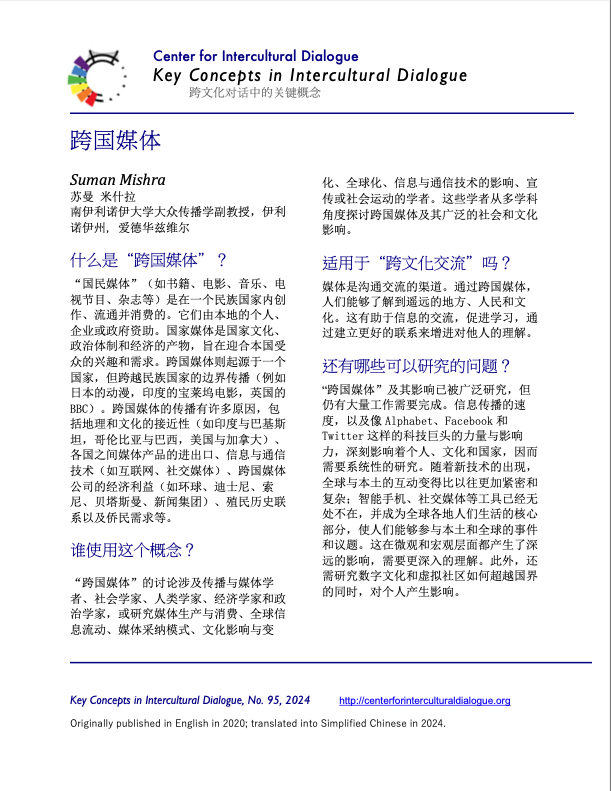
Key Concepts in ICDContinuing translations of Key Concepts in Intercultural Dialogue, today I am posting KC25: Metacommunication, which I wrote for publication in English in 2014, and which Yan Qiu has now translated into Simplified Chinese.

As always, all Key Concepts are available as free PDFs; just click on the thumbnail to download. Lists of Key Concepts organized chronologically by publication date and number, alphabetically by concept, and by languages into which they have been translated, are available, as is a page of acknowledgments with the names of all authors, translators, and reviewers.

Key Concept 25: Metacommunication translated into Simplified ChineseLeeds-Hurwitz, W. (2024). Metacommunication [Simplified Chinese]. (Y. Qiu, trans). Key Concepts in Intercultural Dialogue, 25. Available from: https://centerforinterculturaldialogue.org/wp-content/uploads/2024/11/kc25-metacommunication_sim-chinese2.pdf

If you are interested in translating one of the Key Concepts, please contact me for approval first because dozens are currently in process. As always, if there is a concept you think should be written up as one of the Key Concepts, whether in English or any other language, propose it. If you are new to CID, please provide a brief resume. This opportunity is open to masters students and above, on the assumption that some familiarity with academic conventions generally, and discussion of intercultural dialogue specifically, are useful.

Wendy Leeds-Hurwitz, Director
Center for Intercultural Dialogue


Creative Commons License
This work is licensed under a Creative Commons Attribution-NonCommercial-NoDerivatives 4.0 International License.

Weatherhead Program on US-Japan Relations Fellowships (USA)

Fellowships

Weatherhead Program on US-Japan Relations Associates, Harvard University, Boston, MA, USA. Deadline: 15 December 2024. 

The roughly 16 Associates who join the Program include businesspeople, government officials, journalists, and scholars. They are primarily from Japan and the United States, but the Program has also hosted Associates from Australia, Canada, the People’s Republic of China, Germany, the Republic of Korea, Malaysia, Mexico, the Netherlands, Panama, Russia, Taiwan, Thailand, and the United Kingdom.

The Program also offers postdoctoral fellowships during the 2025-26 academic year. They seek applications from outstanding recent PhDs in the social sciences who are conducting research that illuminates Japan’s relations with the rest of the world in the broadest sense. Applications are welcome from anthropology, business, economics, history, international relations, law, political science, psychology, public health, public policy, and sociology, among other fields. Scholars may examine domestic issues that bear on Japan’s external relations or problems that it shares with other countries, and projects that compare Japan’s experience cross-nationally are encouraged. The postdoctoral fellowship is a twelve-month appointment, in residence in the Boston area, that begins in either August or September.

The Program was founded in 1980 based on the belief that the United States and Japan have become so interdependent that the problems they face require cooperation. Co-sponsored by the Weatherhead Center for International Affairs and the Edwin O. Reischauer Institute of Japanese Studies, the Program enables scholars and outstanding professionals from government, business, finance, journalism, NGOs, and other fields to come together at Harvard. Over the academic year, they conduct independent research and participate in an ongoing dialogue with Harvard faculty and students, and with others from the greater Cambridge-Boston community. 

CFP Translating Words, Transferring Wisdom, Traversing Worlds

“Publication

Call for contributions to Translating Words, Transferring Wisdom, Traversing Worlds. Deadline for chapter proposals: 17 November 2024; full chapters due 14 January 2025.

Mimi Yang (Professor Emerita, Carthage College) seeks chapter contributions to a forthcoming edited volume on translation studies. Translation Studies is far more complex and nuanced than the word-for-word transmission of meaning from one language to another. Translation transfers cultural wisdom and historical value from one language-speaking swath to another and traverses seemingly distant worlds in a vehicle of languages. Translators navigate the diversities of languages, cultures, perceptive frames, and ideologies to bridge words of different tongues, connect disjoint worlds, embark on the search for shared wisdom, and, most importantly, facilitate cross-cultural understandings. This project will unpack the realms hidden behind words, ramified from textual lines, and woven with writers’ horizons when translation occurs. These realms include linguistic and cognitive dimensions, sociopolitical, historical, and geographic contexts/texts, and, most significantly, a cross-cultural power structure that erects hierarchies in languages, cultures, and people of different traditions, races, and religions.

Interested authors please take a look at the full description of the book, register, and send an abstract via this link.

CID Poster 4: Types of Cultural Communication Translated into French

CID PostersSeveral years ago Linda J. de Wit created a dozen CID posters. The Center has just been asked to translate some of these into French, and is in the process of doing so.

Here we present the first one completed, CID Poster 4: Types de communication culturelle, which clarifies the differences between intercultural, intracultural, cross-cultural, and international communication. This new version of the poster now exists thanks to the French translation provided by Léonie Potvin, and the graphic design work by Yan Qiu.

CID Poster 4: Types of Cultural Communication translated into French

Just in case anyone wants to cite this poster, the following would be the recommended format:

Center for Intercultural Dialogue. (2024). Types de communication culturelle [L. Potvin, trans.]. CID Posters, 4. Available from: https://centerforinterculturaldialogue.org/wp-content/uploads/2024/10/cid-poster-4_french.png

As with other series, CID Posters are available for free on the site; just click on the thumbnail to download a printable PNG. They may be downloaded, printed, and shared as is, without changes, without cost, so long as there is acknowledgment of the source.

As with other CID Publications, if you wish to contribute an original contribution, please send an email before starting any work to receive approval, to minimize inadvertent duplication, and to learn about technical requirements. As is the case any series, posters should be created initially in English. If you want to volunteer to translate a poster into a language in which you are fluent, send in a note before starting, to receive approval and to confirm no one else is working on the same one.

Wendy Leeds-Hurwitz
Director, Center for Intercultural Dialogue
intercult.dialogue AT gmail.com


Creative Commons License
This work is licensed under a Creative Commons Attribution-NonCommercial-NoDerivatives 4.0 International License.

IIE: Fulbright Scholar Program Outreach & Recruitment (USA/Hybrid)

“JobAssistant Director, Fulbright Scholar Program Outreach and Recruitment, The Institute of International Education (IIE), Washington, DC (Hybrid). Deadline: 23 November 2024.

This Institute of International Education (IIE) is hiring an Assistant Director, Fulbright Scholar Program Outreach & Recruitment to lead a team of dedicated professionals who connect U.S. scholars to opportunities abroad. This position will work with the Fulbright Outreach and Recruitment department. The Fulbright Program is the flagship international academic exchange program sponsored by the United States Government. Fulbright was founded in 1946 with an ambitious goal—to increase mutual understanding and support friendly and peaceful relations between the people of the United States and the people of other countries. Led by the U.S. Government in partnership with more than 160 countries worldwide, Fulbright offers an expansive suite of life-changing international academic and cultural exchange opportunities.

The Assistant Director develops an outreach plan to reach diverse audiences of prospective applicants and to expand Fulbright’s engagement with higher education institutions in the U.S. Additionally, the Assistant Director executes a comprehensive recruitment plan that leverages the campus network of Fulbright Scholar Liaisons and that supports individual applicants through application advising, virtual activities and digital resources. The Assistant Director leads a team of outreach and recruitment professionals and collaborates across Fulbright teams to advance the Program’s mission and goals. The Assistant Director works closely with Fulbright Program’s sponsor, the U.S. Department of State.

Other positions with IIE available here.

UNESCO: Associate Project Officer: PEACE Project (Cambodia)

“JobAssociate Project Officer, Communication and Information Sector, UNESCO, ​Phnom Penh, Cambodia. Deadline: 18 November 2024.

Under the overall authority and the direct supervision of the UNESCO Representative in Cambodia, in close coordination with the Programme Specialist in Culture, the Associate Project Officer will be responsible for the overall management and implementation of the PEACE Project. In particular, the incumbent will:

  • Provide technical assistance for the overall project management and implementation to deliver the desired project activities and outcomes.

  • Manage the project team to ensure effective performance management to achieve programme objectives, including identifying subject experts and partners, developing Terms of References for experts and institutions, procuring and managing international and national experts and service providers, and ensuring close supervision and quality assurance for deliverables, products and services to implement programme activities.

  • Monitor the timely implementation and delivery of the project workplans and budget plans to achieve the identified project objectives and targets. This includes regular monitoring and supervision of missions and meetings, developing and maintaining monitoring and evaluation worksheets of project targets and progress, and knowledge products.

  • Ensure the timely preparation and submission of all progress reports, in line with KOICA’s reporting requirements.

  • Develop and implement visibility and outreach strategies to maximise the project results and impact, including through developing and disseminating communications and visibility materials such as articles, press releases, social media posts, posters, visual data, brochures, project presentations, among others.

  • Identify, maintain and expand strategic partnerships with relevant partners, including MoCFA, TSGM, Choeung Ek Genocidal Centre, line ministries, research and education institutes, CSOs, development partners, foundations, and the private sector to facilitate innovative project implementation and overall relevance and alignment of project outcomes.

  • Maintain UNESCO’s strategic role in promoting peacebuilding and human rights and addressing hate speech through archives preservation and digitization, culture conservation and peace education. This includes leading/participating and providing inputs in relevant UN inter-agency initiatives, working closely with the UN Country Team in joint advocacy, convening multi-stakeholder engagement with government entities, CSOs, international organizations, development partners, and academia, in line with the UN Sustainable Development Cooperation Framework (2024-2028).

Other current openings with UNESCO available here.