CFP Chinese philosophy and communication

Call for Submissions
A Special Issue of China Media Research
Theme: Chinese Philosophy and Human Communication

This special issue (CMR-2014-04) invites scholars from across disciplines to examine the relationship between Chinese philosophy and human communication. Papers dealing with communication from the perspective of Chinese philosophy, including the application of the thoughts of Confucianism, Buddhism, Daoism, and other schools to the levels of interpersonal, group/organizational, intercultural/international, media/mass communication, rhetorical, political, and sociolinguistic, etc., are invited. Submissions must not have been previously published nor be under consideration by another publication. We’ll accept the extended abstract (up to 1,000 words) of the paper at the first stage of the reviewing process.

Please email Word attachment of the extended abstract to the guest editors, Dr. Guo-Ming Chen and Dr. Xiaosui Xiao. All extended abstracts must be received by November 10, 2013. The complete manuscript must be received by April 25, 2014 after the extended abstract is accepted. Accepted manuscripts should be prepared in accordance with APA style and should not exceed 8,500 words (including references). Please visit China Media Research for more information about this quarterly journal. For inquiry, please contact Dr. Guo-Ming Chen.

Cross-cultural dignity poem

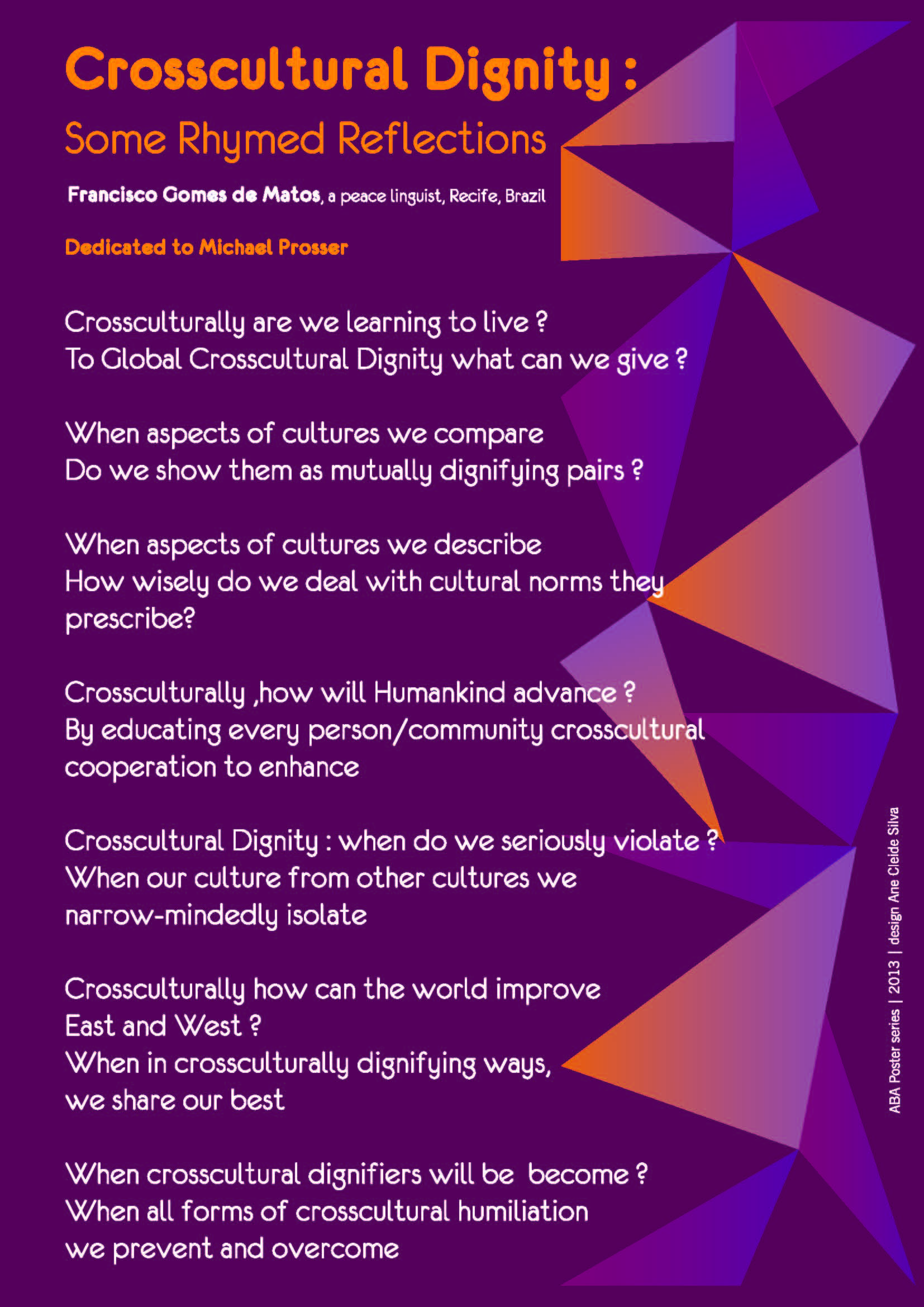
The following is a poster poem on Crosscultural Dignity sent in by Francisco Cardosa Gomes de Matos, a peace linguist-educator from Recife, Brazil. He is Professor Emeritus of Linguistics, Federal University of Pernambuco, co-founder and current President of the Board of Associação Brasil América, and co-founder of The World Dignity University initiative. If others have poems they would like to submit, we will consider posting them as well!

Crosscultural Dignity

Study international reporting in Jerusalem 2014

SUMMER STUDY ABROAD IN JERUSALEM: INTERNATIONAL REPORTING
June 24-July 24, 2014
IEI Media * Hebrew University of Jerusalem
3 credits
Contact: Dr. Susan Jacobson

A meeting place of ancient and new, holy and secular, Jerusalem is a gathering spot for foreign correspondents from around the world. Get a taste of the global journalist’s life by studying with veteran Middle East correspondents; then go into the community to report your own stories. Learn international reporting techniques from a team of journalists, including NPR correspondent Linda Gradstein and former Christian Science Monitor reporter Ilene Prusher.

Jerusalem is one of the oldest cities in the world and a holy place for three of the world’s major religions: Judaism, Christianity and Islam. Included in the program are trips to some of the most important sites in Jerusalem and Israel.

Students will live and learn at Hebrew University of Jerusalem, a modern campus on Mt. Scopus. Undergraduate student will earn 3 transferable credits from the Hebrew University of Jerusalem. GRADUATE CREDIT IS AVAILABLE.

IEI Media will offer other programs on various media-related topics in summer 2014 based in Italy, France, Northern Ireland, China, Spain, and Turkey.

Save

Nordisco 2014

Nordisco 2014, the Nordic Interdisciplinary Conference on Discourse and Interaction
November 12-14, 2014
University of Jyväskylä, Finland

The Nordic Interdisciplinary Conference on Discourse and Interaction (NorDIsCo) was established in 2010 to bring together researchers and doctoral students in the Nordic and Baltic region who investigate discourse and interaction from different disciplinary perspectives.

After two successful meetings in Aalborg (2010) and Linköping (2012), it is now our pleasure to host the third Nordic and Baltic conference at the University of Jyväskylä (Finland). The conference will be organized by the Department of Languages and the Centre for Applied Language Studies in collaboration with the Finnish Association for Applied Linguistics (AFinLA) November 12-14, 2014.

The conference will highlight research on the organization, structures and constitution of texts, talk, discourse and social interaction and provide a forum for discussion and debate across disciplinary boundaries. The theme of this third conference is Discourse, communities and identities in the North.

Hosted at the University of Jyväskylä (Finland), Nordisco 2014 welcomes contributions on any aspects of discourse and social interaction, particularly with respect to discourse, communities and identities in the North.

We encourage participants to explore, from the vantage point of their own research, one or more of the following questions:
*How can discourse studies help us understand developments in today’s communities in the North?
*What kinds of theories, methods, tools and technologies are needed to better understand changing identities and the challenges of communities?
*How can discourse studies help understand, inform, advice and intervene in the lives of communities to promote improved communicative practices?

We invite contributions from different and diverse fields of enquiry, including – but not limited to – discourse studies, conversation analysis, discursive psychology, critical discourse analysis, interaction analysis, rhetoric, narrative analysis, social semiotics, multimodal discourse analysis, gesture studies and communication activism.

Venue and date
The conference will be hosted by the Department of Languages and the Centre for Applied Language Studies at the University of Jyväskylä, Finland, on November 12-14, 2014.

Programme
The conference will consist of two plenary presentations, panel sessions, parallel paper sessions and a plenary round table discussion with contributions from leading researchers representing different domains of discourse studies.

Elizabeth Lanza (Oslo) and Anna Lindström (Uppsala) are plenary speakers, and Paul McIlvenny (Aalborg), will chair a round table on the future of discourse and interaction studies in the Nordic region. More information about the round table will be given in the second Call for Proposals.

Submissions
We invite submissions for panel sessions and paper presentations. Panel sessions consist of several thematically related papers to be scheduled in 90 or 180 minute slots. Paper presentations are organized in parallel sessions with 30 minute slots that include discussion time. We will consider abstract proposals for concluded research projects as well as work-in-progress. If you wish to submit an abstract for consideration by the Scientific Committee, please visit the conference website for more detailed information on the submission process.

The online submission system will open in January 2014. The deadline for proposals for panel sessions is on February 28 and for individual paper presentations April 30, 2014.

Language
Presentations can be given in English or in a Nordic language (if preferred). Please indicate your language preference when you submit your abstract.

Review procedure
Abstracts will be reviewed for quality, relevance, topicality and originality by the Scientific Committee.

Save

Nordic Network Intercultural Comm conference

Separation vs. integration: Challenges of bridging cultural contrasts
20th Nordic Network for Intercultural Communication Conference

The 20th NIC symposium is organised by the Institute of Germanic, Romance and Slavonic Languages  and Literatures, University of Tartu and will be held on 28- 30 November 2013 in Tartu, Estonia. Conference call has been extended to 1 November 2013.

This conference welcomes papers from all areas of intercultural communication but aims to focus on the issues of separation and integration that have always been on the agenda in the Baltic States but have become particularly acute and sensitive for the last twenty years, after the collapse of the Soviet Union.

Two cultures, Russian and Estonian have co-existed for more than two hundred years starting from the early 18th century when the Russian Empire gained control over Estonian lands by winning the war with Sweden.  Since then, numerous generations have had the opportunity to deal with the issues of separation and integration. Unfortunately, mainly due to political reasons, the integration process has not been as successful as expected.   This is where we found our inspiration for the main theme of the conference. We believe that via cooperation and discussion among intercultural communication researchers and practitioners we may manage to find solutions to problems faced by culturally different communities living side by side on a daily basis in any part of the world.  We also believe that power issues and negotiations over power are relevant to the problems involved in intercultural communication in such situations.

Therefore, we welcome contributions from all academic disciplines, including anthropology, sociology, cultural studies, political science, media and communication studies, business studies, organisational studies, educational studies, applied linguistics and sociolinguistics. We are particularly interested in case studies or theoretical papers which address issues of separation, assimilation, marginalisation and integration, as well as (discursive) power negotiations.

One of the main focuses of the Nordic Network for Intercultural Communication (NIC) is to enhance cooperation among Nordic and Baltic researchers exploring the field of intercultural communication. The main NIC activity for the last two decades has been the organisation of the annual international conference on intercultural communication, open to participants from all over the world.

ORGANISING COMMITTEE
*Krista Vogelberg, Professor at the Department of English Language and Literature
*Irina Koksharova, MA, Member of the Conference Organising Committee

Save

University at Albany

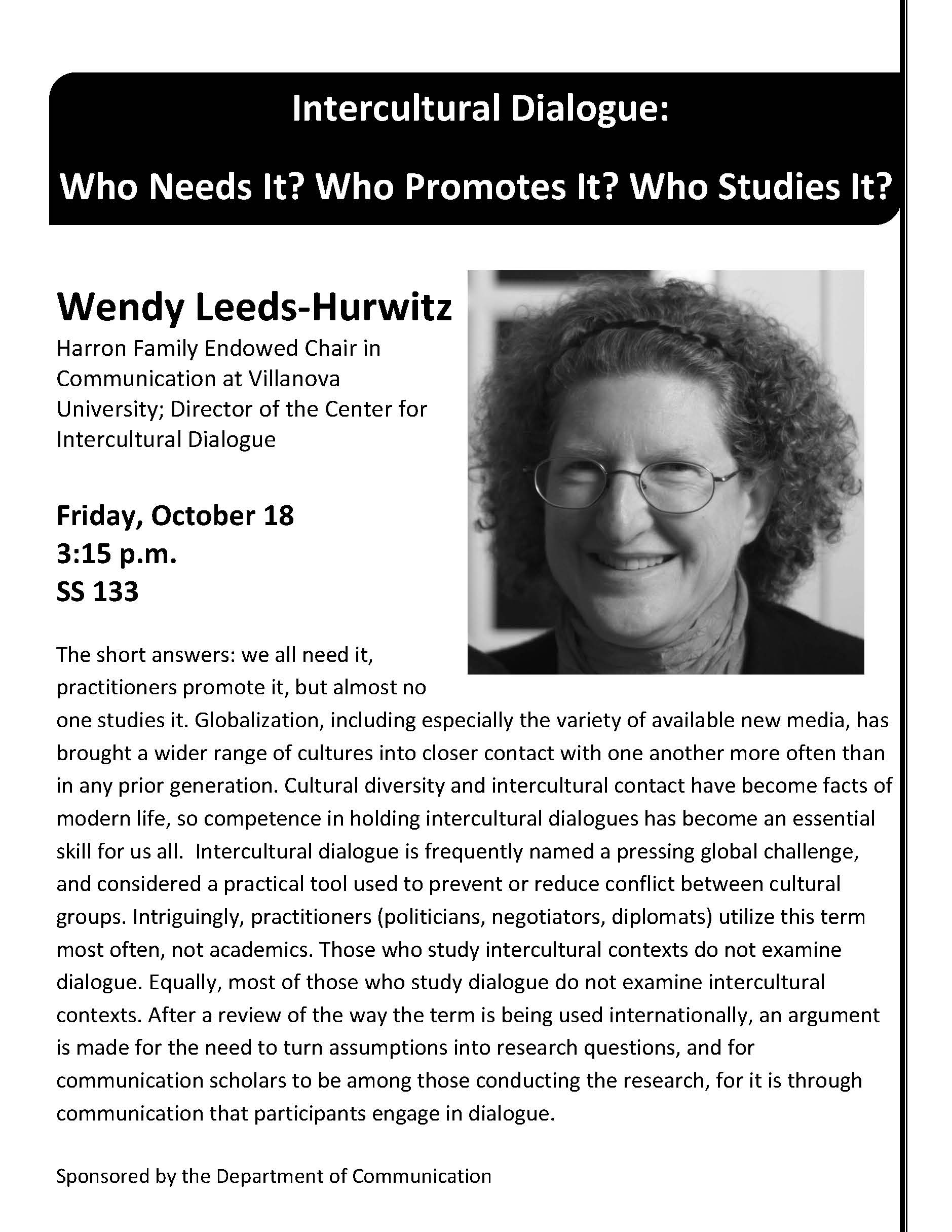
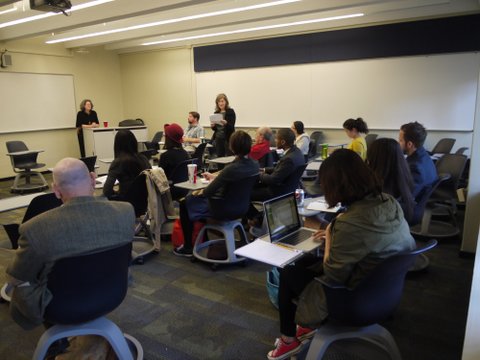
On October 18, 2013 I gave a talk at the University at Albany, State University of New York, entitled “Intercultural Dialogue: Who Needs it? Who Promotes it? Who Studies it?”

Albany flyer

My thanks to Prof. Teresa Harrison for organizing the event, and to Dr. Mihye Seo for integrating my talk into her Proseminar. While there I was able to catch up with several colleagues who I have known for many years (including Profs. Anita Pomerantz, Robert Sanders and Annis Golden) as well as meet several I had not yet met (Drs. Emilie Gould, Matthew Matsaganis).

U at Albany talk

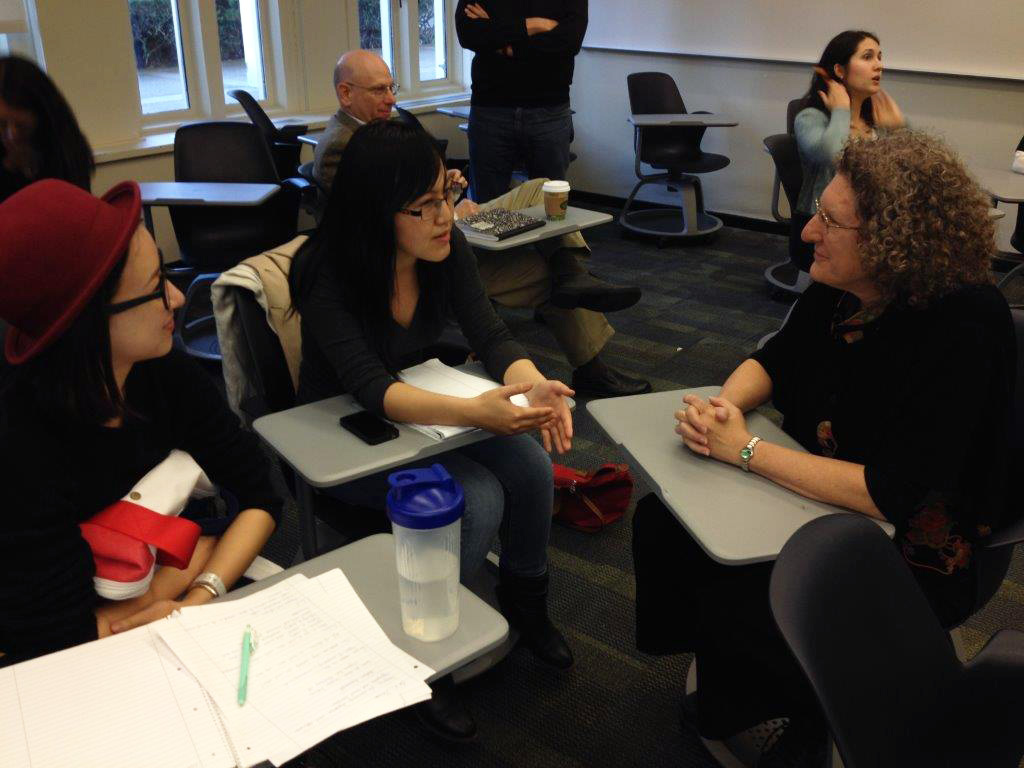
I also had the chance to talk with some of the graduate students, including Erting “Sa Sa” Sa and Sunny Zhao, below.

Albany students

Wendy Leeds-Hurwitz
Director, Center for Intercultural Dialogue

Summer Academy Peacebuilding & ICD

2nd International Summer Academy in Peace-building & Intercultural Dialogue
17.08 – 27.08.2014
Baar, Switzerland

IPD logo

The Institute for Peace and Dialogue is very glad to announce its next International Summer Academy in Peace-building & Intercultural Dialogue, which is going to be held in Switzerland 2014.  Its image as one of the most favourable places for traveling has made it more interesting to offer an exited and comprehensive program for our participants. Our experts, who are professionals in their fields will contribute to this event, with many years of experience in peace and conflict studies.

Nowadays unfortunately several frozen or ongoing conflicts between or within states still exist. Conflicts are different and if we look to the world mankind, how they are facing many new challenges, coupled with new dangerous situations, i.e. terrorist acts, non-legal arming of conflict sides, re-determination of borders, establishing new countries in the world map, non-providing territorial integrity, trafficking of arms, drugs and human; disputes on the implementation of transnational energy projects, democratization and false elections, revolution and internal political conflicts, armed guerrilla movements, violation and discrimination by nationalists, world economic crisis, climate change and unsafely biodiversity etc. Unfortunately the list is long. Conflicts are related and an integral part of human beings, as conflicts cause violation of human rights.

Existing conflicts weaken every kind of cooperation between nations and states. Without mutual cooperation and understanding, the future prosperity of the region would remain only as a good dream. Taking into consideration of peaceful behavior and engagements, we can make a decision on the strict belief, that opportunities for solving conflicts are feasible. Because in every conflict situation and tension forms we consequently face the below mentioned common situations:

1. Desperate situation and non-solving problems are not eternal;
2. It is possible to make common decision which both sides;
3. We can find common values, traditions and similar situation among conflict parties;
4. Protracted conflicts on the same time endanger regional development and prosperity;
5. Any mediation and negotiation actions are better than nothing.

Main Goal
The main goal of the summer academy is to support institutional academic peace education and strengthen peace-building skills and intercultural dialogue of the international society.

Language of the program
The International Summer Academy will be held in English.

Further information, and application, available from the Institute for Peace and Dialogue.

Massey U job ad

The College of Business at Massey University is searching for a Head of School for the School of Communication, Journalism and Marketing, to be located at either the Palmerston North or Wellington campus. Location at the Albany campus could be considered, although is not preferred.

Massey University

The Head of School provides academic leadership and strategic management of the School within the strategic framework of the College and wider University. He or she contributes to the mission and strategic objectives of the College as a member of the College Board and College Executive Team.

The successful candidate will be a dynamic, innovative and effective academic leader who will work with the Pro Vice-Chancellor to lead a large and diverse School across three campuses. The College’s strategic priorities are academic excellence, engaged staff and stakeholders, impactful research, an enterprising culture and outstanding reputation.

Employment will be on an ongoing (tenured) basis with the appointment as Head of School being an initial term of three years after which time a further term may be available or the appointee would take up an academic position within the School. The Head of School should be appointable at Professor Level.

In 2013 Massey University was ranked New Zealand’s fifth most attractive employer in in the annual Randstad Awards, an international survey conducted across 14 countries. It was also the education sector winner. The College of Business has a proud history, with New Zealand’s longest running MBA, journalism and entrepreneurship/small business programmes. The College comprises five schools: Accountancy; Aviation; Communication, Journalism & Marketing; Economics & Finance; and Management. We have programmes on three campuses (Albany, Palmerston North, and Wellington) plus New Zealand’s oldest and most substantial distance education offering. We are accredited by AACSB and AMBA, alongside several discipline-specific endorsements.

The Palmerston North campus is located in the Manawatu region, set between the Tararua and Ruahine ranges in the east and the vast Tasman Sea in the west. Manawatu combines the charm of rural New Zealand with the sophisticated city appeal of Palmerston North. It has a thriving arts and sport scene and is reputed to have the highest number of restaurants, eateries and cafe bars per capita in New Zealand.

Wellington is New Zealand’s capital, with a population of approx. 400,000. The 2010 Mercer Quality of Living Survey ranked Wellington 12th in the world. In 2011 Lonely Planet named Wellington as fourth in its Top 10 Cities to Visit, referring to the New Zealand capital as the “coolest little capital in the world”.

Closing date: 08 January 2013
Reference number: A359-13SF

Intercultural Survey

The Center for Intercultural Dialogue has been asked to help circulate the following notice:

We are currently running a survey on the nature of the intercultural profession with three goals in mind:

1. Gain an understanding of the nature of the intercultural profession globally in 2013

2. Provide guidance for newcomers in the intercultural field

3. Show the development of the intercultural profession over the last 10 years (this will be done based on the results of surveys from 2004 and 2008 from K. Berardo and G. Simons)

We are asking all  who work in the intercultural field (*), be it as educators, trainers, coaches, academics, youth workers or others, to please take time to complete the survey.

Here’s the link to the 15 mins survey: http://www.surveymonkey.com/s/ICProfessionSurvey2013

Thank you all for this collective effort to shed light on our field and the way we work.

Best regards,

Anja Franz (Lecturer and Research Associate at Institute of Educational Science (IEW), Otto-von-Guericke-University Magdeburg, Germany | M.A. Sociology and Education)

Susan Salzbrenner (Intercultural Trainer and Owner of “Fit Across Cultures”, Paris, France | M.A. Psychology)

Tanja Schulze (Program Officer for German-Indian Relations at Robert Bosch Stiftung, Stuttgart, Germany | 2011-2013 President of Young SIETAR | M.A. Romance Languages and Literature,Intercultural Business Communication, History of Economics)

(*) For the purposes of this study, ‘intercultural work’ is defined as work that focuses on the subject of culture and aims to facilitate communication and interaction across cultures. It may involve, though is not limited to, such activities as teaching, training, and consulting. We do keep the term “cross-cultural” as well since it’s commonly used in some parts of the world.

Mudra Institute Comm (India) job ad

Mudra Institute of Communications, Ahmedabad (MICA), India
Faculty Position Openings

Established in 1991, Mudra Institute of Communications, Ahmedabad (MICA) is India’s premier postgraduate institute in Communications Management dedicated to meeting the communication needs of the industry, government and community.  MICA offers  a two-year program  leading to  a Post Graduate Diploma in Management (Communication), a one-year certificate program in Crafting Creative Communication, a three-year doctoral program in communication, and a number on online programs.

MICA invites applications for the following faculty positions from bright and high calibre individuals who possess a proven track record of quality independent research and innovative pedagogical approaches. Alignment with MICA’s culture of professionalism, creativity, generosity and appreciation of diversity is highly desirable for all positions. Remuneration for all positions will be on par with the best academic institutes in India, with generous funding for research projects and to present in international conferences.

MICA invites applications for a tenure-line, open-rank faculty position in one or more of the following areas:
*       Organizational Communication
*       Strategic Leadership  & Communication
*       Brand Communication
*       Health Communication/Communication for Social change
*       Intercultural Communication
*       New Media (Digital Communication)

The desired qualification for the faculty positions is a Ph.D. in communication, organizational behaviour, psychology or a related field. Candidates must demonstrate evidence of strong scholarship, successful teaching, and a deep commitment to institute and community service. ABDs may be considered, but those hired ABD must earn their doctoral degree within six months of being hired.

Please email your application clearly specifying the position applied for and area in the subject line   by October 31, 2013. Application should have (a) covering letter, (b) Curriculum Vitae, (c) Copies of the last two relevant publications, (d) Teaching evaluations, and (e) Three references.

Interviews are scheduled during the NCA 99th Annual Convention on November 22, 2013 which will convene at the Marriott Wardman Park Hotel, Woodley Road, Washington DC.  Please let us know if you are not attending the NCA Conference so that we can organize alternate ways to connect with you.

This institution chooses not to disclose its domestic partner benefits policy.

Save