African American expatriate survey

Collaboration request from Alyssa Hislop:

Research participants wanted! If you are African-American and have lived more than one year of your adult life either working, studying or living abroad, you can contribute to better comprehension of the life of the African American Expatriate and possible implications for racial identity by completing this online survey. The survey can take anywhere from 30 minutes to 1 hour. If there are any questions you may contact Alyssa Hislop, Principal Investigator.

Alyssa Hislop is a Master’s student at Andrews University in Michigan whose research paper is on African American Expatriates and how their racial identity may be affected while living abroad. She is asking that the CID help locate appropriate people to complete her survey.

PLURAL+ Youth Video Festival

Call for Video Entries
PLURAL+ Youth Video Festival on Migration, Diversity and Social Inclusion

The United Nations Alliance of Civilizations ( UNAOC) and International Organization for Migration ( IOM) invite youth to submit original and creative videos focusing on Migration, Diversity and Social inclusion by 27 June 2014 for consideration in the 2014 PLURAL+ Youth Video Festival.

Recognizing youth as powerful agents of social change in a world often characterized by intolerance, and cultural and religious divisions, PLURAL+ invites youth to address key challenges and opportunities related to social inclusion and cohesion, migrant integration, respect for identity, diversity, and human rights, both at local and global levels. Young people up to 25 years old are invited to submit short videos of five minutes maximum in length.

PLURAL+ supports young people’s expression of their opinions by providing them with a variety of media platforms and distribution networks, including broadcasts, video festivals, conferences and events around the world. PLURAL+ not only provides young people with an effective platform to express themselves on key migration and diversity issues, but also reinforces the firm belief of IOM and UNAOC that youth are powerful and creative agents of social change.

A prestigious international jury will select three winners in each age category (9-12, 13-17, 18-25). International Jury winners will be invited to New York, all travel expenses paid, to present their work at the PLURAL + 2014 Awards Ceremony at the Paley Center for Media in December 2014.

PLURAL+ partner organizations will also award other prizes and professional opportunities, such as winning participants presenting their work at film and video festivals, conferences and events around the world.

The PLURAL+ 2014 deadline for video submission is 27 June, 2014. Further information, including guidelines, regulations, awards, and the entry form can be downloaded here and is also available on the PLURAL+ website.

You can watch PLURAL+ 2013 award winning videos here

PLURAL+ is organized by the United Nations Alliance of Civilizations and the International Organization for Migration with the collaboration of many international partners.

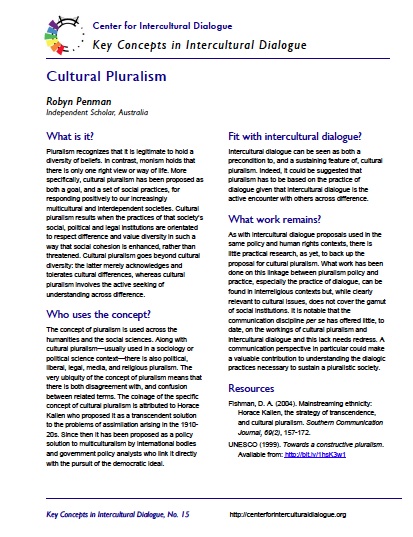
Key Concepts #15: Cultural Pluralism by Robyn Penman

Key Concepts in ICDThe next issue of Key Concepts in intercultural Dialogue is now available. This is KC15: Cultural Pluralism by Robyn Penman. As always, all Key Concepts are available as free PDFs; just click on the thumbnail to download.Lists organized  chronologically by publication date and numberalphabetically by concept in English, and by languages into which they have been translated, are available, as is a page of acknowledgments with the names of all authors, translators, and reviewers.

kc15-sm

Penman, R. (2014). Cultural pluralism. Key Concepts in Intercultural Dialogue, 15. Available from:
https://centerforinterculturaldialogue.org/wp-content/uploads/2014/05/key-concept-cultural-pluralism.pdf

The Center for Intercultural Dialogue publishes a series of short briefs describing Key Concepts in intercultural Dialogue. Different people, working in different countries and disciplines, use different vocabulary to describe their interests, yet these terms overlap. Our goal is to provide some of the assumptions and history attached to each concept for those unfamiliar with it. As there are other concepts you would like to see included, send an email to the series editor, Wendy Leeds-Hurwitz. If there are concepts you would like to prepare, provide a brief explanation of why you think the concept is central to the study of intercultural dialogue, and why you are the obvious person to write up that concept.


Creative Commons License
This work is licensed under a Creative Commons Attribution-NonCommercial-NoDerivatives 4.0 International License.

CFP Conference on Comm and Management (Greece)

International Conference on Communication and Management (ICCM2015)
30 March-1 April 2015
Athens, Greece

The Communication Institute of Greece (COM.IN.G.) organises the International Conference on Communication and Management (ICCM2015) 30 March-1 April 2015, in Athens, Greece. The conference is under the auspices of the Department of Cultural Technology and Communication, University of the Aegean, Greece and the School of Journalism and Mass Communications, Aristotle University of Thessaloniki, Greece.

The aim of this cross-disciplinary conference is to bring together academics, students and researchers from different disciplines and cultural backgrounds, encourage them to present their work, exchange and collaborate. Academics can participate by presenting a paper, chairing a session, organising a panel, or even by being an observer.

For more information please visit the conference website or send an email to Dr. Margarita Kefalaki, President of Communication Institute of Greece.

Communication Institute of Greece (COM.IN.G.) was established as an independent academic association with the mission to become a forum, where academics and researchers – from all over the world – can meet in Athens to exchange ideas on their research and to discuss future developments in their disciplines.

Margarita Kefalaki Profile

Profiles

Dr. Margarita Kefalaki is the founder and current President of Communication Institute of Greece (COMING).

Margarita Kefalaki

She holds a Ph.D. in Cultural Communication and a Master degree in Communication from Pascal Paoli University in Corsica (France). Additionally she holds a Bachelor degree in cultural communication and organization of events from Vauban University in Nimes (Montpellier III).

Her research focuses on intercultural communication, particularly the role of music and dance to connect people and nations. Margarita is also interested in communication and its connection with media, tourism, marketing and management. Margarita has taught in several universities in Greece and France, and has published widely in academic and policy journals such Journal of ‘Business and Management Research’ and the ‘International Small Business Journal’.  Moreover, she has successfully led several intercultural projects inclluding the creation of a musical disc in three languages (Action3 of the European Program for young People of INJEP).  Margarita believes that we can better communicate through intercultural comprehension, communication, exchange and education Academics can contribute to this exchange process. This is what she is trying to achieve with the establishment of the Communication Institute of Greece and the organization of International Academic Conferences.


Work for CID:

Margarita Kefalaki wrote a guest post, Intercultural Dialogue via Organizing International Academic Conferences. She also translated KC1: Intercultural Dialogue into Greek, and has reviewed translations into Greek.

CFP Communication, Postcoloniality and Social Justice conference

Call for papers:
Communication, Postcoloniality, and Social Justice: Decolonizing Imaginations

A four-day conference: Sponsored by the Waterhouse Family Institute for the study of Communication and Society (WFI) at Villanova University, PA, 26th-29th March, 2015, Location: Villanova University (Specifics to be announced later)

Conference Organizers: Bryan Crable; Raka Shome (Biographies of organizers presented at the end of call for papers)

Keynote Speakers: Arjun Appadurai (New York University, USA), Inderpal Grewal (Yale University, USA), and Ravi Sundaram (Center for the Study of Developing Societies, India)

Plenary Speakers: Ramesh Srinivasan (USA); Mohan J. Dutta (Singapore); Shanti Kumar (USA), Ramaswamy Harindranath (Australia); Nitin Govil (USA); John Erni (Hong Kong); Aniko Imre (USA); Radhika Parameswaran (USA); Soyini Madison (USA); Raka Shome (USA); Boulou Ebanda De B’Beri (Canada) (These are confirmed so far; we are awaiting confirmation from other speakers.)

Three Plenary Sessions: 1) Significance of postcolonial studies for communication and media research 2) Postcolonial feminist and queer approaches 3) Postcoloniality and the Global South: Logics of Modernity beyond the West/North

In the past two decades, postcolonial theory has become increasingly influential in various spaces in the Social Sciences and Humanities. Recent communication and media scholarship has also shown some interest in postcolonial frameworks. However, there has not been a focused and sustained conversation in Communication/Media Studies in the United States and we think, even outside, that has engaged the ways in which communication and media studies, and postcolonial studies can mutually inform each other in the advancement of social justice projects. The conference emerges from the recognition that diverse logics, networks, and trajectories of communication and media today (as well as in the past) play a significant role in the production of colonial power relations in contemporary globality.

The organizers of Communication, Postcoloniality and Social Justice: Decolonizing Imaginations thus invite proposals from scholars who employ postcolonial frameworks to study various communication and media phenomena—including their embedded-ness in various logics of transnationality. We are interested in exploring how communication/media scholarship, with its varied rich perspectives, may make contributions to broad field of postcolonial studies by foregrounding the importance of communication/media frameworks for understanding colonial cultures, and transnational relations. At the same time we recognize that many of the core concepts and assumptions in the fields of Communication and Media Studies are rooted in Western/Northern exclusionary intellectual frameworks. Thus, we wish to explore how postcolonial analytical frameworks may productively enrich our understandings of various communication and media phenomena and enable us to decolonize normative frameworks in the field so as to be responsive to various struggles engendered by contemporary (and past) post/colonial logics. The conference aims to provide a productive space that can facilitate dialogue and interconnections amongst scholars conducting postcolonial scholarship in communication and media studies. We also hope that this conference can provide a space for building intellectual solidarities amongst scholars in Media and Communication who are concerned with the politics of colonialisms (including their varied transnational logics) as they inform our research and influence our social, economic, cultural, and academic practices.

REGISTRATION FEES: $250 (includes some meals and coffee; specifics will be confirmed in fall, 2014)

FORMAT: We welcome proposals from scholars, activists, and researchers from various parts of the world. Papers must demonstrate an engagement with the field of postcolonial studies. (Just any descriptive study of colonialism, while suitable for other venues, will not fit the goals of this conference). Submissions must be made by August 30, 2014. Acceptance of papers will be announced sometime in October 2014. PLEASE EMAIL SUBMISSIONS SIMULTANEOUSLY TO: Bryan Crable and Raka Shome. In subject heading please write: “Submission for Communication, Postcoloniality and Social Justice conference.” Given the volume of submissions we expect to receive, we will not be able to acknowledge receipt of every submission.

Please choose any one format:
1) Panel proposals: Panels on a theme relevant to the conference are welcome. A panel should have between 3-4 panelists (including discussant. Chair may be one of the presenters, or you may select your own Chair/moderator who is not a presenter). Please submit title, panel abstract (which should include names/affiliation of participants, description and justification of panel). REQUIRED: 350 word panel description/justification, and approximately 200 words abstract of each paper to be presented.

2) Individual paper proposals: Please send an abstract of around 350 words. Name, paper title, and institutional affiliation must be included.

A statement of commitment to attend is required of all participants. Please include that in your proposal submissions.

Potential topics of interest are (and these are not exhaustive). Postcoloniality and the Global South; Feminist and Queer Approaches; Transgendered subjects and/in colonial cultures; Gay imperialism; Homonationalism; Heterosovereignities; Modernity beyond the West/North (Papers dealing with Islamic modernities from a postcolonial/transnational perspective especially welcome); Memor(ies) and Postcoloniality ; Diaspora (especially new logics of diaspora) and Hybridity; Media and Migrations; Post/colonial Visual cultures; Cultural Studies and the Postcolonial; Nation, nationalisms, national identity; Asylum and Exile; Colonial Necropolitics; Colonial Biopolitics; Subalternity and Communication (e.g., the ‘impossibility’ of communication in the politics of subalternity); Cosmopolitanism(s); Politics of Cultural Translation; Engagements with works of key postcolonial scholars in terms of their relevance for media/communication studies; Communication of “human rights;” Consumption, Cultural Industries, and Postcolonial/Transnational Power relations; Environment and the Postcolonial (papers on mediations of “climate change” are particularly welcome); Intellectual and Cultural Property Issues; Affective regimes and post/colonial relations; Celebrities and Colonialism; Materialities of colonialism; Fashion, Identity and Colonialisms; New Media; Postcolonial Urbanisms; Traveling technologies and colonial circuits; Techno-cities; Transnational Temporalities; Postcoloniality and computer cultures; Postcolonial Piracy; The “global” city; Technological Colonialisms; Science and the Postcolonial; Electronic Others; Postcolonial Securitizations; Politics of Representation; Global health and colonial relations; “Humanitarianism,” “Natural Disaster” and Contemporary colonial logics; Decolonizing Pedagogy and the field of Media/Communication Studies; The contemporary university and (the possibility of) postcolonial interventions.

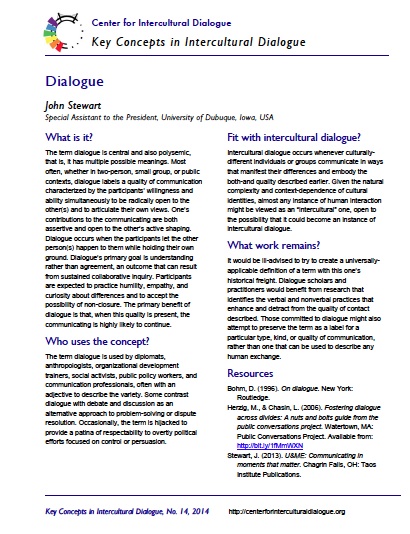
Key Concepts #14: Dialogue by John Stewart

Key Concepts in ICDThe next issue of Key Concepts in intercultural Dialogue is now available. This is KC14: Dialogue by John Stewart. As always, all Key Concepts are available as free PDFs; just click on the thumbnail to download.Lists organized  chronologically by publication date and numberalphabetically by concept in English, and by languages into which they have been translated, are available, as is a page of acknowledgments with the names of all authors, translators, and reviewers.

kc14-smStewart, J. (2014). Dialogue. Key Concepts in Intercultural Dialogue, 14. Available from:
https://centerforinterculturaldialogue.org/wp-content/uploads/2014/05/key-concept-dialogue.pdf

The Center for Intercultural Dialogue publishes a series of short briefs describing Key Concepts in intercultural Dialogue. Different people, working in different countries and disciplines, use different vocabulary to describe their interests, yet these terms overlap. Our goal is to provide some of the assumptions and history attached to each concept for those unfamiliar with it. As there are other concepts you would like to see included, send an email to the series editor, Wendy Leeds-Hurwitz. If there are concepts you would like to prepare, provide a brief explanation of why you think the concept is central to the study of intercultural dialogue, and why you are the obvious person to write up that concept.


Creative Commons License

This work is licensed under a Creative Commons Attribution-NonCommercial-NoDerivatives 4.0 International License.

Rosanne Teniente Micro Grant Award

Teniente

Rosanne Teniente has been awarded a micro grant for international travel, funded by the Association for Business Communication through the Center for Intercultural Dialogue. The following is her description of herself and the project. You can also read the main article describing all award winners.

I am a Rhode Island native who has been transplanted around the world. As an undergraduate at Simmons College in Boston, MA, I studied economics and international relations, focusing on development economics and Middle Eastern politics.  After my undergraduate studies, I moved to Egypt for several years as a Gilman Scholar at the American University in Cairo studying Arabic and interned with the US Foreign Commercial Service, and then worked as an English instructor at an international school.  I am now a master’s candidate in the public administration program at Northeastern University, while working in the field of social services.  I currently reside in Southwest New Mexico with my husband who is serving in the US Air Force.  I embrace new adventures, foreign languages, and cross-cultural learning experiences.

With the support of the CID grant as well as Northeastern University, I will be traveling to Baar, Switzerland to attend a ten-day conference in August hosted by the Institute for Peace and Dialogue, a nongovernment organization that is dedicated to strengthening institutional dialogue between civil societies, international peace and state institutions. The conference is IPD’s International Summer Academy in Peace-building & Intercultural Dialogue, which will feature experts and practitioners in the field of conflict resolution and peace building. Through different workshops, lectures, interactive group work, and negotiation activities, the knowledge gleaned with help me to build upon my past empirical research on the effect of conflict on GDP per capita in developing countries.


September 2014: This project is now complete, and Teniente’s final report is now available.

Inga Milevica – Micro grant award

MilevicaInga Milevica has been awarded a micro grant for international travel, funded by the Association for Business Communication through the Center for Intercultural Dialogue. The following is her description of herself and the project. You can also read the main article describing all award winners.


Dr. Inga Milevica is a researcher and teacher in Latvia, author of more than 90 scientific papers. Her main research interests are: gender communication, business communication, mass communication and translation problems, in particular, problems of translation in films. Milevica has been working at Alberta College since 2008 in all its fields of study: Legal foundation of the business, Entertainment management and production, Cultural tourism management, Marketing and marketings innovations, Staff work organization, Business accountancy and taxes, Information technology, Game development, Economics and organization of small companies and Public relations. She teaches the following courses: Rhetoric and Presentation Skills, Introduction into Communication Theory, Corporate Culture, Business Communication and professional Ethics, Stylistics and Culture of Latvian Language.

The first and the main scientific-practical task of the project is to participate in the international forum and represent one of the private colleges of Latvia – Alberta College. The international forum “Socio-Cultural and Linguistic Aspects in Educational and Scientific Context” will take place in Kyoto (Japan) in Kyoto Sangyo University, September 25-29, 2014. The paper “Naive Argumentation of Authority” is being prepared for the section Intercultural Aspects in Pedagogical Activity. There will be basic peculiarities of the argumentation and especially of an argument authority discussed in the paper, based on the verbal and written discourse of the students.

The second task deals with methodical planning. The partners of the forum are such famous and respected educational institutions of the world as Kyoto Sangyo University (Kyoto, Japan), Middlebury College (Vermont, USA), University of Bologna (Bologna, Italy), Sangmyung University of South Korea (Cheonan, South Korea), Almaty Institute of Power and Communication (Alamty, Republic of Kazakhstan), International Centre of Scientific-Educational Platform of Interaction of Cultures (Yekaterinburg, Russia), Institute of Foreign Languages and Multimedia at University of Greifswald (Greifswald, Federal Republic of Germany). The author intends to discuss with the representatives of the universities possibilities of the programme Erasmus+, which starting from 2014 will expand both geography of the trips and scientific and educational profiles, both for the students and teaching staff.

In addition, this project will help to perfect practical knowledge about the distinctive culture of Japan. For example, such important categories for successful communication and overcoming potential barriers as time (monochrome or polychrome perception) and place (public or private – and to what extent) should be felt already on the airplane, in the hotel, on the streets, at the university, etc., and such a category as argumentation (linear or holistic) also can and must be experienced in real communication.

ABC Micro Grants Awarded

Three scholars have been awarded micro grants for international travel related to research, funded by the Association for Business Communication, in spring 2014. Brief descriptions of the award winners and their projects are below; click on the name of the grant winners for further details. After each project is completed, a link to a report will be posted to the CID website as well.


MilevicaInga Milevica, who teaches at Alberta College in Latvia, will travel to Kyoto, Japan, to connect with colleagues from the Ukraine as well as Japan, working on the topic of the naive argument of authority.

October 2014: Milevica’s report of her activities is now available.


Olena ZelikovskaOlena Zelikovska, who teaches at the National University of Life and Environmental Sciences of Ukraine, will travel to California State University of Los Angeles, working on the topic of intercultural competence.


TenienteRosanne Teniente, a graduate student at Northeastern University, will travel to participate in the Institute for Peace and Dialogue, in Switzerland.

September 2014: Teniente’s report of her activities is now available.