CFP Intercultural Education in an Age of Information & Disinformation (Israel)

ConferencesCall for papers, IAIE 2020: Intercultural Education in an Age of Information and Disinformation Conference, The Kibbutzim College of Education & The MOFET Institute, Tel Aviv, Israel, June 27-30, 2021. Deadline: October 25, 2020. (Extended to November 1, 2020 due to technical difficulties)

The recent outbreak of the COVID-19 pandemic has brought new challenges and rapid changes, which have initiated extensive discussion on key social and educational concepts, such as, racism, equity, nationality, empathy, diversity, and technology. These concepts form a basis for discourse on their role in intercultural education.

In this conference, participants will discuss a variety of topics relevant to the new global situation, among other intercultural topics. The conference includes the following strands:
• Peace Education
• Cooperative and Collaborative Learning in Multicultural Settings
• Using Assistive Technology to Promote Universal Design for Learning in an Inclusive Learning Environment
• Language Awareness
• Educational Assessment Suitable for the Multicultural Era of the 21st Century
• History Education and Multiculturality
• Democracy and Mutual Life
• Technology to Promote Globalization & Intercultural Education
• Intercultural Competence: Policies and Innovative Practices
• Empathy & Gender
• Diverse Academia
• Ecohumanism and the Challenges of Cultural and Environmental Sustainability
• Religious Education, Immigration and Interreligious Education

Sasho Ognenovski Profile

ProfilesSasho Ognenovski (Ph.D.) is a Communicologist, writer, and theater director. He is President of PERUN ARTIS, an Association for Art and Multiculturalism, in Bitola, North Macedonia.

Sasho Ognenovski

His primary interest is in the multicultural landscape and environments, especially researching the so-called “invisible nations,” that is, those communities without a nation-state, displaced around the world. His doctoral research was in Public Relations.His professional career can be divided into two streams: artistic and scientific. Sasho is a writer and translator with five poetry collections (a sixth in production), four children’s plays staged in theatres in Macedonia, two plays for adults, of which one has been translated and published in the USA, and one novel (published in 2019), with a second in production. He also translates between English, Serbian, and Bulgarian.

In addition to PERUN ARTIS, he is chief editor of Literary Elements, a literary magazine dedicated to the world contemporary literature, produced in Macedonian in hard copy format; next year he expects to produce an electronic version in English.

Sasho earned his M.A. from the Institute of Sociological, Political and Juridical research in Skopje, and his Ph.D. from the Institute for Media and Communications of the Faculty of Law “Iustinianus Primus” in the University of Ss. Cyril and Methodius, in Skopje, North Macedonia. He worked as an assistant in the Pedagogical Faculty in Bitola, and as a professor in the Slavic University “G. R. Derzhavin,” also in Bitola. As a scientist, he attended numerous congresses, conferences, and symposia dedicated to multiculturalism around the world, including Gothenburg, Oslo, Milan, Sofia, Belgrade, and London. He has collaborated with societies and foundations such as SIETAR, NIC, and SPARK. He has had short study visits at York University in Toronto, Canada, and The University of Santiago del Compostela, Spain. He has published in multiple scientific journals in North Macedonia and abroad. In the field of Communication and Media, he has written articles connecting theatre as a medium with other types of media. He writes literary, film, and theatre reviews for Macedonian and Serbian magazines and portals, and he is a member of ITI (International Theatre Institute) and to IACT (International Association of Theatre Critics). He’s also a member of the Macedonian Scientific Association in Bitola.

Partial listing of publications and conference papers:

Ognenovski, S. (2019). The Ransom Riggs’ trilogy of the peculiar children as a hybrid of realism and fantasticsThe Childhood, International Center for Literature for Children Zmaj’s Children Games, Novi Sad, Serbia, ISSN 0350-5286

Ognenovski, S. (2019). Children’s creative reception of a theatre play: The contribution to the preschool education in the achieving of the goals in the education. The College for Preschool Educators, Aleksinac, Serbia, ISBN 978-86-7746-755-5

Ognenovski, S. (2018). Multiculturalism and Macedonian cinematography. SIETAR, Fondazione Intercultura Onlus, Milan, Italy, ISBN 978-88-942887-1-1.

Ognenovski, S. (2017). The migrating movements and the multicultural landscape in the post-communist countries. Annual of Institute of Sociological, Political and Juridical Research, 41(2).

Ognenovski, S. (1999). Paralinguism in the theater and international theater festivals. Journal of Intercultural Communications.


Work for CID:
Sasha Ognenovski has reviewed translations into Macedonian.

Harvard U: Postdocs in Migration and the Humanities (USA)

PostdocsPostdoctoral Fellowships in connection with the Center’s Andrew W. Mellon Foundation seminar on the topic of migration and the humanities for 2021-22, Mahindra Humanities Center, Harvard University, Cambridge, MA, USA. Deadline: November 6, 2020.

Migration plays as critical a role in the moral imagination of the humanities as it does in shaping the activist vision of humanitarianism and human rights. Too often, the humanities are summoned merely as witnesses whose primary aesthetic and moral values lie in their illustrative powers of empathy and evocation. Yet the intellectual formation of the humanities—their very conception of the nature of meaning, knowledge, and morals—is deeply resonant with the displacement of values and the revision of norms that shape narratives of migrant lives.

MHC welcomes applications from scholars in all fields whose work innovatively engages with migration and the humanities. In addition to pursuing their own research projects, fellows will be core participants in the bi-weekly seminar meetings for both academic terms of the fellowship. Other participants will include faculty and graduate students from Harvard and other universities in the region, and occasional visiting speakers.


Heriot-Watt U PhD Studentships (Scotland)

“Studentships“
PhD Studentships 2020-21 in Language and Culture, School of Social Sciences, Heriot-Watt University, Edinburgh, Scotland, UK. Deadline: 10 September 2020.

Heriot-Watt University’s School of Social Sciences is offering a number of full-time PhD studentships in the area of language and culture to start in January 2021. Studentships include a tuition fee waiver and an annual stipend currently set at £15,285 for the academic year 2020-21. The duration of the studentships is three years. The School of Social Sciences also offers a research support allowance of £2,250 over the registered period of study. In addition, full-time scholarship holders are normally offered an opportunity to undertake a modest amount of paid teaching support each academic year. The School consists of the Department of Languages & Intercultural Studies, the Department of Psychology, and Edinburgh Business School. Research in language and culture is based around the Centre for Translating and Interpreting Studies and the Intercultural Research Centre.

Projects in areas related to language and culture include Translating global heritage: people, space, and memory.

CFP Lessons From Practice: Extensions of Current Negotiation Theory and Research

“PublicationCall for Papers: Lessons From Practice: Extensions of Current Negotiation Theory and Research, for special issue of Negotiation and Conflict Management Research. Deadline for proposals: October 15, 2020.

Special Issue Editors: Jimena Ramirez Marin, IESEG School of Business; Daniel Druckman, George Mason University, Macquarie University, University of Queensland; William Donohue, Michigan State University.

Practice can be a resource for investigating the limits of current negotiation and conflict management theories. Practice can also help academics engage in a reality-check process that contributes to our understanding of the phenomenon. This issue is intended to bring various types of practices closer to ongoing and planned research. The call for papers is focused on contributions from practice to current negotiation/ conflict management theory and research as well as from research to practice. Collaborations between researchers and practitioners are strongly recommended.

KC73 Argumentative Dialogue Translated into Hungarian

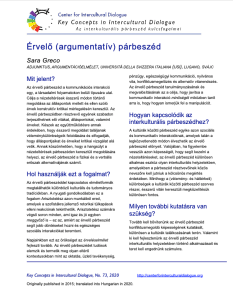
Key Concepts in ICDContinuing translations of Key Concepts in Intercultural Dialogue, today I am posting KC#73: Argumentative Dialogue, which which Sara Greco wrote in English for publication in 2015, and  which Katalin Egri Ku-Mesu has now translated into Hungarian.

As always, all Key Concepts are available as free PDFs; just click on the thumbnail to download. Lists of Key Concepts organized alphabetically by conceptchronologically by publication date and number, and by languages into which they have been translated, are available, as is a page of acknowledgments with the names of all authors, translators, and reviewers.

KC73 Argumentative Dialogue_Hungarian

Greco, S. (2020). Érvelő (argumentatív) párbeszéd. (K. Egri Ku-Mesu, Trans.). Key Concepts in Intercultural Dialogue, 73. Available from:
https://centerforinterculturaldialogue.org/wp-content/uploads/2020/07/kc73-argumentative-dialogue_hungarian.pdf

If you are interested in translating one of the Key Concepts, please contact me for approval first because dozens are currently in process. As always, if there is a concept you think should be written up as one of the Key Concepts, whether in English or any other language, propose it. If you are new to CID, please provide a brief resume. This opportunity is open to masters students and above, on the assumption that some familiarity with academic conventions generally, and discussion of intercultural dialogue specifically, are useful.

Wendy Leeds-Hurwitz, Director
Center for Intercultural Dialogue


Creative Commons License
This work is licensed under a Creative Commons Attribution-NonCommercial-NoDerivatives 4.0 International License.

CFP PeaceCon 2020: Pandemics, Peace and Justice (Online)

EventsCall for proposals: PeaceCon 2020: Pandemics, Peace and Justice: Shaping What Comes Next, To be held online, December 7-9, 2020. Deadline: September 13, 2020.

In partnership with the United States Institute of Peace (USIP), the Alliance for Peacebuilding is proud to announce the theme for PeaceCon 2020, Pandemics, Peace and Justice: Shaping What Comes Next, taking place virtually, December 7-9. In the midst of a global pandemic, rising global violence, and a national and worldwide reckoning over systemic injustice and racism, PeaceCon 2020 will bring together experts and practitioners to consider the interplay of justice and peacebuilding, and strategies to elevate and integrate peacebuilding in our collective effort to shape a more just, secure and peaceful future in the wake of the COVID-19 pandemic.

Recognizing the challenges to international travel and large group gatherings this year, PeaceCon 2020 will take place entirely online, from December 7-9, 2020. Peacebuilders from across the world will be invited to share their ideas for interactive sessions, workshops, or other creative online formats, with an emphasis on moving beyond the traditional format of long panel presentations followed by-brief audience question-and-answers. Organizers seek submissions for interactive panels, ignite talks, workshops, and networking sessions with diverse institutional affiliations and speaker backgrounds. Online sessions will be designed to stimulate discussion and audience participation, with opportunities for engagement in the weeks leading up to PeaceCon and in the year to follow.

CFP e-Sociolinguistics Symposium (Hong Kong but online)

ConferencesCall for papers, e-Sociolinguistics Symposium 23: Unsettling Language, University of Hong Kong, Hong Kong, 7–10 June 2021. Deadline for abstracts: 30 September, 2020.

The theme of the conference is Unsettling Language. The contemporary world is an unsettled place due to the COVID-19 pandemic, numerous conflict zones, forced migration, economic imbalances and uncertainties, as well as ideological extremism resulting in (or caused by) unsettling language emanating from powerful people, political organizations, and the media. As a form of social action, this sort of language requires serious, critical consideration, assessment and counter-action. Furthermore, the notion of ‘language’ itself is undergoing a critical reassessment in how it is being theorized. Language is increasingly understood as more than ‘just’ a set of linguistic resources. Its embodied nature, the materiality of its modalities (speech, writing, sign, gesture, touch, silence), interaction with other modalities (sound, music, images, etc.), and with time and space, requires integration of broader contexts of analysis, multimodal data sets, and multidisciplinary approaches. We invite abstracts addressing the conference theme as well as other contributions focusing on current and innovative themes and theoretical challenges.

KC98 Essentialism

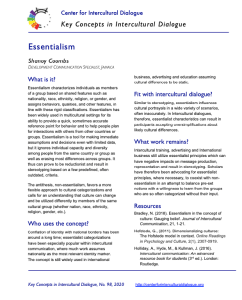
Key Concepts in ICDThe next issue of Key Concepts in intercultural Dialogue is now available. This is KC#98: Essentialism, by Shanoy Coombs. Click on the thumbnail to download the PDF. Lists organized chronologically by publication date and numberalphabetically by concept in English, and by languages into which they have been translated, are available, as is a page of acknowledgments with the names of all authors, translators, and reviewers.

KC98 Essentialism

Coombs, S. (2020). Essentialism. Key Concepts in Intercultural Dialogue, 98. Available from:
https://centerforinterculturaldialogue.org/wp-content/uploads/2020/07/kc98-essentialism.pdf

The Center for Intercultural Dialogue publishes a series of short briefs describing Key Concepts in Intercultural Dialogue. Different people, working in different countries and disciplines, use different vocabulary to describe their interests, yet these terms overlap. Our goal is to provide some of the assumptions and history attached to each concept for those unfamiliar with it. As there are other concepts you would like to see included, send an email to the series editor, Wendy Leeds-Hurwitz. If there are concepts you would like to prepare, provide a brief explanation of why you think the concept is central to the study of intercultural dialogue, and why you are the obvious person to write up that concept.


Creative Commons License
This work is licensed under a Creative Commons Attribution-NonCommercial-NoDerivatives 4.0 International License.

VID Specialized U: Researcher in Migration/Diversity (Norway)

“Job

Senior Researcher at Centre for Intercultural Communication, VID Specialized University, Stavanger, Norway. Deadline: 10 September 2020.

Centre for Intercultural Communication (SIK) at VID Specialized University in Stavanger, Norway, is looking for a senior researcher in a full-time permanent position within the fields of migration and diversity. The position includes participation in ongoing projects, development and management of new projects, and some supervision and teaching. You will participate in ongoing projects at the Centre. The current project portfolio in the areas of migration and diversity primarily deals with labour market integration among newly arrived refugees and intercultural competence among public service providers. You will initiate and lead major research projects funded by, for example, the Research Council of Norway, the European Research Council (ERC) and/or Horizon Europe. You will be expected to participate in the development of the Centre’s research strategies and encourage research colleagues to develop new and innovative projects that cover a wide range of topics related to migration, diversity and civil society development. Some teaching, supervision of junior researchers and administrative work must be expected. You will be a member of the Migration, Religion and Intercultural Relations (MIGREL) research group at VID. Knowledge of Norwegian will weigh in your favour, but is not a requirement for the position.