Stories of Home VR: Immigrant & Refugee Voices (USA but Online)

EventsStories of Home VR: Immigrant and Refugee Voices, StoryCenter, Berkeley, CA, USA (Online), June 11, 2021, 8-9pm GMT.

Pull up a chair and bring along your favorite Friday afternoon snacks as you join StoryCenter for a FREE, one-hour online screening of new immersive media work from Stories of Home VR. Artist-in-Residence Parul Wadhwa has been hard at work during the pandemic, collaborating with three women to document their material memories of home through virtual reality (VR) filmmaking techniques.

Help organizers honor these unique voices as World Refugee Day approaches (June 20). The event will also feature short interviews with the storytellers, captured in partnership with the California Film Institute, and a Q&A with Parul on the value of VR for enhancing wellbeing and building community and compassion.

At the event, the stories will be shown as 360 videos, but after you register, organizers will send you the information you will need to view them on the Oculus Store, if you have a VR headset.

IOM: International Careers for a Social Purpose (Online Job Fair)

“Job

International Organization for Migration (IOM), United Nations, is holding an online job fair, June 3, 2021.


IOM writes: “We are constantly looking for professionals with a wide variety of skills and educational backgrounds. For example: finance and budget, human resourced management, procurement and logistics, health professionals, information technology, project management, legal experts, monitoring and evaluation, communications, migration and border management, fundraising and many more; to work in our more than 400 offices located around the world.

Professionals from any nationality can apply to our positions, but we are especially interested in having applicants from our non-Represented Member States. IOM takes care of all work permit formalities once a candidate is selected for an international position. You can find all open vacancies here and we invite you to check back as every Friday more vacancies are published. Our event will be open for 8 hours straight in order to accommodate various time zones. We look forward to meeting you.”

The International Organization for Migration (IOM) is the UN entity charged with supporting governments and migrants worldwide, to ensure safe and orderly migration. 

CFP Geoculture & Geopolitics

“PublicationCall for proposals: Geoculture and geopolitics: What interplay for soft power inter-communication(s) in a globalized world? special issue of Arab Journal of International Law. Deadline: June 1, 2021 (for working title & intention only).

Historically, cultural ideologies in world communication and public relations have usually bred their own undoing. Indeed, cultural factors and dimensions are resorted to explain emerging political and economic emerging phenomena. It is high time culture were brought into international studies. Generally, international relations (IRs) were envisaged through two models – notably geopolitics and geoeconomics. However, as the international society is marked by the cultural turn in the politics of international and inter- civilizational relations (Tibi, 2012 & Petito, 2009), IRs are approached from a third prism – geoculture. Geoculture is a new emerging paradigm that addresses the influence of culture or, more broadly, civilization in shaping the cultural and political discourses of intercultural and international relations.

Papers may be submitted in English, French, or Arabic.

Aspen Institute: Community Manager for Weave (USA)

“JobCommunity Manager, Weave: The Social Fabric Project, Aspen Institute, Washington, DC. Deadline: Open until filled.

Weave’s Community Manager helps lead one of three strategic pillars: Connecting and Supporting Weavers through peer support, learning, links to resources and opportunities for collaboration. Weave connect Weavers through an online community platform, in-person and virtual gatherings, our website, newsletter and social media. Weavers receive support, training, ideas and a sense of belonging and purpose through our work.

Weave seeks an experienced relationship manager who understands the demands of setting a content strategy, overseeing an online platform such as Jive or Hoopla, inspiring high engagement and adjusting tactics to meet the changing needs of a community. This position will deputize and support superusers to engage others as the community grows. The Community Manager oversees the Community Associate, several Community Facilitators (part-time super-users) and interns, as needed.

Weave: The Social Fabric Project was started by columnist David Brooks and the Aspen Institute in May of 2018 to counter a culture of hyper-individualism in the US that has left Americans divided, isolated and unhappy. This crisis of connection and decline in social trust has led to rising rates of addiction and suicide, persistent inequality and discrimination, and gridlocked politics. Yet in every community, some people have chosen to weave the social fabric by investing in relationships, making commitments to others and creating connection. These “Weavers” are all different. Some work at a suicide hotline, a mentoring program or in schools. Others run a coffee shop where everybody feels at home. Still others just gather neighbors to talk or stop to listen when they see someone distraught. They lead with love, creating countercultural islands where connection and community are more important than ego and self. You will find their stories at WeAreWeavers.org.

Aarhus U: Intercultural Studies & Literature (Denmark)

“JobAssistant/Associate Professor of Intercultural Studies and Literature and/or History and Society, Department of English,  Aarhus University, Aarhus, Denmark. Deadline: 10 June 2021.

The School of Communication and Culture at Aarhus University invites applications for the position of either tenure-track assistant professor or tenured associate professor of intercultural studies and literature and/or history and society, with an emphasis on English-language texts and contexts, based at the Department of English. The tenure-track assistant professorship begins with a full-time, fixed-term, five-year appointment as assistant professor with a view to permanent employment as associate professor. The associate professorship is full-time and tenured. The department’s research covers literature, social/historical/media studies, linguistics and regions in which English is the primary language, as well as English as the global language of international business communication.

Summer School: Language Diversity, Education, Social Participation (Germany)

Study AbroadLanguage diversity, education, and social participation, Hamburg International Summer School, Germany (but virtual). July 5-30, 2021. Deadline: open until all spaces filled.

The program consists of four modules:

  • Key issues in multilingualism
  • Language development and education in multilingual settings
  • Language diversity in formal and informal settings
  • Multilingual learning motivation in a foreign language context

Linguistic (as well as cultural and social) diversity are basic characteristics of today’s societies. Their causes include, among others, increasing migration, globalisation, new technical possibilities of communication, and interactions across traditional borders. Using three nations with significant migration – Australia, China and Germany – as examples, we will explore how increasing diversity affects education and social participation, and what policies and discourses have been developed in response to linguistic diversity. Despite their different socio-political traditions in dealing with migration, the challenges and responses to linguistic diversity in the three countries share many similarities. Central among these is that linguistic diversity continues to be a central factor in social exclusion in the three countries.

The Summer School is suitable for graduate students and will be taught by a group of academics from Hamburg University (Germany), Macquarie University (Australia), Fudan University (China), and several other Asian, European, and North American universities. The fee of Euro200 also includes one week of German language lessons! Discounts are available for students from partner universities, and scholarships for students from low-income countries.

KC1 Intercultural Dialogue Translated into French

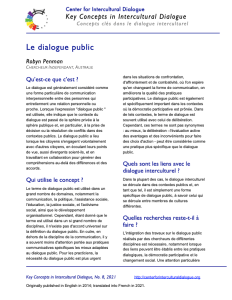
Key Concepts in ICDContinuing translations of Key Concepts in Intercultural Dialogue, today I am posting KC#1: Intercultural Dialogue, which I wrote for publication in English in 2014, and which Mohammed Guamguami has now translated into French.

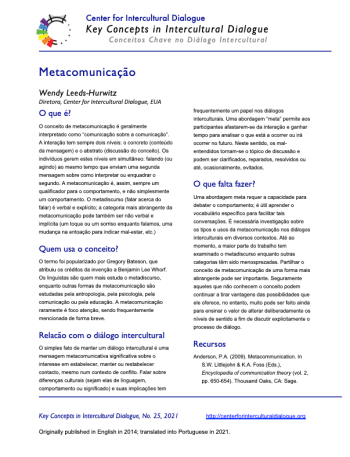
As always, all Key Concepts are available as free PDFs; just click on the thumbnail to download. Lists of Key Concepts organized chronologically by publication date and number, alphabetically by concept, and by languages into which they have been translated, are available, as is a page of acknowledgments with the names of all authors, translators, and reviewers.
 

KC1 Intercultural Dialogue_FrenchLeeds-Hurwitz, W. (2021). Le dialogue interculturel. (M. Guamguami, trans). Key Concepts in Intercultural Dialogue, 1. Available from:
https://centerforinterculturaldialogue.org/wp-content/uploads/2021/05/kc1-intercultural-dialogue_french.pdf

If you are interested in translating one of the Key Concepts, please contact me for approval first because dozens are currently in process. As always, if there is a concept you think should be written up as one of the Key Concepts, whether in English or any other language, propose it. If you are new to CID, please provide a brief resume. This opportunity is open to masters students and above, on the assumption that some familiarity with academic conventions generally, and discussion of intercultural dialogue specifically, are useful.

Wendy Leeds-Hurwitz, Director
Center for Intercultural Dialogue


Creative Commons License
This work is licensed under a Creative Commons Attribution-NonCommercial-NoDerivatives 4.0 International License.
UNESCO: Art-Lab for Human Rights & Dialogue (Online)

“UNESCO”Art-Lab for Human Rights and Dialogue, for World Day for Cultural Diversity for Dialogue and Development, UNESCO and Office of the High Commissioner for Human Rights (webinar),  22 May 2020.

Five “artivists”, artists/activists, will share with the audience how they adapted, in light of Covid-19, their strategies to reach out to the most vulnerable, who are also, most often, the most invisible. Moreover, they will explain how the pandemic has uncovered human and social realities that we can no longer afford to avoid in the post Covid-19 era.

Art-Lab places human rights and dignity at the centre of sustainable development where cultural diversity and dialogue play a fundamental role. In particular, it strives to mainstream artistic and cultural programmes to reposition the central issue of human rights for policy-actors and to support vulnerable communities in the advancement of their human rights and dignity, by providing them with the necessary resistance resources through the Arts.

The webinar aims to shed light on the important role of art and culture as a tool for Dialogue and Development within a context where economic, social and cultural gaps are growing in parallel with the pandemic – echoing #ArtConnects and #ResiliArt, UNESCO’s recent social media campaign shedding light on the resilience of artists during the pandemic.

Held every year on 21 May, the World Day for Cultural Diversity for Dialogue and Development celebrates not only the richness of the world’s cultures, but also the essential role of intercultural dialogue for achieving peace and sustainable development. The United Nations General Assembly first declared this World Day in 2002, following UNESCO’s adoption of the 2001 Universal Declaration on Cultural Diversity, recognizing the need to “enhance the potential of culture as a means of achieving prosperity, sustainable development and global peaceful coexistence.”

Intercultural Achievement Awards 2021 (Austria)

AwardsCall for nominations: Intercultural Achievement Awards, Federal Ministry for European and International Affairs, Vienna, Austria. Deadline: 6 June 2021.

The Intercultural Achievement Award (IAA) is a key project for intercultural dialogue of the Austrian Federal Ministry for European and International Affairs. The award honours successful and innovative projects in the field of intercultural and interreligious dialogue, both in Austria and on a global scale. The award is open to all those who identify and make use of opportunities which positively shape intercultural co-existence. It also rewards those who successfully break new ground in intercultural dialogue, who have mastered a specific challenge through intercultural action, and who promote the dialogue of cultures and religions through their media presence.

Organizers are looking for both large and small projects implemented by organisations or individuals. The IAA specifically promotes intercultural and inter religious projects in the fields of Arts/Culture, Youth, Human Rights, Global Citizenship Education and Integration. The projects need to be either in the process of being implemented or already completed.  Applications are open to both non-profit organizations and commercial organisations. Individuals from civil society can also participate.

UNESCO: Concrete Experiences for Transformational Change

“UNESCO”

Report Addendum: Concrete Experiences for Transformational Change, CID Focus Groups for the UNESCO Futures of Education Initiative, May 2021.

CID Focus Groups report for UNESCOIn January, UNESCO invited the Center for Intercultural Dialogue to participate in the Futures of Education Initiative by holding focus groups on how education needs to evolve today, in order to be more relevant tomorrow. Three sessions were convened, on January 28, 29, and 30, 2021. A report of our conclusions, framed as a response to the UNESCO document, Education in a Post-COVID World: Nine Ideas for Public Action, was submitted in February.

CID Poster 14: 10 IdeasWe proposed a tenth idea, that learning to live together requires intercultural dialogue, which was also published as CID Poster #14.

In April, UNESCO asked the Center to return to the forum group participants, this time requesting “innovative and inspiring concrete experiences to serve as good illustrations of activities and approaches that can contribute to transformational change.” Eight members of the original group were able to submit examples by the tight deadline in early May.  Thanks to the participants who were able to respond so quickly:

  • Evangelos A. Afendras (Greece/Malaysia): Stumbling on adverse realities while building a “Humaniversity” for MDG ideals: Some autoethnographic notes
  • Giovanna Carloni (Italy), Virtual exchange as a transformative process in the Global South
  • Mohammed Guamguami (Morocco): COIL education: Glocal principled innovation
  • Nazan Haydari and Onur Sesigür (Turkey): Gender and sound culture workshop in Turkey 
  • Maria Hussain (UK): Nurturing inclusive intercultural dialogue beyond borders through student-led podcasts: The case of Cultural Insight Wednesdays 
  • Sr. Teresa Joseph (India): Don Bosco: Word in the Ear
  • Maura Di Mauro (Italy): Systemic university change towards internationalisation for academia (SUCTIA) 
  • Yehuda Silverman (Canada/USA): Incorporating diversity into intrapersonal peace and conflict prevention

Constructing ICD 12One of these examples has already been published as Constructing Intercultural Dialogues #12, and several others are in preparation as further publications on this site.