CFP: Korean American Communication Association (USA)

ConferencesCall for proposals: Korean American Communication Association, University of Hawaiʻi at Mānoa, Honolulu, Hawaiʻi, 2-5 January 2026. Deadline: 31 August 2025.

Organizers welcome high-quality papers that offer valuable implications for the broader scholarly community both within and beyond the Korean communication context. Areas of interest include, but are not limited to: advertising, cultural studies, interpersonal and organizational communication, journalism, political communication, public relations, and science, health, environment and risk communication.

Submissions exploring Korea-related communication contexts are particularly encouraged and will be prioritized, provided they meet the conference’s quality standards.

You do not need to be a member of the KACA to submit a completed paper or extended abstract. However, if your paper or extended abstract is accepted, you must (1) be a member of the KACA, (2) register for the conference, and (3) attend the conference to present your research.

Munich School of Philosophy: Ethics of Intercultural Dialogue Certificate (Germany)

Graduate StudyEthics of Intercultural Dialogue Programme
at the Munich School of Philosophy (HFPH)
, Munich, Germany. Application deadline: 15 July 2025.

What is right and wrong in a globalised world? Which values matter in culturally diverse societies? The part-time certificate programme Ethics of Intercultural Dialogue focuses on the ethical challenges professionals encounter in today’s interconnected world. Entirely online and taught in English, this graduate-level programme offers a solid ethical foundation, political-philosophical insight, and practice-oriented knowledge – ideal for professionals looking to deepen their skills and reflect critically on their work in international and intercultural contexts. What makes this programme truly unique is its embodiment of interculturality, bringing together individuals from various countries, religions, and cultures to engage in meaningful dialogue and shared learning experiences.

📌 Key Facts
Offered by: Munich School of Philosophy & Jesuit Worldwide Learning
Programme type: Graduate certificate (36 ECTS), fully online, in English
Start: October 2025
Application deadline: 15 July 2025 (if places remain, late applications will be accepted in September)
Tuition fees: €2,880 + approx. €240 per semester in administrative fees
Scholarships: Four full scholarships available (details at hfph.de/eid)

🔗 Learn more and apply: hfph.de/eid
📩 Contact the programme team

French Institutes for Advanced Study: Fellowships 2026-27 (France)

Fellowships

Fellowships in 2026-2027, French Institutes for Advanced Study, seven locations in France. Deadline: 16 July 2025.

The French Institutes for Advanced Study Fellowship Programme (FIAS-FP) offers 10-month fellowships in the seven Institutes of Aix-Marseille, Loire Valley (Orléans-Tours), Lyon, Montpellier, Nantes, Paris and Rennes. It welcomes applications from high-level international scholars to develop their innovative research projects in France. For the 2026-2027 academic year, FIAS offers 28 fellowships of 10 months: 7 in Aix-Marseille, 2 in Loire Valley (Orléans-Tours), 3 in Lyon, 2 in Montpellier, 4 in Nantes, 7 in Paris and 3 in Cergy.

This call is open to all disciplines in the social sciences and the humanities (SSH) and to all other research fields interfacing with the SSH. Applicants are strongly encouraged to consult the webpages of the host Institutes for Advanced Study (IAS) to learn more about their specific scientific priorities, areas of focus, and institutional partners, as these should be carefully considered before applying.

FIAS Fellows will benefit from the support and stimulating scientific environment offered by the IAS, characterized by a multidisciplinary cohort of fellows and strong connections to local research centers and laboratories. They will be free to organize their work and conduct research according to their own priorities and interests.

FIAS awards fellowships to outstanding researchers of all career levels, from postdoctoral researchers to senior scientists. The minimum requirement is a PhD + 2 years of research experience at the time of the application (PhD training period will not be considered in the calculation of experience). Researchers from all countries are eligible to the FIAS Fellowship Programme but they must have spent no more than 12 months in France during the three years prior to the application deadline.

CFP: Global Diaspora and Social Media

“Publication

Call for submissions: Global Diaspora and Social Media, a special issue of Online Media and Global Communication. Deadline: 4 August 2025 (deadline extended to 30 September 2025).

Editors of the Special Issue:
Xi Cui (College of Charleston, USA)
Sumin Zhao (Edinburgh University, UK)

“Social media platforms play an essential role in the formation and maintenance of global diaspora communities, enabling dispersed members to maintain cross-border connections, negotiate collective identities, and mobilize around shared meanings and histories. This special issue builds upon foundational scholarship on digital diasporas while advancing new theoretical frameworks to understand contemporary social media practices among diaspora communities. We seek research that critically examines how social media mediates diasporic experiences through identity construction, political participation, language and culture preservation, and transnational social and economic exchanges. We encourage submissions that theorize the evolving relationship between social media and diaspora engagement in an era of platformization and rising anti-globalization sentiment and geopolitical tensions worldwide.

We are also interested in research exploring personal experiences of diaspora members, including the negotiation of ‘old’ and ‘new’ identities, emotional responses to separation and reunion, psychological well-being, and everyday social media practices. Studies investigating how emotions like nostalgia, hope, and belonging are articulated through social media, as well as research on how different platforms shape cognition and memory among diaspora individuals, will make valuable contributions.

The special issue aims to cover diverse methodological approaches that capture the complexity of diaspora social media communication, including (digital) ethnography, (critical) discourse analysis, quantitative survey, content analysis, as well as research utilizing computational tools. We particularly welcome mixed-methods research that combines these approaches to provide multidimensional perspectives on how social media is transforming diaspora experiences in transnational contexts. We also encourage works that explore diaspora communities that are understudied and underrepresented in current literature.”

KC103 Geoculture Translated into Simplified Chinese

Key Concepts in ICD

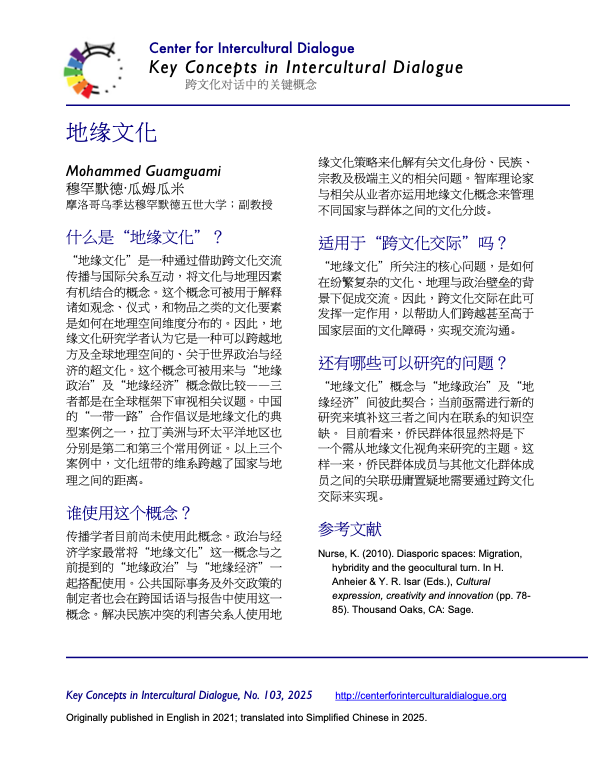
Continuing translations of Key Concepts in Intercultural Dialogue, today I am posting KC#103: Geoculture, originally written by Mohammed Guamguami for publication in 2021, and now translated by Mingshi Cui into Simplified Chinese.

KC103 Geoculture_Sim Chinese

As always, all Key Concepts are available as free PDFs; just click on the thumbnail to download. Lists organized chronologically by publication date and numberalphabetically by concept in English, and by languages into which they have been translated, are available, as is a page of acknowledgments with the names of all authors, translators, and reviewers.

Guamguami, M. (2025). Geoculture [Simplified Chinese]. (M. Cui, trans). Key Concepts in Intercultural Dialogue, 103. Available from: https://centerforinterculturaldialogue.org/wp-content/uploads/2025/06/kc103-geoculture_sim-chinese.pdf

The Center for Intercultural Dialogue publishes a series of short briefs describing Key Concepts in Intercultural Dialogue. Different people, working in different countries and disciplines, use different vocabulary to describe their interests, yet these terms overlap. Our goal is to provide some of the assumptions and history attached to each concept for those unfamiliar with it. As there are other concepts you would like to see included, send an email to the series editor, Wendy Leeds-Hurwitz. If there are concepts you would like to prepare, provide a brief explanation of why you think the concept is central to the study of intercultural dialogue, and why you are the obvious person to write up that concept.


Creative Commons License
This work is licensed under a Creative Commons Attribution-NonCommercial-NoDerivatives 4.0 International License.

UNAOC: Communications Specialist (USA)

“JobCommunications Specialist, United Nations Office for Project Services, United Nations Alliance of Civilizations, New York, NY, USA. Deadline: 20 July 2025.

The United Nations Alliance of Civilizations was created to serve as a soft-power political tool of the United Nations Secretary-General for conflict prevention and conflict resolution. It is a coalition against extremist forces, a movement to advance mutual respect for cultures, traditions, and religious beliefs, and a platform to bridge divides and overcome prejudice, misconceptions, misperceptions, and polarization. The United Nations Alliance of Civilizations was intended to promote collective action in society as a means of addressing the threats that emerge from the hostile perceptions that foment violence, overcoming cultural and social barriers, reducing tensions, and improving relations between societies and communities with diverse cultural and religious backgrounds, and combatting violent extremism.

The incumbent of this position will be personnel of UNOPS under its full responsibility. Functional responsibilities will include:

  • Within assigned authority, the Communications Specialist will provide support to the Spokesperson and communication team in developing, writing and preparing written material for delivery by the High Representative and senior management and managing communications, both external and internal, between the senior management and a wide range of audiences, including media.
  • Perform day-to-day tactical communications such as social media posts, news items, letters, and informational updates, all with a view to build strong, bold, sharp and principle-based brand; works with UN departments, funds and agencies to develop ways to implement and collaborate on campaigns system-wide and to incorporate the campaign message and themes into all relevant events and products.
  • Participate in the development and implementation of assigned programme/projects in the area of communication activities.
  • Identify problems and issues to be addressed and propose corrective actions.
  • Research, analyze and present information gathered from diverse sources that could/may impact the work of UNAOC.

Osnabrück U: Postdoctoral Researcher in Reflexive Migration Research (Germany)

Postdocs

Postdoctoral Researcher in Reflexive Migration Research, Osnabrück University, Osnabrück, Germany. Deadline: 25 June 2025.

The DFG-funded Collaborative Research Centre ›Production of Migration‹ (SFB 1604) examines the conditions and functions of the social production and negotiation of migration across disciplines. The aim of SFB 1604 is to establish reflexive migration research as an approach to the study of society. SFB 1604 is located at Osnabrück University (Germany) – a university with diverse research activities that attract students and scientists from all over the world to a city with a high quality of life. The SFB 1604 is seeking to appoint a Postdoctoral Researcher (m/f/d) (Salary level E 13 TV-L, 100%). The position is to be filled as soon as possible and is initially limited to two years.

Your tasks:

  • Development and submission of a high-quality funding proposal (Heisenberg Programme (DFG), ERC Grant, Emmy Noether Programme (DFG) or comparable programmes) for a research project within the topics of the Collaborative Research Centre by mid-2026. In terms of concept and research focus, the project should be closely aligned with the Collaborative Research Centre and deepen and/or supplement its ongoing work.

  • On-site participation in the events and activities of the SFB in Osnabrück

  • Active participation in the theoretical development of the SFB and its publication projects

U Limerick PhD Studentship: ID Compression (Ireland)

“Studentships“PhD studentship in Psychology to work with the project ID-Compression, University of Limerick, Ireland. Deadline: 10 July 2025.

There are 2 studentships available for this project; the one that is most likely of interest to followers of this Center is for a PhD in Social Sciences with an interest in Social Identity.

The ERC-funded ID-COMPRESSION project explores the idea that issue-based polarization is information compressibility, where attitudes provide redundant (i.e. compressible) information about groups and identity. This framework conceptualizes people holding attitudes as a social information system where people are located by their own attitudes and can easily locate each-other in the social system from a few expressed attitudes. The more compressible the social information system, the fewer bits of information are required to locate people within it. These ideas flow from the social identity and social representations approaches to attitudes. Team members are particularly excited to explore conversion pathways where, they hypothesize, people’s willingness to adopt an idea will depend on their current location in the social information system. The PhD candidates will work as part of this team testing these ideas with secondary data, social experiments and simulations. They will particularly explore whether and how information becomes compressible when it is passed through simple social networks, whether social information compression maps to polarization (e.g. that people compress social information more in highly polarized contexts), and will experimentally test the concept of conversion pathways. Applied mathematicians in the group will develop metrics and methods for estimating compressibility, and for mapping it to other measures of polarization

Royal Roads U: Postdoc Possibilities (Canada)

Postdocs

Multiple postdoc opportunities, Royal Roads University, Victoria, BC, Canada. Deadline: 3 July 2025.

Royal Roads University (RRU) invites expressions of interest from those wishing to develop a Canada Postdoctoral Research Award (CPRA) application. CPRA award amounts of $70,000 (taxable income) per year for 2 years (non-renewable) are used to fund a postdoctoral researcher position at the university and are subject to MERCs (mandatory employment related costs). RRU seeks expressions of interest specific to a series of research topics; that most likely relevant to followers of this Center is this one:

Dr. Juana Du is seeking a postdoctoral scholar to support her research interests which include the impact of cultural awareness and assumptions on intercultural experiences; communication and intercultural adjustment of sojourners, particularly around international students and business expatriates; organizational culture, learning and knowledge sharing in multinational and multilingual organizations in different cultural and institutional contexts. Her recent research projects examine organizational identification in global virtual teams and boundary conditions, with an emphasis on the role of emerging technology, and AI literacy at the hybrid workplace.

CFP: Intercultural Competence in a Rapidly Changing World (USA & Online)

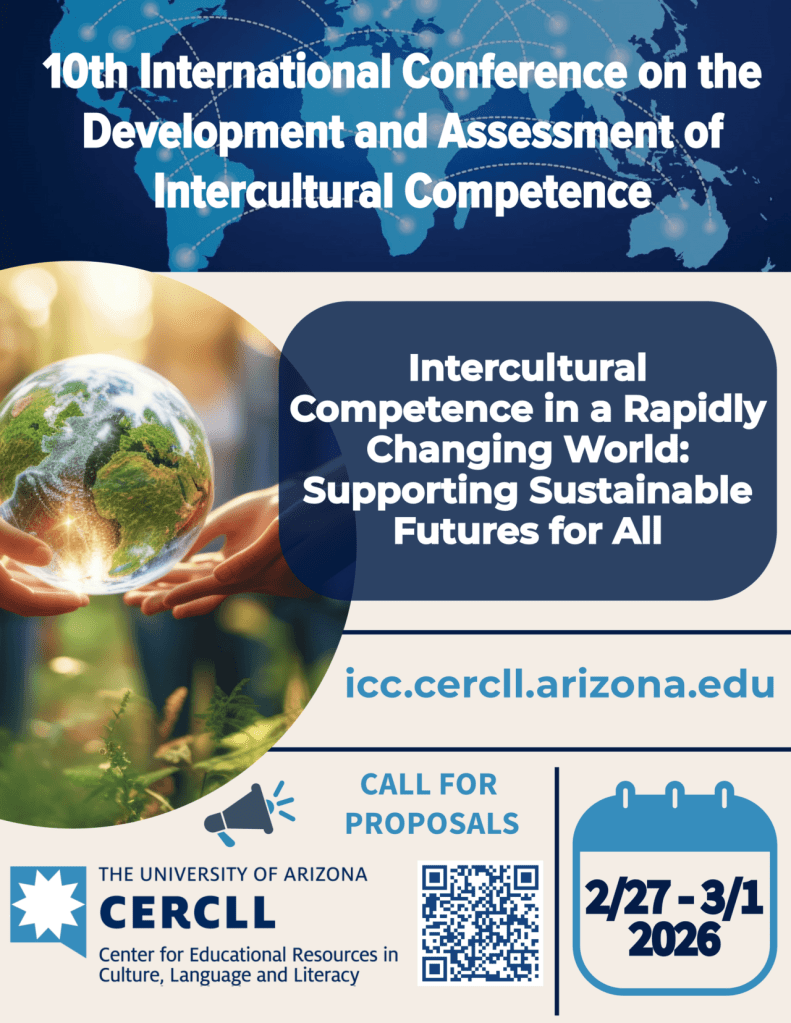
ConferencesCall for proposals: Supporting Sustainable Futures for All: Intercultural Competence in a Rapidly Changing World, 10th International Conference on the Development and Assessment of Intercultural Competence, University of Arizona, Tucson, AZ and Online hybrid, 27 February-1 March 2026. Deadline: 21 July 2025.

Intercultural Competence in a Rapidly Changing World

What role might intercultural communicative language education play in promoting a more sustainable world for all? What might an intercultural communicative language education for a more sustainable world look like? What might be the implications for teachers and learners of moving towards intercultural communicative language education for sustainability? With these issues and questions in mind, CERCLL invites language educators to reflect on how they could re-envision what they teach and how they teach it to meaningfully address these crises with the goal of building a sustainable world for all. The organizers of ICC 2026 seek presentation proposals that focus upon these questions.