Language Diversity, Education & Social Participation (Germany)

Study AbroadSummer Course: Language Diversity, Education and Social Participation, Hamburg International Summer School, University of Hamburg, Germany, July 6-31 July 2020. Deadline: Rolling admission.

Earn up to 10 credits (ECTS). Language of instruction: English. Linguistic (as well as cultural and social) diversity are basic characteristics of today’s societies. Their causes include, among others, increasing migration, globalisation, new technical possibilities of communication, and interactions across traditional borders. Using three nations with significant migration – Australia, China and Germany – as examples, the course will explore how increasing diversity affects education and social participation, and what policies and discourses have been developed in response to linguistic diversity. Despite their different socio-political traditions in dealing with migration, the challenges and responses to linguistic diversity in the three countries share many similarities. Central among these is that linguistic diversity continues to be a central factor in social exclusion in the three countries. All Summer School programs include our supplementary program, focusing on German culture and history, taught through field trips and excursions.

Four core topics:

  • Key Issues in Multilingualism
  •  Language Development in Multilingual Settings
  • Language Diversity in Formal and Informal Settings
  • Multilingual Learning Motivation in a Foreign Language Context
CFP Ethnic and Religious Conflict Resolution & Peacebuilding (USA)

ConferencesCall for papers: 7th Annual International Conference on Ethnic and Religious Conflict Resolution and Peacebuilding, September 29-October 1, 2020, Mercy College, New York. NOTE: Event canceled as of July; there will be another event in 2021.

The theme of the 7th Annual International Conference on Ethnic and Religious Conflict Resolution and Peacebuilding is Ethnic, Racial and Religious Conflicts Globally: Analysis, Research and Resolution. To increase understanding of ethnic, racial and religious conflicts in different countries around the world, the conference will consider submissions from multidisciplinary fields of study and practice. Qualitative, quantitative or mixed methods research studies from university scholars and researchers are accepted. Case studies, lessons learned, success stories, policy analysis or design, and best practices from policy makers, practitioners, and indigenous peoples are also accepted. Successful abstracts or full papers shall not only bridge theory, method and practice, but must include findings and recommendations designed to further understanding and inform practical application.

Chi-Hoon Kim Profile

Profiles

Chi-Hoon Kim holds a PhD in Anthropology (Indiana University) and an MA in Anthropology of Food (School of Oriental and African Studies).

Chi-Hoon Kim

Her research examines the global rise of gastro-national branding as a nation-building strategy to understand why nation-states use food to enhance their international reputation. She investigates the political process of promoting culinary practices through international heritage regimes and global media. Chi-Hoon has published on topics such as the inflight experience of national cuisines, the use of plastic food models as gastro-national tools, and the politics of kimchi as intangible cultural heritage.

Publications:

Kim, C.-H. (2017). Let them eat Royal Court Cuisine! Heritage politics of defining global hansik. Gastronomica: The Journal of Critical Food Studies, 17 (3), 4-14.

Kim, C.-H. (2016). Kimchi nation: Constructing kimjang as an intangible Korean heritage. In C. M. K. Lum & M. de Ferrière le Vayer (Eds.), Urban foodways and communication: Ethnographic studies in intangible cultural food heritage around the world (pp. 39-54). London, UK: Roman and Littlefield.

August, T., & Kim, C.-H. (2016). The turn to ‘bad Koreans’: Transforming televisual ethnicity. Television & New Media, 17 (4), 335-349.

Kim, C.-H. (2014). The power of fake food: Plastic food models as tastemakers in South Korea. M?C Journal: A Journal of Media and Culture, 17(1).

Kim, C.-H. (2014). Tasting the nation in the air: Branding the Korean nation through airline meals. In R. Bendix & M. Fenske (Eds.), Political meals (pp. 207-217). Berlin, Germany: LIT Verlag Publications.


Work for CID:
Chi-Hoon Kim translated KC35: Media Ecology into Korean.

U Glasgow: International Officer (UK)

“Job
Senior International Officer: South and South East Asia, University of Glasgow, Glasgow, UK. Deadline: 24 February 2020.

You will work directly with the International Recruitment Manager for South and South East Asia and other Senior International Officers in meeting institutional and College targets in relation to the University’s International Recruitment strategy and agreed key performance indicators.

You will provide a friendly and efficient service to international students and visitors, facilitate the development of partnerships/collaborations with key institutions, agents, government agencies and other contacts within and outwith the University. You will support the delivery of institutional internationalisation strategic objectives.

**NOTE the post may be rotated on a periodic basis to give experience of different international markets.**   

Hong Kong Baptist U: Communication Studies (China)

“JobProfessor/Associate Professor/Assistant Professor, Department of Communication Studies, School of Communication, Hong Kong Baptist University, Hong Kong, China. Deadline: February 20, 2020.

The Department invites applications for two full-time, tenure-track faculty positions in Organizational Communication and Public Relations. The successful candidates must have a PhD degree in communication or a relevant field, and should be able to teach public relations courses and/or communication studies courses (e.g., interpersonal communication, group communication, organizational communication, intercultural communication, information technology and social impact, and empirical research methods).

Conflict & Society Moving to Open Access in 2020

Resources in ICD“ width=Conflict and Society is a part of the Berghahn Open Anthro subscribe-to-open initiative, a pilot aiming to convert 13 Anthropology journals to full Open Access on an on-going and sustainable basis, starting with their volumes published in 2020.

Subscribe-to-open is a model of sustainable open access for scholarly journals in which institutions continue to “subscribe” to the journals that their communities value at similar prices and with the same quality as when those same journals were accessed under a conventional subscription. Subscribe-to-open is a form of subscription that allows libraries to direct funds through the same subscription channels routinely used to provide journal access to their own researcher community, while also supporting the journals’ readership across a wider community as an open access publication. In addition, if an institution has also established open access funds to support transitional initiatives or author open access publication, then these funds may also be used for this model through a simpler, journal-level process.

Bruno Catalano Les Voyageurs Sculptures

Applied ICDSculptor Bruno Catalano creates life-size, bronze sculptures titled “Les Voyageurs” (The Travelers). These serve as a visual depiction of the disruption caused by migration.

Catalano was born in Morocco to a Sicilian family, and raised in France, so knows the issues first hand.

Further reading:

Bruno Catalano website.

Waldmann, Nadine. (20 July 2018). Not all there – the enigmatic sculptures of Bruno Catalano. Daily Art Magazine.

Ethnography, Language, Communication Summer School (England)

Study AbroadEthnography, Language & Communication: Key Concepts and Methods Summer School, University College of London, London, UK, 27-31 July 2020. Application Deadline: 1 March 2020.

Is ‘qualitative data analysis’ too vague for you? Are you wondering how to do justice to your data? If you are researching social processes, institutions, culture or identity,  but are unsure about how to analyse the discourse data from your fieldwork, then consider joining this five-day research training course. 
The programme is designed to help PhD and post-doctoral researchers to navigate the twin perils of over- and under-interpreting discourse data. It introduces a range of key perspectives and tools used to study language and communication ethnographically and it facilitates the study of social practice in a wide range of different settings – education, workplace, recreation, health etc.

The course will be taught by an international team from several leading research institutions:  Prof Jeff Bezemer, Dr Adam Lefstein, Dr Piia Varis, Dr Julia Snell, Prof Ben Rampton.

KC95 Transnational Media

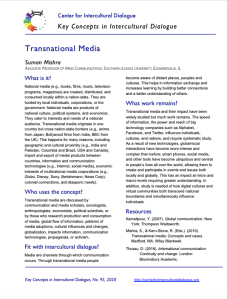
Key Concepts in ICDThe next issue of Key Concepts in intercultural Dialogue is now available. This is KC#95: Transnational Media, by Suman Mishra. Click on the thumbnail to download the PDF. Lists organized chronologically by publication date and numberalphabetically by concept in English, and by languages into which they have been translated, are available, as is a page of acknowledgments with the names of all authors, translators, and reviewers.

KC95 Transnational Media

Mishra, S. (2020). Transnational media. Key Concepts in Intercultural Dialogue, 95. Available from:
https://centerforinterculturaldialogue.org/wp-content/uploads/2020/01/kc95-transnational-media.pdf

The Center for Intercultural Dialogue publishes a series of short briefs describing Key Concepts in Intercultural Dialogue. Different people, working in different countries and disciplines, use different vocabulary to describe their interests, yet these terms overlap. Our goal is to provide some of the assumptions and history attached to each concept for those unfamiliar with it. As there are other concepts you would like to see included, send an email to the series editor, Wendy Leeds-Hurwitz. If there are concepts you would like to prepare, provide a brief explanation of why you think the concept is central to the study of intercultural dialogue, and why you are the obvious person to write up that concept.


Creative Commons License
This work is licensed under a Creative Commons Attribution-NonCommercial-NoDerivatives 4.0 International License.

Royal Roads U: Program Associate (Canada)

“Job

Program Associate, School of Communication & Culture, Royal Roads University, Victoria, BC, Canada. Deadline: February 10, 2020.

Under the general direction of the School Manager of the School of Communication & Culture and the Faculty of Social and Applied Sciences Administrative Manager, the program manager is responsible for performing administrative and day-to-day operational functions to support the effective and efficient delivery of the program(s). The program manager will liaise with School staff, faculty (core and associate), learners (prospective, current and alumni), and university support areas on a daily basis in order to ensure that the program is supported, delivered and promoted effectively.