Grawemeyer Award for Ideas Improving World Order

Grawemeyer Award for Ideas Improving World Order
University of Louisville

The Award in World Order is accompanied by a prize of $100,000, which is presented in full during the awards ceremony.
Deadline: January 31, 2016

The Grawemeyer Award For Ideas Improving World Order is presented annually to the winner of a competition designed to stimulate the recognition, dissemination and critical analysis of outstanding proposals for improving world order.

Submissions will be judged according to originality, feasibility and potential impact, not by the cumulative record of the nominee. They may address a wide range of global concerns including foreign policy and its formation; the conduct of international relations or world politics; global economic issues, such as world trade and investment; resolution of regional, ethnic or racial conflicts; the proliferation of destructive technologies; global cooperation on environmental protection or other important issues; international law and organization; any combination or particular aspects of these, or any other suitable idea which could at least incrementally lead to a more just and peaceful world order.

The university committee overseeing the award invites nominations from throughout the world by individual political scientists expert in the area, by professional associations of political scientists or related disciplines in international relations, by university presidents or by publishers and editors of journals and books in political science and world affairs. Self-nominations will not be considered.

CFP International Conference on Language and Social Psychology (Thailand)

Call for Submissions – International Conference on Language and Social Psychology

Now accepting paper and symposia/panel proposals for the 15th International Conference on Language and Social Psychology (ICLASP) which will be held in conjunction with the 5th Language in the Realm of Social Dynamics (LIROD) conference June 22-25th, 2016 in Bangkok, Thailand.

Deadline: 15th February, 2016 (decision by 15th March); later submissions will be reviewed on ongoing basis

This conference will bring together international scholars from different disciplines who explore language and communication in their social contexts using both quantitative and qualitative methods. Papers and symposia that contribute to ongoing scholarship in language and social psychology are invited for submission. Please view our website for the full call for papers and details about registration and the beautiful venue – the University of the Thai Chamber of Commerce in Bangkok.

Submissions will be accepted in three forms (see below). Please note that (i) all submissions and presentations need to be in English; (ii) by submitting a proposal for presentation at ICLASP15 you are agreeing to register for and attend the conference should your paper/symposia be accepted.

Send ALL Submissions via email with  “ICLASP LIROD submission” in subject line by 15th February, 2016.

1. Symposia/panel submission should be a single file containing:
(i)     Name(s) and complete contact information of the convener(s)
(ii)    A 250 word maximum introduction to the thematic content of the symposium with title
(iii)   A list of the individual papers, including titles and brief abstracts of each (250 words max.), the names, complete contact information for all authors, clearly indicating the presenter(s). A typical symposium is 3-4 presenters with an introduction and a discussant

2. Individual paper submissions should be a single file containing:
(i)     The names and complete contact information of all authors with a clear indication of who will present the paper
(ii)    A 250 word (maximum) abstract of the presentation that outlines research aims, methods, findings and implications clearly.

3. Student-authored paper submissions should be a single file containing:
(i)     The names and complete contact information of all authors with a clear indication of who will present the paper and which authors are students
(ii)    “Student paper” in the subject line
(iii)   A 250 word (maximum) abstract of the presentation that outlines research aims, methods, findings and implications clearly.

International Relations Postdoctoral Scholarship USC

Hayward R. Alker Postdoctoral Scholar Research Associate Competition

Application materials must be RECEIVED on or before JANUARY 15, 2016
The Center for International Studies at the University of Southern California invites applications from scholars who specialize in international relations and political science. This covers a wide range of topics but we are particularly eager to encourage applications from candidates engaged in scholarship related to the research activities of our faculty. The competition is open to junior scholars who will have defended a dissertation by August 1, 2016. Equivalent experience is not accepted. No English tests are required. Applications from a variety of disciplines, including the social sciences, humanities and communications are encouraged.

PREFERRED APPLICANTS: Junior Scholars who have received a Ph.D. within the last three years. Applicants MUST have attained PhD prior to date of appointment.

COMPENSATION The Center will provide a stipend, office space, USC library privileges, health insurance, $1,000 each towards moving and research expenses, and computer support.

APPLICATION PROCEDURES ALL application materials must be RECEIVED on or before JANUARY 15, 2016. To submit applications, please follow these three steps:
1) All candidates will need to apply electronically for position via USC Jobs site.
2) Please upload the following documents once you have created an account on USC jobs site:
• Curriculum vitae
• 5-7 page research proposal (single-spaced preferred)
• Cover letter
• Writing sample
3) Three confidential letters of recommendation are required
Please have your referees submit letters of recommendation directly via email on or before January 15, 2016 (we request that the letters be signed, and please include applicant name in the subject line of the email)

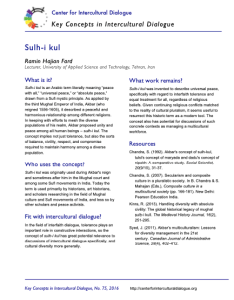
Key Concept #75: Sulh-i kul by Ramin Hajianfard

Key Concepts in ICDThe next issue of Key Concepts in intercultural Dialogue is now available. This is KC75: Sulh-i kul by Ramin Hajianfard. As always, all Key Concepts are available as free PDFs; just click on the thumbnail to download. Lists organized chronologically by publication date and numberalphabetically by concept in English, and by languages into which they have been translated, are available, as is a page of acknowledgments with the names of all authors, translators, and reviewers.

KC75 Sulh-i Kul

Hajianfard, R. (2016). Sulh-i kul. Key Concepts in Intercultural Dialogue, 75. Available from:
https://centerforinterculturaldialogue.org/wp-content/uploads/2019/11/kc75-sulh-i-kul.pdf

The Center for Intercultural Dialogue publishes a series of short briefs describing Key Concepts in Intercultural Dialogue. Different people, working in different countries and disciplines, use different vocabulary to describe their interests, yet these terms overlap. Our goal is to provide some of the assumptions and history attached to each concept for those unfamiliar with it. As there are other concepts you would like to see included, send an email to the series editor, Wendy Leeds-Hurwitz. If there are concepts you would like to prepare, provide a brief explanation of why you think the concept is central to the study of intercultural dialogue, and why you are the obvious person to write up that concept.


Creative Commons License
This work is licensed under a Creative Commons Attribution-NonCommercial-NoDerivatives 4.0 International License.

Save

CFP International Association for Dialogue Analysis (Pittsburgh)

14th NATIONAL COMMUNICATION ETHICS & 2016 INTERNATIONAL ASSOCIATION FOR DIALOGUE ANALYSIS CONFERENCE
Duquesne University – Pittsburgh, PA
June 1–4, 2016

The 14th National Communication Ethics and 2016 International Association for Dialogue Analysis (IADA) conferences will be held June 1-4, 2016 at the Duquesne University Power Center in Pittsburgh, PA, sponsored by the Department of Communication & Rhetorical Studies, the Communication Ethics Institute, and the International Association for Dialogue Analysis.

We welcome papers and panel proposals addressed to each of the conference’s four content areas: (1) Dialogic Ethics; (2) Organizational Language and Dialogue; (3) Rhetoric and Dialogue; and (4) Semioethics.

The conference features invited speakers for each area:
Dialogic Ethics: Lisbeth Lipari, Denison University, the recipient of the James A. Jaska Scholar in Residence Award in Communication Ethics
Organizational Language and Dialogue: François Cooren, Université du Montréal
Rhetoric and Dialogue: Scott Stroud, University of Texas at Austin
Semioethics: Guest panel to be determined

Papers: We invite abstracts of 200–500 words or completed papers of a maximum of 30 pages, including references. Any citation style is permitted (e.g., MLA, APA, Chicago).

Panel Proposals: Panel proposals may include up to five participants. Please include a title page with a 500-word (maximum) rationale and 200-word abstract for each presentation.

Send all submissions to cec@duq.edu by April 30, 2016.

Registration:
Registration costs include three evening receptions with hors d’oeuvres, two lunches, a full breakfast buffet on Saturday, and a one-year IADA membership (including a subscription to Language and Dialogue and 30% off Dialogue Studies series by John Benjamins).
• Faculty—$280.00
• Graduate—$180.00
• Undergraduate—$110.00

For additional information, please contact conference directors (Ronald C. Arnett, Garnet Butchart, or Janie Harden Fritz) at the conference email.

Ramin Hajianfard Profile

ProfilesRamin Hajianfard (Ph.D., International Islamic University of Malaysia) is senior lecturer in Art & Design at the University Pendidakan Sultan Idris, in Selangor, Malaysia.

Ramin Hajian FardHis main area of research is on Mughal miniature painting, with a secondary emphasis on interfaith dialogue during the Mughal Empire of India. His MA was on peace painting, resulting in the following article:
• Hajianfard, R. (2013). Iranian painters for peace. Peace Review: A Journal of Social Justice, 25(2), 284-290.

He has written multiple entries for encyclopedias: six entries for The Great Events in Religion: An Encyclopedia of Pivotal Events in Religious History (English), and five entries for the Great Islamic Encyclopedia (Persian).

He has published articles in both Persian and English including:

• Hajianfard, R. (2013). An introduction to the art of illuminating the Qur’an. Journal of Arts, Culture & Heritage, 2, 95-109 (English).

• Hajianfard, R. (2012-2013). Hajj painting: A traditional Egyptian art celebrating the Hajj. Bulletin of International Institute of Islamic Science, Thought and Civilization, 4, 12-13.

• Hajianfard, R. (2014). French orientalist painting: Colonial views or an artistic approach? In B. Atashinjan (Ed.), Naghd-e Nāmeh-e Honar [Professional Book (vol. 6) on the Research and Art Criticism] (pp. 25-45). Tahran: Mugham (Persian).

He has also translated multiple books, articles, and book chapters, about music, art, and philosophy, into Persian for publication in Iran.

He was the winner of the second prize for publishing and research at the University of Applied Science and Technology, Iran, 2013.

A video presentation he recently made, Persian Manuscripts of Ramayana || Illustrative Miniature Paintings, is now available on YouTube. (His part begins at 15:27.)


Work for CID:

Ramin Hajianfard wrote KC75: Sulh-i-Kul and KC83: Intercultural Aesthetics. He has translated KC1: Intercultural DialogueKC2: Cosmopolitanism, KC3: Intercultural CompetenceKC4: Coordinated Management of Meaning, KC5: Intercultural CommunicationKC6: Intercultural CapitalKC7: Intergroup Relations DialogueKC8: Public Dialogue, KC10: Cross-Cultural Dialogue, KC75: Sulh-i-Kul, and KC83: Intercultural Aesthetics into Persian. He also has served as a reviewer for translations into Persian. He is currently working on a project looking at visual art as a tool for intercultural dialogue between sister cities, and is interested in hearing from people with overlapping interests.

CFP Language, Linguistics, Literature & Translation: Connecting the Dots in a Glocalized World (Oman)

Conference Call
Third International Conference on Language, Linguistics, Literature and Translation: “Connecting the Dots in a Glocalized World”
November 3-5, 2016
Sultan Qaboos University, Muscat, Oman

Call Deadline: 11 April 2016

Connecting the Dots in a Glocalized World 2016 will provide a forum for the exchange of ideas in the four main disciplines of language, linguistics, literature and translation. As the title for the conference suggests, the aim is to focus on the relationship between global themes and local practices, highlighting the under-examined interactions that occur as globalization takes on negotiated forms in different contexts. With an emphasis on interdisciplinary studies and methodologies, the conference will centralize both research that theorizes the links between the local and the global and research that shows, through practical evidence, how local and global interact. Proposals that aim to address either of these two areas, and which emphasize exploratory, experimental research or reconstructed concepts, frameworks of analysis, or approaches, are particularly welcome. Proposals may be situated within any of the four disciplines but research demonstrating an interdisciplinary focus or approach is highly encouraged.

Confirmed Keynote Speakers:
– Jan Blommaert (Linguistics): Tilburg University, The Netherlands.
– Michael Cronin (Translation): Dublin City University, Ireland.
– Ian Almond (Literature): Georgetown University, Qatar.
– Rani Rubdy (Language): Independent Scholar.

Sample conference themes include the following, but a wide range of proposals is invited:
Language
– Language, culture and globalization
– Global teaching policies and local norms
– Language commodification and ideologies
– Globalizing technologies and the language classroom
Linguistics
– Social media and identity
– Language acquisition and migrant populations
– Language change and the media
– Global/local language adaptation
Literature
– Localizing global literature
– Arabic and non-Western literature in a globalized world
– Literature from the diaspora
– The sociolinguistics of literature
Translation
– Issues in global and local translation
– Translating culturally remote literature
– Translation and multimodal texts
– Machine translation and the web

Submission Details:
Proposals are invited for papers (20 +10 minutes discussion) and poster presentations (with scheduled discussion times).

To submit your abstract, please send an email (with a Word attachment) by 11 April 2016. Please include ALL the following information, numbered:
1. Brief outline of the paper/presentation for inclusion in the conference program (100 words max)
2. Full abstract for the review committee (500 words max)
3. Name, title and affiliation (university/college/etc)
4. Full address (include country), email and telephone
5. Indicate if the proposal is for a Paper or a Poster presentation
6. Title of paper/presentation
7. Areas which the paper/presentation links (please be precise)
8. Please provide up to five relevant keywords

Conference Chairs: Najma Al Zidjaly and Andrew Littlejohn (Sultan Qaboos University)

Sultan Qaboos University, Oman’s largest and most prestigious institution of higher learning, is located 45km from Muscat. The University offers undergraduate and postgraduate degrees to approx. 16,000 students.

Oman, a peaceful nation on the Arabian Gulf in the Middle East, is hailed as the jewel of Arabia. It has landscape covering desert, riverbed oases and long coastlines on the Persian Gulf, the Arabian Sea and the Gulf of Oman. The capital city, Muscat, is home to the majestic Sultan Qaboos Grand Mosque, Royal Opera House Muscat, and the old waterfront Muttrah quarter, with its labyrinthine traditional bazaar.