Doctoral Research Grants, European Association for International Education, Amsterdam, Netherlands. Deadline: 1 August 2025.
The EAIE Doctoral Research Grants support early-career scholars conducting doctoral research on internationalisation in higher education. In 2025, up to five grants of up to €4500 each will be awarded to help cover research-related expenses such as travel, data collection tools and access to academic resources. The grant is open to doctoral candidates from around the world whose work is relevant to the European context and the EAIE community. In addition to funding, the programme offers visibility, engagement opportunities and a platform to contribute to the broader field of international higher education.
In 2025, the EAIE will award up to five Doctoral Research Grants to support doctoral candidates researching internationalisation in higher education. Each grant provides up to €4500 in support of research that forms part of the official requirements for completing a doctoral degree. The grant may cover expenses such as travel for data collection or conferences, data collection and analysis tools, such as surveys and data analysis software, and access to books, journals or other paid academic literature.
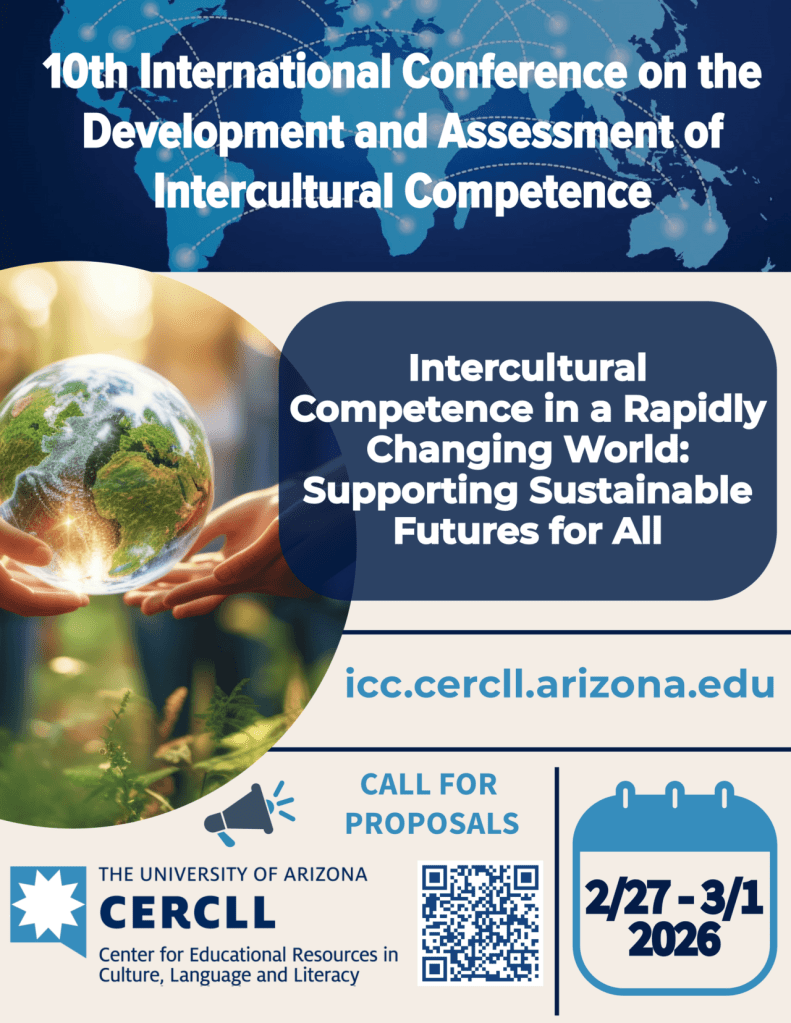
What role might intercultural communicative language education play in promoting a more sustainable world for all? What might an intercultural communicative language education for a more sustainable world look like? What might be the implications for teachers and learners of moving towards intercultural communicative language education for sustainability? With these issues and questions in mind, CERCLL invites language educators to reflect on how they could re-envision what they teach and how they teach it to meaningfully address these crises with the goal of building a sustainable world for all. The organizers of ICC 2026 seek presentation proposals that focus upon these questions.
Reporting to the President, the Executive Director of International Education will provide strategic leadership for the development, implementation, and evaluation of the institution’s international education initiatives. This role involves overseeing international partnerships, study abroad programs, global engagement, and cross-cultural initiatives, while ensuring alignment with institutional goals and objectives. The Executive Director will also play a key role in fostering global awareness in an academic environment, supporting faculty, staff, and students in their international endeavors.
YES Specialist, AFS-USA, New York, NY, USA, hybrid position. Deadline: posted 11 August 2023, open until filled.
AFS-USA is part of a worldwide network of AFS partner organizations that work together to advance global education and foster meaningful connections across cultures. As the network’s largest partner, AFS-USA works to increase the global competency of U.S. citizens by providing a variety of international and intercultural learning experiences to individuals, families, schools, and communities.
This position is within the Sponsored Programs Department at AFS-USA, which manages several programs of the Bureau of Educational and Cultural Affairs at the U.S. Department of State, providing scholarships for adolescents to participate in international exchange. Specialists focus on a specific portfolio of grant-funded program(s), which, depending on the size and scope of programs, may encompass more than one program or may mean working in tandem with other staff on some part of a larger program or project. The YES Abroad Specialist will work most closely with the Manager of Outbound Sponsored Programs, as well as other department and division staff.
This position will focus on sending American participants on the Kennedy-Lugar Youth Exchange and Study (YES) program, known as YES Abroad, including designing and implementing programmatic components. Core responsibilities of the role include carrying out program requirements, such as conducting orientations, managing projects, communicating with participants and domestic and international partners, communicating with volunteers, working on participant orientations and travel/logistics, carrying out program-focused projects, and reporting to the sponsor.
Participant Support Specialist, AFS-USA, New York, NY, USA, remote position. Deadline: posted 21 June 2023, open until filled.
AFS-USA is part of a worldwide network of AFS partner organizations that work together to advance global education and foster meaningful connections across cultures. As the network’s largest partner, AFS-USA works to increase the global competency of U.S. citizens by providing a variety of international and intercultural learning experiences to individuals, families, schools, and communities. We are proud of our Staff from our national office in New York City as well as home offices across the county, who collaborate with our more than 2,000 AFS-USA Volunteers to deliver high quality programs and global education resources. These include immersion-based study abroad experiences in over 40 countries worldwide; opportunities to host foreign AFS exchange students; and global learning workshops and curricula for educators, schools, and businesses.
The Participant Support Teams primary role is maintaining the safety and wellbeing of all participants, while facilitating intercultural learning. The Participant Support Specialist works closely with the Senior Participant Support Specialist (Sr. PSS) and the Participant Support Manager (PSM) in developing and implementing quality support for the hosting and sending programs. The Support Specialist works with the PSM and the Team Development Specialist (TDS) to advise, train, and strengthen their volunteer area teams’ capacity to support participants, host families, natural families, schools, and partners during the intercultural living experience.
Crises including the COVID-19 pandemic, the unfolding climate emergency and ongoing and resurgent violent conflict have shown that progress towards a sustainable planet is fragile and reversible. Ensuing and ever-increasing inequality and injustice threaten progress towards the goal of equitable quality education and lifelong learning (including social, emotional, physical, cognitive, and creative aspects) for all by 2030 (SDG4) and require urgent remediation and mitigation. Education and learning among marginalised groups in particular must be prioritised as a shared global responsibility if the tide of widening inequalities and injustices is to be stemmed and in furtherance of global human rights. Moreover, equitable and sustainable progress require much more than ’business as usual’, calling not only for innovation but for transformation. Re-thinking conceptualisations of education and learning and spaces where they take place (diverse learning spaces such as home, community, religious spaces, among many others) is critical. Re-imagining relations between global North and South in education and learning is fundamental to addressing marginalisation and its root causes, including by ‘reversing the gaze’ to critically examine the role played by the North in education, learning, and development from the perspectives of the global majority.
This conference will bring together scholars and practitioners in the field of international education, training, and lifelong learning at this crucial half-way point on the timeline set for the SDGs in 2015, offering opportunity for diverse and critical dialogue and debate on ways forward in this crucial field of research and practice.
King’s College London is seeking to recruit a social science scholar with interests in the global dimensions of education to contribute to teaching and programme administration on an MA Education suite of programmes and other programmes as required. They will also undertake doctoral supervision and conduct high quality research. The successful candidate will have expertise in, or that can be applied to, international and comparative education, education and international development, education in a global context and/or intercultural education. Expertise relating to school leadership and management will be particularly welcome but is not essential.
In addition to state (or public) primary and secondary schools, with students in my study abroad program, which ended on July 18, 2022, I visited two NGOs during our second week of study, the London Chinese Community Centre (CCC) in London’s Chinatown and the Islington Centre for Migrants and Refugees in the Islington district just north of the City of London. Our goal was to have direct exposure to how community-based organizations help newcomers in their intercultural adaptation in the U.K., as well as some of their challenges and successes in this regard.
London’s Chinatown, a communal center for generations of immigrants of Chinese heritage in the U.K. (Photo credit: Casey Lum)
During the initial stage of adaptation, one of the most immediate needs of new migrants is the acquisition of services in helping them settle into their new daily routines. Such can prove to be a difficult task, especially for those who do not have a sufficient level of social or functional English. As such, community-based NGOs like the two we visited last week can play a vital role. For example, CCC routinely assists their immigrant members with legal aid for securing social services from the local government or otherwise offering a place for them to build a new social network with their compatriots.
On the other hand, the Islington Centre also regularly helps their clients, many of whom are refugees from conflict regions, with various kinds of legal aids referral services to help them address issues such as political asylum status application, as well as various other everyday life matters related to poverty or job seeking, health maintenance (some of their clients do not know how to fill their medical prescriptions), housing or homelessness, learning about their rights like all other citizens, learning their way around the city, and so on.
One of the challenges facing the staff at these organizations has to do with how, and the extent to which, they can maintain a balance between their professional obligation to their clients and their own personal emotional well-being. On the one hand, one needs to be compassionate about the lives of the newcomers – especially since many of the refugees come from conflict or war-torn regions or escape from political persecution – and many of these people are going through an extremely traumatic stage of their lives. One legal aid staff member of the Centre confided that their day rarely concludes at the end of the workday as their clients’ (at times desperate) needs do not end then.
But there also are moments of joy and great satisfaction. Many members at the Chinese Community Centre enjoy taking part in the various Chinese arts and culture events and workshops, as well as English-language classes. This has been a source of encouragement for the center’s staff and volunteers to continue with their work. An executive at the Islington Centre told us that at times they organize field trips for their clients, to visit museums or attend cultural events across London. During these field trip events and various other such social activities, they sense noticeable joy among their clients. As their clients see or learn something new, their cultural experiences allow them to begin to regain some sense of normalcy in their intercultural adaptation to an otherwise unfamiliar social landscape.
Casey Man Kong Lum, Associate Director
Center for Intercultural Dialogue
The important role of bilingual education and storytelling in the social development of young students have been two recurring themes running throughout the first week of my summer study abroad program on United Kingdom: Intercultural Perspectives in Teaching and Learning at NYU London (July 4-18, 2022).
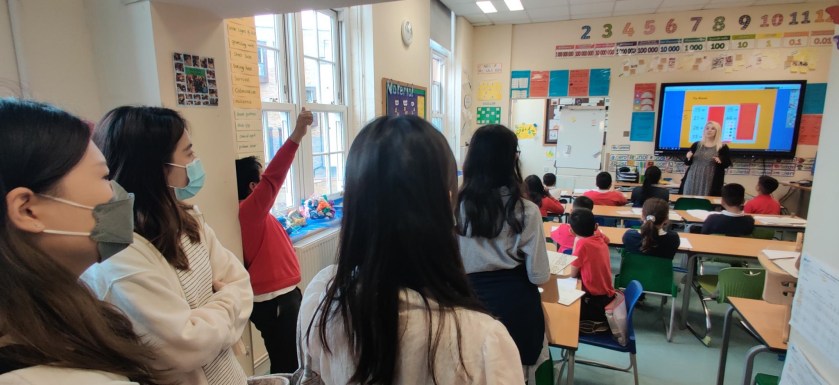
Summer study abroad students from NYU observing a class in session at Mayflower Primary School in London. (Photo credit: Casey Lum)
In her guest lecture to my students on “Rethinking Teaching Languages in European Schools (with a Focus on England): A Healthy Linguistic Diet Approach,” Dina Mehmedbegovic-Smith (July 5) emphasized the importance of bilingual education among the young in the United Kingdom nowadays. This topic was shared by Nicky Busch (July 6) in her special presentation on “The Intersectional Dynamics of Immigration, Intercultural Education, and Intergroup Relations in the United Kingdom,” in which she similarly acknowledged how acquiring English as a second or additional language can help immigrant students gain a voice of their own in their intercultural adaptation to life in the UK.
Our understanding of the above ideas – and many more others that this brief post simply cannot include – has been greatly enhanced by what my students and I witnessed “on the ground level” during our field visit at the Mayflower Primary School, a public school located in the eastern borough of Tower Hamlets in London. While the 2011 census in the UK reported that about one-third of the borough’s population came from Bangladesh, about 90% of the students at Mayflower Primary today are Bangladeshi. Many come from low-income families with a relatively low level of literacy, with parents who are not fluent in spoken English. These are some of the reasons why the school has adopted an approach that emphasizes developing their students’ competence in reading and storytelling in English. At the same time, the teachers encourage their students’ families to speak in their home language, in part to help promote bilingual fluency among the students.
From one practical (or pragmatic) perspective, the emphasis on reading is meant to help the students become savvy information seekers and users for personal and professional development purposes. On the other hand, it is believed that a high level of oracy – with a high degree of competence in taking in one’s experience of the world around them and then in being able to articulate or tell “stories” about their experience orally – can help the young build a solid foundation for acquiring writing skills.
But the above teaching and learning strategies do not and most likely will not automatically or by default lead to the development of students’ competency in intercultural communication, adaptation, or dialogue. For example, Heba Al-Jayoosi, the Assistant Head (Inclusion) at Mayflower Primary School, suggests that many of the parents have never been to London Bridge, which is not far from home. Hence, the school has embarked on a project to take the students and their families on a field trip to London Bridge. Such co-curricular activities are meant to help them gain more exposure to the larger social and cultural environment and help them better adapt. These field trips (similar to my current study abroad program in London) set the stage for follow-up discussion or storytelling among the participants afterward.
Casey Man Kong Lum, Associate Director
Center for Intercultural Dialogue
I will be directing and teaching a short-term summer study abroad program for New York University’s Steinhardt School of Education, Culture, and Human Development. Entitled “United Kingdom: Intercultural Perspectives in Teaching and Learning,” the program will be based at NYU London (July 4-18, 2022).
I have invited four distinguished colleagues to share their insights with students from NYU’s main campus on Washington Square in New York City. They include Nicky Busch (NYU London) on The Intersectional Dynamics of Immigration, Intercultural Education, and Intergroup Relations in the UK; Myria Georgiou (London School of Economics and Political Science) on Remote Teaching and Learning during the COVID-19: Challenges and Opportunities; Dina Mehmedbegovic-Smith (University College London) on Language Education in the UK; and Maria Tsouroufli (Brunel University London) on Gender Inequality in Education in the UK.






 Center for Intercultural Dialogue