U Jyväskylä: Intercultural Communication (Finland)

“JobUniversity Teacher in Intercultural Communication, University of Jyväskylä, Finland. Deadline: 3 August 2025.

The University Teacher’s position is allocated to the discipline of Intercultural Communication in the Department of Language and Communication Studies. The department provides high quality, research-based academic education in language and communication studies.

The University Teacher will be a part of a team responsible for research and education in the field of Intercultural Communication. The teaching takes place in the international MA degree programme Language, Globalization and Intercultural Communication and the study module in Intercultural Communication. The contents of the teaching modules deal for example with themes related to critical approaches to diversity in organizational communication, dynamics of migration, technology-mediated communication across contexts, issues related to intergroup communication, discourses of power, and both qualitative and quantitative methodology.

University Teachers are required to have a relevant master’s degree. The duties, qualification requirements and language skills of a University Teacher are stipulated by the University of Jyväskylä Regulations and language skills guidelines. Excellent proficiency in English is required in this position.

In addition, the following skills and achievements are regarded as merits: (i) experience in teaching, (ii) pedagogical training, (iii) development of teaching materials, (iv) other merits in teaching, (v) other skills and achievements relevant to the task of the University Teacher, and (vi) collaboration possibilities in teaching within the broader structure of the department. Research (vii) in one of the core research areas of the department or at their crossroads is also considered a merit (see https://www.jyu.fi/en/humsoc/kivi/research-at-kivi).

Elizabeth Root Profile

Profiles

Elizabeth Root is an associate professor of intercultural communication in the School of Communication at Oregon State University, and holds a PhD from the University of New Mexico.

Elizabeth RootShe began her career as an English as a second/foreign language teacher. Besides teaching refugees, immigrants, and international students in Minnesota, she also taught conversational English classes in both China and South Korea for seven years. Her experience working with international students prompted her to return to graduate school to study intercultural communication. Research during her PhD program took her back to South Korea to collect narrative data exploring the intercultural relationships between native-English-speaking teachers and Korean students in a classroom setting. This branch of her research explores how the hegemony of English has impacted foreign language classrooms. Ideological beliefs attached to English influence how cross-cultural adaptation occurs in complex and uneven ways. She has also examined perceptions of agency of English speakers within the context of English hegemony. Another branch of Elizabeth’s research is focused on intercultural communication pedagogy. She employs qualitative research to study teacher identity and students’ descriptions of intercultural learning. Deeper intercultural learning occurs through acknowledgement of dialectical tensions as students navigate cultural differences and similarities.

Research publications on English hegemony:

Root, E. (2022). “English is my knight”: Descriptions of perceived agency within the hegemony of English. Intercultural Communication, 31(2), 57-72.

Root, E. (2018). “English Fever” in South Korea: Examining English as the language of globalization through the lens of intercultural praxis. In W. Jia (Ed.), Intercultural communication: Adapting to emerging global realities (2nd ed., pp. 261-278). Cognella.

Root, E. (2016). Cultural adjustment from the other side: Korean students’ experiences with their sojourner-teachers. China Media Research, 12(1), 35-45.

Root, E. (2012). Participation in and opposition to the ideology of English in South Korea: Insights from personal narratives. Asian EFL Journal, 14(3), 178-213.

Root, E. (2009). “I’m just a foreign teacher doing my job”: Ways in which discursive constructions mask an ideology of English in South Korea. NIDA Journal of Language and Communication, 14(14), 57-80.

Research publications on intercultural communication pedagogy:

Root, E. (2018). Staging scenes of co-cultural communication: Acting out aspects of marginalized and dominant identities. Communication Teacher, 32(1), 13-18. DOI: 10.1080/17404622.2017.1372617

Root, E. (2014). Definitions of an intercultural encounter: Insights into “Internationalization at Home” efforts. The Northwest Journal of Communication, 42(1), 35-60.

Root, E. (2013). Insights into the differences—similarities dialectic in intercultural communication from university students’ narratives. Intercultural Communication Studies, 22(3), 61-79.

Root, E., Hargrove, T. D., Ngampornchai, A., & Petrunia, M. D. (2013). Identity dialectics of the intercultural communication instructor: Insights from collaborative autoethnography. Intercultural Communication Studies, 22(2), 1-18.

Root, E., & Ngampornchai, A. (2012). “I came back as a new human being”: Student descriptions of intercultural competence acquired through education abroad experiences. Journal of Studies in International Education. doi:10.1177/1028315312468008


Work for CID:

Elizabeth Root wrote ICD Exercise 8: Exploring Layers of Identity Through Interviews.

NHH: Associate Professor of Intercultural Communication (Norway)

“JobAssociate Professor of Intercultural Communication, NHH: Norwegian School of Economics, Bergen, Norway. Deadline: 20 March 2025.

NHH in Bergen, Norway, invites applicants for a position as Associate Professor (førsteamanuensis) in Intercultural Communication at the Department of Professional and Intercultural Communication. The position requires a PhD in intercultural communication, business communication or linguistics with a track record of research within communication in the workplace.

The department’s research and education profiles reflect NHH’s objectives and are focused on modern professional communication in a broad sense within NHH’s subject areas. The department has an active research environment in professional and intercultural communication, and its research profile encompasses terminology, corpora and language resources, specialised translation, intercultural communication and discourse analysis. For further information about the department, please visit our website.


Coastal Carolina U: Visiting Assistant Professor of Communication (USA)

“JobVisiting Assistant Professor in Communication, Coastal Carolina University, Conway, SC, USA. Deadline: open until filled; posted 3 February 2025.

Coastal Carolina University invites applications for a Visiting Assistant Professor in Communication, or related fields, to begin in August 2025 with the possibility of renewal for up to two years. Candidates must have a Ph.D. in Communication, Journalism, Mass Communication, or a closely related discipline. ABD candidates with a clear plan for degree completion prior to May 31, 2026, may be considered. The teaching load is three courses per academic semester and may include face-to-face, hybrid, or distance learning deliveries. They are seeking excellent teacher-scholars who have the ability to teach the department’s foundation courses, including communication theory and communication research. Faculty will also teach courses in their area of expertise. Preference will be given to those whose area of expertise is in Film Studies, Film Production, Social Media, or Intercultural Communication. Faculty are expected to provide high-quality instruction, mentor students, and provide service to the Department, College, and University when appropriate. Visiting faculty are encouraged to maintain an active research agenda.


U Birmingham: Assistant Professor in Digital Media & Intercultural Communication (UK)

“JobAssistant Professor in Digital Media and Communications (Intercultural Communication), University of Birmingham, Birmingham, UK. Deadline: 13 January 2025.

This position is in the Department of Linguistics and Communication, which is in the School of English, Drama and Creative Studies. As part of strategic growth and investment in Digital Media and Communications, the School seeks to recruit an Assistant Professor with effect from 1st April 2025 to be based on the University’s Edgbaston campus. The post holder will demonstrate particular expertise in intercultural communication, and be able to evidence experience of teaching and researching in this area.

The post holder will contribute high quality teaching to a suite of successful programmes which includes the BA in Digital Media and Communications launched on the University’s Edgbaston campus in September 2023, the MA in Digital Media and Creative Industries launched on the Edgbaston campus in September 2024, and the MA in Digital Media and Communications to be launched on the Edgbaston campus in September 2025. The post holder will also play an active role in the development of the Digital Media and Communications provision on the University’s Dubai campus, including optional travel opportunities to that campus.

Research excellence will include initiating, conducting and disseminating original research. The post holder’s research will have measurable outcomes reflected in growing national (and ideally international) reputation. In addition to delivering excellence in teaching and research, successful candidates will be expected to demonstrate academic citizenship, developing and maintaining generous, mutually respectful and supportive working relationships with all colleagues and students. Management and administration is likely to involve contributions at Departmental and School level, and/or making an important contribution to some managerial/leadership activities (e.g. working groups) within the University. This may include developing and making substantial contributions to knowledge transfer, enterprise, business engagement, public engagement, widening participation, school’s outreach, or similar activities at Department/School level or further within the University.

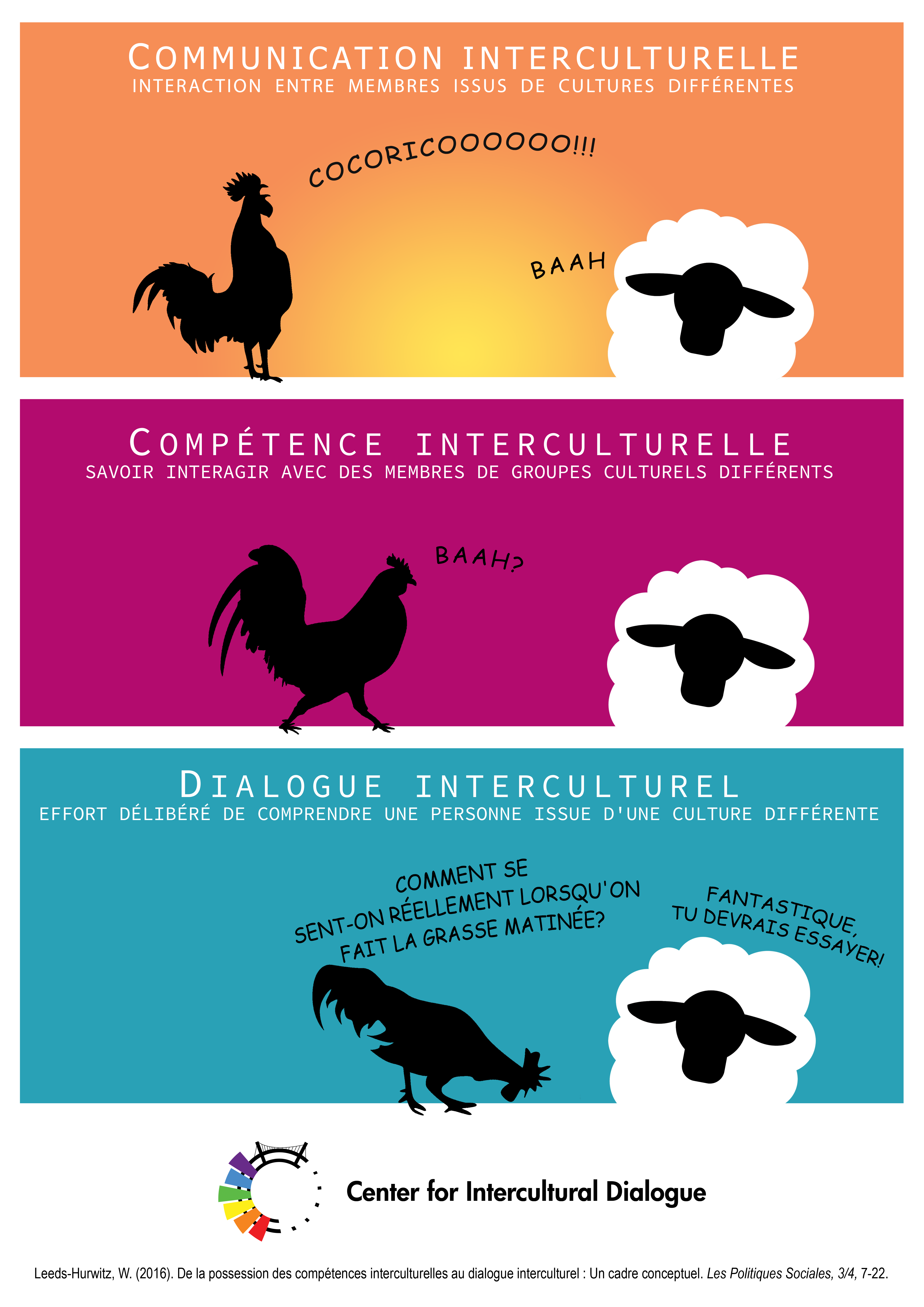
CID Poster 1: Intercultural Communication / Competence / Dialogue Translated into French

CID PostersThis is another of the posters designed by Linda J. de Wit, and now translated into French. This one provides a quick and easy way to understand, and differentiate between, the concepts of “intercultural communication,” “intercultural competence,” and “intercultural dialogue,” using a rooster and a sheep to represent members of different cultures (and she notes that the animals are vector designs by vecteezy.com).

The article where these explanations of these concepts (as well as lots of other concepts) were published is:

Leeds-Hurwitz, W. (2016). De la possession des compétences interculturelles au dialogue interculturel: Un cadre conceptuel [Moving from having intercultural competencies to constructing intercultural dialogues: A conceptual framework]. Les Politiques Sociales, 3/4, 7-22.

The French translation was provided by Léonie Potvin, and the graphic design work necessary to revise was by Yan Qiu. Here then is CID Poster 1: Communication/Compétence/Dialogue Interculturel.

CID Poster 1: Intercultural Communication / Competence / Dialogue Translated into FrenchJust in case anyone wants to cite this poster, the following would be the recommended format:

Center for Intercultural Dialogue. (2024). Communication / Compétence / Dialogue Interculturel [L. Potvin, trans.]. CID Posters, 1. Available from: https://centerforinterculturaldialogue.org/wp-content/uploads/2024/10/cid-poster-1-animals_french.png

As with other series, CID Posters are available for free on the site; just click on the thumbnail to download a printable PNG. They may be downloaded, printed, and shared as is, without changes, without cost, so long as there is acknowledgment of the source.

As with other CID Publications, if you wish to contribute an original contribution, please send an email before starting any work to receive approval, to minimize inadvertent duplication, and to learn about technical requirements. As is the case any series, posters should be created initially in English. If you want to volunteer to translate a poster into a language in which you are fluent, send in a note before starting, to receive approval and to confirm no one else is working on the same one.

Wendy Leeds-Hurwitz
Director, Center for Intercultural Dialogue
intercult.dialogue AT gmail.com


Creative Commons License
This work is licensed under a Creative Commons Attribution-NonCommercial-NoDerivatives 4.0 International License.

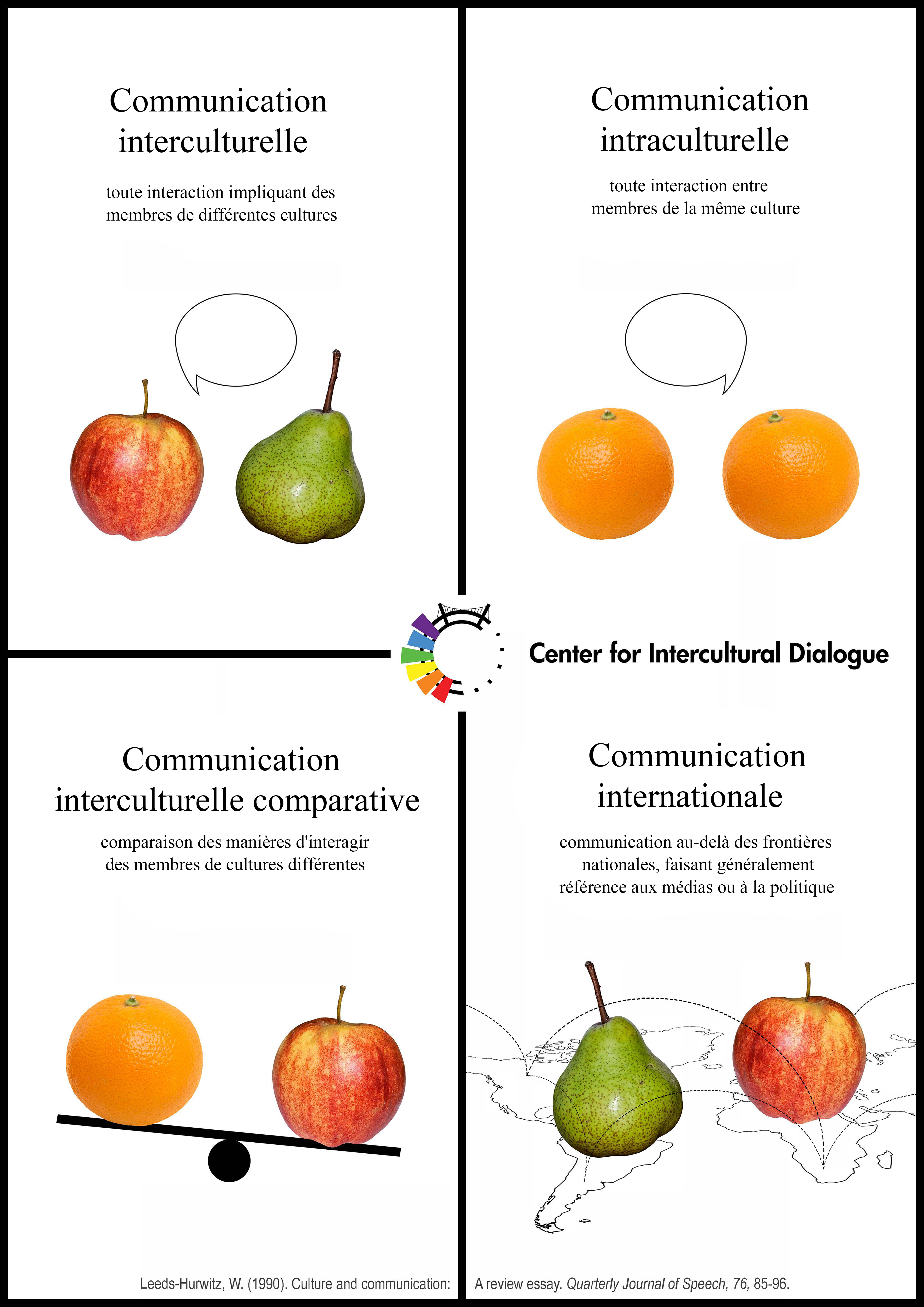
CID Poster 4: Types of Cultural Communication Translated into French

CID PostersSeveral years ago Linda J. de Wit created a dozen CID posters. The Center has just been asked to translate some of these into French, and is in the process of doing so.

Here we present the first one completed, CID Poster 4: Types de communication culturelle, which clarifies the differences between intercultural, intracultural, cross-cultural, and international communication. This new version of the poster now exists thanks to the French translation provided by Léonie Potvin, and the graphic design work by Yan Qiu.

CID Poster 4: Types of Cultural Communication translated into French

Just in case anyone wants to cite this poster, the following would be the recommended format:

Center for Intercultural Dialogue. (2024). Types de communication culturelle [L. Potvin, trans.]. CID Posters, 4. Available from: https://centerforinterculturaldialogue.org/wp-content/uploads/2024/10/cid-poster-4_french.png

As with other series, CID Posters are available for free on the site; just click on the thumbnail to download a printable PNG. They may be downloaded, printed, and shared as is, without changes, without cost, so long as there is acknowledgment of the source.

As with other CID Publications, if you wish to contribute an original contribution, please send an email before starting any work to receive approval, to minimize inadvertent duplication, and to learn about technical requirements. As is the case any series, posters should be created initially in English. If you want to volunteer to translate a poster into a language in which you are fluent, send in a note before starting, to receive approval and to confirm no one else is working on the same one.

Wendy Leeds-Hurwitz
Director, Center for Intercultural Dialogue
intercult.dialogue AT gmail.com


Creative Commons License
This work is licensed under a Creative Commons Attribution-NonCommercial-NoDerivatives 4.0 International License.

Loyola Marymount U: Intercultural Communication (USA)

“Job

Instructor of Intercultural Communication, Communication Studies, Loyola Marymount University, Los Angeles, CA, USA. Deadline: 3 January 2025.

The Communication Studies Department at Loyola Marymount University (LMU), Los Angeles seeks applications for one full-time, non-tenure track Instructor position in Intercultural Communication, beginning Fall 2025. The teaching workload for this position is 3/3. The chosen candidate will teach students to apply and evaluate theories in intercultural communication and emphasize global challenges in their teaching and research. The ideal candidate should have expertise in one or more of the following areas: communication across and within cultures, perceptual and behavioral contexts, the use of communication to address disparities.

Illinois College: Intercultural Communication (USA)

“JobAssistant Professor of Intercultural Communication, Illinois College, Jacksonville, IL, USA. Deadline: open until filled; posted 5 September 2024.

The Department of Communication Arts at Illinois College invites applications for an assistant professor, tenure-track position in Intercultural Communication with primary focus on intercultural communication within organizations to begin Fall 2025. Strong preference will be given to candidates with expertise and/or interest in studying issues of race, ethnicity, and culture within organizations in the U.S. context.

Secondary areas of particular need for the department include the ability to teach business communication, public relations, mass communication, and health communication. Candidates should have an interest and ability to teach the department’s introductory public speaking course. While most teaching is on campus, preference for candidates who have online teaching experience and an interest in teaching in the online program. Candidates must have a strong commitment to undergraduate teaching, advising, scholarship, and service. The department seeks candidates committed to diverse and inclusive perspectives in teaching, scholarship, and service as well as enthusiasm for working closely with students in a liberal arts setting.

CFP ECA: Contemporary Problems, Creative Solutions (USA)

ConferencesCall for Papers and Panels: Intercultural Communication Interest Group, Eastern Communication Association, March 26-30, 2025, Buffalo, NY, USA. Deadline: 16 October 2024.

The Intercultural Communication Interest Group is requesting paper and panel submissions for the 116th Annual ECA Convention. The 2025 convention theme is Contemporary Problems, Creative Solutions, encouraging “submissions that interrogate the following:

  • How can Communication Studies scholarship, teaching, and practice provide creative solutions to contemporary societal, environmental, geopolitical, technological, and economic problems?
  • How can we best prepare undergraduate and graduate students to address these contemporary problems with creative solutions?
  • How can we extend Communication Studies scholarship, teaching, and practice to settings and situations outside our traditional contexts?

The Intercultural Communication Interest Group is devoted to the study and practice of representing, performing, and negotiating cultural identities in face-to-face interaction and mediated communication in cross-cultural and international contexts. The interest group welcomes submissions from scholars at all stages in their academic careers, especially those interested in integrating theory and practice in intercultural communication research.

As much of our work intersects with diverse voices and methodologies, organizers especially encourage proposals that can be co-sponsored by our colleagues in Voices of Diversity and Interpretation & Performance Studies. Some ideas for consideration include critical/cultural considerations, autoethnographic engagement, narrative methodological work, and performance pieces.