Constructing ICD #14: Intercultural Case Management: Addressing Discrimination to Empower Migrants

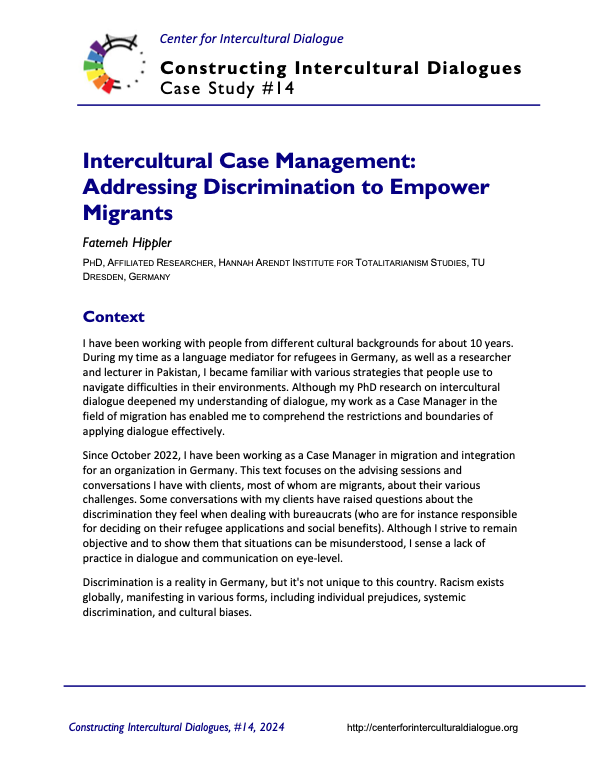
Constructing ICDThe next issue of Constructing intercultural Dialogues is now available, “Intercultural Case Management: Addressing Discrimination to Empower Migrants” by Fatemeh Hippler.

Case management in the context of migration refers to a structured process that helps migrants navigate the complexities of resettlement, integration, and legal processes. Key components include assessment, planning, and monitoring. A crucial component of case management is empowerment, which involves helping migrants build the skills and confidence needed to navigate their new environment independently over time. It fosters autonomy and self-sufficiency, allowing migrants to take control of their lives and decisions.

As a reminder, the goal of this series is to provide concrete examples of how actual people have managed to organize and hold intercultural dialogues, so that others may be inspired to do the same. As with other CID series, these may be downloaded for free. Click on the thumbnail to download the PDF.

Constructing ICD 14: Intercultural Case Management: Addressing Discrimination to Empower MigrantsHippler, F. (2024). Intercultural case management: Addressing discrimination to empower migrants. Constructing Intercultural Dialogues, 14. Available from: https://centerforinterculturaldialogue.org/wp-content/uploads/2024/10/constructing-icd-14.pdf

If you have a case study you would like to share, send an email to the series editor, Wendy Leeds-Hurwitz.


Creative Commons License
This work is licensed under a Creative Commons Attribution-NonCommercial-NoDerivatives 4.0 International License.

DFG Fellowships and Funding for Refugee Researchers (Germany)

Fellowships

The Deutsche Forschungsgemeinschaft (DFG, German Research Foundation) supports researchers who have fled their home countries by making it easier for them to join research projects and apply for funding under the Walter Benjamin Programme. Deadline: open.

The following requirements must be met in principle:

  • The person has not been outside their home country for more than three years at the time of application and

  • they have residential status in connection with an asylum procedure within the EU and are recognised as being at risk, or

  • in lieu of proof of residency status, they are able to present credible third-party evidence of being at risk no more than 12 months prior to application.

This way, the DFG also underlines its solidarity with researchers from Ukraine and Russia who had to flee their home country due to the current war situation triggered by the Russian attack. By integrating them swiftly in the German research system, the aim is to enable them to maintain continuity in their academic work.

In acute crisis situations, proposals can be submitted without proof of the respective status after consultation with the DFG.

Individuals are only eligible for sponsorship if they have not previously been sponsored through the Philipp Schwartz Initiative of the Alexander von Humboldt Foundation and the Federal Foreign Office or under any comparable programme for integration in the academic system or have been employed in the German academic system via a fellowship or a position for a total of two years or more.

Leuphana Institute for Advanced Studies in Culture and Society Fellowships 2026/27 (Germany)

FellowshipsCall for applications: Fellowships at the Leuphana Institute for Advanced Studies in Culture and Society, Leuphana University Lüneburg, 2026-27. Deadline: 15 January 2025.

The Leuphana Institute for Advanced Studies in Culture and Society at Leuphana University Lüneburg invites applications for 12-month fellowships in residence for 2026/27 starting April 1, 2026 and ending March 31, 2027. The research programme aims at countering a discourse of no alternatives. It fosters engaged scholarship to uncover, support, and multiply modes of social potentialization by questioning existing certainties and therefore activating new possibilities.

They invite researchers to investigate the historical, contemporary, socio-cultural, epistemological, political-economic, legal, and technical-scientific conditions of living together in a globalized, entangled world.

CrossCulture Programme Fellowships (Germany)

FellowshipsCrossCulture Programme Fellowships, Institut für Auslandsbeziehungen (IFA), Germany. Deadline: 5 December 2024.

Each year around 55 Fellowship recipients from host organisations in Germany or in one of the over 40 partner countries gain experience in intercultural networks. Through occupational stays abroad, the programme enables and promotes actors from the cultural, educational, human rights, sustainability, scientific, and media sector to work together. The goal of the CrossCulture Programme is to strengthen lasting civil society networks between Germany and countries across the globe. The programme was launched in 2005 and now counts more than 1.100 alumni to its ever-growing network.

With the CCP Fellowships, the CrossCulture Programme (CCP) funds professionals and committed volunteers from more than 40 countries each year. During two to three months of work-related stays in host organisations in Germany or CCP partner countries, participants deepen their expertise, establish new contacts and acquire intercultural skills. In turn, the host organisations benefit from the expertise, regional knowledge and networks of the CCP Fellows. Participants can also attend transcultural workshops, networking and professional events hosted by the CCP. After returning to their daily working lives, participants then bring the experience they have gained into their home organisation.

CFP Meth@Mig: Between Data and Dialogue: Focusing on Participants in Migration Research (Germany)

ConferencesCall for submissions: 4th Annual Meth@Mig Workshop: Between Data and Dialogue: Focusing on Participants in Migration Research, Chemnitz University of Technology, Chemnitz, Germany, 3-4 April 2025. Deadline: 8 December 2024.

In migration research, as in social research more generally, the role of participants is critical in shaping both the data collected and the knowledge generated from it. Depending on the methodological approach and research question, participants may be seen as mere providers of information, or be involved as more active contributors and co-creators of knowledge. How researchers engage with participants profoundly influences the results, ethical considerations, and validity of studies. This also holds true with respect to long-established qualitative, quantitative, and mixed-mode approaches, but also considering methods building on artificial intelligence (AI), machine learning, and digital behavioral data, where the continuum may run from the collection of digital traces of individuals that are not even aware of being studied to their voluntary, informed data donations.

Therefore, this workshop will focus on the role that participants may play in any stage of the research cycle, spanning from a project’s design phase to the dissemination of its results. This workshop aims to facilitate a discussion on how different methodologies influence the role of participants and gain insight into the ethical challenges that arise when involving or excluding them at different stages.

Possible topics that might be addressed include (without being limited to them):

  • Scientific Quality: How does the role of participants in research have an impact on overall scientific quality, including validity and reliability of the data and research results, and the rigor of data collection, analysis, or interpretation?

  • Ethical Considerations: What kind of complex ethical responsibilities (e.g., who is responsible for protecting participants and avoiding potential harm) and complex power relations (e.g., persistence of the power dynamics even though participants are actively involved in research) arise depending on the role of participants in research?

  • Practical Issues: What practical issues arise if participants have varying levels of engagement in the research process, including questions of dataset ownership, data management and protection, and entitlement to authorship of research outputs?

  • Impact of Methodological Innovation: What new complexities arise with the use of emerging methodologies and data sources?

Organizers welcome contributions from any methodological school or angle (e.g., qualitative, survey-based, mixed, relying on digital trace data) that critically explore the role of participants in research, examining the ethical and methodological implications of treating participants as data providers versus involving participants as active collaborators in the research process. A clear methodological focus is required for all contributions.

Jane Yau Profile

Profiles

Jane Yau is a senior researcher at the Leibniz Institute for Research and Information in Education in Germany.

Jane YauShe is a member of the Global Young Academy and co-led the Science Education for Youth and UN SDGs working groups from 2022-24. She is also a member of the International Science Council and an expert member of the Science Education consultative working group. In addition, she is an Advisory Committee member of the Smithsonian Science Education Center based in Washington DC. Previously, she was a Visiting Researcher at the UNESCO Institute for Lifelong Learning, Hamburg.

She is currently the Program Manager of a Horizon Europe project – GREAT Realising Effective and Affective Transformation (2023-26), that aims to use games as an effective global communication channel between citizens and policy-makers. Via games, citizens’ attitudes on climate policies are collected with the aim of supporting policy-makers to make policies more suited to their needs. She has published over 80 articles in Mobile Learning, Learning Analytics and Educational Technologies.


Work for CID:

Jane Yau is participating in an expert group organized by the Center.

U Tübingen: Postdoc in Peace & Conflict Studies/International Relations (Germany)

Postdocs

PostDoc Position in Peace and Conflict Studies/International Relations, Universität Tübingen, Germany. Deadline: 18 October 2024.

The Faculty of Social Sciences, Institute of Political Science, University of Tuebingen is seeking to fill one vacancy in the research cluster on Peace and Conflict Studies/International Relations from 1 February 2025 one PostDoc Position in the area of Peace and Conflict Studies. The PostDoc will contribute to research within the areas of conflict analysis and post-conflict peace building. S/he will also be given the opportunity to develop and pursue her independent research and contribute to teaching. The teaching load is 4 hours per semester and includes introductory modules in International Relations as well as seminars in conflict research and quantitative methods. The successful applicant will be expected to contribute to the administration of the research cluster.

Universität für Weiterbildung Krems: 3 Positions in Migration/Globalization (Germany)

“Job

Multiple positions related to migration and globalisation, Universität für Weiterbildung Krems, Germany. Deadline: varies by position. 

Senior Scientist (postdoc), Department of Migration and Globalisation. Deadline 30 September 2024.

This search is for a Post-Doctoral Researcher interested in conducting independent research on ethical issues related to migration policy making. The topic should fit broadly within the thematic scope of the project The Ethics of Migration Policy Dilemmas. Candidates should submit a brief outline in their application defining the topic they want to research about and explaining in which way their topic relates to the aims of the Dilemmas project. In particular, they welcome applications by researchers that have recently finished their PhD and who want to use the time to publish one or two articles out of (or as a follow-up to) their dissertation work, as well as to prepare a new research proposal for external funding (for example by the Austrian Science Fund’s ESPRIT program, the Austrian Academy of Sciences’ APART program, or the European Union’s Marie Curie program).

Early Stage Researcher (PhD Student), Department of Migration and Globalisation. Deadline: 25 September 2024.

This position begins with a two-month Visiting Research Fellowship dedicated for drafting a PhD Proposal. Upon successful evaluation, it transitions into a three-year fixed position within the ERC Starting Grant project “MixedRivals”, funded by the EU. The PhD candidate will play a pivotal role in the MixedRivals project, primarily focusing on the data collection related to de facto (forced) migration policies, supporting qualitative interviews, and assisting with survey design and analysis. This position offers a unique opportunity to engage in cutting-edge research at the intersection of (forced) migration and conflict studies.

Project Research Associate, Research Lab Sustainable Cultural Heritage. Deadline: 1 October 2024.

The research associate will have the following tasks: to conduct research in the field of historical textiles and bookbinding techniques, focusing on conservation methods; develop and refine research charters, transitioning these into an electronic format; manage and safeguard research data, contributing directly to ongoing conservation projects; writing scientific texts and presenting the results; gain specialized expertise through research work, which will significantly enhance future career prospects; and participate in project coordination and management tasks as required.

Munich School of Philosophy: Ethics of Intercultural Dialogue (Germany)

Study AbroadEthics of Intercultural Dialogue Certificate Programme, Munich School of Philosophy, Munich, Germany (but online). Application deadline: 15 September each year to begin in October.

What is right and what is wrong in a globalized world? What values count in a society of diversity? The part-time English study programme “Ethics of Intercultural Dialogue” focuses on the ethical questions professionals face in today’s globalized and culturally diverse world. This programme was introduced for the first time in the winter semester 2023/24 and is a graduate level certificate programme available entirely online and in English. It offers a robust ethical foundation, political-philosophical insights, and practical orientation knowledge, ideal for professionals who aspire to deepen their skills and broaden their understanding and reflection. Important facts:

  • Offered by: the Munich School of Philosophy and Jesuit World-Wide Learning
  • Programme Type: Certificate programme (36 ECTS), graduate level, English, fully online
  • Start: every year fall term (October), application any time (deadline Sept. 15th)
  • Tuition fees: 2,880.00 € plus semester fees (approx. 240€/Semester)
  • Q&A Session: 30th July 2024 at 7pm CEST online.

The course is designed for working professionals and leaders who are confronted with the challenges of globalization in their professional contexts and are particularly interested in ethical reflection. These are, for example, people who work in international companies, educational institutions, non-governmental organizations, social work, churches, advocacy groups, medical fields incl. care work, political institutions or as freelance consultants. EID is also attractive for students who seek expertise in intercultural communication. Since this programme is a collaborative effort with Jesuit Worldwide Learning, marginalized people and refugees from around are also a crucial target group.

For more information check out their website hfph.de/eid or contact the programme-coordinator, Julianne McCormack.

DAAD Postgraduate Scholarships & Research Grants (Germany)

“Studentships“

Postgraduate studies, scholarships and research grants , DAAD, Bonn, Germany. Deadline: varies by program.

DAAD (Deutscher Akademischer Austauschdienst, or German Academic Exchange Service) has a scholarship programme offering a wide range of opportunities, from master’s degrees to doctoral degrees, and including research grants. A few examples include:

Master Studies for All Academic Disciplines

Research Grants in Germany (during doctorate or early post-doctoral phase)

Research Grants – Doctoral Programmes in Germany