Norwegian School of Economics Studentship: Professional and Intercultural Communication (Norway)

“Studentships“

PhD Research Scholar : Professional and Intercultural Communication, Norwegian School of Economics (NHH), Bergen, Norway. Deadline: 15 January 2024.

NHH is pleased to announce vacancies as PhD research scholar at the Department of Professional and Intercultural Communication. The department welcomes applications within three fields of research as specified below. The PhD specialisations offered by the Department of Professional and Intercultural Communication aims to give dedicated students solid training in performing high quality research. The students must undertake relevant course work equivalent to 45 ECTS. Given the international focus of the department, the PhD research scholars are strongly encouraged to carry out some of their coursework abroad or at other Norwegian institutions.

Qualifying education in the PhD specialisations in Professional and intercultural Communication should normally be a master’s degree in language/linguistics or translation. Emphasis will be placed on the quality and relevance of the research proposal. Some formal education in economics, business administration or other social sciences is an advantage.

In the application, candidates should state explicitly which research area they are applying for. Research proposals should preferably include a sustainability perspective.

  • Specialised translation

The research proposal should focus on translation of specialised texts preferably from or into Norwegian or a Scandinavian language, but other language combinations may also be relevant.

  • Digital text analysis

The research proposal should include computational approaches and focus on data and topics relevant for business organisations.

  • Discourse analysis/Conversation analysis

The research proposal should focus on the qualitative study of professional communication. Possible topics include, but are not restricted to, intersubjectivity, pragmatic strategies, multilingualism, or English as a business lingua franca.

New CID Competition/Publication: Student Voices

“Student Voices

This is a reminder the Center for Intercultural Dialogue has invited students to apply for the opportunity to be published in a new publication, titled Student Voices.

Students (at any level, high school to doctoral students) may submit entries at any time; they will be judged four times/year. All entries submitted will be reviewed, and the best ones prepared for publication. This is not a competition with just a few winners; all entries passing review will be published. The students whose work is accepted for publication will be given profiles on the website. The first winner’s essay was published in September: Rohak Jain, a high school student at Interlake High School in Belleview, wrote The Virtues of an Open Mind: Making Room for Flexibility in Intercultural Dialogue.

The goal of the competition is to invite a wide range of students to tell the story of their own experience with intercultural dialogue, or what they have learned about intercultural dialogue, or what they want to share with others. As made clear on our website, intercultural dialogue is jointly constructed by participants, requiring cooperation to engage in new and different ways of interacting. This series is designed to publicly amplify the voices of students who have engaged in intercultural dialogues. Those dialogues do not have to have been successful; we can learn as much from things that go wrong as when things go right.

There will be several deadlines per year, to accommodate different schedules. The next deadline is February 29, 2024. Details about Student Voices can be found by reading the original post.

King’s College London: International Relations (UK)

“Job

Reader in International Relations, King’s College London (KCL), London, UK. Deadline: 10 January 2024.

The Department of War Studies seeks to appoint a Reader in International Relations in order to contribute to the Department’s teaching and research capacity. The Department is looking for a candidate with a strong research and teaching background in International Relations theory, broadly defined. The successful candidate will have a track record of high-quality publications, research funding and innovative teaching in the field of International Relations. The successful candidate will be expected to contribute to both compulsory and optional teaching in the department at both BA and MA levels. In particular, the successful candidate will be expected to contribute to the leadership and teaching of the Department’s MA degree in International Relations and should have the background and research interests commensurate with leading a large post-graduate programme that explores International Relations from a variety of theoretical and methodological perspectives.

Duolingo: Learning Designer for Languages (USA)

“JobLearning Designer for Languages, Duolingo, Pittsburgh, PA, USA. Deadline: open until filled (posted early December 2023).

Duolingo, the enormously popular language-learning application, is looking for an outstanding language enthusiast and educator with a strong background in linguistics, languages, language typology, and language teaching. The ideal candidate is a polyglot energized by diving into languages they don’t (yet) know, with a passion for developing language-learning materials and a combination of analytical and creative skills. At Duolingo, you will have an opportunity to apply your skills and knowledge in a fast-paced, collaborative environment, where you see the immediate impact of your work on millions of learners worldwide.

You Will…

  • Work side by side with other learning designers, project managers, and engineers to deliver high-quality course curricula and content for a variety of languages
  • Leverage generative AI for creating content that is fun, accessible, and targets learners at specific proficiency levels
  • Use your “generalist” linguistic skills to effectively work across different languages, consulting subject matter experts as needed
  • Review, edit, and proofread learning materials for our language courses
  • Train and supervise other course content creators

You Have…

  • Linguistics background. You have an MA (or equivalent experience) in linguistics, applied linguistics, language (with a linguistic focus), or a related field.
  • Language knowledge. You have basic proficiency in multiple languages, including at least two of the following: Spanish, French, German, Italian, Chinese, Japanese, Korean. You can quickly get up to speed on the key properties of unfamiliar languages.
  • Curriculum design and teaching experience. You have taught at least one language other than English, and have strong skills in designing language curricula.
  • Analytical thinking. You can think about language in a structured and analytical way. For example, you excel at breaking down grammatical concepts into smaller parts for the purposes of teaching.
  • Creativity. You think outside the box and have excellent intuitions about how to build content that is engaging to a wide range of learners.
  • Excellent collaboration skills. You have outstanding interpersonal and communication skills. You give and receive feedback well, and you build and maintain strong professional relationships with colleagues.
  • Operational focus. You are organized and efficient, and strive to continuously improve your workflow and processes.

Duolingo has many other positions available as well (full-time and part-time, US and international) – see their jobs page.

CFP Feminist Pedagogy: Pedagogies of Peace

“Publication

Call for submissions: Feminist Pedagogy Special Issue: Pedagogies of Peace: Witnessing, Dialogue, and Collective Healing. Deadline: 8 January 2024 abstract; 26 February 2024 full paper.

Special Issue Editor: Caitlin Marie Miles (Denison University, USA).

In the last 20-25 years, our social and political worlds have been marked by a saturation of ongoing political, state-sanctioned, and extrajudicial violence, made all the more visible and palpable by the 24hr news cycle, live streaming, and ubiquity of social networking platforms. The lingering traumas and resultant violences from 9/11, U.S. invasion of Iraq, police killing of unarmed black men and women, civil war in Syria and Yemen, famine in the horn of Africa, coup-attempts stretching across the globe, the Russian invasion of Ukraine, humanitarian crisis in Gaza and October 7th attacks, ethnic cleansing in the Democratic Republic of Congo, in addition to other forms of structural violence that increasingly make “life” untenable for many of our most vulnerable neighbors. While these conflicts of the last two decades are certainly bound up in a globally intertwined military-industrial complex, they each resonate with us, our students, our campuses, and classrooms in unique and contingent ways. Moreover, while contending with the traumas of witnessing and experiencing these violences, we must find ways to center peace, dialogue, and community-centered forms of catharsis so as not to perpetuate the normalcy and ontology of war.

With this in mind, this special issue invites critical commentaries (1,000-1,200 words) and teaching/classroom strategies (1,500 – 2,500 words), which may include topics such as:

  • Teaching about and discussing political violence such as police brutality, war, ethnic cleansing/genocide, terrorism, and other forms of violence in ways that consider intersecting identities and positionality

  • Witnessing as a means of trauma-informed pedagogy and community-building in the classroom

  • Approaches to cultivating safe and brave classroom spaces when critically analyzing of complex, intertwined, and politically controversial conflicts

  • Centering stories and narratives of empowerment, peace, arts, and culture of communities and places stereotyped as violent in mainstream discourses

  • Strategies for connecting urgent and pressing current events to our various course themes

  • Media-making, journaling, and other forms of creative expression that foster understanding, catharsis, and/or healing

  • The role of setting ground rules and obtaining consent in class discussions on political/politicized violence

  • Reflections on successes AND failures in teaching and discussing violent, potentially traumatic, and/or triggering topics

Also of interest are Media Reviews of educational resources and documentaries useful for teaching on these subjects (500-1,000 words). They ask that media criticism be constructive in nature and largely positive. Reviews should note the scope and purpose of the work and its usefulness to educators. They are particularly interested in reviews that detail ways to use the media as a teaching tool.

AIEA Workshops on Internationalization 2024 (USA)

EventsAssociation of International Education Administrators Workshops, 23-25 January 2024 (some also available online).

Before their annual conference (the deadline for submission is unfortunately long past), the Association of International Education Administrators (AIEA) is holding a series of workshops, some of which are virtual and open to non-members, though at a cost.

Virtual workshops:

  • ​Navigating the Diversity, Equity, Inclusion, and Belonging (DEIB) Landscape: Strategies for Senior International Officers (SIOs)
    Tuesday, January 23; 2:00 p.m. – 4:30 p.m. ET
  • Becoming an SIO: What You Need to Know
    Tuesday, January 23; 10:00 a.m. – 12:30 p.m. ET
  • ​Internationalization as if the Planet Mattered: Strategy and Policy that Makes Programming and Global Learning Eco-literate and Sustainable
    Thursday, January 25; 10:00 a.m. – 12:30 p.m. ET
  • Making the Case for Internationalization
    January 25, 2024; 2:00 p.m. – 4:30 p.m. (ET)

On-site workshops will be held in Washington, DC.

Intercultural Leadership Institute Fellowships (USA)

FellowshipsCall for applications: Intercultural Leadership Institute Fellowships 2024, San Antonio, TX, USA. Deadline: 12 January 2024.

“The Intercultural Leadership Institute is a year-long intensive leadership experience for artists, culture bearers and other arts practitioners. ILI is a collaborative program of Alternate ROOTS, First Peoples Fund, National Association of Latino Arts & Cultures (NALAC) , PA’I Foundation, Sipp Culture, First Alaskans Institute, and The International Association of Blacks in Dance. The effort grew out of our direct experiences as leaders of these founding cultural organizations. We often found that many personal and professional leadership programs emphasized dominant cultural norms, modes of learning and social approaches that didn’t match our commitment to cultural equity and change-making in our own communities.

ILI’s “intercultural” approach emphasizes overlapping experiences, shared spaces and mutual accountability – and seeks to challenge dominant social norms while honoring differences of histories, traditions, vocabulary and more. We seek to develop leaders specifically within the arts & culture field to adeptly respond to significant changes that impact society, politics, environment and economy. As a peer cohort, ILI intercultural leaders hone personal and professional skills to affect local, national and global communities – and promote a shift toward greater awareness, resourcing and action in the broader field of arts & culture.”

ILI Year 6 (2024) application here. Unfortunately, ILI does not accept applicants from individuals who reside outside of the United States and US Territories.

CFP Promoting Human Rights, Building Peace, and Progressing Democracy (USA)

ConferencesCall for papers: Conference in Conjunction with 25th Anniversary of NATO Intervention in Kosovo: Promoting Human Rights, Building Peace, and Progressing Democracy, 26-28 March, 2024, Clinton Presidential Center, Little Rock, AK, USA. Deadline: 31 December 2023.

This conference will bring together practitioners, policy makers, and scholars to reflect on the lessons of the humanitarian intervention in Kosovo and the developments in the last 25 years that offer both challenges and opportunities for democracy, peace, and security not only in Southeastern Europe, but around the globe. Organizers envision conversations and activities that are above all practical in nature, in which practitioners, policy makers, and democracy scholars present, discuss and debate bold actions for promoting human rights, building peace, and progressing democracy globally based on lessons from taking just and necessary stands, such as the one taken in Kosovo, against genocide and the violation of human rights.

They specifically encourage proposals from those who work at the intersection of theory and practice in a variety of areas including but not limited to:

  • Political Theory & Practice
  • Political & Public Communication
  • Media Studies
  • International Relations
  • Public Policy Analysis
  • Conflict & Public Dispute Resolution
  • Peacemaking & Peacebuilding
  • Security Studies
  • Deliberative Democracy Practice
  • Collaborative Governance
  • Community Engagement

In keeping with the commitment to action from President Clinton, the Clinton Foundation, the Clinton Presidential Library, and the Clinton School of Public Service, the focus of the conference would be the on-going real-world work of people who have made a commitment to ensure safe places to learn, practice, and exercise democratic actions continue to not only exist but to strive and grow.

KC10 Cross-Cultural Dialogue Translated into German

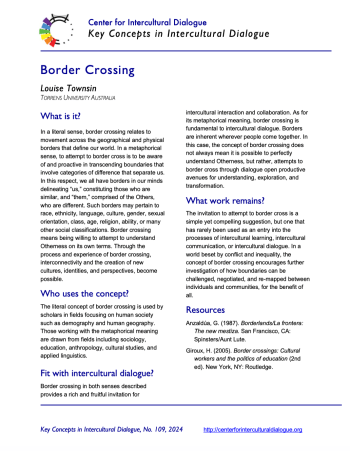
Key Concepts in ICDContinuing translations of Key Concepts in Intercultural Dialogue, today I am posting KC10: Cross-Cultural Dialogue, which I wrote for publication in English in 2014, and which Marlena Pompino has now translated into German.

As always, all Key Concepts are available as free PDFs; just click on the thumbnail to download. Lists of Key Concepts organized chronologically by publication date and number, alphabetically by concept, and by languages into which they have been translated, are available, as is a page of acknowledgments with the names of all authors, translators, and reviewers.

KC10 Cross-cultural dialogue translated into German

Leeds-Hurwitz, W. (2023). Kulturübergreifender Dialog (M. Pompino, Trans). Key Concepts in Intercultural Dialogue, 10. Available from:
https://centerforinterculturaldialogue.org/wp-content/uploads/2023/11/kc10-cross-cultural-dialogue_german.pdf

If you are interested in translating one of the Key Concepts, please contact me for approval first because dozens are currently in process. As always, if there is a concept you think should be written up as one of the Key Concepts, whether in English or any other language, propose it. If you are new to CID, please provide a brief resume. This opportunity is open to masters students and above, on the assumption that some familiarity with academic conventions generally, and discussion of intercultural dialogue specifically, are useful.

Wendy Leeds-Hurwitz, Director
Center for Intercultural Dialogue


Creative Commons License
This work is licensed under a Creative Commons Attribution-NonCommercial-NoDerivatives 4.0 International License.


Strong Cities Network: Head of Western Balkans Regional Hub

“JobHead of Western Balkans Regional Hub, Strong Cities Network, remote (based in Albania, Bosnia and Herzegovina, Kosovo, Montenegro, North Macedonia or Serbia). Deadline: 15 December 2023.

Launched at the United Nations in 2015, Strong Cities is an independent global network of more than 220 cities and other local governments dedicated to addressing all forms of hate, extremism and polarisation at a local level.

The Head of the Western Balkans Regional Hub will lead engagement with mayors and cities, as well as other relevant partners including national governments, multilateral and civil society organisations and donors, fostering strong and effective relationships to deliver the Strong Cities mission. The role will lead coordination and implementation of an annual workplan, build high-level strategic partnerships and strong relationships with relevant stakeholders and partner institutions in the region, and lead ongoing development and sustainability efforts. Overall, the role will ensure that the Network’s strategy and activities are driven by – and ultimately responds to – the needs and gaps that cities themselves identify in their ability to prevent hate, violent extremism and polarisation at local levels.