RMIT University: Deputy Dean, International (Australia)

“Job

Deputy Dean, International, RMIT University, Melbourne, Australia. Deadline: 4 February 2024.

As the Deputy Dean, International, you will be responsible for providing strategic and scholarly leadership for all international activities within the School, including both research, and learning and teaching. You will be responsible for strategic planning and the management of the School’s international operations in order to achieve School performance targets in student recruitment, as well as the delivery of high impact and influential research outcomes. You will work across the School and the College to promote collaboration across our international precincts.

A key goal is to expand our international research activities, including working with our staff across our international campuses to expand their research opportunities. The School will develop new innovation hubs across multiple international locations, and as the Deputy Dean, International, you will play a key role in driving this new activity.

The position will require the ability and willingness to travel across our international locations.

CFP World Anthropological Union (South Africa)

Conferences

Call for papers: World Anthropological Union, 11-15 November 2024, University of Johannesburg, South Africa (in person). Deadline: 31 January 2024.

Reimagining Anthropological Knowledge: Join others in Johannesburg, South Africa, from November 11th to 15th, 2024, for a transformative exploration of anthropological knowledge under the theme: “Reimagining Anthropological Knowledge: Perspectives, Practices, and Power.” Organizers invite you to contribute your insights to this groundbreaking event organized by Anthropology Southern Africa and hosted by the University of Johannesburg.

Key Themes for Panel Proposals:
– Changing fields of anthropological subdisciplines
– Politics of producing social, cultural, linguistic, biological, and paleo-anthropological knowledge
– Post-covid practices in anthropological knowledge-making
– Digital worlds and the role of new technologies in fieldwork
– Legitimacy of museums and collections as knowledge repositories
– Truth and/or post-truth in knowledge-making and representation
– Anthropology as the humbling practice of learning
– Tensions between local and academic knowledge production
– Disaggregating local knowledges in light of critical decolonial perspectives
– Challenges and successes of the decolonial imperative

CRASSH: Fellowships for Scholars from the Global South 2024-5 (UK)

FellowshipsVisiting Fellowships for Scholars from the Global South: Religious Boundaries, CRASSH, University of Cambridge, UK. Deadline: 25 February 2024.

The Centre for Research in the Arts, Humanities and Social Sciences (CRASSH) at the University of Cambridge is inviting applications for funded Visiting Fellowships for scholars from the Global South. The purpose of these Fellowships is to provide opportunities for scholars working at higher education institutions in the Global South to exchange ideas with other researchers based at CRASSH and elsewhere in the University of Cambridge and to draw benefit from access to the University’s collections and resources. It is hoped that these visits will lead on to future collaborations and exchanges.

For 2025, CRASSH will partner with the Faculty of Divinity and the Cambridge Interfaith Programme. Applications are invited from scholars whose research is connected to the theme of inter-religious relations, with a particular focus on religious boundary-making. This invites projects that study how two or more religious groups form one another in their mutual encounter, when and how they demarcate difference, and how boundaries between them remain mutable through various activities of exchange such as dialogue or missionary endeavours. The call also welcomes projects that are interested in how religious boundary-constructions relate to other articulations of identity, such as ethnicity, class, politics, or gender.

They invite applications from any discipline, including anthropology, history, philosophy, political science, sociology and theology. Projects should aim to advance current understandings of interfaith conflict and dialogue through concrete case studies of religious boundary-making or ideas about them, situated in the Global South.

There are other visiting fellowships possible at CRASSH, but they must be self-funded.

CFP International Rhetoric Workshop: Borders & Crossroads 2024 (Croatia)

Conferences

Call for papers: International Rhetoric Workshop: Borders & Crossroads, 18-20 June 2024, University of Dubrovnik, Dubrovnik, Croatia (in person). Deadline: 18 February 2024.

The Planning Committee for the 4th Biennial IRW invites international PhD students and emerging, early-career scholars to come together and consider the myriad ways that our contemporary and established traditions of rhetorical theory, pedagogy, and criticism inform global flows of meaning-making. Senior and more established scholars are also welcome to apply. This year’s theme, Borders and Crossroads, prompts us to examine the notions of 1) physical, cultural, and conceptual borders that delineate territories and boundaries, marking spaces of distinction, separation, and connection; and 2) crossroads that represent intersecting paths, encounters, confluences, and opportunities to confront and transcend restrictive boundaries. Borders and Crossroads are encountered across inter/national, political, identity, and cultural contexts, all amid widespread refugee, migratory, wartime, economic, racial, and environmental crises. Guided by this theme, the workshop seeks to explore how rhetoric can contribute to shaping novel responses, articulate new socio-political narratives, and cultivate human hopes and imaginaries for resolution, world-making, justice, possibility, sustainability, and reconciliation.

Held over the course of three days, the IRW consists of an opening keynote address each day from internationally renowned scholars, workshop sessions in which participants review and discuss drafts of ongoing research with faculty mentors and each other, and faculty discussion panels engaging topics relevant to the conference theme. This year’s keynote speakers include Lisa A. Flores and Karma Chávez.

CFP Representing/Communicating the US in Local and Global Turmoil

“Publication

Call for chapters for Representing/Communicating the US in Local and Global Turmoil: From Wars to Contemporary Challenges. Deadline: 1 March 2024 (proposal only).

Editors: Mark Finney (Emory and Henry College) and Sudeshna Roy (Stephen F. Austin State University).

This book is among a slate of others being considered for adoption as a series by editors Victoria Ann Newsom (Olympic College) & Lara Lengel (Bowling Green State University) entitled Conflict, Culture, Communication from Lexington Books.

Premise

Views of the United States from a conflict standpoint can vary widely depending on the specific conflict, region, and the time period in question. Different countries and individuals may hold different perceptions of the US based on their own geopolitical interests, historical experiences, and cultural perspectives.

There are a wide range of communication subfields that interact with conflict and peace perceptions about the United States – intercultural communication, rhetoric, critical cultural communication, media studies, global communication and social change, philosophy, theory, and critique, etc. Similarly, scholars have identified different contexts within which the US conflict and peace perceptions unfold.

This book will be influenced by two important questions which have received less attention than they deserve: How do people, engaged in conflict with one another, come to understand their opponents and what roles do institutions, such as, media, international multilateral organizations, national ideological parties, etc., play in the formation and maintenance of beliefs about the others? This book takes the United States as its thematic center, and countries/communities with which the United States has conflict as the spokes. Each author in this volume will examine a contemporary or recent conflict involving the United States and, instead of centering representations in the United States, examine the representations of the United States – representations that cast the United States as the other. The editors believe that the scholarly questions and answers being developed in this book will make useful contributions to the development of knowledge about international conflict situations and conflict resolution, communications studies and international relations. Though designed for scholars, the chapters should be accessible by undergraduate and graduate level courses concerned with representation and conflict management.

(See attached PDF for the full description)

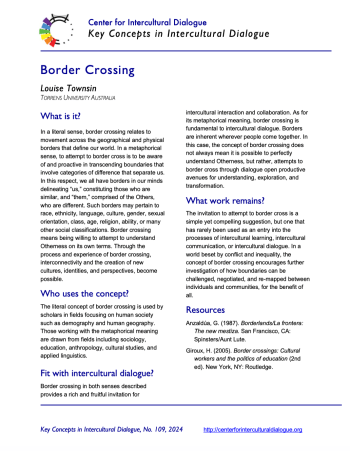
Key Concept 109: Border Crossing

Key Concepts in ICD

The next issue of Key Concepts in intercultural Dialogue is now available. This is KC109: Border Crossing by Louise Townsin. As always, all Key Concepts are available as free PDFs; just click on the thumbnail to download. Lists organized chronologically by publication date and numberalphabetically by concept in English, and by languages into which they have been translated, are available, as is a page of acknowledgments with the names of all authors, translators, and reviewers.

Key Concept 109: Border CrossingTownsin, L  (2024). Border crossing. Key Concepts in Intercultural Dialogue, 109. Available from: https://centerforinterculturaldialogue.org/wp-content/uploads/2024/01/kc109-border-crossing.pdf

The Center for Intercultural Dialogue publishes a series of short briefs describing Key Concepts in Intercultural Dialogue. Different people, working in different countries and disciplines, use different vocabulary to describe their interests, yet these terms overlap. Our goal is to provide some of the assumptions and history attached to each concept for those unfamiliar with it. As there are other concepts you would like to see included, send an email. If there are concepts you would like to prepare, provide a brief explanation of why you think the concept is central to the study of intercultural dialogue, and why you are the obvious person to write up that concept.


Creative Commons License
This work is licensed under a Creative Commons Attribution-NonCommercial-NoDerivatives 4.0 International License.

University of Pennsylvania: Assistant Director, International Studies, Lauder Institute (USA)

“Job

Assistant Director of International Studies, Lauder Institute, Wharton School of Business, University of Pennsylvania, Philadelphia, PA, USA. Deadline: open until filled; posted 11 January 2024.

The Assistant Director for International Studies manages all administrative aspects of Lauder international studies courses and policies related to the core curriculum, Global Program, and non-language Africa Program. A key component of this position is to provide administrative support related to the delivery of the summer term curriculum and the master’s thesis program, which involves project management, data management, support for faculty and students, as well as overseeing assessment of critical writing abilities. This position also supports course logistics for the Global Program, international studies core courses, workshops, and immersions, which include some off-campus programs in domestic and international locations. The incumbent additionally will work with stakeholders to generate and manage website content creation related to academic and programming activities.

U Sheffield: International Business (UK)

“Job

International Business / International Business Strategy, Management School, University of Sheffield, England. Deadline: 23 February 2023.

The Management School at the University of Sheffield has an opportunity for a Professor in International Business or International Business Strategy to deliver excellence in research and teaching. They welcome applications from researchers with expertise in International Business or International Business Strategy who can contribute to the School and the wider University in the areas of research, teaching, leadership and professional standing, and wider engagement. You will contribute to delivering International Business (IB) and/or Strategy teaching at undergraduate and postgraduate levels and to developing programme offerings in the discipline of IB and/or Strategy.

The School has six Subject Groups and this opportunity is located in the Entrepreneurship, Strategy and International Business (ESIB) Group which:
• produces excellence in research, supported by a vibrant and collegiate research environment, and is home to the Centre for Regional Economic and Enterprise Development (CREED);
• delivers postgraduate and undergraduate modules and programmes in international business and management, international business strategy & strategic management, entrepreneurship, enterprise, new venture creation, business economics, and on the Doctoral Programme.

Writing Practices in the Multilingual Workplace (Finland but Online)

EventsWriting practices in the multilingual workplace: A case study of language brokering, by Anna Solin, University of Jyväskylä, Finland (online), 12 February 2024, 12 EET.

On Monday 12 Feb at 12:00 East European Time, Anna Solin (University of Helsinki, Finland) will give a talk titled ‘Writing practices in the multilingual workplace: A case study of language brokering’. The event will be live-streamed online with interactive Q&A after the talk. All are welcome to attend. Read the abstract and register here. Once you’re registered, you’ll be emailed the live stream info soon before the seminar.

Abstract: “In the talk, I will present a study of workplace writing, which focuses on administrative work in multilingual universities. While there is a wealth of research into institutional multilingualism, most studies on higher education have looked at teaching and research, and relatively little is known about the often invisible work of administrators. The study explores the collaborative writing practices of eight administrators who work at a Finnish university, drawing on interviews, meeting recordings and text histories. The analysis tracks the production of a genre which is central to local decision-making: the meeting agenda. Data collection took place during a period when a decision had just been made to begin publishing agendas in two languages (Finnish and English), in order to support the inclusion of international staff. The shift from monolingual to multilingual texts resulted in negotiation over both language choice and what kind of English is “appropriate” or “good enough” in meeting agendas. I will describe this negotiation from the perspective of language brokering, and particularly how different participants intervened in the writing process and the drafts being produced. The analysis focuses on questions such as who/what takes on or is given the role of broker, what kind of language features become targets of negotiation and what normative orientations are displayed in the administrators’ talk.”

U Edinburgh: PHD Scholarship in Peace & Conflict Resolution 2024 (UK)

“Studentships“

Chrystal Macmillan PhD Scholarship, School of Social & Political Science, University of Edinburgh, Edinburgh, Scotland. Deadline: 1 February 2024.

Applications are invited for the Chrystal Macmillan PhD Scholarship, which is offered by the School of Social and Political Science to a new PhD student studying a field relevant to Chrystal Macmillan. This is open only to new PhD pursuing a PhD topic in one of the following fields:

  • social justice
  • gender and equality
  • human rights
  • peace and conflict resolution

Chrystal Macmillan was a pioneering campaigner for social justice. In 1896, she was the first woman to graduate from the University of Edinburgh in science, later converting to law, and becoming one of the first group of women to be called to the English bar in 1924. She was a leading suffragist, campaigning for votes for women and equality of opportunity in other spheres. She was a prominent figure in the international women’s movement, campaigning for peace and conflict resolution during the First World War, and was a delegate to the Paris Peace Conference in 1919.