CFP China international comm annual

China International/Intercultural Communication Annual 2013

For Greater China (including Mainland China, Hong Kong and Macau, Taiwan, as well as overseas Chinese and elsewhere), working within the scope of the relevant international / intercultural communication research group, construction of the academic publishing field, comprehensive reflection of international / intercultural communication research topics, and frontiers of the latest research results, the Chinese Academy of Social Sciences has developed the innovative project “Intercultural Communication in the Age of Globalization: Academic Research and Application of Achievements.” Specifically, we plan to launch the China International / Intercultural Communication  Annual, in order to publish research on international / intercultural communication each year. The annual will be published each October starting in 2014.

We hope this annual will be an important summit from which to review the past and plan the future. We welcome all scholars who are interested in international / intercultural communication research to submit papers. Please submit your proposed title and abstract, as well as your affiliation, academic rank, telephone number and E-mail address.

Deadlines: Title and abstract by 15 September 2013, full paper by 31 December 2013

For submission or inquiry, please email ciica2013 AT 163.com to contact Ms. XIE Ming

CFP Religious others, schooling, civic identities

Religious ‘Others,’ Schooling, and the Negotiation of Civic Identities

Interdisciplinary Symposium
25.06. – 28.06.2014
Hannover, Germany

The symposium will explore the relationship between hegemonic discourses of citizenship, religio-cultural belonging, and the negotiation of civic identities among religio-cultural minority youths in educational settings. The question of how non-dominant youths negotiate their civic identities as citizens in light of their coexisting religio-cultural identities has been at the center of a heated debate in many modern societies. The ongoing public concern about the resurgence of the religious  – and here especially the religious ‘other’ – in the public sphere has led to the emergence of a public debate over how to handle the ‘religious’ in the institutions, civic society, and public sphere of ‘postsecular’ society. The symposium will explore how societal master narratives about secularity, religion/ the religious ‘other,’ and citizenship are instantiated in the everyday practices of schools and classrooms, and how students from religious minority groups in turn come to navigate their identities as citizens.

These questions will be theorized and explored empirically in presentations and discussion workshops focused on 1) the macro-level of hegemonic formations of citizenship and belonging that characterizes classrooms across a variety of settings, with particular attention to the role of the religious ‘other’ in these formations, 2) the micro-level of everyday practices through which these formations are enacted in curricula and in the classroom, 3) the personal experience of moments of inclusion, exclusion, and silencing, and 4) the policy level of ongoing transformations and mutual openings that allow for the construction of a shared civic identity among youths as future citizens.

Researchers from a range of disciplines, including, but not limited to, education, anthropology, religious studies, philosophy, linguistics, sociology, and political science, are invited to participate.

Application deadline with short statement of interest: July 10, 2013

Call for Participation

Travel cost and lodging will be covered for all accepted participants. At this point we are solicitating informal statements of interest of academic researchers who would be interested in contributing to the symposium by giving paper presentations or leading workshops on particular topics. Please send your letter of interest together with a short CV, contact information, and a specification of your research interest in relation to the theme of symposium to: Dr. Julia Eksner by July 10, 2013.

A full proposal will be submitted to the Volkswagen Foundation. If funded, doctoral and post-doctoral students will be invited to participate during fall 2013.

Symposium Organizers:

Julia Eksner, Ph.D.
Freie Universität Berlin
Institute of Social and Cultural Anthropology/ Institute of Intercultural Education
Landoltweg 9-11
14195 Berlin
eMail: julia.eksner AT fu-berlin.de

Zvi Bekerman, Ph.D.
School of Education, Melton Center
Hebrew University of Jerusalem
Mount Scopus
Jerusalem
Israel, 91905
eMail: zvi.bekerman AT mail.huji.ac.il

U Penn ASC job ad

The University of Pennsylvania‘s Annenberg School for Communication is seeking to fill a tenured or tenure track faculty position (open rank) in “digital culture” to begin fall semester 2014.  Preference will be given to early and mid-career scholars whose research and teaching contribute to field, interpretive, and/or critical approaches to the study of culture and its intersection with digital media such as the internet, social media, mobile media, virtual reality, online games, user-generated sites, and/or location-aware media. The specific cultural practices or objects of study are open and could include cultural production, digital design, technoculture, global culture and transnational flows, gender, race and ethnicity, surveillance studies, and/or intellectual property.

Applicants must hold a Ph.D. (in Communication or a related field or discipline) and have a strong record of teaching and research. Responsibilities include conducting a program of research and publication, teaching at the undergraduate and graduate levels (including supervising doctoral dissertations), and contributing service to the school and university.

The Annenberg School for Communication at the University of Pennsylvania is a graduate school of communication theory and research, with 18 full-time faculty and approximately 80 doctoral students representing a wide range of disciplinary backgrounds and interests. The faculty also has primary responsibility for an undergraduate communication major within the School of Arts and Sciences.

Submit letter of interest, curriculum vitae, three names of references, and up to three articles, chapters or other research to Professor Michael X. Delli Carpini, Dean, Annenberg School for Communication, University of Pennsylvania via http://facultysearches.provost.upenn.edu/postings/8. To receive full consideration, applications should be received by September 16, 2013.

The University of Pennsylvania is an affirmative action/equal opportunity employer.

Save

Example of dialogue among cultures

Guest PostsAn interesting example of dialogue among cultures by Maria Flora Mangano.

I have just taught a course in a rather unique context. The course was Communication of Scientific Research, offered to students (MSc and PhD) at the Mediterranean Agronomic Institute, located in Bari (in Southern Italy). The Institute is part of the International Centre for Advanced Mediterranean Agronomic Studies, located in Paris.

This course was an extraordinary experience: five days, of 8 hours of lessons per day, supplemented by moments of dialogue during the meals and after dinner. All told, a very intense week, with more than 25 students from Masters and PhD courses in various agronomic disciplines. Among the group, only two were Italian, the other students coming from almost 15 countries in the Mediterranean area, from Kosovo to Morocco.

The course produced many challenges for me: first of all, the fear to propose content in a non-native language, especially topics related to dialogue as a space of relationship among, beyond and across our cultures and disciplines; then the proposal of building this space during all the week, in class and out, with students who came from countries where there are still conflicts.

We discussed in class the attack in Beirut last week, as one student had parents who lived in that zone; the same with the Egyptian students with whom we tried to talk about the 50 deaths in Cairo during the riots in the streets.

It was extremely intense to dialogue with students about the value of the other and otherness, starting from European philosophy, which risked appearing far from all their cultures. I tried to introduce the content starting from keywords, as I usually do in my teaching activities, also in Latin and ancient Greek languages, exploring the meaning of the various terms in all of their languages.

I proposed that every student introduce her or himself in 10 minutes by using whatever tools they wanted. We spent a lot of time in class analyzing their oral presentations, which were delivered by slide, oral speeches, or music (one student played some songs from his country with a guitar).

The issues around scientific research gave me the opportunity to introduce other topics related to the relationship with the other, which are different for every country. I also shared with them the notion of creating a “safe” space of dialogue.

One exercise used the short film, Twice upon a time (about bilingualism in Canada). The results were interesting: the students who came from countries close to the European tradition (if we can use this expression), like Turkey or the Balkans (in particular, Macedonia, Kosovo, and Bosnia), appreciated the movie and found it a fitting conclusion to the lesson. But the students from the Maghreb (Morocco, Tunisia, Algeria) and from the Middle East (Egypt, Palestine, Lebanon) did not enjoy it as much. In fact, they found it boring and a bit excessive, as they did not fully appreciate the issues depicted.

Ramadan started during the course, which provided another wonderful opportunity for sharing and dialogue. The majority of the students in this course were Muslim, but only about half were observant. Those who were needed to fast (not only avoiding food, but also even water), throughout the day, even though in Southern Italy the summer is hot. I proposed to the students that I would participate in their evening prayer, after dinner, for almost one hour, since it was the only one of the five times dedicated to daily prayer that we might share. They were very happy and surprised, as they told me that it was uncommon for a non-Muslim to join in prayer with them.

At the end of the sessions we had ice cream in the garden (the campus is really beautiful), after dinner and after prayer. It was another occasion for interaction among the group members, including some students who were not enrolled in this course.
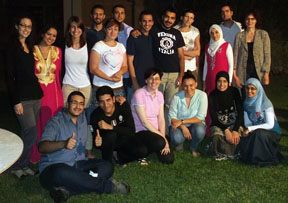
Course CSR_MAI 2013-rev

I asked students to send me their feedback and so I have been receiving beautiful notes. I have the feeling that we shared something new, beyond only disciplinary content, as many of them have now told me.

Download the entire post as a PDF.

UCSB job ad

The Department of Communication at the University of California, Santa Barbara invites applications for a tenured senior Associate or Full Professor faculty position, with an anticipated start date of July 1, 2014.  The successful candidate will complement one or more of the Department’s core areas in interpersonal/intergroup communication, media communication, and organizational communication, and any of our cross-cutting emphases in communication and technology, media neuroscience, globalization, family, group, health, political, legal, or intercultural communication.  Candidates must have a Ph.D. in Communication or related discipline and an exceptional record of scholarship. The successful candidate will be expected to assume the role of Chair for a 3-year term beginning July, 2016.  Thus, administrative experience is highly desirable.

Applicants should submit a cover letter highlighting qualifications, a curriculum vitae, evidence of teaching excellence and administrative effectiveness, three publications, and a list of 3 references along with contact information to the appropriate sections of the job search website.  Questions should be directed to the Search Committee Chair, Dr. Howie Giles, at giles AT comm.ucsb.edu. The search committee will begin screening completed applications on November 1, 2013, and all materials need to be submitted before this date.

The department is especially interested in candidates who can contribute to the diversity and excellence of the academic community through research, teaching, and service.  UCSB is an Equal Opportunity/Affirmative Action employer.

Save

Nat U Singapore job ad

The Department of Communications and New Media at the National University of Singapore (NUS) seeks to hire a tenured Full Professor with research and teaching specialization in Communication Management. We are interested in internationally recognized scholars who value diverse research methods and approach communication through new and emergent media perspectives. For this position, candidates must have a Ph.D., extensive teaching experience, globally recognized research achievements, proven administrative experience, and leadership qualities. The successful candidate will be expected to teach a range of courses and play active roles in developing the Department’s graduate program, supervising graduate students, and mentoring junior faculty. Minimum qualifications will include demonstrated excellence in teaching and research. Our Remuneration is internationally competitive.

NUSApplication Deadline: Position will remain opened until filled. We strongly uphold the principle of non-discrimination and encourage every qualified individual to apply. For application info, please visit here.

Santoi Wagner-microgrant report

NCA Micro Grant Report
Santoi Wagner, University of Pennsylvania

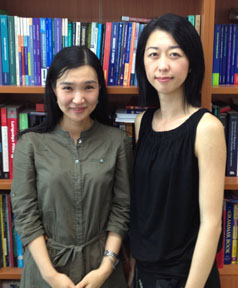
Dr. Eun Sung Park and Dr. Santoi Wagner
Drs. Eun Sung Park and Santoi Wagner

In May 2013, with support from a Center for Intercultural Dialogue micro grant funded by the National Communication Association, I traveled to Seoul, South Korea, to meet with Dr. Eun Sung Park of Sogang University. We are both applied linguists, though we have different research concerns: my interests lie at the interface of language and social interaction while Dr. Park’s work has centered on cognitive aspects of second language acquisition. However, given our professional roles in working with TESOL (Teaching English to Speakers of Other Languages) teachers, we share common interests in second language teaching and learning, and how to effectively educate teachers in both theory and practice. I am currently the Acting Director of TESOL at the University of Pennsylvania’s Graduate School of Education. Dr. Park is an Associate Professor of TESOL/Applied Linguistics and Director of the General English Education Program at Sogang. Although we had corresponded briefly via email about the possibility of working together, we had not previously had the opportunity to engage in an extended discussion. I envisaged our conversation to be an exploratory step to examine an issue that has been of particular interest to me over the past few years: how well do Master’s TESOL (Teaching English as a Second Language) programs prepare international students to teach in classrooms in their home countries that may be very different from those experienced via study and fieldwork in their graduate programs?

My preparations for the trip were fairly smooth. While the micro grant did not quite cover the entire airfare to Seoul, I was fortunate to able to fund the remainder through my faculty conference/travel fund. One of the more difficult aspects of preparation was to find a suitable time to travel given my teaching responsibilities and the fact that I wanted to be able to meet with Dr. Park while her university was still in session. By planning several months in advance, I was able to schedule my summer teaching to fit in with my plans to travel as soon as my spring semester had finished. This also gave me time to track airfares to ensure I found the best price possible (I used a tracking and notification tool available on Kayak).

Dr. Park was very generous with her time while I was visiting. We had broad and informative discussions, ranging from the teacher training and credentialing process in South Korea and the changing environment of English teaching there in terms of a greater emphasis on oral skills, to the career paths of graduates who have studied overseas and returned to Korea. Very interestingly, Dr. Park described how, in her experience, native English speaking teachers are perceived by students at her university to be better teachers than non-native English speaking teachers, but how more often than not, it is the non-native English speaking teachers who receive better student evaluations. This particular theme was not one that I had initially considered, but we brainstormed on the various ways we might go forward with this idea, including accessing and analyzing the available data, and we will follow up our discussion on email and hopefully arrange a meeting at a conference in the United States next year.

During my time in Seoul, two opportunities arose that I had not originally planned for. Firstly, Dr. Park arranged for me to observe a graduate class she was teaching, ENG 6217: Second Language Acquisition. The class was conducted in English as the program has a number of overseas students. Dr. Park asked me to speak to the students about studying in the United States and to answer questions about applying to doctoral programs there. I enjoyed this experience as it enabled me to engaged directly with the students (and to do some promotion of my home institution’s program!)

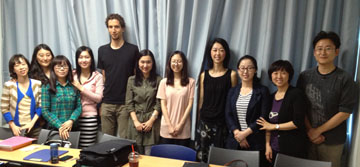
Dr. Wagner with students

Secondly, I was also able to meet with a former graduate student from my home institution who was teaching English at Sogang. Our conversation was particularly beneficial as we talked about her experience of a TESOL Master’s program in the US and how it had prepared her for teaching in Korea. Two rather surprising issues arose. One was the unrealistic expectation held by international students on entering the Masters program with regards to the ease of finding a good teaching position in their home country after they complete their degree. The other related issue was the perception of the most significant benefit from obtaining the degree. Rather than improving one’s pedagogy or knowledge about teaching, as I might have posited, the former student pointed to the increase in her authority that stemmed from her students’ knowledge of her educational background. Although my methodology in my original project proposal is centered on the micro-analytic examination of classroom interaction, this meeting underlined the usefulness of such conversations in generating ideas and developing possible themes for further inquiry.

I am deeply appreciative of the time I spent in Seoul, and for the NCA micro grant that enabled me to make such a trip. Although I initially had formulated quite firm proposal ideas, the conversations I had were extremely valuable in opening up my perspective about the possible and effective ways to further my research goals, and possibly expand them to encompass new directions for my work. I feel that the grant’s support of “participation in intercultural dialogue through academic interactions” is especially important in the exploratory stage of research. Dr. Park and I are not in the same sub-fields of our discipline, and so this type of in-depth conversation might be less likely to happen through regular conference or peer contacts. Phone, email, or even video-conferencing would have been poor substitutes for this type of exploratory discussion: I am grateful for the opportunity to meet potential collaborators in person, engage in face-to-face interaction, and establish productive professional relationships.

[NOTE: Santoi Wagner’s original project proposal is available here.]

Postdoctoral TA Northeastern U

Post-Doctoral Teaching Associate

The Communication Studies Department at Northeastern University (Boston, MA) invites applicants for a post-doctoral teaching associate position. Responsibilities include teaching Public Speaking and/or Quantitative Research Methods, along with advanced courses in Argumentation and Debate, Communication and Gender, Global and Intercultural Communication, Interpersonal Communication, Organizational Communication, Rhetorical Criticism, and Social Movements. The position carries a 3-3 teaching load with the possibility of summer teaching.

Applicants must have teaching experience at the college level and a doctorate completed within the past five years and prior to the start of the appointment. This is a one-year position with the possibility of renewal for two additional years. The starting date is August 28, 2013.

To apply, visit the College of Arts, Media and Design website, click on “About” then “Careers” to take you to Faculty Positions. If viewing this through a Northeastern website, simply click on the “Apply to this Job” button at the top.

Questions about the position may be addressed to Dale Herbeck, Chair, Communication Studies Department. Applications received by Friday, July 19, 2013, will be given full consideration. Positions remain open until filled.

Northeastern University particularly welcomes applications from minorities, women and persons with disabilities. Northeastern University is an E-Verify Employer.

Save

CFP Conf on Newspapers, war and society

Call for Papers for Newspapers, War and Society, a conference to be held 29 April-1 May 2014 at Gregynog Hall, Wales, UK.

This conference will explore the relationship between newspapers and society during times of war. It is organised by the Leverhulme Trust  funded  British Press in World War Two project and the Centre for Media History, Aberystwyth University.  The conference will have an international perspective, and focus on the importance of newspapers as objects of historical enquiry in their social contexts.

Newspapers have a fundamental role in societies at war. They relay the experience of war, provide a means for the state to communicate to the population directly, and serve to entertain readers. However, little attention has been paid to the dynamics of their production, circulation and reception during wartime and how the wider context of war affects those processes.  In what ways does the circuit of communication between the press and its readers change during wartime? How is newspaper content altered as a result of wartime restrictions? How is news sourced? How do newspapers balance their commercial interests and the purpose of informing readers, using restricted resources?  How do newspapers interact with the wider culture of wartime societies?

The conference also invites papers that address methodological issues relating to the use of newspapers in historical inquiry. Historical studies of wartime home fronts have tended to forgo the complexity of newspapers and use them illustratively, rather than systemically examining their content. We therefore welcome papers that critically engage with the newspaper as an historical object. Approaches might include quantitative and qualitative studies of content, or analysis of how newspapers were read and understood by their audiences.

We welcome proposals from a range of geographical and methodological backgrounds. Whilst the conference will be weighted towards the period 1914-1945, we also invite contributions which approach the theme from wider chronological perspectives. Abstracts of around 200 words for papers of between 20 to 25 minutes duration should be sent by close of business on 14 July 2013 to cmhstaff AT aber.ac.uk.

This conference is jointly organised by the Centre For Media History, Aberystwyth University, and the journal Media History, with the financial support of the Leverhulme Trust. It is held at the historic University of Wales conference centre Gregynog Hall, near Newtown, Powys, Wales.  Additional enquiries can be directed to one or more of the following: Dr Sian Nicholas, Professor Tom O’Malley or Dr Marc Wiggam.

Save

Grant for Comm in Emerging Democracies

Call for Grant Proposals for the Promotion of Communication in Emerging Democracies

Grant Funded by The Dale G. Leathers Memorial Fund to Promote Communication Studies in Emerging Democracies. Proposals are being solicited that promote scholarship and teaching of communication studies to benefit emerging democracies and their peoples. Any activity which contributes to this goal is potentially eligible for funding. Such activities include (but are not limited to) the following:
*International travel for residents of emerging democracies to attend conferences or advanced training in communication studies
*International travel for U.S. residents to disseminate communication scholarship or to conduct training in communication studies in emerging democracies
*Procuring and disseminating scholarly and instructional materials in communication studies for use by institutions within emerging democracies
*Research about various topics in communication conducted by residents of emerging democracies who would otherwise lack adequate support for such research
*Research about communication phenomena in emerging democracies, which may be conducted by U.S. scholars or by others, and which promises to directly or indirectly promote effective communication practices

General Procedures for Proposals

Proposals should not exceed 10 pages and shall include the following information:
(1) rational for considering the target nation an emerging democracy
(2) a clear statement of methods or listing of activities, depending on the nature of the proposal
(3) a clear statement of expected outcomes and their relationship to the purpose of the grant
(4) a clear statement of the intended use of monies provided by the grant
(5) an abbreviated, 3 page CV of applicant or principle investigator

Proposals will be reviewed and funded on an annual cycle. If the Trustees deem that no satisfactory proposals have been received in a particular cycle, or if the Trustees deem that available funds are insufficient to justify an award during a given cycle, no award need be made.

Deadline to submit proposal is October 1, 2013.

Grantees will be required to follow the National Communication Association’s Promotional Activities and Sponsorship Acknowledgement Policy for NCA-Funded Events and Projects.

Grant awards are funded by The Dale G. Leathers Memorial Fund to Promote Communication Studies in Emerging Democracies. For 2014, the total grant amount available is $500, and must be spent within the 2014 calendar year.

Please send proposals to: Brad Mello, bmello AT natcom.org
Proposals must be in English.