CFP Urban Foodways and Communication

Urban Foodways

Call for Chapter Proposals for a New Book
Urban Foodways and Communication: Ethnographic Studies in Intangible Cultural Food Heritages Around the World

Chapter Proposal Submission Deadline: November 15, 2014

Editors:
Casey Man Kong Lum, William Paterson University, USA, and
Marc de Ferriere le Vayer, the UNESCO Chair Project on Safeguarding and Promoting Cultural Food Heritage, the University of Tours, France

Book Overview:
Embedded in the quest for ways to preserve and promote heritage of any kind is an appreciation or a sense of an impending loss of a particular way of life – knowledge, skills set, traditions — deemed vital to the survival of a culture. Foodways places the production, procurement, preparation and sharing or consumption of food at an intersection among culture, tradition, and history. Thus, foodways is an important material and symbolic marker of identity, race and ethnicity, gender, class, ideology and social relations.

Intangible cultural heritage, according to the 2003 Convention for the Safeguarding of Intangible Cultural Heritage, refers to “the practices, representations, expressions, knowledge, skills – as well as the instruments, objects, artefacts and cultural spaces associated therewith – that communities, groups and, in some cases, individuals recognize as part of their cultural heritage. This intangible cultural heritage, transmitted from generation to generation, is constantly recreated by communities and groups in response to their environment, their interaction with nature and their history, and provides them with a sense of identity and continuity, thus promoting respect for cultural diversity and human creativity.”

Urban Foodways and Communication seeks to enrich our understanding of unique foodways in urban settings around the world as forms of intangible cultural heritage. Each ethnographic case study is expected to focus its analysis on how the featured foodways manifests itself symbolically through and in communication. The proposed volume aims to help advance our knowledge of urban food heritages in order to contribute to their appreciation, preservation, and promotion. We invite chapter proposals from scholars from all geographic and cultural regions of the world, and are particularly interested in attracting scholars from diverse disciplinary backgrounds to write ethnographic case studies of distinctly identifiable foodways that they consider worthy of examination as intangible cultural heritage.

Submission Guidelines:
While the definition of intangible cultural heritage by the 2003 UNESCO Convention for the Safeguarding of Intangible Cultural Heritage provides a good general conceptual framework, interested colleagues are encouraged to contribute their most current research and interpretation to substantiate, augment, or otherwise advance our understanding in this area of academic inquiry.

What to submit:
All submissions must include two documents, a Chapter Proposal and a separate CV of no more than three pages. The Chapter Proposal must contain (a) a working title of the proposed chapter, (b) an 800 to 1,000-word exposition consisting of a clear description of the proposed ethnographic case study and a concise statement on how and why the foodways being examined can be regarded as a form of intangible cultural heritage, and (c) a one to two-page annotated outline of the proposed chapter. Please do not identify yourself in any way in the Chapter Proposal. Include in your submission a separate CV of no more than three pages. All submissions will go through a referee process by a review committee established in conjunction with the UNESCO Chair Project on Safeguarding and Promoting Cultural Food Heritage at the University of Tours, France.

Submission format:
All submissions must be written in English and prepared in accordance with the style of the sixth edition of the American Psychological Association (APA) Publication Manual. Please submit your documents in the MS Word file format.

Submission deadline (and contact person for inquiry):
Please send your Chapter Proposal and CV in the same email on or before November 15, 2014 (Eastern Time) to: Casey Lum
Notification of acceptance status of chapter proposals: December 15, 2014
Submission deadline of complete chapters: on or before April 15, 2015

Length of each complete chapter manuscript:
Each complete chapter manuscript must be between 5,000 and (no more than) 5,500 words, inclusive of the main text and References. The use of the 12-point Times New Roman font in MS Word is preferred.

Int’l Day of Non-Violence

The International Day of Non-Violence is marked on 2 October, the birthday of Mahatma Gandhi, leader of the Indian independence movement and pioneer of the philosophy and strategy of non-violence.

According to United Nations General Assembly resolution A/RES/61/271 of 15 June 2007, which established the commemoration, the International Day is an occasion to “disseminate the message of non-violence, including through education and public awareness”. The resolution reaffirms “the universal relevance of the principle of non-violence” and the desire “to secure a culture of peace, tolerance, understanding and non-violence”.

Introducing the resolution in the General Assembly on behalf of 140 co-sponsors, India’s Minister of State for External Affairs, Mr. Anand Sharma, said that the wide and diverse sponsorship of the resolution was a reflection of the universal respect for Mahatma Gandhi and of the enduring relevance of his philosophy. Quoting the late leader’s own words, he said: “Non-violence is the greatest force at the disposal of mankind. It is mightier than the mightiest weapon of destruction devised by the ingenuity of man”.

U Virginia job ad: Social Media/Mobile Technologies

Assistant Professor of Social Media and Mobile Technologies at University of Virginia

The Department of Media Studies at the University of Virginia seeks to hire a tenure-track Assistant Professor, appointment beginning August 25, 2015. The successful candidate must have a PhD (or be ABD with expected completion of June 2015), evidence of innovative and effective teaching, and excellent research promise in the field of media studies. We are searching for a scholar who specializes in social media and mobile technologies. We particularly welcome candidates with a focus on one or more of the following: infrastructures, mobilities, and non-North American perspectives. Candidates should be well versed in theories of technology, globalization, and new media so as to complement current departmental strengths in global media, technology, and policy.

To apply, candidates must submit a Candidate Profile through Jobs@UVA, and electronically attach the following: a cover letter of interest that describes research agenda and teaching experience, curriculum vitae that includes the names and contact information of three (3) references that can speak to research excellence. Also, under separate cover by e-mail please arrange for one (1) of the references listed in the CV to send a confidential letter of recommendation to: Professor Bruce Williams, Chair of Search Committee.

For priority consideration, please submit all application materials and letters of reference by November 1, 2014. The position will remain open until filled.

Questions regarding the application process should be directed to Professor Bruce Williams, Chair of Search Committee.

CFP History in the Making: Arab Media

History in the Making: Arab Media and Processes of Remembering
Conference organised by the Arab Media Centre
Communication and Media Research Institute (CAMRI),
Date: Friday 24 April, 2015
Venue: University of Westminster, Regent Street Campus,
309 Regent Street, London W1B 2UW

Keynote Speaker:  Kay Dickinson, Concordia University, Montreal. Author of Off Key: When Film and Music Won’t Work Together (2008) and co-editor of The Arab Avant-Garde: Musical Innovation in the Middle East (2013).

‘If history is a term that means both what happened in the past and the varied practices of representing that past, then media are historical at several levels’. These words of Lisa Gitelman in her 2008 book, Always Already New: Media, History, and the Data of Culture, highlight the multiple ways in which media are implicated in our retelling of history. It is not just a question of journalism being seen as the first ‘rough draft’ of history (an observation credited to a former publisher of The Washington Post), or the fact that what are now sometimes called ‘legacy media’ were themselves new media several decades ago. It is also the role of films and other entertainment media in our awareness and understanding of the past, as well as the deliberate or unwitting silencing of histories through the highly selective processes of media representation. Such silencing is compounded when archives, or parts of archives, are neglected or destroyed.

Yet digital media and political upheaval in Arab countries raise new theoretical and practical questions about historical records. On one hand, online archiving of user-generated content seems to contradict the old maxim that history is written by the victors. On the other, who now has the right to be forgotten? Online digital infrastructures make it possible to trace dissident voices and sources in ways that threaten to sustain the entrenched control mechanisms of dictatorships.

Perhaps because Arab media outlets have expanded so rapidly in recent years, historical dimensions of media development or media use in the region have received limited attention. Eric Davis noted in the 1990s how much writing about the Arab world suffers from a ‘presentist’ fallacy, whereby inadequate or cursory coverage of historical forces contributes to essentialist constructions, which in turn represent the Middle East as incomprehensible political spectacle. More recently Walter Armbrust has pointed out the dangers of what he describes as a ‘relentless presentism’ and predominant ahistoricism in Arab media studies, born in his view from a form of technological determinism.

This one-day conference will seek to address issues raised by the place of media in history, the function of media artefacts as historical sources, and the processes involved in documenting and storing media images and accounts that will make the past accessible to future generations. A focus on history seems appropriate for what will be the tenth in the Arab Media Centre’s series of annual international conferences.

We welcome papers from scholars and media practitioners that engage critically with the issues outlined above. Themes may include, but are not limited to, the following:
·       Arab media history and historiography
·       The place of history in Arab media studies
·       Methodological questions in researching Arab history: the place of media
·       Oral histories of Arab media
·       Formation of film and broadcasting through colonial and postcolonial times
·       Suppressed histories from the media sector
·       Historicising the rise of subversive media across different political contexts
·       Archiving and digitizing: who decides what and how?
·       The performance of museums and libraries in preserving media artefacts
·       Translation of historic media texts
·       Gender, media and social history
·       Media and memory studies
·       Historic patterns in media coverage of Arab affairs
·       Audience feedback in 20th century Arab media

PROGRAMME AND REGISTRATION
This one-day conference, taking place on Friday, 24th April 2015, will include a keynote address, plenary sessions and parallel workshops. The fee for registration for all participants, including presenters, will be £110, with a concessionary rate of £59 for students, to cover all conference documentation, refreshments and administration costs. Registration will open in February 2015.

DEADLINE FOR ABSTRACTS
The deadline for abstracts is Monday, November 3rd, 2014. Successful applicants will be notified early in mid-December 2014. Abstracts should be 300 words. They must be accompanied by the presenter’s name, affiliation, email and postal addresses, together with the title of the paper and a 150-word biographical note on the presenter. Please send all these items together in a single Word file, not as pdf, and give the file and message the title ‘AMC 2015’ followed by your surname. The file should be sent by email to the Events Administrator, Helen Cohen, at journalism@westminster.ac.uk

TRAVEL EXPENSES
Participants fund their own travel and accommodation expenses.

PUBLICATION
There will be various openings for publication of selected conference papers, which will be discussed further after the conference.

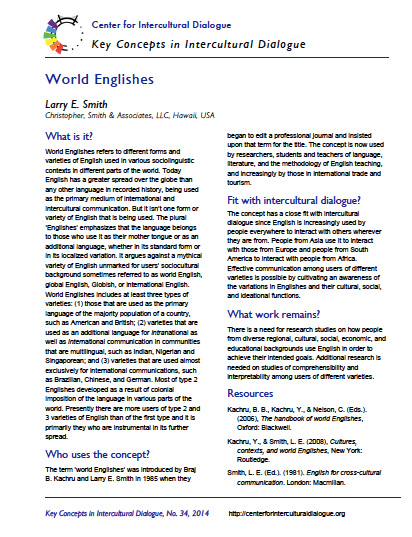
Key Concept #34: World Englishes by Larry E. Smith

Key Concepts in ICDThe next issue of Key Concepts in intercultural Dialogue is now available. This is KC34: World Englishes by Larry E. Smith. As always, all Key Concepts are available as free PDFs; just click on the thumbnail to download. Lists organized  chronologically by publication date and numberalphabetically by concept in English, and by languages into which they have been translated, are available, as is a page of acknowledgments with the names of all authors, translators, and reviewers.

kc34-sm

Smith, L.E. (2014). World Englishes. Key Concepts in Intercultural Dialogue, 34. Available from:
https://centerforinterculturaldialogue.org/wp-content/uploads/2014/09/key-concept-world-englishes.pdf

The Center for Intercultural Dialogue publishes a series of short briefs describing Key Concepts in intercultural Dialogue. Different people, working in different countries and disciplines, use different vocabulary to describe their interests, yet these terms overlap. Our goal is to provide some of the assumptions and history attached to each concept for those unfamiliar with it. As there are other concepts you would like to see included, send an email to the series editor, Wendy Leeds-Hurwitz. If there are concepts you would like to prepare, provide a brief explanation of why you think the concept is central to the study of intercultural dialogue, and why you are the obvious person to write up that concept.


Creative Commons License
This work is licensed under a Creative Commons Attribution-NonCommercial-NoDerivatives 4.0 International License.

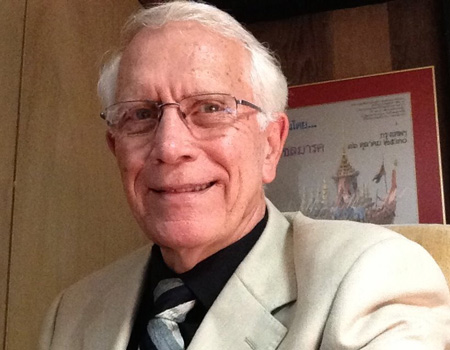
Larry E. Smith Profile

ProfilesLarry E. Smith is President of Christopher, Smith & Associates, LLC, (CSA) a leadership institute of Hawaii. Before joining CSA, he was Dean and Director of Education and Training at the East-West Center in Honolulu.

Larry E. Smith

He is the co-founder (with Braj B. Kachru) of the professional journal, World Englishes: Journal of English as an International and Intranational Language. He was the first President, the first Executive Director and presently the Chief Financial Officer of the International Association for World Englishes (IAWE), Inc. His research interests include the intelligibility, comprehensibility, and interpretability of world Englishes across cultures as well as the consequences of the spread of English world-wide. He currently leads a program for university students called “Living World Englishes.” His most recent publications can be found in the second edition of The Handbook of World Englishes, published by Wiley/Blackwell.


NOTE: Larry Smith, co-founder of the International Association for World Englishes and also of the journal World Englishes, passed away December 13, 2014. He authored KC34: World Englishes. An obituary is available here.
-Wendy Leeds-Hurwitz

Royal Roads U job ad: Intercultural Communication (Canada)

Assistant/Associate Professor
School of Communication and Culture
Faculty of Social and Applied Sciences
Royal Roads University
Victoria, Canada

Royal Roads University invites your interest in a probationary appointment at the rank of assistant or associate professor within our School of Communication and Culture in the Faculty of Social and Applied Sciences. You will play a key role in the administration, delivery, and instruction of the Master of Arts in Intercultural and International Communication on-campus program.

Your primary responsibilities will include providing high quality face-to-face and online instruction, facilitating high quality course revision and program development as well as building strong relationships with students, faculty, and staff across Royal Roads University and within relevant sectors.

In addition, you will be responsible for recruiting, developing and supporting instructors, managing student issues, monitoring the day-to-day delivery of the program, participating in program planning and reviews, attending program events and contributing to the marketing of the program. This program offering is geared at international and domestic graduate students and delivered on campus in Victoria, British Columbia. Our vision for this program is that of a graduate, global learning community.
Our ideal candidate is passionate about helping others achieve their academic pursuits, enjoys working within a highly entrepreneurial, collaborative and team-based teaching environment, and possesses well-developed interpersonal and intercultural communication skills and relationship-building abilities.
The School of Communication and Culture houses a vibrant community of scholar-practitioners who deliver undergraduate and graduate programs in communication. To learn more about our faculty and programs, please visit School of Communication and Culture.

Royal Roads University is committed to appreciating and celebrating the diversity of students, faculty, and staff. We strive to increase understanding and acceptance of each other, thereby making us more compassionate human beings and strengthening the fabric of our communities. Experience working in diverse settings is essential to this position.
To be considered, candidates will possess:
 Doctorate in related discipline
 Bilingualism
 Evidence of personal or professional experience outside of Canada and in diverse learning communities
 Demonstrated teaching excellence at the upper-level undergraduate and graduate level in intercultural and international communication (employing adult learning, English as a second language and applied learning principles)
 Experience in the communication sector, and ability to develop international networks
 Ability to work within an interdisciplinary, outcomes-based curriculum
 Applied research experience in a social and applied sciences field
 Experience in curriculum design and development at the graduate level preferred
 Experience in supervision of graduate students preferred

In addition to a collegial learning community, RRU offers a comprehensive compensation package, with a starting salary and academic rank based on qualifications and experience. This is a 5 year probationary appointment with the possibility of conversion into a continuing appointment, subject to performance and program needs.

To apply please forward your cover letter, curriculum vitae, and a statement of teaching philosophy (preferably in electronic format) to:
E-mail: rru-career-opportunities@royalroads.ca
Competition #14-070 or Human Resources – Career Opportunities
Royal Roads University
2005 Sooke Road
Victoria, BC V9B 5Y2
Fax: (250) 391-2570
Tel: (250) 391-2511

The competition will begin on September 16, 2014. Review of applications will begin December 1, 2014; however, the competition will remain open until a successful candidate is found.

While Royal Roads University values all applications we receive, only those candidates chosen for further consideration will be contacted. Shortlisted candidates will be required to provide the names and contact information for three referees, and to arrange for the forwarding of degree transcripts directly from the granting institutions.

RRU is an equal opportunity employer, committed to the principle of equity in employment. All qualified candidates are encouraged to apply; however, Canadians and permanent residents will be given priority consideration.

CFP IADA: Anthropologies of Dialogue (France) 2015

ANTHROPOLOGIES OF DIALOGUE
Nancy, August 27-29, 2015
25th anniversary of the International Association for Dialogue Analysis (IADA)

Since the Conference is celebrating the 25th anniversary of the International Association for Dialogue Analysis (IADA), this event’s theme will be the anthropologies of dialogue. According to Kant, anthropology refers to the study of the human beings in their essence and progress. Given the omnipresence and omnitemporality of dialogue, we can claim that it constitutes one of the principal characteristics of humanity, i.e., what makes human beings who they are. Thus, the study of dialogue is simultaneously concerned with the humanities, the social sciences and the natural sciences. The 25th anniversary of IADA is an excellent opportunity to examine the progress made in our knowledge of dialogue and this will be the subject of the plenary conferences.

The conference will be organized as follows: plenary conferences will focus on the main  theme of dialogue, while workshops and poster sessions will offer the opportunity to discuss all the aspects, properties and applications of this knowledge. Workshops will host panels and lectures devoted to the most recent fields of social practices, such as tele-medicine, dialogical therapeutic tele-interviews, robotic care for the elderly, and dialogue in its various contexts: education, politics, mental or somatic health care, labor, legal, etc.

The conference language is English.

CALL FOR PAPERS
Please read all instructions carefully.
Note that IADA membership is required for presenting during the conference. Membership can be arranged instantly by going to IADA Website.

DEADLINES
*   October 30, 2014 for panel proposals
*   November 30, 2014 for individual submissions (lectures and Posters).

INSTRUCTIONS
*   Panel proposals (deadline October 30, 2014): max. 500 words. Within four weeks of this deadline, the conference committee will, on the basis of the outline, decide whether the proposal is accepted. The minimum number of presentations planned for one 90-minute session, however, should be three.
*   Individual proposals for lectures and posters (deadline November 30, 2014): max. 300 words.

Proposals should be submitted as e-mail attachments to Alain Trognon and Martine Batt.

Penn State job ad: International Communication

The Department of Film-Video and Media Studies at Pennsylvania State University is seeking candidates with the ability to contribute to the broad intellectual and creative life of an interdisciplinary media studies program. As such, we seek to fill a tenure-track assistant professor position in international communication starting August 2015.

Candidates should have demonstrable research interest and teaching expertise in international communication and related topics (e.g., comparative media systems). To that end, experiential knowledge in the form of grounded research exposure and/or an extended period living outside the US is advantageous. Applicants with geopolitical expertise related to the regions/countries within Central/South America or the Middle East are particularly encouraged to apply.

Key responsibilities include teaching two courses per semester (including – with required qualification – the possibility of graduate-level teaching and mentoring), service on departmental and college committees and the active pursuit of a substantive research/creative agenda. As a department committed to the premise of integrated educational experiences including a study abroad component (embedded/summer programs) for students interested in international communication, the preferred candidate will bring an interest, fresh ideas, and an enterprising agenda for developing similar initiatives in his/her area of expertise on board. An earned Ph.D. in Mass Communication, Media Studies, or a related field is preferred, although ABD status will be considered.

The College of Communications at Penn State is home to four departments: Advertising/Public Relations; Film-Video and Media Studies; Journalism; and Telecommunications. In addition, the College offers a master’s degree program in media studies, and a Ph.D. program in mass communications. The University Park Campus is set in State College, a university town located in the heart of central Pennsylvania. State College offers a vibrant community with outstanding recreational and cultural activities, and excellent public schools. The campus is also within a half-day drive to Washington, DC, Baltimore, Philadelphia, New York City and Pittsburgh.

Candidates must electronically submit a letter of application and a curriculum vita detailing teaching and research/creative experience and the names of three to five references. All candidates should request letters from three references to be sent directly to Tasha Smith. Applications received by October 31, 2014, will be assured of full consideration; however, all applications will be considered until the position is filled.