UNC Chapel Hill postdocs for faculty diversity

UNC-Chapel Hill Postdoctoral Program for Faculty Diversity

As part of a continuing commitment to building a culturally diverse intellectual community and advancing scholars from underrepresented groups in higher education, The University of North Carolina at Chapel Hill Carolina Postdoctoral Program for Faculty Diversity (CPPFD) offers postdoctoral research appointments for a period of two years. The purpose of CPPFD is to develop scholars from underrepresented groups for possible tenure track appointments at the University of North Carolina and other research universities. Postdoctoral scholars will be engaged full-time in research and may teach only one course per fiscal year. This program is funded by the State of North Carolina. Deadline is November 15, 2014.

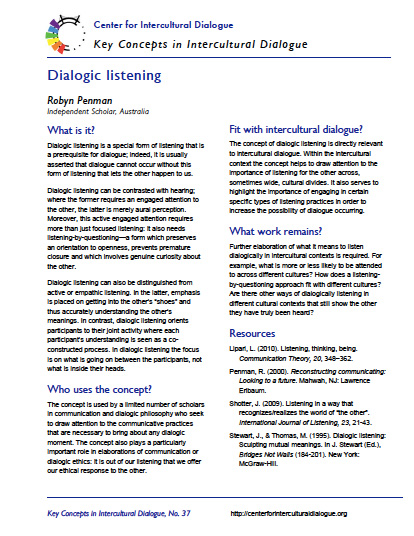
Key Concept #29: Dialogic Civility by Robyn Penman

Key Concepts in ICDThe next issue of Key Concepts in intercultural Dialogue is now available. This is KC29: Dialogic Civility by Robyn Penman. As always, all Key Concepts are available as free PDFs; just click on the thumbnail to download. Lists organized  chronologically by publication date and numberalphabetically by concept in English, and by languages into which they have been translated, are available, as is a page of acknowledgments with the names of all authors, translators, and reviewers.

kc29-sm

Penman, R. (2014). Dialogic civility. Key Concepts in Intercultural Dialogue, 29. Available from:
https://centerforinterculturaldialogue.org/wp-content/uploads/2014/08/key-concept-dialogic-civility.pdf

The Center for Intercultural Dialogue publishes a series of short briefs describing Key Concepts in intercultural Dialogue. Different people, working in different countries and disciplines, use different vocabulary to describe their interests, yet these terms overlap. Our goal is to provide some of the assumptions and history attached to each concept for those unfamiliar with it. As there are other concepts you would like to see included, send an email to the series editor, Wendy Leeds-Hurwitz. If there are concepts you would like to prepare, provide a brief explanation of why you think the concept is central to the study of intercultural dialogue, and why you are the obvious person to write up that concept.


Creative Commons License
This work is licensed under a Creative Commons Attribution-NonCommercial-NoDerivatives 4.0 International License.

Dorm Room Diplomacy

I just ran across an interesting example of applied intercultural dialogue that may be of particular interest either to students taking, or faculty teaching, courses on intercultural topics:

“Founded by students at the University of Pennsylvania in 2009, Dorm Room Diplomacy fosters intercultural dialogue and mutual understanding among an international group of university students. Dorm Room Diplomacy employs videoconference technology to facilitate virtual exchanges that help students to see the individuals behind reductionist cultural stereotypes.

The videoconference program occurs each academic semester, and the same set of 8 students join in a virtual dialogue with a trained facilitator each week. Dorm Room Diplomacy is entirely student-run, encouraging students to take ownership over the dialogue process, establish campus chapters, and empower themselves and their peers. As a non-partisan organization, Dorm Room Diplomacy does not engage in political activities or advocacy, other than the promotion of intercultural dialogue. “

For more information, and for the source of this quote, go to the website for Dorm Room Diplomacy.

Intercultural Harmony grants

The Laura Jane Musser Fund would like to promote mutual understanding and cooperation between groups and citizens of different cultural backgrounds within defined geographical areas through collaborative, cross-cultural exchange projects. Projects must be intercultural and demonstrate intercultural exchange, rather than focused on just one culture. Applications will be accepted from September 17 through October 17, 2014.

PRIORITY IS PLACED ON PROJECTS THAT:
Include members of various cultural communities working together on projects with common goals
*Build positive relationships across cultural lines
*Engender intercultural harmony, tolerance, understanding, and respect
*Enhance intercultural communication, rather than cultural isolation, while at the same time celebrating and honoring the unique qualities of each culture

PROJECTS MUST DEMONSTRATE:
*Need in the community for the intercultural exchange project
*Grassroots endorsement by participants across cultural lines, as well as their active participation in planning and implementation of the project
*The ability of the organization to address the challenges of working across the cultural barriers identified by the project
*Tangible benefits in the larger community

LIMITS OF GEOGRAPHY:
Only programs in Colorado, Hawaii, Michigan, Minnesota, Ohio and Wyoming may apply.

PROJECTS ELIGIBLE FOR SUPPORT:
Intercultural Harmony projects can be carried out in a number of areas, including (but not limited to):
*The arts
*Community service
*Youth activities

OUTCOMES SHOULD INCLUDE:
*A demonstration of intercultural exchange between cultures
*Increased comfort in interaction between the groups and individual citizens addressed by the project
*Harmonious shared use of public space and community facilities
*Continued cooperation by the participants or communities addressed by the project

WHAT THE PROGRAM WILL COVER:
*New programs or projects within their first three years (up to $18,000)
*The planning and implementation phase of a project (up to $18,000)

WHAT WILL NOT BE FUNDED:
*Capital Expenses
*General Operating Expenses
*Ongoing Program Support

WHO CAN APPLY:
*Nonprofit 501(c)(3) organizations
*Organizations that are forming if they have a documented fiscal sponsor relationship
*Organizations located within one of the eligible states listed above

Save

Difference & Globalization issue of Visual Communication

Out now — Special issue: Difference and Globalization, Visual Communication 13(3), August 2014
Guest editors: Giorgia Aiello (University of Leeds) and Luc Pauwels (University of Antwerp)

This special issue investigates the nexus of globalization and visual communication through a rich discussion of the significance of national, racial, ethnic, gender, class, embodied and emplaced differences. While globalization does entail the ever-growing significance of deterritorialized practices and transcultural flows, these connections, movements and exchanges still largely occur across specific locales and identities, and through appeals to various dimensions of cultural and social difference. The visual is an especially privileged and in fact crucial mode of communication in contexts of globalization thanks to its perceptual availability and cross-cultural potential.

Taken together, the seven contributions included in this special issue address questions related to the integration and deployment of major dimensions of social and cultural difference in visual communication materials; the perspectives and practices of designers, image-makers and media producers in relation to the work involved in the planning and creation of such materials; and both the dominant ways of seeing and unique experiences that impact on the visual ‘reading’ of globalization.

A combination of well-known and emerging scholars makes for an unusually energetic take on concepts and concerns that underlie several of the major frameworks that have become established in the inherently interdisciplinary field of visual communication, including multimodal and critical discourse analysis, social semiotics, rhetorical criticism, visual anthropology and visual sociology.

Table of contents
*Guest Editorial: Giorgia Aiello and Luc Pauwels
*Ariel Chen and David Machin: The local and the global in the visual design of a Chinese women’s lifestyle magazine: a multimodal critical discourse approach
*Giorgia Aiello and Greg Dickinson: Beyond authenticity: a visual-material analysis of locality in the
global redesign of Starbucks stores
*Toussaint Nothias: ‘Rising’, ‘hopeful’, ‘new’: visualizing Africa in the age of globalization
*Arjun Shankar: Towards a critical visual pedagogy: a response to the ‘end of poverty’ narrative
*Melissa A Johnson and Larissa Carneiro: Communicating visual identities on ethnic museum websites
*Helene Pristed Nielsen and Stine Thidemann Faber: A strange familiarity? Place perceptions among the globally mobile
*Luc Pauwels: World cities reframed: a visual take on globalization

Int’l Day of Peace

Each year the International Day of Peace is observed around the world on 21 September. The General Assembly has declared this as a day devoted to strengthening the ideals of peace, both within and among all nations and peoples.

To mark the 30th anniversary of the General Assembly Declaration on the Right of Peoples to PeacePDF document, the theme of this year’s International Day of Peace is the “Right of Peoples to Peace”. This anniversary offers a unique opportunity to reaffirm the United Nations commitment to the purposes and principles upon which the Organization was founded. The Declaration on the Right of Peoples to Peace recognizes that the promotion of peace is vital for the full enjoyment of all human rights.

The International Day of Peace was established in 1981 by resolution 36/67PDF document of the United Nations General Assembly to coincide with its opening session, which was held annually on the third Tuesday of September. The first Peace Day was observed in September 1982.

In 2001, the General Assembly by unanimous vote adopted resolution 55/282PDF document, which established 21 September as an annual day of non-violence and cease-fire.

The United Nations invites all nations and people to honour a cessation of hostilities during the Day, and to otherwise commemorate the Day through education and public awareness on issues related to peace.

Save

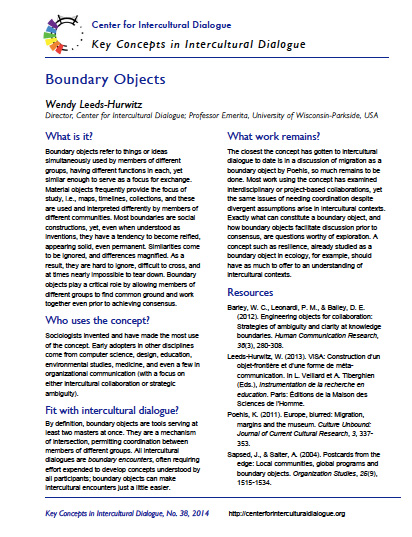
Key Concept #28: Postcolonialism by Raka Shome

Key Concepts in ICDThe next issue of Key Concepts in intercultural Dialogue is now available. This is KC28: Postcolonialism by Raka Shome. As always, all Key Concepts are available as free PDFs; just click on the thumbnail to download. Lists organized  chronologically by publication date and numberalphabetically by concept in English, and by languages into which they have been translated, are available, as is a page of acknowledgments with the names of all authors, translators, and reviewers.

kc28-smShome, R. (2014). Postcolonialism. Key Concepts in Intercultural Dialogue, 28. Available from:
https://centerforinterculturaldialogue.org/wp-content/uploads/2014/08/key-concept-postcolonialism.pdf

The Center for Intercultural Dialogue publishes a series of short briefs describing Key Concepts in intercultural Dialogue. Different people, working in different countries and disciplines, use different vocabulary to describe their interests, yet these terms overlap. Our goal is to provide some of the assumptions and history attached to each concept for those unfamiliar with it. As there are other concepts you would like to see included, send an email to the series editor, Wendy Leeds-Hurwitz. If there are concepts you would like to prepare, provide a brief explanation of why you think the concept is central to the study of intercultural dialogue, and why you are the obvious person to write up that concept.


Creative Commons License
This work is licensed under a Creative Commons Attribution-NonCommercial-NoDerivatives 4.0 International License.

Humanities Postdoctoral Fellowships (Germany)

Humanities Postdocs for Study/Research in Germany

Each academic year, the Andrew W. Mellon Foundation and the Volkswagen Foundation fund up to twelve Post-doctoral Fellowships in the Humanities for stays of 9 to 12 months in Germany. The cooperating institutions are: the Freiburg Institute for Advanced Studies, the Lichtenberg-Kolleg in Göttingen, the Exzellence Cluster and the Zukunftskolleg der Universität Konstanz, the Dahlem Humanities Center, Freie Universität Berlin, the Berliner Zentrum Moderner Orient, the Deutsche Archäologische Institut (DIA) in Berlin, the Staatlichen Museen zu Berlin, the Deutsche Nationalbibliothek in Frankfurt, the Herzog August Bibliothek in Wolfenbüttel, the Deutsche Literaturarchiv in Marbach, the Leibniz Institute of European History Mainz (IEG) and the Leopoldina Centre for the Study of the History of Science and Science Academies at Halle (Saale).

The Fellowships address postdocs at American universities and research institutes working in the Humanities who wish to spend some time in Germany working on a research project.

Visit Volkswagen’s main site for more information. Applications must be filed electronically via the electronic application system. Application deadline is October 15, 2014.

Texas State U job ad: Intercultural Communication

Intercultural Communication/ Communication Diversity
Tenure Track Assistant/Associate Professor

Texas State University

The Department of Communication Studies at Texas State University seeks an assistant/associate professor, tenure track faculty member with a demonstrated program of research and teaching in intercultural communication and diversity. The application must include evidence of peer-reviewed scholarship, and a record of teaching excellence at the University level. The department expects the successful candidate to teach classes in intercultural communication at the graduate and undergraduate levels, maintain an active program of published research, and pursue external research funding.

Texas State is designated by the U.S. Department of Education as a Hispanic-Serving Institution. Applicants should provide evidence through their experience, teaching, or research of their potential to serve a diverse student population.

Qualifications

Required:
PhD in Communication or related field (Emphasis in Intercultural Communication and/or Communication Diversity); Evidence of University level teaching; Evidence of a program of research in Intercultural Communication/Communication Diversity as evidenced by published articles and/or the presentation of research papers at professional conferences.

Preferred:
We seek a faculty member with demonstrated potential to contribute to a Hispanic-Serving Institution; evidence of externally funded research and grant writing activities; and a faculty member who can enhance instruction in our graduate program as evidenced by graduate coursework or research experience in one or more of the following areas: Communication and Technology, Communication Training and Development, Health Communication, Instructional Communication, Interpersonal Communication, Organizational Communication, or Rhetorical Studies.

Application Procedures
All application materials much be received by October 10, 2014. Send vita, letter describing your qualifications, and names and phone numbers of three references to:
Dr. Maureen Keeley
Intercultural Communication and Diversity Search Committee Chair
Department of Communication Studies
Texas State University
601 University Drive
San Marcos, TX 78666

CFP Comm Yearbook literature reviews

Communication Yearbook 40: Deadline February 15, 2015
A Publication of the International Communication Association
Editor: Elisia L. Cohen

CY 40 is a forum for the exchange of interdisciplinary and internationally diverse scholarship relating to communication in its many forms. Specifically, we are seeking state-of-the-discipline literature reviews, meta-analyses, and essays that advance knowledge and understanding of communication systems, processes, and impacts. Submitted manuscripts should provide a rigorous assessment of the status, critical issues and needed directions of a theory or body of research; offer new communication theory or additional insights into communication systems, processes, policies and impacts; and/or expand the boundaries of the discipline. In all cases, submissions should be comprehensive and thoughtful in their synthesis and analysis, and situate a body of scholarship within a larger intellectual context. For CY 40, the editorial board also welcomes essays that advance knowledge and understanding of communication research methodologies and applications.

Details
*Submit manuscripts electronically via a Word attachment to Elisia L. Cohen, Editor
*Submissions for CY 40 will be considered from January 1, 2015 through February 15, 2015
*Use APA style, 6th edition
*Include a cover letter indicating how the manuscript addresses the CY 40 call for papers
*Prepare manuscripts for blind review, removing all identifiers
*Include a title page as a separate document that includes contact information for all authors
*Following Communication Yearbook‘s tradition of considering lengthier manuscripts, initial manuscript submissions may range from 6,500 to 13,000 words (including tables, endnotes, references).
*Incomplete submissions not adhering to the above journal guidelines will be returned to authors for revision.

For more information about CY 40 or this call for submissions, please contact Dr. Cohen, Editor, Communication Yearbook.