
Hebrew University of Jerusalem job ad (Israel)

Tenure-Track Position in Communication and Journalism – 2016

The Noah Mozes Department of Communication and Journalism at The Hebrew University of Jerusalem invites outstanding candidates to apply for a tenure-track position starting July, 2016. Excellent candidates in all areas of communications are invited to apply. The successful applicant will join a dynamic research-oriented faculty offering innovative undergraduate, graduate and doctoral programs. For more information about our faculty and research please visit the website.

Applicants must hold a Ph.D. degree at the time of hire, and demonstrate an active research program, indicating the potential for outstanding scholarship. The person hired will teach introductory and advanced courses in communications in their areas of specialization. He/she will also be expected to supervise Masters and Ph.D. students and to contribute to departmental and university service. Ability to teach in Hebrew is required (in exceptional cases, successful candidates will be expected to teach courses in Hebrew within a few years of their arrival).

Appointment procedures will be conducted in accordance with the rules and regulations of the Hebrew University and are subject to the approval of the university authorities. The university is not obliged to appoint any of the candidates who apply for the position. Applications should be submitted online.

Applications should include the following documents (each in a separate PDF file) in English:
•   Candidate’s letter of application (cover letter).
•   Detailed CV (including email address) according to the format of the Hebrew University.
•   Full list of publications according to the format of the Hebrew University. Please present each of the following as separate categories: books, articles in refereed journals, chapters in books, other publications.
•   Scientific biography outlining research and teaching interests and research plans for the next several years (3-4 pages long).
•   Names, addresses, affiliation, academic status, and email addresses of at least two referees qualified and willing to assess the candidate’s achievements and potential. The referees will upload their letters of recommendation directly to the system.
•   Copies of three selected recent publications that best showcase the candidate’s scholarship (these may also include accepted articles or book chapters).
•   Brief description of 3-4 potential courses that the candidate would be able teach.  For each proposed course please include the following information: Title, type of course, brief description, and specify whether the candidate has taught it before.
•   Teaching evaluations (if such exist).
Applicants will compete with candidates of other departments in the Faculty of Social Sciences for academic positions.

PLEASE ALSO SEND THESE DOCUMENTS IN ONE SINGLE PDF ATTACHED FILE.

Inquiries should be directed to:
Professor Ifat Maoz
Chair, Department of Communication,
Hebrew University of Jerusalem

Deadline for applications: September 20, 2015.
In order to ensure that the referees’ letters arrive by the deadline, it is recommended to create an account in the application system as early as possible.

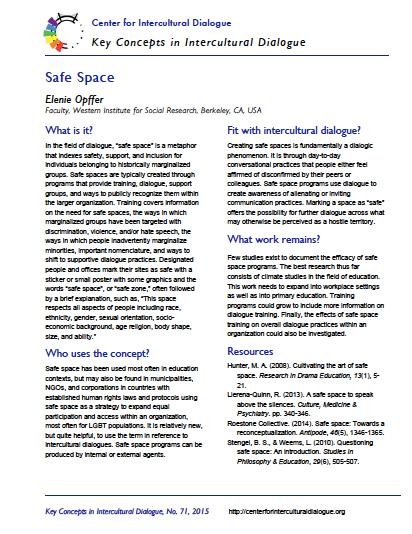
Key Concept #71 Safe Space by Elenie Opffer

Key Concepts in ICDThe next issue of Key Concepts in intercultural Dialogue is now available. This is KC71: Safe Space by Elenie Opffer. As always, all Key Concepts are available as free PDFs; just click on the thumbnail to download. Lists organized chronologically by publication date and numberalphabetically by concept in English, and by languages into which they have been translated, are available, as is a page of acknowledgments with the names of all authors, translators, and reviewers.

Key Concept 71 Safe Space by Elenie Opffer

Opffer, E. (2015). Safe space. Key Concepts in Intercultural Dialogue, 71. Available from: https://centerforinterculturaldialogue.org/wp-content/uploads/2015/08/kc71-safe-space.pdf

The Center for Intercultural Dialogue publishes a series of short briefs describing Key Concepts in Intercultural Dialogue. Different people, working in different countries and disciplines, use different vocabulary to describe their interests, yet these terms overlap. Our goal is to provide some of the assumptions and history attached to each concept for those unfamiliar with it. As there are other concepts you would like to see included, send an email to the series editor, Wendy Leeds-Hurwitz. If there are concepts you would like to prepare, provide a brief explanation of why you think the concept is central to the study of intercultural dialogue, and why you are the obvious person to write up that concept.


Creative Commons License
This work is licensed under a Creative Commons Attribution-NonCommercial-NoDerivatives 4.0 International License.

Ebenezer Soola Conference on Communication (Nigeria) postponed

Dear colleagues,

You will recall that on February 26, 2015, the African Council for Communication Education (ACCE) Nigeria Chapter sent out its Call for Papers for its 17th National Conference and AGM scheduled to hold from October 20 to 23, 2015 at the International Conference Centre, University of Calabar, Cross River State, Nigeria.

Then on May 16, 2015, the conveners of the Ebenezer Soola Conference on Communication sent out its Call for Papers for the 3rd edition of the Ebenezer Soola Conference on Communication scheduled to hold from September 27 to 30, 2015 at the Conference Centre, University of Ibadan, Ibadan, Nigeria.

This was followed on May 28, 2015 by the Call for Papers of the Association of Communication Scholars & Professionals of Nigeria (ACSPN) for its 2nd Annual Conference scheduled to hold from September 23, 2015 at the Lagos Airport Hotel, Ikeja, Lagos.

Then on June 10, 2015, the organizers of the Idowu Sobowale Conference sent out its Call for Papers for the 3rd edition of the Idowu Sobowale Conference scheduled to hold from October 26 to 29, 2015 at Covenant University, Ota, Ogun State, Nigeria.

We, the Conveners of the Ebenezer Soola Conference on Communication are of the strong opinion that this rash of communication conferences in Nigeria all scheduled for between September and October 2015, and all targeting the same community of communication scholars and professionals is unnecessary and unwarranted. Things can be better managed than this obvious show of non-consultation and insensitivity. Since we cannot get the organizers of the other conferences to do something to correct this anomaly by shifting and re-scheduling their conferences, we have decided to re-schedule ours.

Consequently, we have, painfully but with all sense of maturity, decided to shift the 3rd Ebenezer Soola Conference on Communication from September this year to sometime in 2016. The new date will be announced shortly but the theme of the conference remains as earlier announced “Communication, Change Management and Sustainable Development in the 21st Century”.

We sincerely apologise to all patrons, friends, well-wishers, and all of you who have either sent in abstracts and full papers or who have marked the date in their diaries for this shift. Be rest assured that your abstracts and papers will be stored in our e-library till the new date of the conference. The theme of the conference is as relevant today as it will be next year.

Meanwhile, we will be pleased to receive your comments and suggestions.

We thank you all for your understanding and patience.
Thank you and God Bless you.
Dr. Eserinune McCarty Mojaye
Secretary, Conveners Committee
July 30, 2015

CFP Time, Memory & Identity in the Images of the New Millennium (Italy)

CINEMA & HISTORY: Time, memory and identity in the images of the new millennium
26-27 November 2015

Conference convenors
Christian Uva and Vito Zagarrio

Institutional partners
University of Leeds Centre for World Cinemas (UK)
Victoria University of Wellington (NZ)
SISSCO (Società Italiana per lo Studio della Storia Contemporanea)
CPA (Centro Produzione Audiovisivi) – Università degli Studi Roma Tre
Cinema e Storia. Rivista di studi interdisciplinari (Rubbettino Editore)

Call for Papers
The 21st annual international conference of the Dipartimento Filosofia, Comunicazione e Spettacolo (formerly Dipartimento Comunicazione e Spettacolo) of Università Roma Tre will consider the relationship between cinema and history, identifying new directions and contemporary approaches in the field. This conference reprises a theme central to discussion in the 1980s, when a number of important symposia and publications in Italy responded to the translation of key French scholarship. Returning to the question of cinema and history after three decades implies the consideration of aspects and forms of knowledge absent from those earlier debates. Bringing the discussion right up to date, the aim of this conference is to employ a plurality of discourses to explore in greater depth the theme of cinema and history and to clarify a crucial relationship that has been essential to cinema since its inception.

Taking as its premise the fact that in our digital era the relationship between cinema and history is played out over a broad and complex terrain, the conference seeks to consider cinema in /hybrid /and /expanded /terms. This may require analysing cinema’s relationship with history within a broader mediatic context, taking into account – for instance – adjacent and tangential media such as television, videoart, internet and videogames. The convenors therefore warmly invite contributions that aim to problematize the relationship between cinema and history in ways not limited to the following:
• the use of cinema and history as a /method/ or lens through which to read a range of film categories beyond any historical film ‘genre’: films that, while setting their action in the present, suggest a dialectical and critical attitude towards the past, especially in order to address conceptions and perceptions of national, cultural, gender and political identity; films that are capable of addressing and affecting contemporary imaginaries and mentalities, thus becoming historical /agents/ in their own right; films that become valuable primary sources for scholars, by embodying the customs and material habits of their time; films which, though set in the present, allow us to reflect on material and everyday “microhistories” in which the story “dissolves” time and erupts into the present (Baudrillard);
• the rethinking and transcending of traditional film histories by seeing cinema and history in the light of a hybrid and global iconographic system that forces us to wonder whether we should thinking in terms distinct from the “longue durée” and allows us to avoid “textbook” slogans and stereotypes;
• history as critique, between ‘the end of history’ (Fukuyama) and its traumatic return following 9/11;
• history as /imaginary /(Ferro) and as /myth /(Rosen), but also as /atmosphere/;
• counter-factual history (“What if?”);
• history as /anti-history/: a form of projection into the past of scepticism and disillusion with present and future;
• history as /anachronistic/ configuration — for Georges Didi-Huberman a ‘heretical’ approach to image and history: while it confirms the necessity to conceive of cinema and history as part of visual culture, Didi-Huberman’s perspective stresses the intimate ‘exuberance’, ‘complexity’ and ‘overdetermination’ (/Überdeterminierung/) of images, forcing a rethinking of the cinema-history relationship within the context of the /construction of memory/;
• from ‘historical facts’ to ‘memory facts’ (Ricoeur): cinema as site of memory (both individual and/or collective); cinema as an ideal space in which to activate not the ‘time of dates’ (Bloch) but instead a dimension — often framed negatively as nostalgia (Boym) — that humanizes history and constantly reconfigures it;
• the digital imaginary between memory and history (Burgoyne);
• theoretical and practical reconsiderations of cinema through a feminist and gendered lens:  analysing the dynamics of production and reception; the interaction between Foucauldian genealogical thought and feminist theories;
• from /‘official’ history/ to /‘popular’ history/, from /engagé /to escapist cinema: the cinema-history relationship as an opportunity to reframe works that have traditionally been excluded from the analysis of cinema and history, not least because of the enduring legacy and role of /engagement /in representing the past (Landy);
• the study of the experience and reception of the historical film, in all its possible variations;
• history in audio-visual contexts: from television to videoart; history in videogames; history and photography;
• the employment and potential of digital technology and quantitative methods to serve an expanded understanding of cinema and history.

We will consider every proposal (300-500 words), with 5 keywords, 3-5 bibliographic references, and a brief biography of the proponent, sent before September 7th, 2015, by email. The selection results will be announced before September 30th. Official languages of the Conference: English, French, Italian.

Conference fees
Until 15 October 2015: 50 € (Faculty member), 30 € (Student)
From 15 October 2015 (late payment): 70 € (Faculty member), 50 € (Student)
(details of the conference website and of methods of payment will be provided in due course)

Chair in Islamic Studies & Intercultural Dialogue (Australia)

A new endowed Chair in Islamic Studies and Intercultural Dialogue has been created at the Alfred Deakin Institute for Citizenship and Globalisation (ADI), part of Deakin University in Australia.

The Chair was announced at Deakin University’s annual Iftaar dinner, co-hosted with the Australian Intercultural Society, and will be named in honour of the highly respected Muslim scholar and human rights advocate Fethullah Gülen, founder of the Gülen movement. “This Chair marks a significant initiative that will assist in developing the foundations of true dialogue, where people of different traditions and beliefs get the opportunity to know one another and work together towards the ideal of living in peace together,” said Mr Gülen.

The endowed Chair reflects the growing strategic partnership between Deakin University, the Australian Intercultural Society and the Selimiye Foundation. “The proposed Research Chair in Islamic Studies and Interfaith Dialogue within the Alfred Deakin Institute for Citizenship and Globalisation has a particularly important role to play in contributing to understanding our global world and to affirming the importance of understanding difference in ways that go far beyond tolerance,” said Deakin University’s Vice-Chancellor, Professor Jane den Hollander.

In 2009 Fethullah Gülen was voted one of the world’s top public intellectuals by “Foreign Policy/Prospect” magazine. In 2013 he was rated one of the world’s most influential 100 people by “TIME” magazine, and in April this year he was awarded the Martin Luther King Jr. International Chapel at Morehouse College Gandhi King Ikeda Peace Award, in recognition of his life-long dedication to promoting peace and human rights.

Applications for the position will open soon. For more information please contact: Jo Collins

Call for articles: KOME Hungarian Communication Studies Association journal

KOME, an international Open Access journal published by the Hungarian Communication Studies Association is currently seeking articles for its future issues. The journal aims to create a platform for an innovative interdisciplinary discourse in the field of communication and media studies, with a focal point on pure communication inquiry.

KOME is a theory and pure research-oriented journal of communication studies and related fields. Therefore theoretical researches and discussions that helps to understand better, or reconceptualize the understanding of communication are its centre of interests; being either an useful supplement to, or a reasonable alternative of current communication theories. Scholarly perspectives with the aim of creating an intellectual plus in the metatheory of communication, policies or research methods are especially welcomed, as well as linguistic or etymological analyses. KOME is also committed to the ideas of trans-and interdisciplinarity and prefer topics which are relevant for more than one special discipline of social sciences.

Co-editors-in-chief
Marton Demeter, PhD; Károli Gáspár University of the Reformed Church, Hungary
Janos Toth, Corvinus University of Budapest, Hungary

Indexation:
EBSCO’s Communication Source
ERIH Plus
DOAJ
MIAR

All submission undergo double blind peer review. Average turnaround time is 8 weeks. No APC’s, page charges, submission charges; we do not charge authors for publishing their work and do not solicit or accept payment for contributions. KOME assigns DOIs to all published articles and submits article metadata and identifiers to CrossRef. All published articles are archived in REAL, the Repository of the Library of the Hungarian Academy of Sciences.

University of Amsterdam job ad (The Netherlands)

The “>Department of Political Science of the University of Amsterdam (UvA) is currently seeking an Assistant professor in International Relations, with a focus on Security and/or Conflict.

Job description
The successful candidate has to be able to teach introductory courses in International Relations and a broad range of advanced courses in the field of security or conflict studies, at graduate and undergraduate levels. Special attention is given to contemporary questions around security and conflict, for example new security problems (including but not limited to: non-state violence, human rights, energy and resource scarcities, private security), or the politics of (violent) conflict and civil wars. She or he should bring to students in international relations (and students in political science more broadly) insights from contemporary debates on security and conflict.

In terms of research, the successful candidate should contribute to the existing research agendas of the  AISSR Research Group ‘Transnational Configurations, Conflict and Governance’. We expect the successful candidate to engage in conceptual innovation and contribute to cutting-edge debates in conflict studies and/or (critical) security studies. We expect the candidate to be capable of engaging in methodologically pluralist debates. Central in the group’s program is the examination of notions of identities, categorizations and boundaries as defined by classical political science concepts through analyses of contemporary policy practices and their changing institutional contexts, with a keen eye to the (implicit) politics involved.

Tasks
• Developing, conducting, and supervising high quality academic research in the field of security/conflict;
• teaching general courses in International Relations and specialist courses in security/conflict at both undergraduate and post-graduate levels, and involvement in post-graduate supervision;
• a dynamic contribution to the research profile of the AISSR research group ‘Transnational Configurations, Conflict and Governance,’ and to the development of the field through scholarly publications and participation in national and international research networks;
• (participation in) acquisition of external research funding;
• contributing to administrative tasks in the Department.

Requirements
Candidates should have:
• a PhD degree and a background in international relations, political science, or a related field;
• an ongoing programme of research and publications, focused on international, peer-reviewed journals and/or books published by internationally recognized academic presses;
• a demonstrated interest in security and/or conflict studies, and a broad general knowledge in International Relations;
• ability to provide excellent and inspiring teaching at both undergraduate and postgraduate levels;
• a capacity to teach core courses within the International Relations curriculum;
• a capacity to teach in English or Dutch, and a willingness to learn Dutch within two years;
• the basic qualification at Dutch universities in higher education (Basiskwalificatie Onderwijs; BKO) certificate, or a willingness to acquire such within two years.

Further information
Further enquiries may be directed to:
Prof. Marieke de Goede, Co-Director of the AISSR Research Group Transnational Configurations, Conflict and Governance

Appointment
Based on a full-time appointment (38 hours per week) the gross monthly salary will range from €3,259 to €5,070 (scale 11 or 12) depending on experience. The salary will be increased by 8 % holiday allowance and 8,3 % annual bonus. The Collective Labour Agreement (CAO) for Dutch Universities is applicable. The appointment will be temporary for three years, with the prospect of a permanent appointment if the conditions for tenure are realized.

Job application
Applications should comprise a letter of motivation, a full CV including a list of publications. These should be sent in one document as a pdf-file to  sollicitaties-fmg@uva.nl with vacancy number 15-235 as subject. Please do not send us additional documentation at this stage. The deadline for applications is Monday 7 September 2015.

The University of Amsterdam (UvA) is a university with an internationally acclaimed profile, located at the heart of the Dutch capital. As well as a world centre for business and research, Amsterdam is a hub of cultural and media activities. The University of Amsterdam is a member of the League of European Research Universities.

The Department of Political Science is one of the departments of the Faculty of Social and Behavioural Sciences (FMG). The College of Social Sciences (CSW) and the Graduate School of Social Sciences (GSSS) are responsible for the undergraduate and graduate teaching programmes in Political Science. The research within the Department is conducted in research programmes of the Amsterdam Institute for Social Science Research (AISSR). The AISSR unites the social science research of the UvA, and is one of the largest research institutes in Europe.

Visual Documentary Project: Human Flows, Movement in Southeast Asia

Visual Documentary Project 2015:
Human Flows – Movement in Southeast Asia

Movement is a fundamental reality of human societies. In Southeast Asia how does it influence individuals, families, communities and nations? What journeys do people take as they move within, across and out of the region? What are their reasons to move and what stories do they have to tell? What experiences define movement in the region? And how will the region’s governments manage flows on the eve of the birth of ASEAN Economic Community?

The Center for Southeast Asian Studies (CSEAS) is accepting short documentaries from young filmmakers who are citizens of Southeast Asian nations and Japan to reflect on Human Flows in Southeast Asia. Submissions of up to 30 minutes can be on any topic that touches upon Southeast Asian’s experiences of human movement in the region. Themes can include economic migration, movement between countries in the region, pilgrimages, migration due to political crisis or environmental degradation, cultural influences and borderless journeys/ wanderings.

About the Project
Southeast Asia is rich in its diversity of ethnic, religious and cultural composition. The region has maintained the coexistence of such diversity while at the same time achieving economic progress and becoming a hub for the flow of people, goods, money and information. Yet at present, the region is also confronted with serious issues such as the decrease of biodiversity and tropical forests, disasters, pandemics, aging population, ethnic and religious conflicts, economic differentiation and poverty.

In the face of this, how is coexistence and sustainability possible despite the diversity that exists? How can we make public resources out of the region’ s social foundations which are the basis of people’ s everyday lives? And, how can we connect these in a complementary way to existing systems of governance towards solving the problems and issues mentioned above?

In order to address these questions in the context of Southeast Asia, the Center for Southeast Asian Studies, Kyoto University has initiated this “Visual Documentary project” which explicitly examines the contours of their everyday lives through a visual approach since 2012. This project aims to use visual forms of expression to complement the growing literature that exists on Southeast Asian societies. From 2014, the Japan Foundation Asia Center joins this project as co-organizer to help widely promote the richness of Southeast Asian cultures to people in Japan. As of 2015, the project has linked up with numerous film schools in the region to help strengthen the documentary filmmaking network.

Organized by Center for Southeast Asia Studies, Kyoto University and The Japan Foundation Asia Center
In cooperation with Yangon Film School, Documentary Arts Asia, WATHANN FILM FESTIVAL, In-Docs, Bophana Audiovisual Resource Center

Save

St. Mary’s College job ad (California)

Assistant Professor: Global Communication at St. Mary’s College of California

RESPONSIBILITIES:
Faculty contractual responsibilities are equivalent to seven (7) courses each academic year.  Typical teaching load is six (6) courses with one (1) additional course equivalent reassigned for dedicated work with students. This position is primarily responsible for instruction and curricular development for courses in public communication with an emphasis on contemporary global media. We are particularly interested in scholars with an emphasis in non-Western countries and contexts. A strong commitment to the Communication field is important with demonstrated expertise in one or more of the following areas: a) theories and practices of journalism and mass media, b) transnational/transcultural critique, d) strategic mediated communication for social change, e) social movements theory, or f) political economics of global media industries.

While the candidate must have knowledge and experience in teaching their area of specialization within the context of a Public Communication curriculum, a strong understanding and commitment to the broader components of the Communication field is also desired to allow for instruction in general courses within the department, such as lower division intro courses and Senior Capstone, as well as mentoring of internships in the media, and academic advising for undergraduate majors.

Faculty are expected to regularly participate in two core liberal arts programs, the Collegiate Seminar Great Books Programs and the January Term and serve the College on committees and engage in scholarly activities. The work is collegial in a highly collaborative and culturally diverse campus environment. The successful candidate will be expected to contribute to the mission of the College, which is informed, animated and expressed through its Catholic, Lasallian and Liberal Arts traditions.

QUALIFICATIONS:
Candidates must have a Ph.D. or equivalent degree in Communication or related field with evidenced teaching experience and scholarship. Candidates must hold a strong commitment to student-centered teaching and research and professional activity at the national level. Candidates should also be committed to a liberal arts education and are expected to participate in departmental and College service activities. Appreciation of and deep respect for the learning/teaching environment and for the students, staff and faculty who comprise it and the willingness to embrace the Lasallian commitment to teaching and learning is required.  Demonstrated commitment and success working in diverse, multicultural communities, preferably in higher education settings should be apparent.

SUPPLEMENTAL INFORMATION:
Apply online. A completed application includes a cover letter describing how you meet the qualifications of the position and are prepared to support the mission of the College, a current curriculum vita, separate summaries of teaching philosophy, course syllabi, most recent teaching evaluations, if available, research plans and the name and contact information for three (3) professional or academic references. Candidates who submit names of references should expect that the College will contact references, in confidence, and that credentials will be confirmed prior to hire.  Candidates who become finalists will be expected to sign a consent authorizing a broader inquiry.

Deadline
Consideration and review of applications will begin immediately and continue until filled.

For earliest consideration and possible interview at the NCA conference, apply by October 1, 2015.  For further information, please contact Lori Erokan.

ASC-IIAS Fellowship Application (The Netherlands)

The ASC-IIAS Joint Fellowship Programme
This fellowship is jointly offered by the International Institute of Asian Studies (IIAS) and the African Studies Centre in Leiden, The Netherlands.

It aims to attract researchers whose work is informed by current theoretical debates in the social sciences and humanities over global connectivities and who are able to critically engage with shifting paradigms  in “area studies” beyond the ways in which these have traditionally been conceived in the West.

We are particularly interested in receiving fellowship proposals that go beyond a mere analysis of current issues associated with African-Asian comparative economic developments or Chinese investments in Africa — although none of these themes, if appraised critically and for their societal consequences, will of course be excluded. Our definition of Asia and Africa is broad and inclusive, Asia ranging from the Middle-East to the Pacific Coast, and Africa from North-Africa to the southern tip of the continent.
• Fellowship of maximum 6 months
• Fellows will receive a monthly grant to cover the cost of living and housing
• Applications include a work plan of 1000 words maximum and a CV
• Candidates should have a PhD

For whom?
The ASC-IIAS fellowship is intended for researchers specialising in Asian-African interactions. Interested applicants are invited to email/post their applications, consisting of:
Application form  download here (Word)
Curriculum Vitae
• Two letters of reference

Please ensure that a minimum of two letters of reference are sent to us in confidence via email or post, commenting on the applicant’s academic abilities and the value of  the applicant’s research project.

Closing dates for applications:
NEXT deadline: 15 March 2016.
NOTE: It is not possible to apply in September 2015.
From 2016 the closing dates are again 15 March and 15 September of each year.

Note for applications via email:
• You will receive a reply acknowledging receipt of your email/application.
• If you have already sent in your application via email, kindly do not send the same application via post and vice versa.
• Please keep your email and attachments below 10MB by zipping any large files, as emails larger than 10MB will be rejected by our email system.Address for submission of applications, reference letters and/or queries:
(1) Email
OR
(2) IIAS-ASC Fellowship Programme
c/o Ms. Sandra van der Horst
International Institute for Asian Studies
Rapenburg 59
2311 GJ Leiden
The Netherlands