What Does Peace Look Like?

Applied ICDIn a surprisingly close parallel to the Center for Intercultural Dialogue’s video competition question, What does intercultural dialogue look like?, it turns out that Everyday Peace Indicators is running a photography contest, asking What does peace look like? Please participate in their event, but remember to participate in ours as well!

“The Everyday Peace Indicators project invites you to post on Facebook, Twitter and Instagram pictures of everyday peace in your own life. These #everydaypeacepics would be scenes from your daily life (home, family, work, commute, college, neighbourhood). The pictures could be of a family scene that indicates serenity, or perhaps – depending on location – a defunct security installation that indicates a post-conflict situation, or anything you use in your daily life to determine that you are more or less at peace. Tag photos with the hashtag #everydaypeacepics so we can see them, and we’ll contact the finalists to send us copies of their photos to be posted on everydaypeaceindicators.org (you will retain copyright of your picture and all pictures will be acknowledged).

If you can, please add a description and location of the picture when you post it, explaining why the scene means everyday peace to you. The closing date for pictures is 1 March and the best picture – as judged by the EPI team – will win a copy of Roger Mac Ginty’s International Peacebuilding and Local Resistance book and Pamina Firchow’s forthcoming Reclaiming Everyday Peace: Local Voices in the Politics of Measurement and Evaluation after War book.”

Anastasia Karakitsou Profile

ProfilesAnastasia Karakitsou was born in Athens, Greece. She has an MA in Professional Language and Intercultural Studies from the University of Leeds, UK (Distinction, 2017), and a BA in English Language and Literature from the University of Athens, Greece (2012). She speaks Greek, English, German and Turkish.

Anastasia Karakitsou

During her 2010 Fall semester she took part in the Erasmus exchange program by attending the İstanbul Kültür Üniversitesi (Turkey), where she had a first-hand experience of the problems of ‘inappropriate’ as well as the potential of ‘appropriate’ intercultural communication. Then, she fell in love with observing and studying issues of language, culture and identity.

Anastasia is interested in linguistics, more specifically in the interdisciplinary domains of sociolinguistics, psycholinguistics, and anthropological linguistics. She focuses on how language is strategically used to shape our thoughts and actions, e.g. through racist and xenophobic rhetoric in politics and the media, and how intercultural differences are managed, e.g. in translation. What is more, she is fascinated by how the ‘language police’ works, for instance by how certain dialects and accents are functionalized to categorize people into upper and lower social classes. Her goal is to contribute to the formation of an open and diverse society by critically thinking about and resisting the linguistic and cultural status quo.

She has actively taken part in the research project The challenges in dealing with cultural practices that differ from one’s own in the intercultural communication exchange among individuals from diverse cultures managed by the University of Leeds, UK and the University of Guanajuato, Mexico (November 2017-February 2018). She has also worked as a Research Assistant for the research project The Anthropology of Swimming: Exploring Communication, Identity and Inclusivity in British Swimming Pools (University of Leeds, UK, July 2017).

She has worked mainly in the education and translation sector: as a TEFL (Teaching English as a Foreign Language) teacher, a Greek language teacher, an English language exams preparation coach, a student education service assistant, an EN>GR/GR>EN translator and proofreader.


Work for CID:

Anastasia Karakitsou wrote KC89: Xenophobia, as well as a guest post on Xenophobia vs. intercultural dialogue, and was interviewed about xenophobia. She has translated KC2: Cosmopolitanism, KC6: Intercultural Capital, KC8: Public Dialogue, KC14: Dialogue, KC15: Cultural Pluralism, KC16: MigrationKC19: MulticulturalismKC25: Metacommunication, KC27: GlobalizationKC33: Moral Conflict, KC34: World Englishes, KC38: Boundary ObjectsKC40: English as a Lingua Franca, KC46: Politeness, KC51: Critical Discourse Analysis, KC52: Harmony, KC53: Conflict Management, KC54: Critical MomentsKC55: Stereotypes, KC76: Intercultural SustainabilityKC77: Negotiation and KC89: Xenophobia into Greek. She also has served as a reviewer for Greek.

CFP Communication, Ecology & Cultural Heritage (China)

Conferences4th Symposium on Communication and Public: Communication, Ecology, and Cultural Heritage, Penn Wharton China Center, Beijing, China, June 7 and 8, 2018. Deadline: February 28, 2018.

The call for submissions of paper abstracts of 800-1000 words is now open. The analysis could focus on media and communication technologies and their uses in the protection of ecology and cultural heritage or on practices of cultural heritage and environmental protection as media of communication. The symposium organizers encourage empirical studies that examine the practices and cultures of both citizens and institutions.

Submissions should be emailed by February 28, 2018. Authors will be notified of results by March 10, 2018. Organizers will cover accommodation and meals in Beijing, as well as domestic travel in China. (International travel cannot be covered.)

All papers should be written and presented in English. Selected papers will be published as a special issue in Communication and the Public.

CFP Globalization & Culture (USA)

ConferencesCFP Globalization & Culture Working Group at Cultural Studies Association (CSA) 2018 Conference, May 31-June 2, 2018, Pittsburgh, PA. Deadline: February 16, 2018.

The Working Group on Globalization and Culture of the Cultural Studies Association would like to invite submissions for the 16th Annual Meeting of the Cultural Studies Association (U.S.), at to be held on May 31-June 2, 2018 at the campus of Carnegie Mellon University in Pittsburgh, PA. We welcome a wide range of papers addressing the broad nexus between globalization and culture. This year we aim to constitute at least two panels:

General Call: The first is an open call for papers for a panel on Globalization and Culture broadly conceived. We invite interdisciplinary papers that explore the relationships among circuits of production and consumption, the movement of people, social inequalities and collective identities, globalizations from “above” and “below,” new/emerging media and technologies, transnationalism, and cultural industries. In addition, proposals broadly addressing any aspect of globalization and culture are most welcome.

Theme Panel: The second will focus on the conference theme of “Interventions.” We seek interdisciplinary papers that pull from philosophy, sociology, economics, political science, literature, critical pedagogy and/or cultural studies, among others.

KC90: Islamophobia

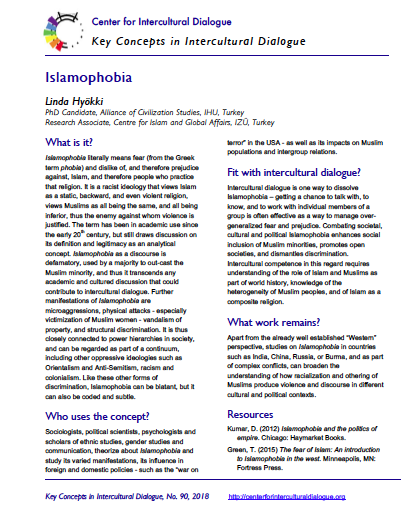
Key Concepts in ICDThe next issue of Key Concepts in intercultural Dialogue is now available. This is KC#90: Islamophobia, by Linda Hyökki. Click on the thumbnail to download the PDF. Lists organized chronologically by publication date and numberalphabetically by concept in English, and by languages into which they have been translated, are available, as is a page of acknowledgments with the names of all authors, translators, and reviewers.

KC90 IslamophobiaHyökki, L. (2018). Islamophobia. Key Concepts in Intercultural Dialogue, 90. Available from:
https://centerforinterculturaldialogue.org/wp-content/uploads/2018/02/kc90-islamophobia.pdf

The Center for Intercultural Dialogue publishes a series of short briefs describing Key Concepts in Intercultural Dialogue. Different people, working in different countries and disciplines, use different vocabulary to describe their interests, yet these terms overlap. Our goal is to provide some of the assumptions and history attached to each concept for those unfamiliar with it. As there are other concepts you would like to see included, send an email to the series editor, Wendy Leeds-Hurwitz. If there are concepts you would like to prepare, provide a brief explanation of why you think the concept is central to the study of intercultural dialogue, and why you are the obvious person to write up that concept.


Creative Commons License
This work is licensed under a Creative Commons Attribution-NonCommercial-NoDerivatives 4.0 International License.

Ariane de Rothschild Fellowships 2018

FellowshipsSince its inception in 2009, the Ariane de Rothschild Fellowship has been passionately committed to diversity, the promotion of cross-cultural and religious understanding, and the respect for human dignity. In a world where divisive forces polarize people and communities, these values are ever more urgent and vital. Deadline: March 4, 2018.

There is already a large amount of interfaith initiatives but little focus addresses interreligious and cross-cultural relations from a social innovation and business-driven perspective. AdRF strongly believes that entrepreneurs and social innovators can make a huge impact on their environment and in bridging to other communities.

The Fellowship focuses on entrepreneurs from North America and Europe, especially from Jewish and Muslim communities, who demonstrate a proven commitment towards inclusion while at the same time strengthening the sustainability of their organization.

In particular, the Fellowship is looking for applicants:

  • who demonstrate convincingly their potential for both economic self-sufficiency and social impact;
  • with at least a tested proof of concept or (even better) a solid track-record in developing a socially impactful business in wide-ranging sectors ( housing, food, education, art, health, environment, technology…) ;
  • and a commitment to empower under-served communities, reduce isolation and build collaboration with society at large.

The AdR Fellow is a visionary leader who challenges retrenchment and fear of the Other. She/he endeavors to make a real impact through developing innovative solutions and promoting inclusive collaboration.

Woolf Institute Visiting Fellowship (UK)

FellowshipsThe Woolf Institute, which specialises in the study of relations between Jews, Christians and Muslims from a multidisciplinary perspective, invites applications for its annual visiting fellowship. Deadline: February 16, 2018.

The Fellowship is tenable for a two to three month period that overlaps one of the Cambridge terms 2019:
Lent term: 15 January–15 March 2019
Easter term: 23 April–14 June 2019

The successful candidate will be expected to be involved in a project of academic research or public education in an area relevant to the Institute’s work. The Fellow will be asked to present their work at a symposium on the subject of their project proposal.

There is no stipend attached to the Fellowships, but Fellows will be entitled to free accommodation in Cambridge and one round-trip journey to Cambridge. They will also have access to the Woolf Institute and Cambridge University libraries.

The Fellowship is available for a postdoctoral scholar of any academic rank, a policymaker or analyst in a relevant area of work and will most likely be asked to participate in some of the Institute’s teaching or practice-based activities.

CMM Institute Fellows (USA)

FellowshipsThe CMM Institute for Personal and Social Evolution is advertising several opportunities that may be of interest to followers of CID this year, not just their CMM Fellows Program.

Opportunity #1:
U.S. East Coast CMM Learning Exchange

In collaboration with the MBA program at Assumption College in Worchester, Massachusetts, our first Learning Exchange will occur on Friday and Saturday, April 20-21, 2018.  The theme is CMM in the World:  Cases for Social Change.  The cost is $50 and includes a light dinner and a continental breakfast.   We are soliciting case studies and envision our time together as a collaborative inquiry to strengthen our individual and collective practices around social responsibility.  For more information, contact ra.frkalATassumption.edu

Opportunity #2:
2018 Fellows Program:  Call for Proposals

In partnership with Columbia University, we are seeking innovative proposals that “take a communication perspective” and draw on CMM in ways that address patterns of inequality and that foster inclusion.  Applications are due by March 15 and notification of acceptance will take place in mid-April.  Our 2018 Fellows will present their work at the 2018 Learning Exchange in Oracle, Arizona in late October.  Fellows recipients will also receive a $500 honorarium and money toward their travel expenses to the Learning Exchange in Arizona.  For more information and for the application, contact bartonbuechnerATgmail.com 

Opportunity #3:
U.S. West Coast CMM Learning Exchange

Save the Date:  Saturday and Sunday, October 27 and 28.
The CMM Institute will travel back to the beautiful Sonoran desert where we have had past Learning Exchanges to explore the theme of “Building Community.”   We will provide more information in the weeks and months to come but, for now, save the date.

U Edinburgh Job Ad: Discourse Analysis (UK)

Job adsLecturer in Discourse Analysis, University of Edinburgh, UK. Deadline: 6 March 2018.

The School of Philosophy, Psychology and Language Sciences at the University of Edinburgh is seeking to appoint a Lecturer in Discourse Analysis to our department of Linguistics and English Language.  The successful candidate will contribute original research and public impact in an area of discourse analysis, offer teaching at all levels of the curriculum in this area, contribute to our thriving MSc programme in Applied Linguistics including directing the degree when necessary, and recruit and supervise PhD students.

Shortlisting is anticipated to take place week commencing 12th March 2018. We aim to contact shortlisted candidates at least two week in advance.

Short-listed candidates will be required to give two presentations on their research and teaching to the department as well as an interview panel process. A full timetable will be issued in advance. Interviews are like to take place week commencing 2nd April 2018.

The Department of Linguistics and English Language particularly welcome applications from candidates belonging to groups that have been traditionally underrepresented in the subject, including, but not limited to, women and ethnic minorities.

CID Poster #11: Language and Intercultural Communication

CID PostersThis is CID Poster #11, designed by Brandon Peña, illustrating a quote related to KC78: Language and Intercultural Communication by Jane Jackson. This is the first designed by someone other than Linda J. de Wit. It came about because he is a student of Anna Klyueva, at the University of Houston-Clear Lake, and she turned posters into a course project (other faculty are welcome to do so as well, of course).

CID Poster #11: Language and Intercultural Communication

Just in case anyone wants to cite this poster, the following would be the recommended format:

Center for Intercultural Dialogue. (2018). Language and intercultural communication. CID Posters, 11. Available from:
https://centerforinterculturaldialogue.org/wp-content/uploads/2018/02/language-and-intercultural-communication-poster.png

As with other series, CID Posters are available for free on the site; just click on the thumbnail to download a printable PDF. They may be downloaded, printed, and shared as is, without changes, without cost, so long as there is acknowledgment of the source.

As with other series, if you wish to contribute an original contribution, please send an email before starting any work to receive approval, to minimize inadvertent duplication, and to learn about technical requirements. As is the case with other CID Publications, posters should be created initially in English. Given that translations of the Key Concepts in Intercultural Dialogue have received so many views, anyone who wishes to translate their own poster into another language (or two) is invited to provide that as well. If you want to volunteer to translate someone else’s poster into a language in which you are fluent, send in a note before starting, to receive approval and to confirm no one else is working on the same one.

Wendy Leeds-Hurwitz
Director, Center for Intercultural Dialogue
intercult.dialogue AT gmail.com


Creative Commons License
This work is licensed under a Creative Commons Attribution-NonCommercial-NoDerivatives 4.0 International License.