Drawing on the example of the California Series in Public Anthropology, the Center for a Public Anthropology announces a new open-access book series that addresses important public issues. It embraces the hope that anthropology has value to those beyond the discipline, beyond the university. The focus is on publications that matter to other people – by the power of their ideas and by how, with the help of others, they transform peoples’ lives for the better.
INTERNATIONAL COMPETITION. Each year the Center will hold an international competition seeking out prospective manuscripts that align with this vision. The Series reviews proposals independent of whether the manuscripts themselves have been completed. The proposals submitted should be 3-4,000 words long and describe both the overall work as well as a general summary of what is (or will be) in each chapter.
This one-day research seminar is being prepared and organized by the Centre for Interaction Research and Communication Design at the University of Copenhagen. The day is planned as a single-track research seminar. Proposals are invited for paper presentations related to Video ethnography, EMCA, multimodality and interaction analysis. We especially encourage paper presentations that deal with difficult methodological issues and/or presents novel solutions to methodological issues. The invited keynote speaker is Christian Heath, Professor in work, interaction and technology. Kings College London. The title of his presentation is: Institutional form and multimodal interaction: ecologies of participation and engagement.
CID’s first video competition is now over, and the judges have reviewed all the videos. As a reminder, the instructions were to answer the question “What does intercultural dialogue look like?” in 90-120 seconds, on video.
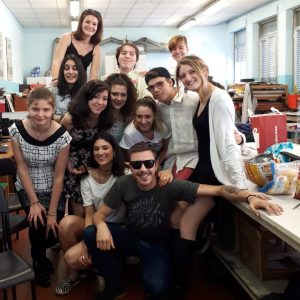
Second prize goes to Class 5B, the final year at the School of Arts “Aldo Passoni,” Turin (Italy). Students have 3 main fields of study: Graphic and Editorial Book Design, Industrial Design, and Textile and Fashion Design. Judges praised this video for creativity and originality, as well as for complexity and professionalism, said it was beautifully shot, and particularly mentioned both the music and the use of color.
Title: What does intercultural dialogue look like? It’s InterCOLORal Dialogue!
Description: Given that we are a multicultural and multilingual Institute, we decided to develop our video focusing on different words in different languages, and as we are a School of Arts we paired each word with a specific color. Indeed, works of art are a whole made up of different colors and brushstrokes, and this is how we understand intercultural dialogue: the participation and the contribution of each of us to a common project, that of mutual understanding. Within such a perspective, we view intercultural dialogue in the widest sense of a dialogue across all types of cultures linked not only to nationality or ethnicity, but also as a dynamic able to challenge all stereotypes regarding gender, sexual orientation, etc.
Specific credits:
Direction & Editing: Stefano Millesimo
Recording & Sound Engineering: Edoardo Denunzio, Bruno Alicata, Matteo Rizzo
Set: Bruno Alicata
Make-Up & Colors: Michela Geremia
Casting: Giorgia Culotta
Texts: Martina Dinoi
There were first, second and third place winners, as well as 3 videos that merited awards of excellence. Each of these is being highlighted in a separate post, as they warrant our attention. My thanks to the judges of the competition, professionals who made time to review student videos. Thanks also to all the competitors, who took the time to really think about the question of how to show intercultural dialogue visually.
The Mushtaq Gurmani School of Humanities and Social Sciences at the Lahore University of Management Sciences (LUMS) seeks a qualified scholar to occupy the Dr. Khurshid Hyder Chair. The qualified person will either be a Senior Associate Professor or Full Professor (PhD required) who has research focus and teaching experience in the disciplinary areas of International Relations/Political Science.
The research concentration can range from conflict and security studies to multi- or bi-lateral diplomacy within South Asia or in other geographical regions (Middle East, Africa, Latin America, Europe, East Asia). Preferably the Chair will have further specialization in the study of International Cooperation and Institutions.
The Office of International Education and the Department of Communication at the University at Buffalo (UB) invite applications for instructors to teach Communication courses in the UB undergraduate program at the Singapore Institute of Management in Singapore. Available Communication courses may include those in the following areas: Communication Theory, Mass Communication, Intercultural Communication, Organizational Communication, Interpersonal Communication, Communication Technology, Advertising and Public Relations.
SlowFood recently posted an interesting article titled Glimpses and Smells: Recipes and Short Films, based on an interview of Diana Maria Tohătan (a Romanian immigrant to Italy, who prepared food for the Migranti Film Festival, held at the University of Gastronomic Sciences campus in Pollenzo and in Bra in June 2018. Among the quotes is this: “Food is a primary need, it’s the easiest way to start an intercultural dialogue” which shows the relevance of this article for followers of this site.
Additional resources on food as a form of intercultural interaction include:
“Guest residencies for journalists of up to two months each. The objectives of the Fellowship program are to support high-quality journalism in the area of the history of science, promote the public dissemination of topics in the history of science, and strengthen the dialogue that the history of science enables among the humanities, social sciences, and natural sciences. At the same time, the program offers scholars at the Institute the opportunity to find ways of enhancing the public communication of their research.
As a Fellowship recipient, you will shadow a research project in one of the Institute’s departments and carry out your own research. You will be able to attend the colloquiums and workshops of the various departments. During your residency, you will be mentored by an MPIWG researcher and the head of communications. We expect you to offer an internal colloquium event on a theme related to journalism and science.”
Organized by Associazione Poesia e Solidarietà in collaboration with Centro Internazionale di Studi e Documentazione per la Cultura Giovanile. General topic: Ethics and complexity in the time of Global city (from different point of views and experiences).
The present call is addressed to young adults aged 18 to 35, without distinction as to nationality. The Forum works will be conducted both in Italian and in English; simultaneous translation from/to both languages will be provided. Those who are interested in taking part to the Forum must apply by filling and submitting the online form available on the organization’s website.
The 1st SIETAR Spain Congress will be an intersectoral conference, where professionals from different realms of society (business, academic, public administrations, NGOs…) will discuss the topic of inclusion. This Congress aims to become a platform to exchange innovative ideas and to debate different aspects of interculturality. We will also have a close look at how this interculturality permeates different fields, such as education, research and civil and business organizations. After this Congress, one thing will become clear: the intercultural competence will stand out as one of the most decisive tools when ensuring inclusive organizations and societies in our modern world.
CID’s first video competition is now over, and the judges have reviewed all the videos. As a reminder, the instructions were to answer the question “What does intercultural dialogue look like?” in 90-120 seconds, on video.
First prize goes to Jinsuk Kim, a Master’s student in Media Studies and Production at Temple University (USA). He has just graduated, and gotten married (thus this photo). He works as Director of Media and Communications at K-Global Accelerator, and has prior experience as a video editor, and assistant producer. Judges praised the camera work and use of music especially, and liked the uncommon short narrative film format, as well as the fact that his video clearly shows a great example of intercultural dialogue.
Title: Jin
Description: “My video is a personal narrative (short film), based on my own experiences, that looks at cultural differences and language issues that foreigners experience in America. The purpose of this project is to encourage foreigners who are have a hard time with cultural differences and language issues in America and to help Americans understand foreigners better. I hope this video serves as a bridge between Americans and foreigners.”
There were first, second and third place winners, as well as 3 videos that merited awards of excellence. Each of these is being highlighted in a separate post, as they warrant our attention. My thanks to the judges of the competition, professionals who made time to review student videos. Thanks also to all the competitors, who took the time to really think about the question of how to show intercultural dialogue visually.

 PUBLIC ANTHROPOLOGY: MODELING THE HOPE. New book series, Center for a Public Anthropology. Deadline: November 5, 2018.




 First prize goes to Jinsuk Kim, a Master’s student in Media Studies and Production at Temple University (USA). He has just graduated, and gotten married (thus this photo). He works as Director of Media and Communications at K-Global Accelerator, and has prior experience as a video editor, and assistant producer. Judges praised the camera work and use of music especially, and liked the uncommon short narrative film format, as well as the fact that his video clearly shows a great example of intercultural dialogue.
 Center for Intercultural Dialogue