Mother Tongue Film Festival (Online)

Intercultural PedagogyThe Smithsonian Institution’s Mother Tongue Film Festival celebrates cultural and linguistic diversity by showcasing films and filmmakers from around the world in Washington, DC, until May 31, 2021.

Through digital storytelling, the festival amplifies the work of diverse practitioners who explore the power of language to connect the past, present, and future. Since 2016, the annual festival has celebrated International Mother Language Day on February 21. The sixth annual festival will take place via a monthly online screening series from February 21 to May 31, 2021.

Many of these films would be valuable in teaching about cultural differences, if not intercultural dialogue explicitly. The theme this year is The Healing Power of Storytelling.

Marlena Pompino Profile

ProfilesMarlena Pompino, MA, is is Marketing Manager at Buzzwoo Asia in Chiang Mai, Thailand.


Marlena Pompino

Marlena Pompino holds an undergraduate double major in English Studies, focusing on Linguistics, and Economic Sciences, with a minor in Intercultural German Studies. She spent one year in Namibia, in order to learn more about that beautiful continent and its diverse cultures, tribes, and people. She also holds a postgraduate degree in Media and Communication Management from the Macromedia University of Applied Sciences in Cologne. Her thesis was titled: Interculturality: Between real diversity and fake stereotypes – a comparative content analysis of corporate content communication around the world. She further holds certificates in Diversity Leadership, Balanced Leadership and Change Management.

See her LinkedIn profile for further information.


Work for CID:

Marlena Pompino has translated KC9: Communicative Competence, KC10: Cross-cultural Dialogue, KC11: Intercultural Discourse and Communication, KC27: Globalization, KC30: Critical Intercultural Communication, KC78: Language and Intercultural Communication, KC84: Double Intercultural Dialogue, KC88: Critical Cultural Linguistics, KC92: Kintsugi, KC95: Transnational Media, KC97: Anti-Racist Education, KC100: Transcultural Communication, KC102: Inclusive Communication, KC107: Interculturality, and KC108: Superdiversity  into German.

Virginia Tech: Intercultural Learning (USA)

“Job

Assistant Director for Intercultural Learning and Program Director for Mozaiko LLC, Virginia Tech, Blacksburg, VA. Deadline: May 7, 2021.

The Assistant Director for Intercultural Learning & Program Director for Mozaiko Living-Learning Community reports to the Director of Cranwell International Center and serves as the leader of intercultural learning efforts within Cranwell International Center and the Mozaiko Living-Learning Community.

The selected individual must be a seasoned educator with an unrelenting commitment to student success, learning, and diversity, with a Master’s degree in intercultural communication, language education, international affairs, counseling, student affairs, higher education administration, or related field.

Aspen Institute: Program Assistant to Weave (USA)

“Job

Program Assistant, Weave: The Social Fabric Project, Aspen Institute, Washington, DC. Deadline: Open until filled.


Weave’s Program Assistant works across each of Weave’s strategic priorities to ensure the operational efficiency and relational focus of the Weave team. This role serves as the primary contact for all inquiries to Weave, offering a warm response to emails, social media, community hub posts, and website correspondence. The Program Assistant will work with Weave team members to coordinate speaking engagements, manage relationships with Weave’s supporters, and support logistics for Weave events.

The Assistant must be highly organized with an ability to monitor and manage multiple moving workstreams to accomplish project success. The Program Assistant is also a skilled communicator and will write correspondence to Weavers and Weave supporters along with content for Weave’s website and social media. The ideal candidate has passion for Weave’s mission, enjoys organizing effective systems, and is at ease getting to know new people of all backgrounds.

Weave: The Social Fabric Project was started by columnist David Brooks and the Aspen Institute in May of 2018 to counter a culture of hyper-individualism in the US that has left Americans divided, isolated and unhappy. This crisis of connection and decline in social trust has led to rising rates of addiction and suicide, persistent inequality and discrimination, and gridlocked politics. Yet in every community, some people have chosen to weave the social fabric by investing in relationships, making commitments to others and creating connection. These “Weavers” are all different. Some work at a suicide hotline, a mentoring program or in schools. Others run a coffee shop where everybody feels at home. Still others just gather neighbors to talk or stop to listen when they see someone distraught. They lead with love, creating countercultural islands where connection and community are more important than ego and self. You will find their stories at WeAreWeavers.org.

National U Singapore: Global Media Communication (Singapore)

“JobAssistant Professor in Global Media Communication, Communications and New Media, National University of Singapore, Singapore. Deadline: May 12, 2021 (position reopened).

The Department of Communications and New Media (CNM) at the National University of Singapore invites applicants with expertise in one or more of the following areas: global media and communication, environmental communication, media industry studies, intercultural communication, science and technology studies, development communication, digital technology and social change, global media governance, media communication in Asia and/or Southeast Asia. CNM offers an undergraduate double degree with the School of Business; undergraduate minors in Interactive Media Development and Cultural Studies, the Cultural Studies in Asia PhD programme, and a new Master of Social Science in Communication programme. It has research concentrations in media and publics, critical theory, cultural studies, communication policy, computation and creativity, health communication. Successful candidates for this position will join an engaging community of 46 full-time faculty, 13 part-time instructors, and approximately 800 undergraduate and graduate students.

Overcoming Polarized Narratives

Applied ICDOn January 27th 2021, as part of Fielding Graduate University’s first Alumni Conference themed Global Leading and Learning in the Next Decade, Coordinated Management of Meaning Institute (CMMi) board members co-organized a panel dialogue on “Overcoming Polarized Narratives.” Four of this year’s CMMi Fellows shared their work in this theme, and four board members set the context.

In the context of global leading and learning in the next decade, we can say that overcoming polarized narratives is a key competence for leaders in the context of the relationships that they facilitate with their organizations, be they single entities, communities, networks, nations, or international cooperatives. From a communication perspective, we see the constitutive role of metaphor in overcoming polarized narrative as critical. In addition to watching the video, it is possible to also download slides.

KC #100: Transcultural Communication Translated into French

Key Concepts in ICDContinuing translations of Key Concepts in Intercultural Dialogue, today I am posting KC#100: Transcultural Communication, originally written by Mohammed Guamguami for publication in 2021, and now translated by him into French.

As always, all Key Concepts are available as free PDFs; just click on the thumbnail to download. Lists organized chronologically by publication date and numberalphabetically by concept in English, and by languages into which they have been translated, are available, as is a page of acknowledgments with the names of all authors, translators, and reviewers.
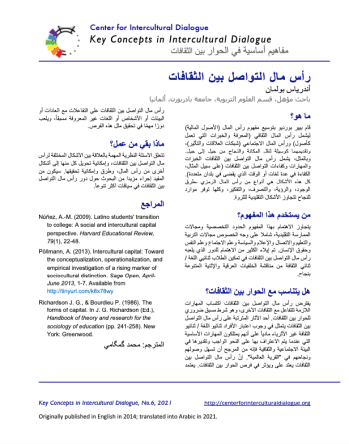
KC100 Transcultural Communication_French_v2Guamguami, M. (2021). Communication transculturelle. Key Concepts in Intercultural Dialogue, 100. Available from: https://centerforinterculturaldialogue.org/wp-content/uploads/2021/05/kc100-transcultural-communication_french_v2.pdf

If you are interested in translating one of the Key Concepts, please contact me for approval first because dozens are currently in process. As always, if there is a concept you think should be written up as one of the Key Concepts, whether in English or any other language, propose it. If you are new to CID, please provide a brief resume. This opportunity is open to masters students and above, on the assumption that some familiarity with academic conventions generally, and discussion of intercultural dialogue specifically, are useful.

Wendy Leeds-Hurwitz, Director
Center for Intercultural Dialogue


Creative Commons License
This work is licensed under a Creative Commons Attribution-NonCommercial-NoDerivatives 4.0 International License.

Save

CFP: Multilingual, Multicultural, Migrant & Diasporic Radio

“Publication Call for Papers: Multilingual, Multicultural, Migrant & Diasporic Radio, for a Symposium in Journal of Radio & Audio Media, to be edited by Anne F. MacLennan  and Masudul Biswas. Deadline: August 1, 2022.

Radio connects communities regionally, nationally, and transnationally. Multilingual, multicultural, migrant & diasporic radio connect communities within larger communities crossing boundaries & barriers. This call for papers is for a symposium to be published in the May 2023 issue of JRAM. Editors invite submission of research on the roles of multicultural, multilingual, migrant, and diasporic radio stations in a multicultural society. The scope of research can be geared towards the community radio stations that serve immigrant, refugee, ethnic minority, or diasporic communities. Research on how mainstream radio stations incorporating multi-lingual programming to reach a wide range of audience can fall within the purview of this special edition.

Expressions of interest prior to submission are appreciated but not required (email Anne F. MacLennan  and/or Masudul Biswas, with Multilingual, Multicultural, Migrant & Diasporic Radio in the subject line). 


Counter-Narratives in Language Education Research (UK but Online)

Events

Counter-Narratives in Language Education Research, Center for Language Education Research, University of Leeds, Leeds, UK (Online), May 18, 2021, 2-4 BST.

Counter-Narratives in Language Education Research will highlight presentations by Dr. Nelson Flores, University of Pennsylvania and Dr. Giovanna Fassetta, University of Glasgow, with contributions from University of Leeds colleagues: Dr. Daniel Fobi, Dr. Kate Spowage and Rumana Hossain.

The speakers’ presentations in diverse areas of language education inquiry will lead to a more general reflection. Among the topics to be discussed:

  • What are the dominant narratives of language (and) education in our respective contexts and domains of inquiry?
  • Which/whose stories are not included in them and why do they need to be
  • How does our research need to change to make space for the multiple, complex and often competing counter-narratives?

KC101 Antisemitism

Key Concepts in ICDThe next issue of Key Concepts in intercultural Dialogue is now available. This is KC#101: Antisemitism, by Daniel Mateo Ordóñez. Click on the thumbnail to download the PDF. Lists organized chronologically by publication date and numberalphabetically by concept in English, and by languages into which they have been translated, are available, as is a page of acknowledgments with the names of all authors, translators, and reviewers.


KC101 AntisemitismOrdóñez, D. M. (2021). Antisemitism. Key Concepts in Intercultural Dialogue, 101. Available from: https://centerforinterculturaldialogue.org/wp-content/uploads/2021/04/kc101-antisemitism.pdf

The Center for Intercultural Dialogue publishes a series of short briefs describing Key Concepts in Intercultural Dialogue. Different people, working in different countries and disciplines, use different vocabulary to describe their interests, yet these terms overlap. Our goal is to provide some of the assumptions and history attached to each concept for those unfamiliar with it. As there are other concepts you would like to see included, send an email to the series editor, Wendy Leeds-Hurwitz. If there are concepts you would like to prepare, provide a brief explanation of why you think the concept is central to the study of intercultural dialogue, and why you are the obvious person to write up that concept.


Creative Commons License
This work is licensed under a Creative Commons Attribution-NonCommercial-NoDerivatives 4.0 International License.