
Key Concept #57: Contextualization Cues by Cynthia Gordon

Key Concepts in ICDThe next issue of Key Concepts in intercultural Dialogue is now available. This is KC57: Contextualization Cues by Cynthia Gordon. As always, all Key Concepts are available as free PDFs; just click on the thumbnail to download. Lists organized  chronologically by publication date and numberalphabetically by concept in English, and by languages into which they have been translated, are available, as is a page of acknowledgments with the names of all authors, translators, and reviewers.
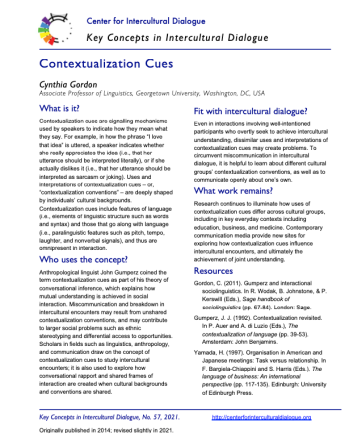
KC57 Contextualization cues v2Gordon, C. (2015). Contextualization cues. Key Concepts in Intercultural Dialogue, 57. Available from:
https://centerforinterculturaldialogue.org/wp-content/uploads/2021/06/kc57-contextualization-cues-v2.pdf

The Center for Intercultural Dialogue publishes a series of short briefs describing Key Concepts in Intercultural Dialogue. Different people, working in different countries and disciplines, use different vocabulary to describe their interests, yet these terms overlap. Our goal is to provide some of the assumptions and history attached to each concept for those unfamiliar with it. As there are other concepts you would like to see included, send an email to the series editor, Wendy Leeds-Hurwitz. If there are concepts you would like to prepare, provide a brief explanation of why you think the concept is central to the study of intercultural dialogue, and why you are the obvious person to write up that concept.


Creative Commons License
This work is licensed under a Creative Commons Attribution-NonCommercial-NoDerivatives 4.0 International License.
Key Concept #56: Racial Incorporation by Jolanta Drzewiecka

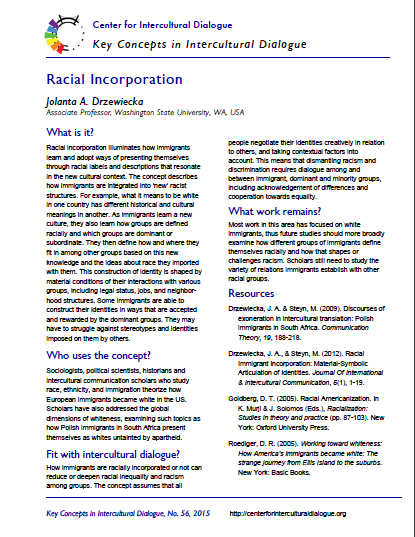
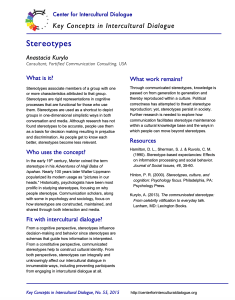
Key Concepts in ICDThe next issue of Key Concepts in intercultural Dialogue is now available. This is KC56: Racial Incorporation by Jolanta A. Drzewiecka. As always, all Key Concepts are available as free PDFs; just click on the thumbnail to download. Lists organized  chronologically by publication date and numberalphabetically by concept in English, and by languages into which they have been translated, are available, as is a page of acknowledgments with the names of all authors, translators, and reviewers.

Key Concept #56 Racial Incorporation by Jolanta Drzewiecka

Drzewiecka. J. A. (2015). Racial incorporation. Key Concepts in Intercultural Dialogue, 56. Available from: https://centerforinterculturaldialogue.org/wp-content/uploads/2015/03/key-concept-racial-incorporation.pdf

The Center for Intercultural Dialogue publishes a series of short briefs describing Key Concepts in Intercultural Dialogue. Different people, working in different countries and disciplines, use different vocabulary to describe their interests, yet these terms overlap. Our goal is to provide some of the assumptions and history attached to each concept for those unfamiliar with it. As there are other concepts you would like to see included, send an email to the series editor, Wendy Leeds-Hurwitz. If there are concepts you would like to prepare, provide a brief explanation of why you think the concept is central to the study of intercultural dialogue, and why you are the obvious person to write up that concept.


Creative Commons License
This work is licensed under a Creative Commons Attribution-NonCommercial-NoDerivatives 4.0 International License.
Key Concept #55: Stereotypes by Anastacia Kurylo

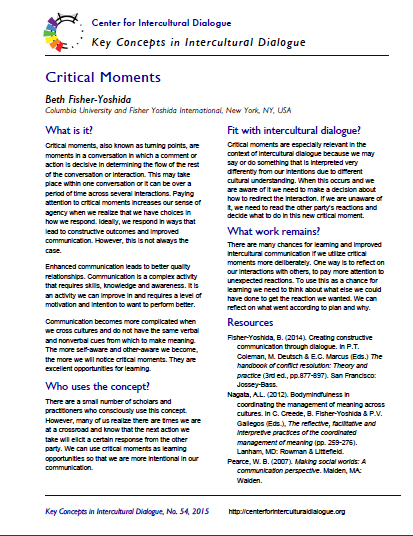
Key Concepts in ICDThe next issue of Key Concepts in intercultural Dialogue is now available. This is KC55: Stereotypes by Anastacia Kurylo. As always, all Key Concepts are available as free PDFs; just click on the thumbnail to download.

Key Concepts in Intercultural Dialogue 55: Stereotypes

Lists organized  chronologically by publication date and numberalphabetically by concept in English, and by languages into which they have been translated, are available, as is a page of acknowledgments with the names of all authors, translators, and reviewers.

Kurylo, A. (2015). Stereotypes. Key Concepts in Intercultural Dialogue, 55. Available from:
https://centerforinterculturaldialogue.org/wp-content/uploads/2018/11/kc55-stereotypes3.pdf

The Center for Intercultural Dialogue publishes a series of short briefs describing Key Concepts in Intercultural Dialogue. Different people, working in different countries and disciplines, use different vocabulary to describe their interests, yet these terms overlap. Our goal is to provide some of the assumptions and history attached to each concept for those unfamiliar with it. As there are other concepts you would like to see included, send an email to the series editor, Wendy Leeds-Hurwitz. If there are concepts you would like to prepare, provide a brief explanation of why you think the concept is central to the study of intercultural dialogue, and why you are the obvious person to write up that concept.


Creative Commons License
This work is licensed under a Creative Commons Attribution-NonCommercial-NoDerivatives 4.0 International License.
Key Concept #54: Critical Moments by Beth Fisher-Yoshida

Key Concepts in ICDThe next issue of Key Concepts in intercultural Dialogue is now available. This is KC54: Critical Moments by Beth Fisher-Yoshida. As always, all Key Concepts are available as free PDFs; just click on the thumbnail to download. Lists organized  chronologically by publication date and numberalphabetically by concept in English, and by languages into which they have been translated, are available, as is a page of acknowledgments with the names of all authors, translators, and reviewers.

Key Concept #54: Critical moments by Beth Fisher-Yoshida

Fisher-Yoshida, B. (2015). Critical moments. Key Concepts in Intercultural Dialogue, 54. Available from: https://centerforinterculturaldialogue.org/wp-content/uploads/2015/03/key-concept-critical-moments.pdf

The Center for Intercultural Dialogue publishes a series of short briefs describing Key Concepts in Intercultural Dialogue. Different people, working in different countries and disciplines, use different vocabulary to describe their interests, yet these terms overlap. Our goal is to provide some of the assumptions and history attached to each concept for those unfamiliar with it. As there are other concepts you would like to see included, send an email to the series editor, Wendy Leeds-Hurwitz. If there are concepts you would like to prepare, provide a brief explanation of why you think the concept is central to the study of intercultural dialogue, and why you are the obvious person to write up that concept.


Creative Commons License
This work is licensed under a Creative Commons Attribution-NonCommercial-NoDerivatives 4.0 International License.
Key Concept #53: Conflict Management by Qi Wang

Key Concepts in ICDThe next issue of Key Concepts in intercultural Dialogue is now available. This is KC53: Conflict Management by Qi Wang. As always, all Key Concepts are available as free PDFs; just click on the thumbnail to download. Lists organized  chronologically by publication date and numberalphabetically by concept in English, and by languages into which they have been translated, are available, as is a page of acknowledgments with the names of all authors, translators, and reviewers.

KC53 Conflict ManagementWang, Q. (2015). Conflict management. Key Concepts in Intercultural Dialogue, 53. Available from https://centerforinterculturaldialogue.org/wp-content/uploads/2016/12/kc53-conflict-management-v2.pdf

The Center for Intercultural Dialogue publishes a series of short briefs describing Key Concepts in Intercultural Dialogue. Different people, working in different countries and disciplines, use different vocabulary to describe their interests, yet these terms overlap. Our goal is to provide some of the assumptions and history attached to each concept for those unfamiliar with it. As there are other concepts you would like to see included, send an email to the series editor, Wendy Leeds-Hurwitz. If there are concepts you would like to prepare, provide a brief explanation of why you think the concept is central to the study of intercultural dialogue, and why you are the obvious person to write up that concept.


Creative Commons License
This work is licensed under a Creative Commons Attribution-NonCommercial-NoDerivatives 4.0 International License.
Key Concept #52: Harmony by Guo-Ming Chen

Key Concepts in ICDThe next issue of Key Concepts in intercultural Dialogue is now available. This is KC52: Harmony by Guo-Ming Chen. As always, all Key Concepts are available as free PDFs; just click on the thumbnail to download. Lists organized  chronologically by publication date and numberalphabetically by concept in English, and by languages into which they have been translated, are available, as is a page of acknowledgments with the names of all authors, translators, and reviewers.

Key Concept #52: Harmony by Guo-Ming Chen

Chen, G.-M. (2015). Harmony. Key Concepts in Intercultural Dialogue, 52. Available from: https://centerforinterculturaldialogue.org/wp-content/uploads/2015/02/key-concept-harmony.pdf

The Center for Intercultural Dialogue publishes a series of short briefs describing Key Concepts in Intercultural Dialogue. Different people, working in different countries and disciplines, use different vocabulary to describe their interests, yet these terms overlap. Our goal is to provide some of the assumptions and history attached to each concept for those unfamiliar with it. As there are other concepts you would like to see included, send an email to the series editor, Wendy Leeds-Hurwitz. If there are concepts you would like to prepare, provide a brief explanation of why you think the concept is central to the study of intercultural dialogue, and why you are the obvious person to write up that concept.


Creative Commons License
This work is licensed under a Creative Commons Attribution-NonCommercial-NoDerivatives 4.0 International License.
Key Concept #51: Critical Discourse Analysis by Paola Giorgis

Key Concepts in ICDThe next issue of Key Concepts in intercultural Dialogue is now available. This is KC51: Critical Discourse Analysis by Paola Giorgis. As always, all Key Concepts are available as free PDFs; just click on the thumbnail to download. Lists organized  chronologically by publication date and numberalphabetically by concept in English, and by languages into which they have been translated, are available, as is a page of acknowledgments with the names of all authors, translators, and reviewers.

Key Concept #51: Critical discourse analysis by Paola Giorgis

Giorgis, P. (2015). Critical discourse analysis. Key Concepts in Intercultural Dialogue, 51. Available from: https://centerforinterculturaldialogue.org/wp-content/uploads/2015/02/key-concept-cda.pdf

The Center for Intercultural Dialogue publishes a series of short briefs describing Key Concepts in Intercultural Dialogue. Different people, working in different countries and disciplines, use different vocabulary to describe their interests, yet these terms overlap. Our goal is to provide some of the assumptions and history attached to each concept for those unfamiliar with it. As there are other concepts you would like to see included, send an email to the series editor, Wendy Leeds-Hurwitz. If there are concepts you would like to prepare, provide a brief explanation of why you think the concept is central to the study of intercultural dialogue, and why you are the obvious person to write up that concept.


Creative Commons License
This work is licensed under a Creative Commons Attribution-NonCommercial-NoDerivatives 4.0 International License.
Key Concept #50: Guanxi by Juana Du

Key Concepts in ICDThe next issue of Key Concepts in intercultural Dialogue is now available. This is KC50: Guanxi by Juana Du. As always, all Key Concepts are available as free PDFs; just click on the thumbnail to download. Lists organized  chronologically by publication date and numberalphabetically by concept in English, and by languages into which they have been translated, are available, as is a page of acknowledgments with the names of all authors, translators, and reviewers.Key Concept #50: Guanxi by Juana DuDu, J. (2015). Guanxi. Key Concepts in Intercultural Dialogue, 50. Available from:
https://centerforinterculturaldialogue.org/wp-content/uploads/2015/02/key-concept-guanxi.pdf

The Center for Intercultural Dialogue publishes a series of short briefs describing Key Concepts in Intercultural Dialogue. Different people, working in different countries and disciplines, use different vocabulary to describe their interests, yet these terms overlap. Our goal is to provide some of the assumptions and history attached to each concept for those unfamiliar with it. As there are other concepts you would like to see included, send an email to the series editor, Wendy Leeds-Hurwitz. If there are concepts you would like to prepare, provide a brief explanation of why you think the concept is central to the study of intercultural dialogue, and why you are the obvious person to write up that concept.


Creative Commons License
This work is licensed under a Creative Commons Attribution-NonCommercial-NoDerivatives 4.0 International License.
Key Concept #49: Intersectionality by Gust Yep

Key Concepts in ICDThe next issue of Key Concepts in intercultural Dialogue is now available. This is KC49: Intersectionality by Gust Yep. As always, all Key Concepts are available as free PDFs; just click on the thumbnail to download. Lists organized  chronologically by publication date and numberalphabetically by concept in English, and by languages into which they have been translated, are available, as is a page of acknowledgments with the names of all authors, translators, and reviewers.Key Concept #49: Intersectionality Yep, G. (2015). Intersectionality. Key Concepts in Intercultural Dialogue, 49. Available from:
https://centerforinterculturaldialogue.org/wp-content/uploads/2015/02/key-concept-intersectionality.pdf

The Center for Intercultural Dialogue publishes a series of short briefs describing Key Concepts in Intercultural Dialogue. Different people, working in different countries and disciplines, use different vocabulary to describe their interests, yet these terms overlap. Our goal is to provide some of the assumptions and history attached to each concept for those unfamiliar with it. As there are other concepts you would like to see included, send an email to the series editor, Wendy Leeds-Hurwitz. If there are concepts you would like to prepare, provide a brief explanation of why you think the concept is central to the study of intercultural dialogue, and why you are the obvious person to write up that concept.


Creative Commons License
This work is licensed under a Creative Commons Attribution-NonCommercial-NoDerivatives 4.0 International License.

Key Concept #48: Communication Accommodation Theory by Howard Giles

Key Concepts in ICDThe next issue of Key Concepts in intercultural Dialogue is now available. This is KC48: Communication Accommodation Theory by Howard Giles. As always, all Key Concepts are available as free PDFs; just click on the thumbnail to download. Lists organized  chronologically by publication date and numberalphabetically by concept in English, and by languages into which they have been translated, are available, as is a page of acknowledgments with the names of all authors, translators, and reviewers.

Key Concept #48: Communication Accommodation Theory

Giles, H. (2015). Cultural accommodation theory. Key Concepts in Intercultural Dialogue, 48. Available from:
https://centerforinterculturaldialogue.org/wp-content/uploads/2015/01/key-concept-cat.pdf

The Center for Intercultural Dialogue publishes a series of short briefs describing Key Concepts in Intercultural Dialogue. Different people, working in different countries and disciplines, use different vocabulary to describe their interests, yet these terms overlap. Our goal is to provide some of the assumptions and history attached to each concept for those unfamiliar with it. As there are other concepts you would like to see included, send an email to the series editor, Wendy Leeds-Hurwitz. If there are concepts you would like to prepare, provide a brief explanation of why you think the concept is central to the study of intercultural dialogue, and why you are the obvious person to write up that concept.


Creative Commons License
This work is licensed under a Creative Commons Attribution-NonCommercial-NoDerivatives 4.0 International License.