In response to a grant from the Intercultural Cities Programme, several cities in Spain have successfully concluded a project on developing the intercultural skills of public administration staff as a key element for advancing further in the building of strong intercultural cities and territories. The assumption is that an intercultural competent staff at the service of the public administration will result in better municipal services, increase users’ satisfaction, and contribute to greater trust and sense of belonging.
The project responds to the existing gap in documentation by designing a practical handbook for city officials, transforming the concept of intercultural competence into practical language for local administration officers, defining the basics of an intercultural competent public action, and training local administration staff.
The 2020 Duolingo Language Report, issued December 15, 2020, includes trends, patterns, and analyses about language learning around the world.
The report includes 500 million learners in all 194 countries, and 39 different languages. It describes how interest in learning different languages has changed over time, especially in response to the global pandemic. It is a fascinating window on language learning across the globe and, of course, language learning is important part of intercultural dialogue.
The Conversation, a nonprofit, independent news organization in Australia, has published a number of articles on intercultural dialogue topics. These should also be useful in teaching.
At its best, dialogue promises to bring together people with different worldviews, life experiences, stakes, interests, and goals and provide opportunities for perspective-taking, learning, open-mindedness, and turn-taking.
The authors are co-directors of the Difficult Dialogues Project at Texas A&M University. In this essay for Spectra, the newsletter of the National Communication Association, they provide a long list of accessible resources (such as Scaffolded Antiracism Resources) and academic publications for those interested in the topic to explore.
Riaz Patel is a triple minority: Muslim, an immigrant from Pakistan, and gay. He has been facilitating events at which participants learn to talk across their multiple divides. The article about what he is doing never uses the phrase intercultural dialogue, but it’s a great example nonetheless.
He uses the EPIC system (equalization, personification, information gathering, collaboration). The first challenge is getting people to show up, knowing they will be asked to hold what are at times uncomfortable conversations. Once they are present, activities fall into into 4 stages:
Equalization (determining what participants have in common)
Personification (talking about your own experiences)
Information Gathering (learning about the experiences of others)
Collaboration (working together to determine strategies to solve shared problems)
Full article:Connecting divides. (2020 May/June). Pennsylvania Gazette, 118(5), 67-68).
The Reykjavik City Library in Iceland has started an initiative called ‘Beyond Words’ using art to foster intercultural dialogue. This was developed by Martyna Karolina Daniel, project organiser and the library’s specialist in intercultural affairs.
Martyna and her colleagues are committed to making the city’s libraries a safe haven for all Icelanders, whether native or immigrant and a place where cross-cultural dialogue can take place.
The library is offering a variety of art workshops, making available a wide range of foreign-language books, and using more symbols in their signage in response to linguistic differences. They also offer storytelling in multiple languages, inviting community members to read books in any language they know, and invite extended families to participate. And they co-sponsored a Story Circle Map of Iceland, painted 2013 by 35 women who have participated in Women’s Story Circle, coming from 18 countries to live in Iceland. To make the panting they used the method of the indigenous people of Australia, which entails that many work together to create artworks.
Born in Morocco, now based in Germany, Nadia Doukali has created Iftarlade chocolate which is both kosher and halal, with a label in Hebrew, Arabic, and German.
Doukali first designed a Ramadan calendar, which she called “Iftarlender,” (made up of the word “Iftar” – the evening meal during Ramadan used to break each day’s fast, and the German word “kalender” for the German advent calendars with small paper doors, and sayings or candy behind them). Then she created Iftarlade chocolate (“Iftar” + “schokolade”, or chocolate in German). She decided to make it halal, and then wanted it to be kosher as well, so she worked to gain the appropriate certifications. She sees her products as a way for people to be “united in chocolate.”
COVID-19 vs. Intercultural Dialogue: What Impact? An interview of Professor Fethi Mansouri (UNESCO Chairholder, Cultural Diversity and Social Justice, Deakin University, Melbourne, Australia) by Ann-Belinda Preis (Chief of UNESCO Intercultural Dialogue).
A good question. See the entire interview, but for an excerpt:
ABP: How does lack of contact and social interaction impact the broader Intercultural Dialogue (ICD) agenda, which is built on connectivity, contact and exchange?
FM: This is perhaps where COVID-19 presents a significant challenge to the ICD agenda. Intercultural dialogue has, as one of its core premises, contact between people. And the reason why we have contact as a core premise is because there is an assumption that when people get to know one another, prejudice might be reduced, and that issues of discrimination might disappear. So COVID-19 and its emphasis on social distancing means that a lot of what we would like to achieve through intercultural dialogue, in particular in bringing people together, bringing communities together, bringing diverse communities together (and diversity here means diversity of ethnic backgrounds, religious beliefs, nationalities etc.)…
Intercultural dialogue is in itself an essential tool that we will need in the post-COVID-19 environment.
We will need to renegotiate a new global compact, a new social contract, and I think dialogue will have to play a key role in that. So it is being perhaps compromised right now but it has a big role to play in the post-COVID-19 world that will emerge.
What is a cross-cultural coffee break (CCC Break)? Every participant grabs a cup of coffee (cappuccino, latte macchiato, espresso, you name it) and dives into a vivid exchange on an intercultural topic.
The Objectives of CCC Breaks: Sharing and Learning in an informal virtual setting. Every CCC Break is designed for the maximum number of 10 participants in order to allow the maximum of interaction between participants.
Team behind the scenes: Barbara Covarrubias Venegas, Joanna Sell, Gradiola Kapaj, Camilla Degerth.
NOTE: A prior class of Paola’s won 2nd prize in the CID Video Competition in 2018, and then prepared a reflection on making that video to aid potential 2019 competitors. This video shows how a group might create a video for the 2020 competition, despite quarantine orders.
The idea came in the middle of the eye of the hurricane of COVID-19 in Italy. It was mid-March 2020 and, in the north of Italy where I live, the number of infected people was tripling every day, the hospital system was nearly collapsing, and the death toll was appalling.
I had been meeting my students online regularly. Before starting our lessons on English Literature and Visual Arts, we always had short conversations about how they were, how their family members were, and how they were coping with the situation. Looking at their faces through the screen, I saw their sense of bewilderment, but I also saw their resilience. Their young bodies and their youthful energies were confined, but their minds were not.
Therefore, I thought that maybe we could try together to get out of our physical confinement, and send a message of resilience, solidarity, and hope which could reach other people outside our homes. Yet, such a message was also directed inward to ourselves as an act of resistance and as the possibility to open our inner window on the future.
I proposed that my students make a video in which each of them would read some lines of a poem or a song. Participation was voluntary, yet the majority of them accepted immediately. I looked for some poems on a website which is very well done and which I often use for my lessons too: www.poetryfoundation.org. I chose some lines from four poems which I found particularly inspiring for the purpose we had in mind. I then proposed the poems to the participants: we read the poems together, I translated some parts for them, and then they decided which poem they preferred. Then, each participant read the whole poem that s/he had chosen, recording it on her/his mobile phone or computer. Meanwhile, I had asked a friend of mine, Luca Gasparini, a professional film editor, whether he could edit the different recordings. He accepted immediately and willingly. So, I collected all the different videos and uploaded them for him on a platform. He promptly edited them, and finished in only a few days.
I am so proud of my students! To spread such a message, they accepted to foreground the fragility and the vulnerability of speaking in English, which is not their native language. Even the students who have more difficulties in speaking English agreed to participate, showing that exposing one’s frailty can be a great act of courage. I think they all demonstrated great generosity, hope, and trust.
A final note on the title. The title was inspired by one of the poems, but it was important to convey plurality and solidarity by using use the inclusive pronoun ‘we’ – referring to ‘we’ in the video, but also to ‘we’ in not only our immediate communities, but also in the global community. Then, the verb ‘to rise’ which means ‘to stand up’ and indicates resilience and hope; but at the same time ‘to rise’ also references the rising sun. Therefore, our message also points out that after darkness comes a new dawn.

 Guide on Intercultural competencies applied to the development of public administration projects, Intercultural Cities Programme, Spain.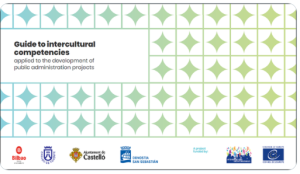
 Center for Intercultural Dialogue