Global Storybooks (Canada)

Applied ICDGlobal Storybooks: freely available digital tales in 50+ languages.

Global Storybooks is a free multilingual literacy resource for children and youth worldwide. Read, download, toggle, and listen to a wide variety of illustrated stories from the African Storybook and other open sites. Development continues at the University of British Columbia, Canada.

One of the United Nations’ Sustainable Development Goals is to achieve quality education globally by the year 2030. High illiteracy rates among children are partly due to a lack of appropriate reading materials in languages familiar to children. Research has shown that children learn to read best in their family’s home language, which also establishes a strong foundation for learning any additional languages. The Global Storybooks portal hosts custom sites with multilingual open-licensed books for over 40 countries and regions on five continents. The vision is to help democratize global flows of information and resources, to facilitate language learning — including Indigenous languages — and to promote literacy.

For further information:

Norton, B., & Stranger-Johannessen, E. (2020, January 19). Global Storybooks: From Arabic to Zulu, freely available digital tales in 50+ languages. The Conversation.

Portal: A Bridge to Unity (Lithuania/Poland)

Applied ICDPORTAL: A Bridge to Unity. On May 26, 2021, Vilnius (in Lithuania) and Lublin (Poland) became the first two cities to connect through PORTAL. This visual bridge brings people of different cultures together, encouraging them to rethink the feeling and meaning of unity.

PORTAL brings a new approach to unity, especially important in times like these when we are being separated by extremely viral polarizing ideas and narratives. As the author and the initiator of the project, Vilnius-based Benediktas Gylys Foundation says, it’s time to transcend the sense of separation and to become the pioneers of a united planet.

Every day there is less room left for dialogue, empathy, and compassion, for feeling and being united in our home – a tiny spaceship Earth rapidly decaying due to too many of them, and too little of us.

The project is not a simple one-timer; organizers plan to connect the world by dozens of PORTALS in the near future. The aim is to involve communities and encourage a public movement that would create social experiments, unexpected reactions, and most important – the unity of different cultures and its’ people in the long run. Reykjavik (Iceland) and London (UK) are next in line.

I Belong (Australia)

Applied ICDI belong, a film made by the Melton City Council, Melton, Australia, to document how residents, who have come from 130 countries, are comfortable as neighbors, due to the welcoming environment.

I just love it when I see everyone gathered together and they come together and they have like different identities but they come together for one thing and that is the community event.

House of Religions, Dialogue of Cultures (Switzerland)

Applied ICD

House of Religions, Dialogue of Cultures (Haus der Religionen – Dialog der Kulturen), Bern, Switzerland.

The ‘House of Religions – Dialogue of Cultures’ is unique in the world as a place that unifies eight religious communities as well as a space dedicated to the dialogue with the public under one roof. Since its opening in December 2014, the House of Religions at Europaplatz (Place of Europe) in Bern welcomes five religious communities that hitherto had no dignified premises. Thus Hindus, Muslims, Christians, Alevis and Buddhists have found their own sanctuary and keep learning to live together. Three other religious communities – Jews, Baha’i and Sikhs – take part in the program by groups of dialogue.

The heart of the house is the dialogue area, which is dedicated to educational services, activities for families and young people, exhibitions, lectures and round tables. A variety of cultural activities and culinary events organised by the Vanakam Restaurant complete the program. The goal is to reach more than just the peaceful coexistence. As a laboratory of living together we invite all interested people – religious or not – to experience and maintain a dialogue beyond the frontiers of religion, language and culture.

Further information, and photographs, available on the Bern city website and on the Bauart architects website.

Bridging Cultural Gap Between Morocco, Japan

Applied ICD

Kawano, G. (2021, April 25). Morocconia, Nipponia: Bridging cultural gap between Morocco, Japan. Morocco World News.

“The greatest strength I gained through this project is cultural awareness. I’m better equipped with skills to work in [a] multicultural environment.”

This article documents the ways in which Hafsa Rifki, of Morocco, who first became interested in Japanese anime, then began studying the Japanese language, and later Japanese culture, became part of a cultural circle of like-minded peers, which turned into the group Nipponia. Later she moved to Japan for a PhD in Media and Governance at Keio University. While in Japan, she developed a similar group of people interested in Morocco, named Morocconia. She now manages both groups.

Three Religions, One House (Germany)

Applied ICD

The House of One: Three Religions Under one Roof, Berlin, Germany.

House of One in Berlin

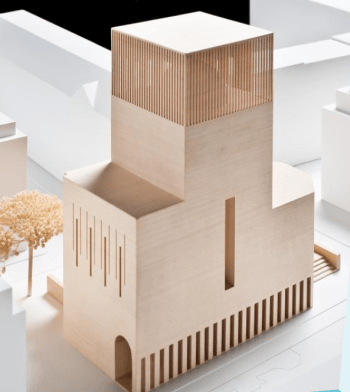
Berlin is soon to become home to something truly unique. Jews, Christians, and Muslims are building a house of worship together – bringing a synagogue, a church, and a mosque together under one roof. The three separate sections will be linked by a communal room in the center of the building. This will serve as a meeting place, where worshippers and members of the public can come together and learn more about the religions and each other.

The House of One on Petriplatz, the medieval birthplace of Berlin, aims to add a new and hopeful chapter to the diverse history of this city. It is being built on the foundations of Berlin’s oldest church (12th century). The architects are Kuehn Malvezzi, who provide detailed drawings of the design.

For further information, see the articles by the BBC, or Visit Berlin.

Image + Bias Competition

Applied ICD

Global call for submissions: IMAGE + BIAS. Deadline: Free workshop using Artivive is May 4, 2021; submissions deadline extended to May 23, 2021.

The Goethe-Institut, Gray Area, Fotomuseum Winterthur, and Artivive are launching an open call for artists, designers, and the general public to submit creative representations on the subject of bias. Submissions should articulate our ongoing concerns with technology’s growing ability to alter people’s visual perception of reality. Submissions may explore discriminatory, misrepresentational, and biased apparatuses or express thought-provoking ideas on how to deal with the perpetuation of bias by technology. Technology is never neutral but a reflection of the biases in our society. Images play an important role in that context: fake photos and videos created with deep neural networks threaten privacy, democracy, and national security. Vision recognition systems skew gender, race, and class differences and become vehicles of discrimination. Underdeveloped AI models misrepresent the health disparities faced by minority populations.

FREE workshops will guide participants through new approaches to storytelling with augmented reality using 2D and 3D animations and videos. These introductory workshops require no prior experience and will introduce artists, graphic designers, illustrators, and the general public to the app and how to use it to bring their projects to life. One remains: May 4, 2021 at 9 a.m. PST.


Overcoming Polarized Narratives

Applied ICDOn January 27th 2021, as part of Fielding Graduate University’s first Alumni Conference themed Global Leading and Learning in the Next Decade, Coordinated Management of Meaning Institute (CMMi) board members co-organized a panel dialogue on “Overcoming Polarized Narratives.” Four of this year’s CMMi Fellows shared their work in this theme, and four board members set the context.

In the context of global leading and learning in the next decade, we can say that overcoming polarized narratives is a key competence for leaders in the context of the relationships that they facilitate with their organizations, be they single entities, communities, networks, nations, or international cooperatives. From a communication perspective, we see the constitutive role of metaphor in overcoming polarized narrative as critical. In addition to watching the video, it is possible to also download slides.

Global Dignity Coloring Books

Applied ICD
How Does Your Dignity Feel? coloring book from Global Dignity, New York, NY, USA.

How Does Your Dignity Feel? is a poem/coloring book to help children understand dignity. Simply download, print and begin coloring!

How Does Your Dignity Feel?

The book is currently available in Arabic, English, French, German, Farsi, Italian, Polish, Portuguese, Russian, Spanish, Turkish and Ukrainian. Even more translations are on the way.

All languages are available to download, print and color for free.

Podcast: Love Premam Kaadhal

Applied ICDLove Premam Kaadhal is a podcast about intercultural love, communication, and one couple’s journey to gain a better understanding of each other’s cultures. Each week, Newlywed hosts Maddy and Shijo discuss communication and their personal experiences as an intercultural couple discovering differences and similarities between the United States and India.

Where to listen

The title is the term for love in the 3 languages this couples speaks: English, Malayalam, and Tamil. Some of the topics included in podcasts so far are high-context vs low-context cultures, individual vs. collective behavior, co-cultural theory, and post colonialism. The podcasts are the result of Maddy’s capstone project in Communication at Bushnell University in Oregon.