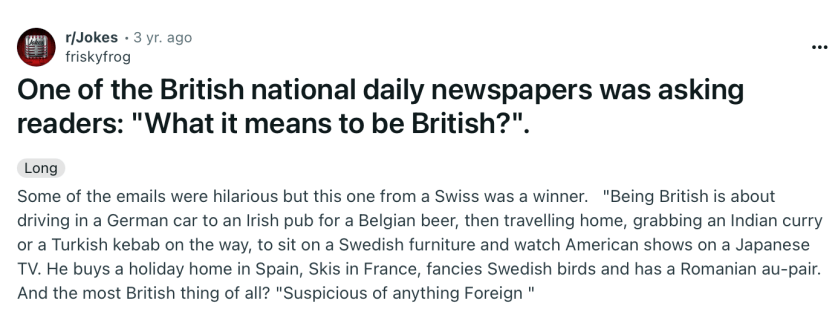
A quote from a Reddit post which is getting a lot of attention turns out to have actually been posted 3 years ago. I have not been able to locate the original, assuming there actually was such a newspaper story – if you know of such a thing, please send a note. But it doesn’t really matter: the point is still the same. We now live in a world that is so thoroughly interconnected and interdependent we often do not even consider the origin of things we take for granted.
Obviously this received many comments. This one seemed worth repeating.
Author: Center for Intercultural Dialogue
U Coimbra: PHD Research Scholarship: Emotional Dynamics of Protective Policies in an Age of Insecurity (Portugal)
Call for applications: First stage researcher (PHD fellowship), Centre for Social Studies, University of Coimbra, Portugal. Deadline: 15 February 2024.
The Centre for Social Studies (CES) – Associate Laboratory – University of Coimbra (Portugal), opens a call for applications for 1 research scholarship in the project “PROTEMO – Emotional dynamics of protective policies in an age of insecurity,” funded by the European Commission, coordinated by Cristiano Gianolla. The project is part of the research line Democracy, Justice and Human Rights. Engaging with the centrality of the democratization of knowledge with the importance of the struggles and experiences of historically oppressed groups, the main objectives of the line are twofold. On the one hand, aims to analyse the persistence of systems of oppression that are intertwined in the structures of racism, heteropatriarchy and capitalism. On the other hand, examine the socio-legal, socio-political and socio-cultural resistances that, in the framework of the modern State and beyond, mark the present of anti-discrimination policies and the constitution of alternative grammars of dignity.
The selected candidates are expected to have the following responsibilities:
– Develop PhD research (already in progress or to begin in 2024) in the framework of the research line: Investigate social representations of protection and the entangled emotions of Ukrainian refugees and also of people mobilising against the war in Ukraine;
– Support the implementation of the scientific tasks foreseen in the project application, namely, literature review, document research, databases and website maintenance, drafting and editing of reports and publications, field work, data analysis and dissemination activities;
– Support the administrative activities of the project, including the organisation of events, management of communication, review and translation of documents and data, and support of the tasks necessary to implement the project.
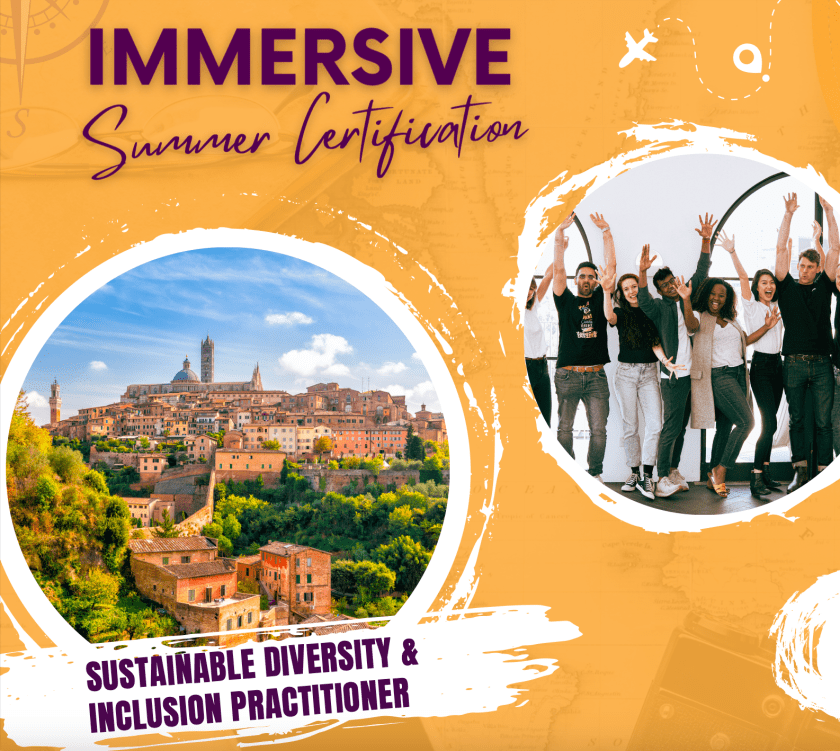
Sustainable Diversity & Inclusion Practitioner Certification 2024 (Italy)
Sustainable Diversity and Inclusion Practitioner Certification program, Siena, Italy, 26-30 August 2024. Deadline: 14 May 2024.

The Sustainable Diversity and Inclusion Practitioner (SDIP) Certification program is tailored for a small group of young international professionals under 35 years old, driven by a desire to enhance their sustainable diversity and inclusion practices.
The program includes:
Learning and Experiencing: Hands-on engagement with sustainable and diversity and inclusion tools and practices for organizational implementation.
Developing Action Plans: Participants create SDIP action plans.
Networking: An opportunity to connect with peers and join a community of
dedicated practitioners.
Cultural Immersion: Participants will enjoy the scenic beauty of Tuscany countryside.
Certification: Participants receive a certificate recognizing them as “Sustainable Diversity & Inclusion Practitioners”
CFP New Journal: Public Humanities
Call for submissions: Public Humanities, to be published by Cambridge University Press starting in 2024. Deadline: ongoing.
Editors: Jeffrey Wilson (Harvard University) and Zoe Hope Bulaitis (University of Birmingham).
Public Humanities is an international open-access, cross-disciplinary, peer-reviewed journal at the intersection of humanities scholarship and public life. It is designed to be an open-access forum for research from around the world and across the disciplines, engaging with a wide range of issues, authors, and readers and demonstrating the breadth, depth, and value of the humanities in its varied contributions to public life.
The humanities study the things humans make—our art, writings, thoughts, religions, governments, histories, technologies, and societies—helping us understand who we are, what we do, how we do it, why, and with what consequences. Honouring the capacious diversity of the humanities, Public Humanities is open to all disciplines, geographies, periods, methodologies, authors, and audiences. The journal is a rendezvous for civically engaged humanities work from (though not limited to) the fields of Anthropology, Archaeology, Architecture, Classics, Cultural Studies, Disability Studies, Economics, Ethnic Studies, Gender Studies, Government, History, Law, Linguistics, Literary Studies, Performing Arts, Religious Studies, Philosophy, Postcolonial Studies, Queer Studies, Psychology, Sociology, Visual Arts, and Women’s Studies.
The journal ranges from historical examples of the humanities at work in the world to theoretical debates about the field today, from governmental policy related to the humanities to scholarly interventions in on-going social problems. Public Humanities creates space for scholars, students, activists, policy-makers, professionals, practitioners, and non-specialists to explore our habits and histories, our art and ideas, our language and beliefs, our pasts, presents, and futures. The journal invites authors and readers to share humanities knowledge, apply it to our societies’ most pressing issues as they arise, and demonstrate the value of the humanities in new and engaging ways.
Public Humanities publishes four themed issues per year curated by guest editors, plus a constant feed of rapid-response commentary. Published digitally to enable speedy delivery to readers and maximum flexibility for authors, articles range from individual of-the-moment responses to roundtable discussions and full-length papers. Through active and rigorous commissioning and peer-review processes, a diverse and committed editorial collective, and a world-leading publishing team, Public Humanities offers a platform for scholarly exchange and exciting new applications of excellent humanities research.

Happy New Year 2024
Happy New Year 2024 from the Center for Intercultural Dialogue. This mandarin duck is from China, but was seen in France, which makes it not only beautiful but an appropriate metaphor for the wide ranging travels of many members of the Center.

Wherever you’re from
Wherever you are
Wherever you’re going
May it be a good year
For you
And for all of us
Thank you to all those who have supported CID over the past year, and over the past 14 years. Our work would not be possible without the considerable contributions of scholars and practitioners around the world. See the acknowledgments for specific names, but you know who you are. Your time and effort are much appreciated.
Wendy Leeds-Hurwitz, Director
Center for Intercultural Dialogue
Casey Man Kong Lum, Associate Director
Center for Intercultural Dialogue
NAFSA: Senior Director, People & Culture (USA)
Senior Director, People and Culture, NAFSA: Association of International Educators, Washington, DC, USA. Deadline: open until filled (posted 17 December 2023).
The Senior Director, People and Culture, will develop and execute NAFSA’s people and culture strategy, contributing to the development and achievement of medium- and long-term strategy, ensuring effective inclusion of key people and culture considerations. To ensure the association is fully leveraging its human talent and fostering an environment that promotes employees’ growth and development, this position works closely with NAFSA’s senior executives, who comprise the Management Team. The position plays a critical role in managing the employee lifecycle, developing organizational culture, and managing change.
The Senior Director is responsible for workforce development, management, and overall strategy for human resources, as well as leading the Office Administration function. Primary areas of responsibility include organizational culture, recruitment, training, compensation, benefits, compliance, employee relations, health and safety, change management, HRIS/HCM, and facilities management.
As an ex-officio member of the Management Team, the Senior Director works closely with the CFO and Deputy Executive Directors to ensure the human resources and financial health of the association. The position contributes to the vision and strategic direction of the organization. This position is responsible for providing day-to-day oversight of human resources functions and supports the CEO with strategic initiatives to advance the organizational culture, health, and operations of the association.
Anna Lindh Foundation: Forum Coordinator (Egypt)
Forum Coordinator, Anna Lindh Euro-Mediterranean Foundation, Alexandria, Egypt. Deadline: 15 January 2024.
The Anna Lindh Foundation (ALF) is seeking a highly motivated individual with distinctive organisational skills to join the ALF Secretariat as the role of the ALForum Coordinator. The ALForum Coordinator will be responsible for coordinating all communications, and organising schedules and activities related to the ALForum, a signature and unique tradition of the Anna Lindh Foundation. The ALForum Coordinator will also participate in securing partnerships for the Forum to enhance its visibility, the funds available and optimize its reach and impact following the indications of the Executive Director.
Applicants must be nationals of one of the 42 (UfM) countries: Albania, Algeria, Austria, Belgium, Bosnia and Herzegovina, Bulgaria, Croatia, Cyprus, Czech Republic, Denmark, Egypt, Estonia, Finland, France, Germany, Greece, Hungary, Ireland, Israel, Italy, Jordan, Latvia, Lebanon, Lithuania, Luxembourg, Malta, Mauritania, Monaco, Montenegro, Morocco, Palestine, Poland, Portugal, Romania, Slovak Republic, Slovenia, Spain, Sweden, Syria, The Netherlands, Tunisia and Türkiye.
Translation and ICD: Words Without Borders
Ito, R. (2 November 2023). Celebrating Literature That ‘Brings the World Close.’ New York Times.
Given how often the Center for Intercultural Dialogue publishes translations, it seems particularly appropriate to point out this article.
Words Without Borders, one of the few magazines in the world dedicated to literature in translation, is turning 20 at a fraught time: Around the world, wars are raging. Writers are being jailed, dissident voices silenced and books banned.
As the magazine’s staff considered its anniversary celebrations — a virtual gala on Nov. 2, following a live one on Oct. 25 — one question was pressing: How do you find words, let alone celebrate them, when bombs are dropping?
The answer, said Karen M. Phillips, the magazine’s executive editor and publisher, was right there, baked into their mission — to gather and celebrate international literature, and in doing so, strengthen the connection between readers and writers around the world. Given the current political climate, the need for such conversations has never been more vital.
“Words Without Borders does this heroic job of bringing the world close to us,” said Courtney Hodell, the director of literary programs at the Whiting Foundation, which presented one of their inaugural Whiting Literary Magazine Prizes to the magazine in 2018. “At times like this, that feels like an essential and fundamental human act.”
CFP Journal of Communication: Qualitative Theorizing and Methodological Advancements
Call for submissions: Journal of Communication Special issue: Qualitative Theorizing and Methodological Advancements. Deadline: 15 July 2024.
Guest Editors: Kristina M. Scharp (Rutgers University, USA), Elizabeth A. Hintz (University of Connecticut, USA), and Sandra Vera Zambrano (Universidad Iberoamericana, Mexico).
This special issue of the Journal of Communication aims to highlight the qualitative communication research that provides important insights into what communicating is like, how it happens, and the institutional and ideological forces enabling and constraining what is possible. Qualitative scholarship is an integral part of communication research as it provides the nuance to discern what results actually mean, the situated understanding to account for the complexities inherent in communication, and the context to inspire hypothesis testing. Despite its promise, qualitative communication research has also long been criticized for being “too descriptive” or for its inability to generate theoretical frameworks and heuristics meaningful beyond a single case or isolated social context. Yet, this misnomer, which emphasizes generalizability at the expense of nuance and context, ironically contributes to the homogeneity of communication research (see #CommunicationSoWhite; Chakravartty et al., 2018) and leads to stagnation. To develop as a discipline, we must be more inclusive of different ways of knowing that allow researchers to ask new questions and address different goals.
U Hull: Studentship in Great Flood Stories and What They Teach Us: Applying Lessons from Cross-Cultural Diluvial Traditions (UK)
PHD Studentship: Great Flood Stories and What They Teach Us: Applying Lessons from Cross-Cultural Diluvial Traditions, University of Hull, Kingston upon Hull, UK. Deadline: 24 January 2024.
Despite being one of the world’s oldest narratives, stories about Great Floods have yet to receive sustained critical attention. No synthesis has brought together the increasingly precious adaptation and mitigation lessons held within the anthropological, literary and historical intercultural responses to past floods. This PhD sets out to mine their potential lessons for the present. It will set out applied historical lessons of global value resulting from analysis of the Great Flood stories that span the ages through Indigenous South and North America, the Near East, the Greco-Roman world, and Mesoamerica.
This exciting PhD project will address this environmental history research gap via detailed examination centred upon the context-specific elements from flood stories that made the flood mitigation/adaptation options successful (or not) within sources such as the “earth-diver’ motif in the Northeastern United States, the Maya Deluge Myth and the Four Flood Myth Traditions of Classical China.
The student will analyse international historical, ethnographic, and paleoclimatology sources, oral history collections and academic literature on Great Flood stories and conduct semi-structured interviews/policy document analysis on present-day flood resilience in a specific flood-prone region.
They will be encouraged to produce a policy report, article and a short book publication such as a Cambridge Element (a book series within Treatied Spaces Research Group). The aim of each output will be to connect historical knowledge to present-day practice.
This is a funded 4-year PhD studentship to start in September 2024. An exciting opportunity for an ambitious, talented and enthusiastic researcher to conduct interdisciplinary research in order to advance thinking within the area of blue-green humanities. Because this project is international in design, it would benefit significantly from being carried out by a candidate with capabilities in multiple languages and cultural registers.