SOAS U of London: Politics / International Relations (UK)

“JobLecturer / Senior Lecturer in Politics and/or International Relations, SOAS University of London, London, UK. Deadline: 30 November 2024.

SOAS (School of Oriental and African Studies) invites applications for two Lecturer / Senior (T&R) Lecturer positions in Politics and/or International Relations starting in the Autumn of 2025. The role holder will be expected to contribute to—and shape—the Department’s research profile as well as the delivery of our undergraduate and postgraduate degrees.

Apart from the publication of outstanding academic research, the role holder will convene and teach both general and specialist modules (individually and with others), advise both undergraduate and postgraduate dissertations, supervise PhD theses (pending completion of a probationary period), and provide pastoral care for students. The role holder will also be expected to work in a collegial and collaborative manner with both academic and non-academic staff across the Department and the School.

Within the discipline of Politics and International Relations, the search is open as to disciplinary subfield and research specialism. Regional expertise is valued, and some experience running both on-campus and online modules, including Executive Education modules, will be beneficial.

U Texas Austin: Intercultural Programs Coordinator (USA)

“JobSenior Intercultural Programs Coordinator, University of Texas, Austin, TX, USA. Deadline: 2 November 2024.

Reporting to the assistant director for intercultural programs and initiatives, the senior coordinator manages the International Student and Scholars Services (ISSS) activities that support and enrich the on-campus experiences for the international student and scholar community. Additionally, the senior program coordinator is responsible for monitoring the ISSS communication plan including emails, social media, and program marketing. Responsibilities include: orientation and intercultural programming; communication, campus outreach and collaboration; and support of ISSS and Texas Global functions.

DiLCo Video Reader: A YouTube-based Collection of Lectures on Digital Language & Communication Research

Resources in ICD“ width=

DiLCo Video Reader: A YouTube-based Collection of Lectures on Digital Language and Communication Research, DiLCo Network (“Digital Language Variation in Context”, University of Hamburg), Germany.

The DiLCo Video Reader is a dedicated YouTube channel with 36 video-recorded presentations that were commissioned and produced by the DiLCo Network (“Digital Language Variation in Context”, University of Hamburg) from 2021-2024.

Authored and delivered by expert researchers from all over the world, these videos represent state of-the art scholarship covering qualitative (interactional, ethnographic), quantitative (variationist, computational), and mixed-methods approaches to digital language and communication research in linguistics.

The DiLCo Video Reader is arranged in 12 Playlists grouped by topic or methodology:

[01] Digital language variation and change
[02] Digitally mediated interaction
[03] Digital discourse and narrative
[04] Semiotic features and communicative practices
[05] Enregisterment on social media
[06] Perceptions and ideologies of digital language
[07] Researching TikTok
[08] Multilingual practices across methods
[09] Approaches to multimodal and transmodal analysis
[10] Digital methods: Research ethics
[11] Digital methods: Natural Language Processing
[12] Digital methods: Multi-sited fieldwork and on/offline nexus analysis

All video content is also available in a chronological listing. And full details are available in a citeable Information file (DOI: https://doi.org/10.25592/uhhfdm.14786). Organizers hope the DiLCo Video Reader will be useful to scholars worldwide as a resource for research and teaching. (If interested in further discussion, connect directly with the DiLCo Team at the University of Hamburg.)

Links:
YouTube channel
Information file
Network website

Update: UNESCO International Forum on the Futures of Education 2024 (Republic of Korea)

EventsUpdate: Renewing Education to Transform the Future: UNESCO International Forum on the Futures of Education, Suwon, Gyeonggido, Republic of Korea, 2-4 December 2024.

In November 2021, the International Commission on the Futures of Education issued a report titled “Reimagining our futures together: A new social contract for education” following a two-year worldwide consultation and reflection facilitated by UNESCO.

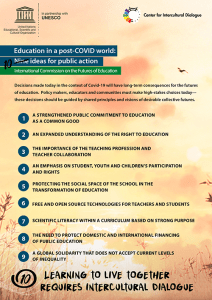
CID Poster 14: 10 IdeasThis Center was one of the organizations consulted; see the report of our conclusions. Basically we argued for including intercultural dialogue as one of their goals. The final UNESCO report, Reimagining our Futures Together, is available as well by now.

The UNESCO International Forum on the Futures of Education 2024 provides an opportunity to continue framing, inspiring and reinvigorating global dynamics to remain publicly and politically active around the urgency to renew education to transform the future.

Objectives

  • To exchange and share contextualized experiences in innovative policy, practice and research to transform education in line with the recommendations of the 2021 report of the International Commission on the Futures of Education.
  • To provide a platform through which Member States and the global community can strengthen knowledge sharing, peer learning and cooperation in relation to the Futures of Education initiative.

Expected Outcomes

  • Forum Synthesis Report: The Forum Report will synthesize the main insights from the three-day event.
  • Thematic Futures of Education Briefs: The Forum Synthesis Report will be complemented by 10 thematic Futures of Education Briefs, each succinctly encapsulating a framing of the core themes serving as the focus of the parallel sessions. Insights gleaned from the contextualized experiences and dialogue at the parallel thematic sessions will be integrated into the Briefs, providing a holistic overview of the Forum’s deliberations. The thematic Futures of Education Briefs will serve as a knowledge-sharing resource to a wider range of education practitioners, researchers and policy makers beyond the participants of the Forum.

CFP Comm & Democracy: Critical Race Theory

“Publication

Call for submissions to a special issue of Communication and Democracy on Critical Race Theory. Deadline for full papers: 15 January 2025.

Guest Editors: Danielle Hodge (University of Colorado) and Karma Chávez (University of Texas).

In 1995, critical race scholar Derrick Bell asked a pointed question of the legal critics of the time: “Who’s afraid of critical race theory?” Interrogating the ways critical race theory (CRT) was reduced to a discipline of “deficiencies,” Bell articulated CRT as an epistemology concerned with the racialization of law, power, and policy that demanded a process of radical assessment. Rearticulated as the “perfect villain” (Wallace-Wells, 2021) and a “divisive concept” (Vought, 2020) twenty-five years later, CRT has since been subject to an onslaught of nationwide assaults that seek to ban its teaching and discussion in both K-12 and higher education contexts. These bans have detrimental implications for free speech, academic freedom, and the possibility for a healthy democracy as they limit what can be taught, learned, and discussed about US history, race and racism, and the contemporary political sphere. Understanding and intervening in these attacks is thus of vital importance for scholars of communication and democracy.

Consequently, in this special issue, the editors ask: Who’s STILL afraid of critical race theory? They seek a venue to respond to the persistent attacks against non-white, but specifically, African American and Black thought, bodies, and lives. Importantly, we are concerned with how these intellectual ambushes are inextricable from broader attacks on democracy that CRT helps to explain. In other words, how do we understand CRT as a sociocultural and political lightning rod that has exposed a democratic and communicative crisis?

Bell (1995) reminds us that “at a time of crisis, critics serve as reminders that we are being heard, if not always appreciated” (p. 908). Yet, in the face of so many attacks, the lack of being heard, let alone appreciated, is palpable. This special issue seeks to bring scholars together to be heard and to lay out an agenda for the relevance of CRT in the field of Communication.

CFP Journal of Family Communication: Global Families

“PublicationCall for submissions for a special issue of the Journal of Family Communication on Communication in Global Families Deadline for abstract: 15 October 2024; deadline for full manuscripts: 1 January 2025.

Special issue editors: Haley Kranstuber Horstman (University of Missouri) and Meng Li (Loyola Marymount University)

The purpose of this special issue is to spotlight scholarship on communication in global families. The editors seek research on family communication that 1) demonstrates global diversities in communication within and about the family and/or 2) reveals the impact of globalization (i.e., the movement of people, ideas, images, capital, goods, and risks on a global scale) on family communication. They call for research that would continue the efforts of the Journal of Family Communication to increase the diversity and inclusivity of family communication scholarship, which has primarily focused on families in the United States.

This special issue will celebrate and encourage current momentum in research on communication in global families. Diverse methodological approaches and innovative theoretical perspectives that reflect the complexities and diversities of communication in global families will be included. The editors encourage researchers from a wide range of fields (e.g., communication studies, ethnic studies, family studies, health fields, psychology, sociology, and women’s and gender studies) to submit. They seek two types of papers: data-based and critical reflections.

CFP: Potential Expert Groups (part 2)

About CID A week ago the Center for Intercultural Dialogue called for expressions of interest in expert groups. Thanks to all who sent in their suggestions!

As a reminder, the major goal of having expert groups is to help make connections between followers of the Center. At present, 251 of the nearly 4500 people who follow on one social media platform or another have profiles on the site. As a result, it can be difficult to first, learn who shares your interests, and second, connect with them in some meaningful way. At the moment, we are assuming initial connections would be conversations held on Zoom, for an average of an hour at a time, but final decisions about meetings should be made by members of each group.

Here are topics already proposed. Please think about which would fit best with your own interests.

  1. Media and intercultural families/intergenerational cross-cultural relationships.
  2. The civic imagination and bridging divides.
  3. Fine arts and intercultural dialogue/the role of art in memory’s construction.
  4. Youth in the cultural and creative sector.
  5. Impacts of digital transformation on intergenerational cultural exchange.
  6. The 250th anniversary of the United States in 2026 – reflections upon multiculturalism and multiracialism as part of the US cultural identity.
  7. International migration/migrant integration – specifically, issues of migrant wellbeing related to student mobility and highly skilled migrants.
  8. Critical approaches to intercultural communication in the context of study abroad.
  9. From intercultural to inter-epistemic competence in the global south EFL education
  10. Culture’s role in shifting and promoting sustainable lifestyles.
  11. Promoting intercultural understanding through education for global citizenship.
  12. Gaps and barriers between policy approaches and implementation mechanisms for social inclusion.
  13. Exploring trainable communication techniques that can enhance human connection, especially across cultures.
  14. Innovations in dialogue design for intercultural communication.
  15. Future of tech in intercultural communication.

In addition, there were several requests to establish geographic groups:

  1. Africa-Europe relations
  2. Latin American cultural studies
  3. Caribbean cultural studies
  4. American cultural studies
  5. Central and Eastern European studies

If you are interested in participating in one or more of these groups, please email (intercult.dialogue@gmail.com) us the following:

  • Which of these topics do you want to join? (You may express interest in several, but will be put into whatever group attracts sufficient interest to be established in this first round.)

  • Within a topic, is there a specific issue you would most like to discuss? Or a specific action you think it might take (perhaps organizing a conference panel, a journal special issue, or an in-person meeting)?

  • Would you be willing to serve as a moderator if asked?

  • Tell us a little about yourself. If you already have a profile on the Center’s website, please check to see that it is current, and if not, please send us updates. If you do not yet have a profile, look at what others have included in theirs, and send us comparable information, as everyone who participates in at least one activity of an expert group will be granted a profile.

Please send in your answers by 7 October 2024 if you wish to participate in the first groups established (there likely will be additional opportunities to participate in the future).

We will start with just a few groups, depending on interest, and they will need to be of manageable size, so it is possible that you will not initially be asked to participate in one.

San Francisco Bay U: Assistant Provost for International Programs (USA)

“JobAssistant Provost for International Programs, San Francisco Bay University, Fremont, CA, USA. Deadline: open until filled (posted 25 September 2024).

San Francisco Bay University is seeking a dynamic and dedicated Assistant Provost for International Programs to develop and support the business operations, design, and delivery of remote educational offerings to students still residing in their country of origin. This is a full-time, remote, staff position, reporting to the Provost, that offers an exciting opportunity to help transform higher education. Through the cultivation, development, and management of innovative partnerships and other entrepreneurial ventures, the Assistant Provost for International Programs will seek, evaluate, and execute growth in new markets of educational opportunity through which SFBU can have an impact by delivering high-quality degree offerings. This is a 12-month contract renewable contingent upon performance review. Work location is remote, with period travel required.

Seeds of Peace: US Director of Dialogue & Training (USA)

“JobUS Director of Dialogue, Seeds of Peace, New York, USA (other offices in UK and Israel). Deadline: open until filled (posted 17 September 2024).

​​Seeds of Peace is in search of a United States Director of Dialogue and Training to design and deliver engaging training programs that enable educators and others to create constructive spaces for dialogue across lines of difference. This person will bring a deep expertise to their work to create and deliver meaningful dialogue and training programs. The ideal candidate will foster a culture of connection, inspire and motivate training participants, and design and execute impactful programming. The US Director of Dialogue and Trainings will be responsible for designing, implementing, and overseeing training programs and dialogue initiatives across key locations in the US, in consult with our Director of Multinational Dialogue Programs. This role requires deep understanding of adult learning principles, experience facilitating dialogue across lines of difference, and effective facilitation strategies. The ideal candidate will have a proven track record in creating impactful dialogue and training programs specifically in schools and organizations.

U Tübingen: Postdoc in Peace & Conflict Studies/International Relations (Germany)

Postdocs

PostDoc Position in Peace and Conflict Studies/International Relations, Universität Tübingen, Germany. Deadline: 18 October 2024.

The Faculty of Social Sciences, Institute of Political Science, University of Tuebingen is seeking to fill one vacancy in the research cluster on Peace and Conflict Studies/International Relations from 1 February 2025 one PostDoc Position in the area of Peace and Conflict Studies. The PostDoc will contribute to research within the areas of conflict analysis and post-conflict peace building. S/he will also be given the opportunity to develop and pursue her independent research and contribute to teaching. The teaching load is 4 hours per semester and includes introductory modules in International Relations as well as seminars in conflict research and quantitative methods. The successful applicant will be expected to contribute to the administration of the research cluster.