KC 77 Negotiation Translated into Greek

Key Concepts in ICDContinuing translations of Key Concepts in Intercultural Dialogue, today I am posting KC#77: Negotiation, which Beth Fisher-Yoshida wrote for publication in English in 2016, and which Anastasia Karakitsou has now translated into Greek.

As always, all Key Concepts are available as free PDFs; just click on the thumbnail to download. Lists of Key Concepts organized chronologically by publication date and number, alphabetically by concept, and by languages into which they have been translated, are available, as is a page of acknowledgments with the names of all authors, translators, and reviewers.

Fisher-Yoshida, B. (2020). Negotiation [Greek}. (A. Karakitsou, trans). Key Concepts in Intercultural Dialogue, 77. Retrieved from:
https://centerforinterculturaldialogue.org/wp-content/uploads/2020/05/kc77-negotiation_greek.pdf

If you are interested in translating one of the Key Concepts, please contact me for approval first because dozens are currently in process. As always, if there is a concept you think should be written up as one of the Key Concepts, whether in English or any other language, propose it. If you are new to CID, please provide a brief resume. This opportunity is open to masters students and above, on the assumption that some familiarity with academic conventions generally, and discussion of intercultural dialogue specifically, are useful.

Wendy Leeds-Hurwitz, Director
Center for Intercultural Dialogue


Creative Commons License
This work is licensed under a Creative Commons Attribution-NonCommercial-NoDerivatives 4.0 International License.

U Penn: KIPP Director (USA)

“JobPenn-Knowledge is Power Program (KIPP) Director, University of Pennsylvania, Philadelphia, PA, USA. Deadline: June 21, 2020.

The Director reports to the Associate Vice Provost for Equity and Access and is based in the Albert M. Greenfield Intercultural Center. The Director will coordinate the Penn-KIPP (Knowledge is Power Program) Partnership, an initiative designed to increase the college completion rates for underserved KIPP students nationwide. The Director is responsible for the design, coordination and implementation of programs and services to support the retention of 50 plus KIPP alumni annually. The Director will collaborate with the Associate Vice Provost, cultural center directors, advisers in all four undergraduate schools, and connect students to offices such as Student Financial Services, the Weingarten Learning Resource Center, Student Intervention Services and Counseling and Psychological Services to support their success at Penn.

U Denver: Director, Office of International Education (USA)

“JobDirector, Office of International Education, University of Denver, Denver, Colorado, USA. Deadline: July 31, 2020.

The Director of the Office of International Education’s (OIE) role is to provide leadership and manage the University’s education abroad programming, and implement developments in term-length and other study abroad opportunities as decided by various constituencies on campus, primarily the Vice Provost for Internationalization, the Internationalization Council and other faculty and staff committees/units. The Director also advises students, parents, faculty, and staff of the various opportunities for studying abroad. This position is responsible for promotion of programs; management of program sites; preparing students for an experience abroad; transferring course credit; managing compliance and risk concerns regarding study abroad for the university; and responding to the needs of students, parents, staff, and faculty. The Director is also responsible for managing the study abroad operational and program budgets in conjunction with the Director of Budget and Operations. Finally, this position advocates and supports the articulation and integration of connections between study abroad and global learning outcomes across campus.

Comparison of cultural values between Japan and the US (Webinar)

EventsComparison of cultural values between Japan and the US to understand the implications for building relationships and doing business, Offered by Tri-State SIETAR (NY-NJ-CT), Wednesday, June 24, 2020, 11:00 AM – 12:30 PM EDT, Online Event.

The webinar will be a comparison of cultural value differences and similarities with Japan and the United States to understand the implications for building relationships and doing business. Leaders will focus on: consideration of others, tradition, work, home life and society. The comparison will be from the point of view of Tamami, a Japanese native who studied in the United States for over two years, from Rob, an American who worked in Japan for three years, and Miriam, an American who has never visited Japan but has been acquainted with many Japanese natives throughout her life.

Follow the link at the top of the page for details about the presenters.

Women’s Actions To Counter Hate Speech (Cameroon)

“CollaborativeThe Cameroonian Committee for the Promotion of Women’s Human Rights (Comité Camerounais de Promotion des Droits Humains des Femmes, CPDF), a women’s organization based in Cameroon in Central Africa, is looking for a US-based organization with which to develop a partnership as part of a project to counter hate speech in Cameroon.

The Women’s Actions To Counter Hate Speech (WATCH SPEECH) project deals with the dissemination of hate speech in Cameroon. It offers an approach to fight hate speech online and in person, through media and information education, and the strengthening of intercultural skills of young beneficiaries.

Cameroon is an ethnically diverse country with about 250 groups. Cameroon’s ethnic community has been known to coexist in peace, and no particular group had political influence over the affairs of the country. These groups contribute to the cultural diversity of the country. But insecurity is increasing in the country, due to terrorism and the resurgence of separatist impulses in the two anglophone northwest and southwest regions. this situation contributes to increasing the tension between the main ethnic groups and between francophones and anglophones. . . Public hatred and socio-ethnic stigma are taking on alarming proportions. The phenomenon has taken on such alarming proportions that the government decided to present a bill to the National Assembly to punish contempt of the tribes and incitement to tribal hatred. . . A tremendous number of intolerant and hateful messages are now exchanged by young Cameroonians on social networks. Hate speech in Cameroon unites and divides at the same time. It creates “us” and “them”. Indeed, while statistics offering a global overview of the phenomenon are not available, both civil society organizations and officials have recognized that hateful messages disseminated online by Cameroonians against Cameroonians are increasingly common and have elicited unprecedented attention to develop adequate responses. . .

The Cameroonian Committee for the Promotion of Women’s Human Rights has chosen to act to counter hate speech in Cameroon. This will be done by promoting peace and security, alternatives to violence to resolve conflicts, tolerance, and mutual understanding between ethnic groups.

Read the full description of the project in the PDF. Contact information is included. If you are able to help, please contact CPDF directly.


CFP Information and Culture

“PublicationCall for Papers: Information & Culture, University of Texas Press.

The journal Information & Culture has recently extended its remit to provide a home for scholarly work that addresses the social and cultural impact of information in our world across all areas of human activity. If you are seeking a home for information scholarship that deals directly with human and social concerns that might not fit easily in more traditional or established venues, consider submitting. Editors intend to create an inclusive, constructive-review environment for interesting work across disciplines and traditions. They do not restrict by method or theory, by topic or by era, only by quality, and welcome lengthy submissions where warranted. Under new arrangements, authors will retain the right to make pre-print and post-print versions of their article available on their personal website, institutional repository, or not-for-profit servers.

The journal welcomes submissions from an array of relevant theoretical and methodological approaches, including but not limited to historical, sociological, psychological, political and educational research that address the interaction of information and culture.

Teaching Diverse Texts

Events

Teaching Diverse Texts, College of General Studies, Boston University, Boston, MA, February 26, 2021.. Deadline: October 15, 2020.

On Friday, February 26, 2021 Boston University’s College of General Studies (CGS) will host a colloquia for Ph.D. candidates who are close to graduating and applying for jobs in academia and whose research interests include teaching diverse texts and facilitating respectful classroom dialogue, especially in general education. We welcome colloquia participant applications from Ph.D. candidates who have experience teaching general education and who are interested in a day and one half symposium where they will present on their research and teaching and will interact with nationally recognized scholars, pedagogues and Boston University students. A joint offering through Boston University’s Office of Diversity and Inclusion and the College of General Studies, participants will receive a stipend to cover transportation, accommodations and food for the day and one half experience.

KC35 Media Ecology Translated into Polish

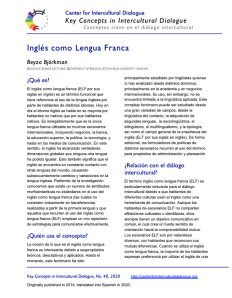
Key Concepts in ICDContinuing translations of Key Concepts in Intercultural Dialogue, today I am posting KC#35: Media Ecology, which Casey Man Kong Lum wrote for publication in English in 2014, and which Beata Krupa has now translated into Polish.

As always, all Key Concepts are available as free PDFs; just click on the thumbnail to download. Lists of Key Concepts organized alphabetically by conceptchronologically by publication date and number, and by languages into which they have been translated, are available, as is a page of acknowledgments with the names of all authors, translators, and reviewers.

KC35 Media Ecology_Polish

Lum, C. M. K. (2020). Ekologia mediów. (B. Krupa, trans). Key Concepts in Intercultural Dialogue, 35. Available from
https://centerforinterculturaldialogue.org/wp-content/uploads/2020/05/kc35-media-ecology_polish.pdf

If you are interested in translating one of the Key Concepts, please contact me for approval first because dozens are currently in process. As always, if there is a concept you think should be written up as one of the Key Concepts, whether in English or any other language, propose it. If you are new to CID, please provide a brief resume. This opportunity is open to masters students and above, on the assumption that some familiarity with academic conventions generally, and discussion of intercultural dialogue specifically, are useful.

Wendy Leeds-Hurwitz, Director
Center for Intercultural Dialogue


Creative Commons License
This work is licensed under a Creative Commons Attribution-NonCommercial-NoDerivatives 4.0 International License.

Yale-NUS Associate Dean of Students (Singapore)

“JobAssociate Dean of Students, Yale-National University of Singapore College, Singapore. Deadline: June 15, 2020.

The Associate Dean of Students is a senior member of the Dean of Students (DOS) Office leadership team, reporting directly to the Dean and will act as the deputy in the Dean’s absence. The role serves as a front-facing liaison to the student community and advises the Dean of Students on a variety of student-related matters, along with driving intra- and inter-departmental projects on behalf of the DOS Office.

This position oversees Campus Life and Student Services. Campus Life includes Student Organisations & Leadership, Athletics & Recreation, and Intercultural Engagement (i.e., Diversity & Inclusion). The selected candidate will develop strategic plans for Campus Life, as well as drive the execution of programmes, policies and initiatives to support the cognitive, intrapersonal and interpersonal development of students. Student Services oversees international student passes, student billing, student insurance, parent/family relations and housing operations.

Yale-NUS will introduce a newly designed residential curriculum starting in academic year 2020-21. The Associate Dean will help further refine the residential curriculum and assist in implementation.

Aarhus U Postdoc: Intellectual History of Global Inequality: Argentina (Denmark)

PostdocsOne-Year Postdoc Position: An Intellectual History of Global Inequality, 1960-2015: Argentina, School of Culture and Society, Aarhus University, Aarhus, Denmark. Deadline: 26 July 2020.

The School of Culture and Society at Aarhus University invites applications for a one-year postdoctoral fellowship in the history of ideas. The position is full-time, and is available from 1 February 2021 or as soon as possible thereafter. The position will be part of the project ‘An Intellectual History of Global Inequality, 1960-2015’.

The project will investigate the historical relationship between location and the intellectual history of inequality. The research objects of this study are concepts, theories and ‘languages’ relating to international economic inequality from 1960 to 2015. The approach is historical-contextualist and combines conceptual and intellectual history, focusing upon contributions to academic and public debates by public intellectuals, especially economists, sociologists, historians and philosophers. Furthermore, the approach is comparative: it will compare the thought of Northern (primarily American), Indian, African (primarily Ghanaian) and South American (primarily Argentinian) public intellectuals. The project is thus divided into four subprojects (with this position focusing on Argentina), each investigating a significant geographical area in the global discourse on economic inequality, enabling us to make new comparisons and trace connections in South-South as well as in North-South exchanges. The project will be an important contribution to the global turn in intellectual and conceptual history. The successful applicant will be responsible for the sub-project on Argentina. The postdoc will study key Argentinian intellectuals and the intellectual history of international and global economic inequality in Argentina.