Global Dignity Coloring Books

Applied ICD
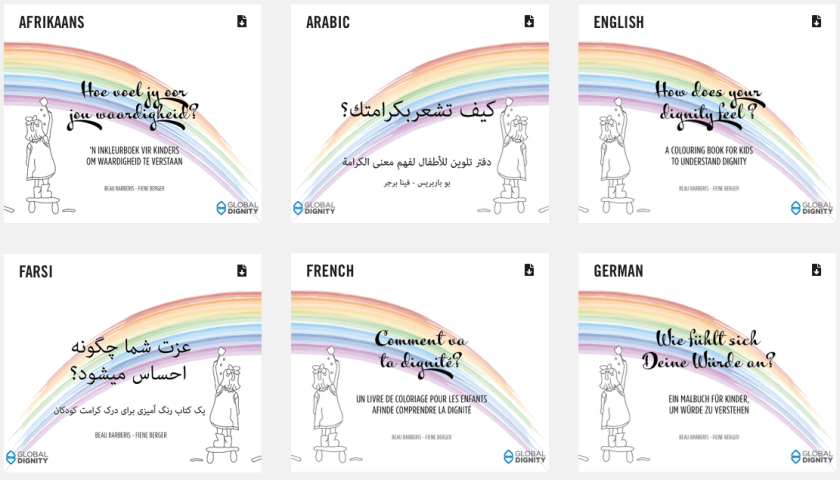
How Does Your Dignity Feel? coloring book from Global Dignity, New York, NY, USA.

How Does Your Dignity Feel? is a poem/coloring book to help children understand dignity. Simply download, print and begin coloring!

How Does Your Dignity Feel?

The book is currently available in Arabic, English, French, German, Farsi, Italian, Polish, Portuguese, Russian, Spanish, Turkish and Ukrainian. Even more translations are on the way.

All languages are available to download, print and color for free.

KC26 Global-Local Dialectic Translated into Spanish

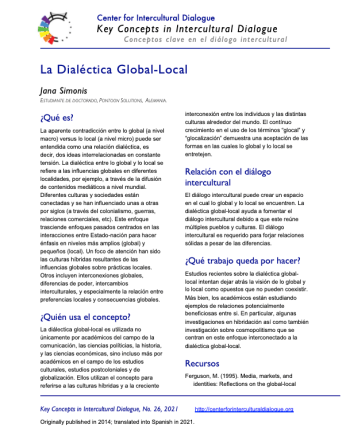
Key Concepts in ICDContinuing translations of Key Concepts in Intercultural Dialogue, today I am posting KC#26 Global-local dialectic, which Jana Simonis published in English in 2014, and  which Jhon Eduardo Mosquera Pérez has now translated into Spanish.

KC26 Global-Local Dialectic_Spanish

As always, all Key Concepts are available as free PDFs; just click on the thumbnail to download. Lists of Key Concepts organized chronologically by publication date and number, alphabetically by concept, and by languages into which they have been translated, are available, as is a page of acknowledgments with the names of all authors, translators, and reviewers.

Simonis, J. (2021). La dialéctica global-local. (J. E. Mosquera Pérez, Trans.). Key Concepts in Intercultural Dialogue, 26. Available from: https://centerforinterculturaldialogue.org/wp-content/uploads/2021/04/kc26_global-local_spanish.pdf

If you are interested in translating one of the Key Concepts, please contact me for approval first because dozens are currently in process. As always, if there is a concept you think should be written up as one of the Key Concepts, whether in English or any other language, propose it. If you are new to CID, please provide a brief resume. This opportunity is open to masters students and above, on the assumption that some familiarity with academic conventions generally, and discussion of intercultural dialogue specifically, are useful.

Wendy Leeds-Hurwitz, Director
Center for Intercultural Dialogue


Creative Commons License
This work is licensed under a Creative Commons Attribution-NonCommercial-NoDerivatives 4.0 International License.

CFP Dialogue with & among Existing, Transforming & Emerging Communities

“PublicationCall for abstracts: Dialogue with and among the Existing, Transforming and Emerging Communities, for a special issue of The Journal of Dialogue Studies. Deadline: Extended to May 16, 2021.

The Journal of Dialogue Studies invites papers addressing ‘communities’ through the lens of dialogue.

Communities have been designated as secure, physical and emotional comfort zones for individuals and unofficially regulated and codified relations between their members. There are communities in which people have a common interest or passion; communities that are united around the idea of bringing about change; communities of people who belong to the same region or country; communities that comprise people of the same profession; and finally, communities of circumstance, that is, groups of people who came together as a result of external factors.

More than a physical entity, a community is about commonalities and it creates attachments. Similar to other social structures, communities always harbour their own values while they may have some underlying liabilities for individuals. However, community is an evolving phenomenon. Communities emerge, transform, and disappear in response to the context they were born into. In today’s world, traditional communities exist side by side with new and emerging communities, ranging from online forums and social media groups to online gaming communities.

As such, new communities emerge every day and challenge traditional views on what a community is. In the life cycle of a community, ‘dialogue’ comes into the picture as a prominent instrument facilitating the transformation and evolution of communities. It is dialogical engagements (inter- or intra-community) of the individuals that allow these social structures to evolve and transform.

The Art of Seeing & Hearing the Other (Online)

Events

The Art of Seeing and Hearing the Other, 20-21 April 2021, ETHER, Leeds, UK (Online Seminar).


How we see and hear the other is often shaped through our attachment to ideas, images and ideologies about ourselves, others and the world. Language ideologies, for instance, delineate what counts as language and as legitimate ways of language use. They set boundaries inside which another is heard, encountered and judged (Inoue, 2003; Piller, 2016). This kind of meeting, however, precludes genuine contact because the listening/looking subject’s ideological preoccupations always put another in the position of an object (‘it’) to be comprehended, made sense of or assimilated. Anthropological philosophy, on the other hand, has entertained the possibility that an authentic encounter with difference can be achieved with a relational shift from ‘I-it’ to ‘I-Thou’ (Buber, 2013). The latter requires the subject’s pre-reflective way of being-in-the world which regards oneself and the other as whole human beings who cannot be reduced to cultural categories (Levinas, 1972). The seminar will examine how the two stances are negotiated in real-life encounters and identify theoretical principles for enabling authentic meetings across divides.

Ethics and Aesthetics of Encountering the Other: New Frameworks for Engaging with Difference (ETHER) is a global research network of members working across academic, arts and public sectors, based at the School of Education at the University of Leeds. ETHER asks asks: How do people of conflicting worldviews, memories and future visions encounter each other?

Paola Giorgis Interview

“Interviews”Dr. Paola Giorgis was interviewed about the concepts of critical discourse analysis and translation as an intercultural practice on March 25, 2021, by Rehana Paul, CID intern.

Dr. Giorgis answers the following questions:

  • Can you explain teaching English as a foreign language with a hidden agenda?
  • What is Critical Discourse Analysis and how does it relate to intercultural dialogue?
  • Is translation an intercultural practice?

For further information, see her one-page summaries:

Giorgis, P. (2015). Critical discourse analysis. Key Concepts in Intercultural Dialogue, 51.

Giorgis, P. (2015).  Critical Cultural Linguistics. Key Concepts in Intercultural Dialogue, 88.

as well as these guests posts:

Giorgis, P. (2015, November 24). Teaching EFL with a hidden agenda: Introducing intercultural awareness through a grammar lesson. Center for Intercultural Dialogue.

Giorgis, P. (2016, August 10). On translation as an intercultural practice. Center for Intercultural Dialogue.

Giorgis, P. (2017, February 27). Intercultural communication or post-cultural communication? Reflecting on mistakes in intercultural encounters. Center for Intercultural Dialogue.

Minnesota State U: Postdoc (USA)

“Job

Communication Studies, Teacher-Scholar Post-Doctoral Fellow, Minnesota State University, Mankato, MN. Deadline: April 13 2021.

Minnesota State University, Mankato, Department of Communication Studies seeks a one-year Teacher-Scholar Postdoctoral Fellow whose teaching, research, and service will contribute to diversity, equity, and inclusion in higher education. The appointment will begin August 16, 2021 and end May 9, 2022. The department is seeking a specialist in Communication Studies to teach Health Communication and/or Intercultural Communication and other courses in the department. Courses in the department are taught on-campus, hyflex, and online. A formal mentoring process will be provided as part of the Postdoctoral Fellowship. The successful candidate is expected to maintain an active record of scholarship, continue professional preparation, contribute to student growth and development, and provide service to the university and department.

LCC University: Communication (Lithuania)

“JobFaculty Position in Communication (open rank and specialization), LCC University, Klaipeda, Lithuania. Deadline: Posted April 2, 2021; open until filled.

LCC International University in Klaipeda, Lithuania, welcomes applications for a full-time faculty position, open rank and specialization, in the Department of Communication beginning August 2021. They seek a candidate who will teach core courses in the BA program in Contemporary Communication, offer courses in the candidate’s particular area(s) of specialization, supervise senior thesis projects, and participate in the active intellectual life of the campus. Specialization within the Communication field(s) is open. Load is 4/4 equivalent, with load time potentially assigned for research and thesis advising. A modest research agenda is expected.

Participatory Governance & Involvement of Civil Society in Intercultural Policy-Making (Lithuania but Online)

EventsParticipatory governance and involvement of civil society in intercultural policy-making, April 13-15, 2021, Kaunas Regional Development agency, Lithuania (Online).

Join three open debates organized by the Kaunas Regional Development agency. Everybody is welcome to join the sessions, free of charge.
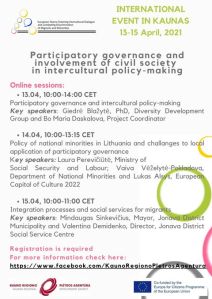
Kaunas event poster

The presentations will be made by a wide variety of participants, focus on these topics:
• diversity development in Lithuania,
• migrant integration policy in Lithuania: obstacles and opportunities,
• diversity and cultural heritage,
• integration policy for foreigners in the Republic of Lithuania,
• policy of national minorities in Lithuania,
• challenges to local application of participatory governance, and
• good practice of integration of migrants in Jonava district municipality.

Detailed agenda here. NOTE: Registration is required: see form. (Links for attending the event will be sent to registered participants on 12th of April.)

This second international event the Kaunas Regional Development agency will promote “Participatory governance and involvement of civil society in intercultural policy-making” by also promoting the European diversity and using intercultural dialogue as tools to build more inclusive and fairer societies in European towns.

Co-funded by the Europe for Citizens Programme of the European Union.

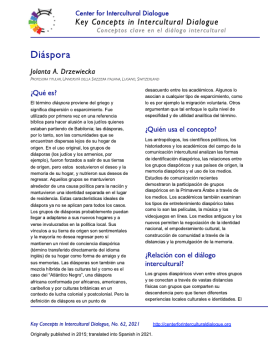
KC62 Diaspora Translated into Spanish

Key Concepts in ICDContinuing translations of Key Concepts in Intercultural Dialogue, today I am posting KC#62: Diaspora, which Jolanta A. Drzewiecka published in English in 2015, and  which Jhon Eduardo Mosquera Pérez has now translated into Spanish.

As always, all Key Concepts are available as free PDFs; just click on the thumbnail to download. Lists of Key Concepts organized chronologically by publication date and number, alphabetically by concept, and by languages into which they have been translated, are available, as is a page of acknowledgments with the names of all authors, translators, and reviewers.

KC62 Diaspora_SpanishDrzewiecka, J. A. (2021). Diáspora. (J. E. Mosquera Pérez, Trans.). Key Concepts in Intercultural Dialogue, 62. Available from: https://centerforinterculturaldialogue.org/wp-content/uploads/2021/03/kc62-diaspora_spanish.pdf

If you are interested in translating one of the Key Concepts, please contact me for approval first because dozens are currently in process. As always, if there is a concept you think should be written up as one of the Key Concepts, whether in English or any other language, propose it. If you are new to CID, please provide a brief resume. This opportunity is open to masters students and above, on the assumption that some familiarity with academic conventions generally, and discussion of intercultural dialogue specifically, are useful.

Wendy Leeds-Hurwitz, Director
Center for Intercultural Dialogue


Creative Commons License
This work is licensed under a Creative Commons Attribution-NonCommercial-NoDerivatives 4.0 International License.

Podcast: Love Premam Kaadhal

Applied ICDLove Premam Kaadhal is a podcast about intercultural love, communication, and one couple’s journey to gain a better understanding of each other’s cultures. Each week, Newlywed hosts Maddy and Shijo discuss communication and their personal experiences as an intercultural couple discovering differences and similarities between the United States and India.

Where to listen

The title is the term for love in the 3 languages this couples speaks: English, Malayalam, and Tamil. Some of the topics included in podcasts so far are high-context vs low-context cultures, individual vs. collective behavior, co-cultural theory, and post colonialism. The podcasts are the result of Maddy’s capstone project in Communication at Bushnell University in Oregon.