Voices from the Field #3: Between World Language Teaching and International and Intercultural Education

Voices from the Field

Between world language teaching and international and intercultural education: A conversation with Skylar Jeffries.

Recently I began a series of conversations with colleagues in various disciplines for their insights and perspectives on matters and practices in intercultural dialogue and, more generally, intercultural communication and education. The first two of these conversations have already been posted in the Associate Director’s Activities column. But after further reflection and deliberation on how best to share these dialogues with interested colleagues, we have decided to introduce a new series entitled Voices from the Field that you see herein. Similar to the entries in our Guest Posts, you will find a link to a PDF of each of the dialogues in this series.

Casey Man Kong Lum, Associate Director, CID


Some highlights from the conversation:

  • The motivation behind becoming a world language teacher
  • Challenges facing world language students and their teachers, as well as the triumph they share
  • A career path between (or from?) world language teaching and (or to?) international and intercultural education
  • Advocating for study abroad programs in schools: challenges and opportunities
  • Benefits for students to partake in curricular travels, such as foreign exchange or study abroad programs
  • The transformative experience of being an international and intercultural educator
  • Best practices in promoting international and intercultural education
  • Some advice for aspiring practitioners in the field

What have been some of your most gratifying experiences or outcomes as a practitioner in intercultural and international communication and education?

“…Some of my best memories from teaching are when I reflect on students playing games in the target language, listening and analyzing music, following a film, or discussing cultural practices. These are priceless, authentic moments where I’ve seen my students be truly comfortable in trying something new and having fun while learning. That’s what it’s all about.”

Download the entire post as a PDF.

Council on Foreign Relations: Director, Richard Haass Center for Education (USA)

“JobDirector, Richard Haass Center for Education, Council on Foreign Relations, New York, NY, USA. Deadline: 28 December 2025.

The Council on Foreign Relations (CFR), one of the world’s preeminent voices on foreign policy, international relations, national security, and transnational issues, seeks a strategic, innovative, and collaborative leader as the inaugural Director of the Richard Haass Center for Education (Haass Center). Established in June 2025, the Haass Center was created to honor Richard Haass’s 20 years as CFR’s president and his profound commitment to civic education and global affairs literacy, both of which are critical to understanding and engaging effectively in the public sphere today. As conceived, the Center will centralize and significantly expand the reach of CFR’s educational work, ensuring the creation of best-in-class educational resources that are widely and readily available to educators and learners in secondary and postsecondary classrooms across the country. Importantly, in this fraught political moment, the Center will also equip educators to teach their students about global affairs through civil discourse and respectful dialogue.

Constructive Dialogue Institute: Chief Culture Change Officer (USA)

“JobChief Culture Change Officer, Constructive Dialogue Institute, New York, NY, USA (Remote). Deadline: Open until filled; posted 25 November 2025.

Over the past three years, since launching its campus-wide strategy, CDI has rapidly grown to partnerships with more than 150 campuses across the country – ranging from Ivy League institutions to community colleges, and everything in between – to deliver programming that supports dialogue across differences. CDI is now embarking on a pivotal phase to deepen its work in supporting campuses in weaving the principles of inquiry and dialogue into their institutional fabric to create lasting cultural change.

The Chief Culture Change Officer will lead this new department, report to the Co-Founder & Executive Director, and serve on CDI’s executive leadership team. They will design and execute CDI’s strategy for large-scale culture-change engagements, oversee delivery across campuses and state systems, and build a high-performing team to drive this work nationally.

The Constructive Dialogue Institute (CDI) is a non-profit dedicated to equipping the next generation of Americans with the skills to communicate and collaborate across lines of difference. They work with U.S. colleges and universities by providing curricular programming for students, professional development for faculty and staff, and strategic guidance to leadership. Our goal is to foster constructive dialogue at every level of the institution and to create the conditions for lasting organizational change.

Humboldt Research Fellowships (& Postdocs) 2026 (Germany)

FellowshipsHumboldt Research Fellowships, Alexander von Humboldt Foundation, Germany. Deadline: Selection committee meets March, July, and November each year, and you should apply well in advance. Applications are usually processed within four to eight months.

The Humboldt Research Fellowship is available to researchers of all nationalities and research areas, at either the postdoctoral or experienced researcher level, to conduct research in Germany. Through the Humboldt Research Fellowship, the Alexander von Humboldt Foundation sponsors researchers with above-average qualifications from across the globe. The fellowship enables you to conduct your own research at various stages of your career in collaboration with a host at a German research institution of your choice. Hosts may apply for a subsidy towards research costs. The Alexander von Humboldt Foundation aims to achieve a good balance between genders and a high level of diversity among its fellows in all areas. They therefore expressly invite female scientists and members of underrepresented groups to apply. They welcome all applications, regardless of ethnic, cultural or social background, gender identity, age, religion, worldview, disability or sexual orientation.

Postdocs

Benefit from research sponsorship in Germany at the beginning of your academic career. The Humboldt Research Fellowship for postdocs enables you to conduct research in Germany. The monthly fellowship amount is €3,000 plus addtional benefits. Fellowships may last from 6 to 24 months and can be divided into up to three stays within three years.

Experienced researchers

You can still apply for research sponsorship in Germany even if you are already well advanced in your academic career. The Humboldt Research Fellowship for experienced researchers enables you to conduct research in Germany. The fellowship amount is €3,170. Fellowships may last from 6 to 18 months and can be divided into up to three stays within three years.

CFP Theorizing Communication in, of, and from the Balkans (Online)

ConferencesCall for participants: Theorizing Communication in, of, and from the Balkans, 27-28 May 2026. Interest form due: 20 January 2026.

Responding to the academic dominance of Western theorizing of communication, this summer intensive aims to “come back to basics” and activate Balkan place-based knowledges to wonder together: What counts as communication in the first place and in this place? Who and what communicates? What forms of communication feel un/familiar and un/necessary? How is communication shaped by and how does it shape creative, educational, civic and political activities and processes, difference and belonging, community building and resilience, and (responses to) local and global crises and conflicts?

This summer intensive will welcome participants to inhabit together the in-betweens of the Balkans as a rich borderlands locale for communication theorizing, so that we can chart new
place-based questions and paths for exploring them. We hope to foster a multinational, interdisciplinary, and intercultural scholarly community around shared interests in questions of
communication in the region. Organizers think of communication very broadly and welcome scholars and practitioners of any academic background who are actively engaged in analyzing, creating, and/or theorizing from and with Balkan (Southeastern European) perspectives and experiences.

In this two-day intensive, participants will first learn about culture-centered approaches (CCAs) and borderlands theorizing as models to elevate context-specific ways of knowing and being and how they are expressed and negotiated with/in communication. Workshops during the first day will focus on methodologies for culture-centered theorizing, such as ethnography, narrative and arts-based research, and critical realist analysis of media. During the second day, we will gather in participatory working groups to further explore how such approaches can be adapted or redefined in and from Balkan contexts. Participants will be able to connect with fellow academics regarding ongoing or future research projects and submit work emerging from the intensive to upcoming publications, including an edited volume.

U Notre Dame: Visiting Research Fellowships 2026-27 (USA)

FellowshipsVisiting Research Fellowships, Kroc Institute for International Peace Studies, Keough School of Global Affairs, University of Notre Dame, Notre Dame, IN, USA. Deadline: 31 January 2026.

Each year, the Kroc Institute’s Visiting Research Fellows Program brings outstanding scholars focused on peace research to the University of Notre Dame for a semester or a full academic year. For the academic year 2026-27, they invite research proposals that focus on one or more of the following themes:

  • Intersection of Gender, Race, Class and Peacebuilding
  • International Mediation
  • Peace Accords Matrix (PAM)
  • Sustainability, Climate Change, and Peace

CMM Institute Webinar: What if We Didn’t Have to Agree? Preserving Relationships While Communicating Across Differences

EventsCoordinated Management of Meaning Institute Webinar: What if We Didn’t Have to Agree? Preserving Relationships While Communicating Across Differences, 10 December 2025, 11 am Eastern US Time (UTC-5).(Online).

In the middle of a holiday season, many dread the seemingly inescapable arguments, hurt feelings, and tension that can arise. With this in mind, Ilene Wasserman and Arthur Jensen will share creative, relational approaches to navigating conversations with loved ones about potentially polarizing and divisive topics. Together, with webinar participants, they will explore possibilities for finding coordination even without coherence.

In communication, each moment is a chance to practice curiosity and compassion- two foundational elements for the continued co-creation of better social worlds. Now, more than ever, each of us must understand our own ability and responsibility to act mindfully into our relationships.

In preparation for the webinar, they invite you to reflect on recent conversations with friends and family members where disagreement occurred. Please consider the following: (1) Where did the conversation start? (2) What did the conversation feel like? and (3) Where did the conversation end?

CID Poster 4: Types of Cultural Communication Translated into German

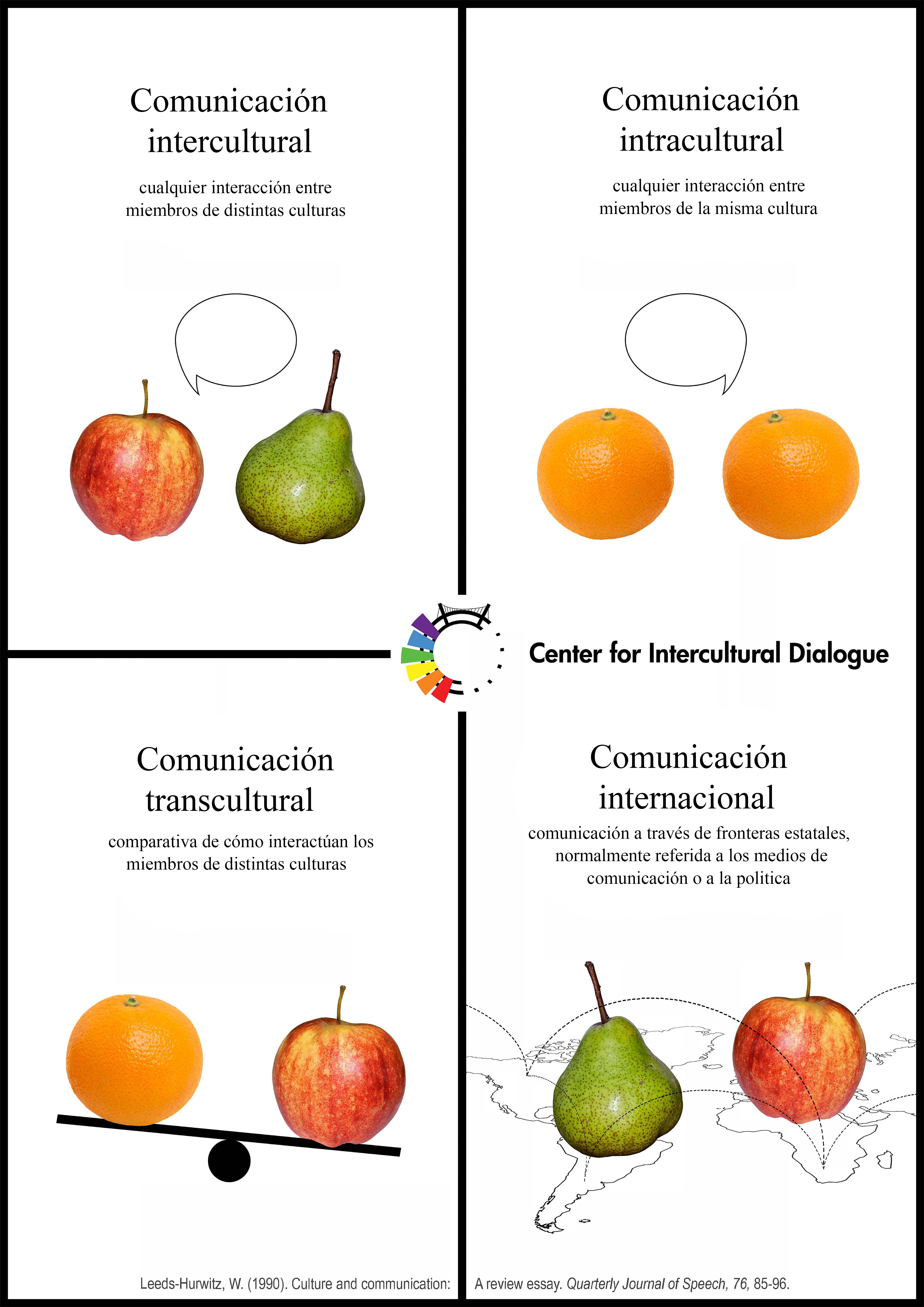
CID PostersThis poster was designed by Linda J. de Wit, and published previously; it now has been translated into German. This one clarifies the differences between intercultural, intracultural, cross-cultural, and international communication.

The German translation was provided by Maria Faust, and the graphic design work necessary to revise was by Yan Qiu. Here then is CID Poster 4: Typen interkultureller Kommunikation.


Center for Intercultural Dialogue poster 4 translated into German

Just in case anyone wants to cite this poster, the following would be the recommended format:

Center for Intercultural Dialogue. (2025). Typen interkultureller Kommunikation [M. Faust, trans.]. CID Posters, 4. Available from:
https://centerforinterculturaldialogue.org/wp-content/uploads/2025/10/cid-poster-4-german.jpg

As with other series, CID Posters are available for free on the site; just click on the thumbnail to download a printable version. They may be downloaded, printed, and shared as is, without changes, without cost, so long as there is acknowledgment of the source.

As with other CID Publications, if you wish to contribute an original contribution, please send an email before starting any work to receive approval, to minimize inadvertent duplication, and to learn about technical requirements. As is the case any series, posters should be created initially in English. If you want to volunteer to translate a poster into a language in which you are fluent, send in a note before starting, to receive approval and to confirm no one else is working on the same one.

Wendy Leeds-Hurwitz
Director, Center for Intercultural Dialogue
intercult.dialogue AT gmail.com


Creative Commons License
This work is licensed under a Creative Commons Attribution-NonCommercial-NoDerivatives 4.0 International License.

Tohoku U: Center for Northeast Asian Studies (Japan)

“JobProfessor or Associate Professor in Interethnic Relations and Conflict Studies, Center for Northeast Asian Studies, Tohoku University, Japan. Deadline: Open until filled; posted 1 November 2025.

The Center for Northeast Asian Studies, established in 1996 as an independent research institute inside Tohoku University, aims to create interdisciplinary knowledge that contributes to solving cross-border environmental issues under cooperative globalization. In response to the changing global socio-political landscape, the Center established a new Department of Geopolitical Studies, founded upon the principles of interdisciplinarity, inter- and trans-regionality, and creative collaboration. Bringing together scholars from around the world, the Center is dedicated to integration – of research within and outside of Japan, of scholarship on and of the expertise of Northeast Asian studies – as a driving force for the development of Geopolitical Studies and as a roadmap for its future.

As part of this new initiative, the Center seeks to appoint a distinguished scholar in the Division of Interethnic Relations and Conflict Studies, Department of Geopolitical Studies. The ideal candidate will have a strong record of research on conflict and confrontation, as well as on the institutions that shape them, with particular attention to Russia, East Asia, and Japan. A demonstrated commitment to international collaboration is essential. The position also emphasizes the ability to lead the planning and organization of international conferences and seminars that connect scholars at Tohoku University, across Japan, and worldwide. They are especially interested in candidates who can situate their work within broader debates on geopolitical change and its social consequences, including the experiences of minority groups, and who can demonstrate excellence in building and coordinating international research networks

U Nottingham Ningbo: Applied Linguistics (China)

“JobAssistant Professor of Applied Linguistics, University of Nottingham in Ningbo, China. Deadline: 12 December 2025.

The School of Education and English is looking for an ambitious, talented, and experienced academic with a passion for teaching and a well-developed research profile to join its team of scholars in the field of Applied Linguistics. The successful candidate will be expected to contribute to teaching, curriculum development and supervision within the undergraduate English and Applied Linguistics and the MA in Applied Linguistics programmes, as well as providing wider supervision for a growing numbers of PhD/EdD students. The successful candidate will also be expected to take a lead role in collaborative research projects, as well as conducting original research of their own that results in presentations and publications of a high international standing in relevant and recognised areas of applied linguistics.