Fulbright-Hays Seminars Abroad 2021

Fulbrights

Fulbright-Hays Seminars Abroad, to be held in Iceland, Morocco, Mexico across June-July or July-August of 2021. Deadline: December 18, 2020.

The Fulbright-Hays Seminars Abroad program supports short-term study opportunities for U.S. educators for the purpose of improving their understanding and knowledge of the peoples and cultures of other countries. The program provides opportunities for qualified U.S. educators to participate in short-term seminars abroad mainly on topics in the humanities, social sciences, and arts. For the Fiscal Year (FY) 2021 competition, the plan is to offer seminars to Iceland (elementary/secondary teachers, Grades K-8), Morocco (secondary teachers, Grades 9-12), and Mexico (postsecondary educators and administrators).

Educators with limited or no study abroad experience are encouraged to apply. Upon their return, participants are expected to develop and disseminate a curriculum project and to share their broadened knowledge and understanding of the host country(ies) with students, colleagues, civic and professional organizations, and the public in their respective home communities. All seminars are composed of a pre-arranged, structured academic phase and a group travel phase.

Note that it is possible that seminar dates may be delayed due to any restrictions that could be enacted in response to the current Covid-19 pandemic.

Creatour.PT Documentary on Creative Tourism (Portugal)

Intercultural PedagogyPrize-winning Creative Tourism Documentary “creatour.pt – creative tourism in Portugal” is available for classroom viewing. Prepared by the Centro de Estudos Sociais da Universidade de Coimbra, Coimbra, Portugal.

At 38 minutes in length, the documentary is freely available online for viewing, with subtitles in English and in Portuguese, on the CES YouTube channel.

The documentary was developed to provide an inspiring and informative profile of Creative Tourism development in small cities and rural areas, as explored and implemented within the CREATOUR research-and-application project in Portugal. It may be a useful complement for tourism courses, addressing topics such as experiential and cultural tourism, sustainable and responsible tourism, and tourism and rural development.


Aarhus Institute for Advanced Studies Fellowships (Denmark)

FellowshipsAIAS-COFUND II Marie Skłodowska-Curie Fellowships 2021-2022, Aarhus University, Aarhus, Denmark. Deadline: 15 January 2021.

Up to 15 AIAS-COFUND fellowships are available for the most talented researchers from around the world and within all research disciplines and topics. The scheme is funded by the European Union’s Horizon 2020 Research and Innovation Programme under the Marie Skłodowska-Curie actions (grant agreement no 754513) and Aarhus University Research Foundation.

There are two types of fellowships:

* AIAS-COFUND Junior Fellowships for postdoctoral researchers with a career experience of 2-10 years. Duration from 12-36 months.
* AIAS-COFUND Senior Fellowships for researchers with a career experience of 10+ years. Duration from 6-18 months.

Who can apply? The target group of the Programme is talented researchers at all career stages with a PhD and a minimum of two years of full-time postdoctoral research experience at the time of the application deadline

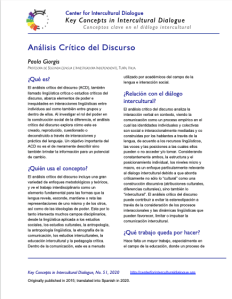
KC51 Critical Discourse Analysis Translated into Spanish

Key Concepts in ICDContinuing translations of Key Concepts in Intercultural Dialogue, today I am posting KC#51: Critical Discourse Analysis, which Paola Giorgis wrote for publication in English in 2015, and which  Jhon Eduardo Mosquera Pérez has now translated into Spanish.

As always, all Key Concepts are available as free PDFs; just click on the thumbnail to download. Lists of Key Concepts organized alphabetically by conceptchronologically by publication date and number, and by languages into which they have been translated, are available, as is a page of acknowledgments with the names of all authors, translators, and reviewers.

KC51 CDA_SpanishGiorgis, P. (2020). Análisis Crítico del Discurso. (J. E. Mosquera Pérez, Trans.). Key Concepts in Intercultural Dialogue, 51. Available from:

If you are interested in translating one of the Key Concepts, please contact me for approval first because dozens are currently in process. As always, if there is a concept you think should be written up as one of the Key Concepts, whether in English or any other language, propose it. If you are new to CID, please provide a brief resume. This opportunity is open to masters students and above, on the assumption that some familiarity with academic conventions generally, and discussion of intercultural dialogue specifically, are useful.

Wendy Leeds-Hurwitz, Director
Center for Intercultural Dialogue


Creative Commons License
This work is licensed under a Creative Commons Attribution-NonCommercial-NoDerivatives 4.0 International License.

Technical U Munich Studentships: Media Portrayal of Majority/Minority Groups (Germany)

“Studentships“2 PHD Studentships, “The media portrayal of majority and minority groups,” at Technical University of Munich / TUM School of Governance, Munich, Germany. Deadline: 18 December 2020.

Both applicants will be core members of the Emmy Noether Junior Research Group “The media portrayal of majority and minority groups.” The group is newly funded by the German Research Foundation and led at TUM by Stefanie Walter. It aims at analyzing similarities and differences in the media portrayal of majority and minority groups by studying them comparatively.

Position 1: Focus on qualitative content analysis.

The position will focus on the project’s qualitative component with an emphasis on qualitative content analysis and methods. The doctoral researcher will be actively involved in the project’s research activities, including the design and implementation of studies. They will also be expected to help co-author articles based on this project for publication and have the opportunity to pursue a doctoral degree.

Position 2: Focus on automated text analysis/computational social science  content analysis.

The position will focus on the project’s quantitative component with an emphasis on automated content analysis and quantitative social science. The doctoral researcher will be actively involved in the project’s research activities, including the design and implementation of studies. They will also be expected to help co-author articles based on this project for publication and have the opportunity to pursue a doctoral degree.

U Mass Amherst: Director Academic Fellows Program (USA)

“Job
Faculty Lecturer / Director- Academic Fellows Program, University of Massachusetts, Amherst, MA. Deadline: December 15, 2020.

The University of Massachusetts Amherst College of Social and Behavioral Sciences (SBS) seeks an innovative, dynamic, and student-centered Faculty Lecturer to direct the Academic Fellows Program (AFP), which serves the approximately 2000 SBS undergraduate students who identify as first-generation, BIPOC (Black, Indigenous, and People of Color), and/or from families with low incomes. The goals of AFP are to ensure equity; foster a sense of belonging and community; provide holistic support for students’ academic, professional development, civic, and personal pursuits; and close the opportunity gap for historically marginalized students.

The Lecturer/Director will teach two courses per semester, including an Integrative Experience (IE) course and a team-based-learning (TBL) course, and will serve as a faculty mentor and sponsor for senior theses, independent studies, and internships. Teaching assignments may also include a research seminar, an advanced transfer student seminar, a cohort-based internship seminar, or a first-year seminar.

SIETAR Europa: Decoloniality, Equity and Belonging (Webinar)

EventsSIETAR Europa Webinar: Decoloniality, Equity and Belonging, by Zarine Jacob & Carlos Gonzalez Carrasco, December 14, 2020 06:00-07:00 CET.

Description: “HCI (Human Conductivity Institute) is an interdisciplinary think-tank whose purpose is to raise human consciousness. We do this by stimulating & inspiring the quality the quality of human connections (conductivity) so that relationships, people and our planet flourish. With a renewed focus on antiracism, we critically question “coloniality” to help frame our understanding of the world. The connections between intercultural understanding, white supremacy, diversity work and decoloniality are not usually articulated in corporate settings. We are enriched by the insights decoloniality has brought to our work. We will present our thoughts and invite collaborative enquiry into its relevance and application in the intercultural world, especially for those in the diversity space.”

After registering, you will receive a confirmation email containing information about how to join the webinar. The webinar video-recording will be provided after the event on the SIETAR Europa YouTube Channel.

Stellenbosch U: Postdoc in Linguistics & Identity (South Africa)

PostdocsPostdoctoral Fellowship in General Linguistics for the project Politics of the Belly: Language, Food, and Memory in the (Re)Construction of South African Identity, Stellenbosch University, South Africa, 2021-23. Deadline: 31 December 2020.

The grantholder of the above project, Dr. Marcelyn Oostendorp, invites applications from suitably qualified doctorate graduates for a postdoctoral fellowship valued at R220 000 per annum. The postdoctoral fellowship is based at Stellenbosch University and is available for two (2) years. The fellowship is only available to one individual who has obtained their doctorate degree within the past five (5) years, who has not attained their doctoral degree at Stellenbosch University, and whose degree was in the area of (applied) linguistics, literature, communication/rhetoric, or another language-related discipline.

This project will investigate the construction of identity and memory in discourses on food, and will employ multimodal discourse analysis as the main theoretical framework and analytical tool. The aim of the project is to shed light on how semiotic resources are used to (re)construct memory, identity, and place in our discursive engagements with food.

Applicants must: a) be available to start the fellowship on 1 April 2021; b) be willing to work full time; c) be competent and experienced in discourse/multimodal analysis and/or in experimental methods (such as eye-tracking); d) hold a PhD and must have graduated within the past five (5) years; e) be able to work in a team environment; f) have experience in writing academic articles; and g) be able to articulately communicate academic findings to disseminate results.

Interculturing Cinema

“Book Notes

Mukherjee, I., & Williams, M. G. (2020). Migration, mobility and sojourning in cross-cultural films: Interculturing cinema. Lanham, MD: Lexington Books.

Ishani Mukherjee and Maggie Griffith Williams analyze six cross-cultural films through an intercultural communication lens and argue that their depictions of migration, mobility, and the resulting intercultural communications are complex and stressful moments of conflict, with mixed outcomes ranging from productive personal growth to endless oppression, familial or social separation, and loss of identity.

Global movements and intercultural communication are oft-explored themes in popular cinema from Hollywood and beyond. The authors pay homage to this cinematic trend by locating transnational films within key themes that tie into global movements, their complexities, and implications. While some films focus on migrants’ experiences of culture-shock, cultural assimilation and/or integration, some cinematic texts focus on cultural identities that are in transition within contexts of social mobility and movements. Other films explore the short-term intercultural impact that sojourners experience in unfamiliar cultural spaces and different social positions.

Dialogic & Collaborative Practices in Challenging Times (Zoom Seminar)

EventsDialogic and Collaborative Practices in Challenging Times, offered by Harlene Anderson and Sheila McNamee, Taos Institute, January 28-30, 2021,12-3pm each day, Zoom seminar.

In this intensive, 9-hour Zoom seminar spread over 3 days (3 hours each day), Harlene and Sheila will introduce, discuss, and provide opportunities to put constructionist theory to practice. Given the challenges we confront globally, discussion will center on exploring the practical implications of social construction while giving ample space for us to collaborate in an effort to put these ideas into practice. Special attention will be given to participants’ own projects and professional contexts. We will provide ample time for sharing and interacting.

This workshop will be useful for those familiar with social construction and relational practice as well as those new or unfamiliar with these ideas. This is an opportunity to be in conversation with others who are working in or who want to work in relational ways. It is a chance to forge connections that might help us sustain relational practices.

Readings and other resource materials will be provided prior to the course.