Promoting ICD through Media, Visual & Performing Arts (Italy but Online)

EventsPromoting Intercultural Dialogue through Media, Visual and Performing Arts, Università Cattolica del Sacro Cuore, Milan, Italy (Webinar), May 19, 2021, 6pm CET.

As part of the series of webinars, Migrations | Mediations. Promoting Intercultural Dialogue through Media, Visual and Performing Arts, the May 19 topic will be We tell a different story – the role of documentary film, alternative and community media in reporting migration.

Speakers:
– Daniela Drastata, Chair of the EBU TV Intercultural and Diversity Group, Senior editor at HRT (Croatian National Radio and Television), Executive co-producer of the EBU New Neighbours series
– Clara Dominguez, Division Director & VOA Director of Partnerships, Latin America Broadcasting, Voice of America
– Fran Atopos Conte, journalist and director, Termini TV
– Nyima Jadama, TV host of Nyimas Bantaba at ALEX Berlin

Moderator:
– Nadia Bellardi, transcultural media consultant

Earlier webinars in the series are available online as well.  Those topics were:

  • Webinar 1: From Integration to Inclusion: Why Culture Matters and How to Build a Positive Narrative; and Migration and the Circuits of Film Culture:
    A Southern Perspective

  • Webinar 2: Beyond the Emergency: Media Representations, Social Encounters and Transculturality.

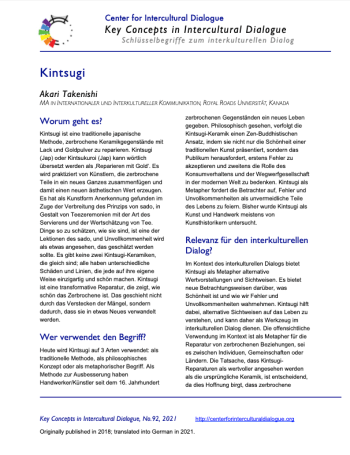
KC84 Double Intercultural Dialogue Translated into German

Key Concepts in ICDContinuing translations of Key Concepts in Intercultural Dialogue, today I am posting KC84: Double Intercultural Dialogue, which María José Coperías-Aguilar wrote for publication in English in 2017, and which Marlena Pompino has now translated into German.

KC84 Double ICD_GermanAs always, all Key Concepts are available as free PDFs; just click on the thumbnail to download. Lists of Key Concepts organized chronologically by publication date and number, alphabetically by concept, and by languages into which they have been translated, are available, as is a page of acknowledgments with the names of all authors, translators, and reviewers.
Coperías-Aguilar, M. J. (2021). Doppelter interkultureller Dialog (M. Pompino, Trans.). Key Concepts in Intercultural Dialogue, 84. Available from: https://centerforinterculturaldialogue.org/wp-content/uploads/2021/04/kc84-double-icd_german.pdf

If you are interested in translating one of the Key Concepts, please contact me for approval first because dozens are currently in process. As always, if there is a concept you think should be written up as one of the Key Concepts, whether in English or any other language, propose it. If you are new to CID, please provide a brief resume. This opportunity is open to masters students and above, on the assumption that some familiarity with academic conventions generally, and discussion of intercultural dialogue specifically, are useful.

Wendy Leeds-Hurwitz, Director
Center for Intercultural Dialogue


Creative Commons License
This work is licensed under a Creative Commons Attribution-NonCommercial-NoDerivatives 4.0 International License.

Racial Literacy

Intercultural Pedagogy

Sealey-Ruiz, Y. (2021). Racial literacy. A Policy Research Brief produced by the James R. Squire Office of the National Council of Teachers of English.

Racial literacy is a skill and practice by which individuals can probe the existence of racism and examine the effects of race and institutionalized systems on their experiences and representation in…society.

Those teaching intercultural dialogue may find this useful. It explains:

  • What is racial literacy?
  • Racial literacy in teacher education
  • Enacting racial literacy
  • Racial literacy development model for teaching and learning


CFP CCCC International Researchers Consortium Workshop 2022 (USA)

ConferencesCall for papers: International Researchers Consortium Workshop, Conference on College Composition and Communication, March 9-12, 2022, Chicago, IL (or online if need be). Deadline: proposal, May 25, 2021; draft text: December 2021.

The International Researchers Consortium is working on a proposal for a 14th annual day-long international research workshop, at the 2022 College Conference on Composition and Communication (CCCC) conference located in the U.S. Though your research is not required to connect to conference themes, this year’s theme is diversity, equity, and linguistic justice.

Organizers invite proposals for up to 24 researcher-participant roles, focused on studies that promote insights into international research and negotiation of conditions beyond national contexts for writing in higher education around the world. By research, they mean a project with a focused research question, an identified methodology (qualitative, quantitative, ethnographic, historical, discourse analysis, corpus, etc.), and the collection of data in some form. This research can be at any stage and does not need to be final. The goal would be to provide a draft text about the research by the end of December 2021, to read the other workshop facilitators’ texts before attending the CCCC conference, and to participate in the day-long workshop by leading a discussion about your own project and participating in discussions of a subset of others’ projects.

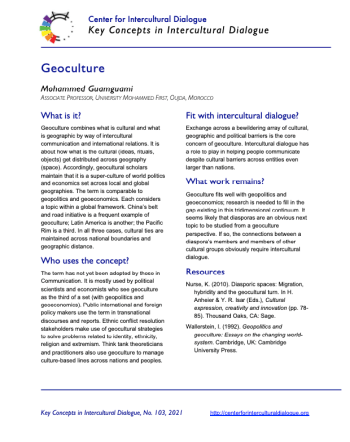
KC102 Inclusive Communication

Key Concepts in ICDThe next issue of Key Concepts in intercultural Dialogue is now available. This is KC#102: Inclusive Communication, by Mohammed Guamguami. Click on the thumbnail to download the PDF. Lists organized chronologically by publication date and numberalphabetically by concept in English, and by languages into which they have been translated, are available, as is a page of acknowledgments with the names of all authors, translators, and reviewers.

KC102 Inclusive communication

Guamguami, M. (2021). Inclusive communication. Key Concepts in Intercultural Dialogue, 102. Available from: https://centerforinterculturaldialogue.org/wp-content/uploads/2021/04/kc102-inclusive-communication.pdf

The Center for Intercultural Dialogue publishes a series of short briefs describing Key Concepts in Intercultural Dialogue. Different people, working in different countries and disciplines, use different vocabulary to describe their interests, yet these terms overlap. Our goal is to provide some of the assumptions and history attached to each concept for those unfamiliar with it. As there are other concepts you would like to see included, send an email to the series editor, Wendy Leeds-Hurwitz. If there are concepts you would like to prepare, provide a brief explanation of why you think the concept is central to the study of intercultural dialogue, and why you are the obvious person to write up that concept.


Creative Commons License
This work is licensed under a Creative Commons Attribution-NonCommercial-NoDerivatives 4.0 International License.
MIT: Postdoc in Linguistic Anthropology (USA)

PostdocsPostdoctoral Associate in Linguistic Anthropology, Anthropology Program, Massachusetts Institute of Technology, Cambridge, MA. Deadline: May 15, 2021.

Postdoctoral Associate in Linguistic Anthropology, Anthropology Program, to teach the twelve-unit course “Language, Culture, and Communication” each year. In addition, will devote three to five hours each week to the Language and Technology Lab, coordinating a recurring workshop, updating the website, and mentoring graduate and undergraduate research partners.

REQUIRED: a Ph.D. in linguistic anthropology or a closely related field by the time of appointment. The area of geographic expertise is open, though we encourage scholars whose work engages with global languages and cultures.
PREFERRED: research interest in the relationship between language and technology, broadly conceived; experience with both qualitative and quantitative research, including computational methods; and experience with collaborative research and a desire to work as part of an interdisciplinary team in a leadership capacity.

This is a one-year appointment with the possibility for renewal, beginning September 9, 2021.

KAIICD: Consultancy on Countering Hate Speech in Europe (Austria)

“JobConsultancy for Research on Countering Hate Speech Initiatives in Europe, King Abdullah bin Abdulaziz International Centre for Interreligious and Intercultural Dialogue(KAICIID), Vienna, Austria. Deadline: May 4, 2021.

KAICIID’s Europe Region Programme started in 2021 a Social Cohesion Initiative, which includes a pillar on Countering Hate Speech (CHS). This CHS project acknowledges that hate speech is becoming an increasingly serious problem in Europe with serious consequences for well-being, intergroup trust, integration and democracy. It also focusses on the important role which religious leaders continue to play in creating and implementing the initiatives and frameworks which stop hate speech and promote respectful dialogue, outreach, trust and community resilience. The project’s aim will be to draw upon the existing expertise and resources available, as well as the needs and priorities of religious leaders, and create training materials which will empower religious leaders to counter hate speech even better.

A crucial part of this process is mapping and analysing the many existing initiatives to counter hate speech, with an emphasis on those which engage religious leaders, which are currently taking place in Europe at national to international level. The point is to identify the strengths and weaknesses of initiatives in this field from the perspective of the organizations and of the religious leaders who both implement some of them and observe the results, and to identify the most pressing calls and recommendations for future action. This research will inform KAICIID’s outreach to potential partners and ensure the relevance of its programmatic work.

The Consultant will carry out desk research in order to create an analytical report on the status of countering hate speech initiatives in Europe. It will map and discuss the most important initiatives and resources to counter hate speech of the last five years across four regions of Europe (Norther, Eastern, Western and Southern Europe) as well as the nature of their involvement of religion and religious actors. It will consider which initiatives have shaped public policy on this topic and how they have (or have not) managed to do so. It will analyze the initiatives’ successes from the perspectives of their organizations, including a number of religious institutions, and explore the strengths, weaknesses of these initiatives.

Image + Bias Competition

Applied ICD

Global call for submissions: IMAGE + BIAS. Deadline: Free workshop using Artivive is May 4, 2021; submissions deadline extended to May 23, 2021.

The Goethe-Institut, Gray Area, Fotomuseum Winterthur, and Artivive are launching an open call for artists, designers, and the general public to submit creative representations on the subject of bias. Submissions should articulate our ongoing concerns with technology’s growing ability to alter people’s visual perception of reality. Submissions may explore discriminatory, misrepresentational, and biased apparatuses or express thought-provoking ideas on how to deal with the perpetuation of bias by technology. Technology is never neutral but a reflection of the biases in our society. Images play an important role in that context: fake photos and videos created with deep neural networks threaten privacy, democracy, and national security. Vision recognition systems skew gender, race, and class differences and become vehicles of discrimination. Underdeveloped AI models misrepresent the health disparities faced by minority populations.

FREE workshops will guide participants through new approaches to storytelling with augmented reality using 2D and 3D animations and videos. These introductory workshops require no prior experience and will introduce artists, graphic designers, illustrators, and the general public to the app and how to use it to bring their projects to life. One remains: May 4, 2021 at 9 a.m. PST.


Fulbright Opportunities

FulbrightsFulbright has announced open awards competitions for both US scholars to travel abroad, and international scholars to travel to the US. Deadlines vary by program.

Awards Competitions Now Open

The Fulbright U.S. Scholar Program and Fulbright U.S Student Program are accepting applications for 2022-23. Application deadlines are in the fall.
New Scholar awards include the Fulbright Future Scholarship (funded by The Kinghorn Foundation) to Australia, the Fulbright- Kalam Climate Fellowship to India, Fulbright Distinguished Scholar Awards, Interdisciplinary Network to Brazil.

Student awards include the Fulbright-National Geographic Storytelling Fellowship, the Fulbright-Fogarty Fellowships In Public Health, and the English Teaching Assistant Programs.

Host a Fulbright Scholar-in-Residence

The Fulbright Scholar-in-Residence Program is accepting applications from U.S. institution of higher education to host a scholar from outside of the United States for a semester or full academic year to teach courses, assist in curriculum development, guest lecture, develop study abroad/exchange partnerships and engage with the campus and the local community. Interested campuses should complete the S-I-R Host Interest Survey by May 15, 2021. The program application deadline is October 15, 2021. Contact SIR@iie.org for more information.

KC27 Globalization Translated into German

Key Concepts in ICDContinuing translations of Key Concepts in Intercultural Dialogue, today I am posting KC#27: Globalization, which Shiv Ganesh and Cynthia Stohl wrote for publication in English in 2014, and which Marlena Pompino has now translated into German.

KC27 Globalization_GermanAs always, all Key Concepts are available as free PDFs; just click on the thumbnail to download. Lists of Key Concepts organized chronologically by publication date and number, alphabetically by concept, and by languages into which they have been translated, are available, as is a page of acknowledgments with the names of all authors, translators, and reviewers.

Ganesh, S., & Stohl, C. (2018). Globalisierung. (M. Pompino, Trans.). Key Concepts in Intercultural Dialogue, 27. Retrieved from: https://centerforinterculturaldialogue.org/wp-content/uploads/2021/04/kc27-globalization_german.pdf

If you are interested in translating one of the Key Concepts, please contact me for approval first because dozens are currently in process. As always, if there is a concept you think should be written up as one of the Key Concepts, whether in English or any other language, propose it. If you are new to CID, please provide a brief resume. This opportunity is open to masters students and above, on the assumption that some familiarity with academic conventions generally, and discussion of intercultural dialogue specifically, are useful.

Wendy Leeds-Hurwitz, Director
Center for Intercultural Dialogue


Creative Commons License
This work is licensed under a Creative Commons Attribution-NonCommercial-NoDerivatives 4.0 International License.