U Illinois Urbana: Global Education & Training Program Coordinator (USA)

“Job

Global Education and Training Program Coordinator, University of Illinois, Urbana-Champaign, Champaign, IL (Hybrid position). Deadline: 22 July 2024.

Coordinate, plan and implement educational and training programs offered through Global Education and Training (GET).

Statement of Duties & Responsibilities:

Develop, plan and administer on-site or remote management for GET in-person, online, or hybrid training and educational programs including: proposal and budget preparation and management; schedule development; faculty, external speaker, and interpreter recruitment; and organization of seminars, field trips, cultural and social events.

Provide hands-on or virtual facilitation and delivery of selected program content. Accompany groups on site visits to regional businesses and cultural activities.

Communicate program planning logistics with all stakeholders, including international partner organizations and participants, in a timely fashion to ensure tight collaboration and coordination

Recruit, hire, train, supervise, and evaluate GET translators and employees working on GET programs.

Monitor and track program budgets and staffing needs.

Create and distribute program evaluations; meet with participants, faculty and staff to gather qualitative feedback on programs.
Utrecht U: Cancelling as a Postcolonial Strategy for Repairing Cultural Heritage (Netherlands)

“Studentships“Ph.D. in Cancelling as a Postcolonial Strategy for Repairing Cultural Heritage, Utrecht University, Netherlands. Deadline: 15 August 2024.

The Department of Media and Culture Studies is looking for a PhD candidate for a project that delves into the meaning and applications of canceling practices within antiracist and decolonial movements. The specific focus is on cancelling as a reparative strategy aimed at addressing the enduring impact of historical injustices in the present. Termed ‘reparative canceling,’ these practices seek to rectify symbols, art, knowledge, cultural heritage, and ingrained cultural norms that are deemed harmful and unjust, thus perpetuating the legacy of colonial history.

You will investigate how reparative cancelling of cultural heritage is performed within antiracist and decolonial activism in both postcolonial (Global South) and post-imperial (Global North) societies. Specifically, it will scrutinise the foundations, justifications, reparative outcomes, and potential drawbacks of the diverse canceling strategies employed by contemporary antiracist and decolonial publics to engage with memory and cultural heritage.

The project will address the following sub-research questions:
* Where does the ‘right to cancel’ stand in relation to the ‘right of memory’ and the preservation of cultural heritage?
* How is the emergence of decolonial and antiracist counter-narratives and counter-memories facilitated by reparative cancelling?

You will tackle these questions by analysing chosen case studies encompassing a range of reparative cancelling practices, such as suppressing/banning, removing/displacing, renaming, and blacklisting/censoring, situated in different geographic locations – namely two postcolonial contexts and two post-imperial contexts.

CosmoKidz Resources (USA)

Applied ICD

CosmoKidz resources, Coordinated Management of Meaning Institute for Personal and Social Evolution, USA.


The global problems of today and of the future will require leaders who are able to helpfully engage with others of varying backgrounds, beliefs, and perspectives. CosmoKidz is providing the building blocks for this kind of leadership. Helping to build better social worlds, one conversation at a time.

The CosmoKidzTM program consists of sets of conversational activities for adults to use with children and teens to help them develop constructive social and emotional intelligences. The CosmoKidzTM activities fit in with a new move in educational thinking: a shift from training students for cleverness and competition to helping them become fulfilled individuals and active, caring, compassionate people. The conversational activities are developed for different age groups—from children, to tweens and teens—based on something CMMi calls a cosmopolitan sensibility. It’s a different way of looking at how adults relate with children and how we would like them to relate with others. It also helps us focus on important things that most people don’t pay attention to that happens in our communicating with others.

CosmoKidz materials are now available in English, Pashto, Farsi, Norwegian, and Romanian. And there are related materials for CosmoTweenz, CosmoTeenz, and CosmoParents, as well as more general SOAR (Sense what’s around you, Open your hands to help others, Act with kindness, Respect other people) activities.

CFP: Family Language Policy Conference (Ireland)

“Collaborative

Call for papers: Family Language Policy Conference: Reimagining the Field, University of Galway, Galway, Ireland, 22-23 October 2024. Deadline: 31 July 2024.

In their 2008 paper, King et al. laid the foundation for the emergence of the field that came to be recognised as Family Language Policy (FLP). Since then, this field of inquiry has received an increasing amount of scholarly attention and has evolved into a burgeoning field over the last decade. In this short time span, the core interests of FLP have shifted: While it initially attempted “to draw direct causal links across ideologies, practices, and outcomes”, it moved on to examining “how families are constructed through multilingual language practices, and how language functions as a resource for this process of family making and meaning making” (King 2016: 728). Recent FLP scholarship has pointed to the necessity of putting under scrutiny the central concepts of family, language, and language policy and not departing from taken-for-granted notions in order to produce situated accounts of FLP (Lanza & Lomeu Gomes 2020). A recent proposal even suggests reimagining the field “under the more all-encompassing label of family multilingualism” (Léglise 2023: 288), arguing that the institutionalisation of FLP as a field has marginalised different kinds of knowledges pertinent to family multilingualism.

Encouraged by the impetus of these and other reflections on the foundations of research on family language policy and family multilingualism, this Hybrid International Conference on Family Language Policy is being organised under the theme of Reimagining the Field. The aim is to provide a forum for discussing epistemological, theoretical and methodological considerations around FLP and family multilingualism (FM), for setting future research agendas and for exploring possibilities for establishing regular venues for such exchange.

Contributions in the form of papers and symposia are welcomed on the following issues:
• Epistemological foundations of FLP/FM
• Key theoretical concepts in FLP/FM
• Nexus of FLP/FM and the wider community
• Interaction between FLP/FM and educational institutions
• Children’s agency
• Digital and multimodal interaction in the family
• Affect and emotion in FLP/FM
• FLP/FM and political economy
• Participatory approaches in FLP/FM

U Penn: Postdoc in Communication, Group Identity, and Computational Methods (USA)

Postdocs
Postdoctoral Researcher in Communication, Group Identity, and Computational  Methods, University of Pennsylvania, Philadelphia, PA, USA. Deadline: 15 August 2024.

The successful candidate for this position will work in the Annenberg School for Communication under the supervision of Dr. Deen Freelon. A recent hire at Annenberg, Freelon is in the process of starting a new lab, and this postdoc will play a crucial role in helping him do so. The unifying idea of the new lab’s work is that many facets of group identity—including race, gender, sexuality, religion, nationality, and others—have historically been neglected as potential factors in co-determining communication patterns and outcomes. Quantification of such characteristics must be done carefully to maximize construct validity and minimize harm and exclusion. (The term “group identity” is used broadly and without reference to any particular theoretical tradition.) Applicants with strong interests in these and related issues are encouraged to apply, as are those with experience analyzing under-studied media types including podcasts, images, and video.

Roughly half this individual’s time will be spent working on Freelon’s projects, while the other half will be devoted to projects initiated independently and with other research groups. The position is designed to allow a highly motivated researcher to build a strong CV under the mentorship of a longtime innovator in political communication and computational social science. Extension of the position to a second year (if desired) will depend on effective performance in the first.

KC97 Anti-Racist Education Translated into German

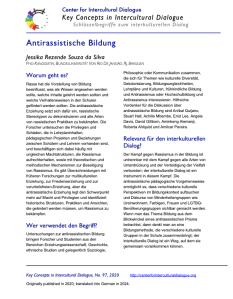
Key Concepts in ICDContinuing translations of Key Concepts in Intercultural Dialogue, today I am posting KC#97: Anti-Racist Education, which Jessika Rezende Souza da Silva wrote for publication in English earlier this year, and which Marlena Pompino has now translated into German.

As always, all Key Concepts are available as free PDFs; just click on the thumbnail to download. Lists of Key Concepts organized alphabetically by conceptchronologically by publication date and number, and by languages into which they have been translated, are available, as is a page of acknowledgments with the names of all authors, translators, and reviewers.

KC97 Anti-racist eduction in German

Souza da Silva, J. R. (2024). Antirassistische Bildung. (M. Pompino, trans.). Key Concepts in Intercultural Dialogue, 97. Available from: https://centerforinterculturaldialogue.org/wp-content/uploads/2024/06/kc97-anti-racist-education_german.pdf

If you are interested in translating one of the Key Concepts, please contact me for approval first because dozens are currently in process. As always, if there is a concept you think should be written up as one of the Key Concepts, whether in English or any other language, propose it. If you are new to CID, please provide a brief resume. This opportunity is open to masters students and above, on the assumption that some familiarity with academic conventions generally, and discussion of intercultural dialogue specifically, are useful.

Wendy Leeds-Hurwitz, Director
Center for Intercultural Dialogue


Creative Commons License
This work is licensed under a Creative Commons Attribution-NonCommercial-NoDerivatives 4.0 International License.

Towson U: Specialist, Study Abroad & Away (USA)

“JobSpecialist, Study Abroad and Away Office, Towson University, Towson, MD, USA. Deadline: 18 July 2024.

The Division of Academic Affairs at Towson University is seeking a passionate and energetic individual to serve as the Specialist for the Study Abroad & Away Office. Reporting to the Associate Director, this position works with the rest of the Study Abroad/Away team to support students participating in transformative experiential learning experiences internationally and within the U.S. If you’re looking for an opportunity to support student success and global learning and want to make an impact every day while gaining valuable experience in the education abroad field this position is for you!

Towson University (TU) is one of the nation’s top 100 public universities. Located north of Baltimore, TU currently enrolls approx. 20,000 students and is the second-largest university in the prestigious University System of Maryland. Towson University values diversity and fosters a climate that is grounded in respect and inclusion to cultivate the intellectual and personal growth of the entire university community.

As a member of the Study Abroad and Away team, the Specialist assists in all aspects of the daily operations of the Study Abroad & Away Office.

Columbia U: Director, Office of International Students & Scholars (USA)

“JobDirector, Office of International Students and Scholars, Teachers College, Columbia University, New York, NY, USA. Deadline: 30 August 2024.

The Office of International Students and Scholars at Teachers College, Columbia University is seeking a Director who will lead the team responsible for immigration advising and support of international students and scholars. Reporting to the Vice Provost for Academic Planning and Global Affairs, the Director of the Office for International Students and Scholars will be responsible for implementing and overseeing all related services and support which includes but is not limited to planning, collaborating, and coordinating activities within the office’s overall scope. The Director will also be responsible for interpreting, establishing and disseminating institutional policies and procedures in accordance with federal regulations, serving as the College’s expert on policies relating to F-1 students and J-1 exchange visitors, and supporting the College’s ongoing development of international student pathways and engagement.

Japanese American Community Foundation Grants

GrantsGrants, JA Community Foundation, Oakland, CA, USA. Deadlines: Letter of inquiry, 31 July 2024; full proposal, 30 September 2024.

The JA Community Foundation funds nonprofit organizations in the United States serving the Japanese American and greater Asian American communities. They accept applications from all 50 states in the United States, and fund programs and projects that focus on senior health and services, history, arts and culture, and youth. All grantees are required to be registered 501c3 public benefit nonprofit organizations. Grant sizes range from $2,500 to $50,000 for new projects or improvements to existing programs. Grants cannot be used for ongoing operating costs. Grantees may not reapply for funding while a current grant is open.

International Day for Dialogue among Civilizations 2024

EventsInternational Day for Dialogue among Civilizations, as established by the United Nations in June 2024, will now occur on 10 June every year.

Underlining the need to raise awareness of the value of diversity of civilizations and promote dialogue, mutual respect, tolerance and global solidarity, the General Assembly today adopted by consensus a resolution declaring 10 June the International Day for Dialogue among Civilizations. The text titled “International Day for Dialogue among Civilizations” (document A/78/L.75) was adopted by consensus.

By the resolution, the Assembly also invited all Member States and other relevant stakeholders to commemorate the International Day appropriately, including through educational and public awareness-raising activities, and share best practices in this regard.

The representative of China, introducing the text, spotlighted multiple interlocking crises and widening peace and development deficits facing the world, which “is entering a new era of instability”, leaving humanity “at a crossroads of history”. Dialogue among civilizations effectively prevents discrimination and prejudice, enhances cooperation and trust, and strengthens solidarity. “There is no alternative to such dialogue,” he emphasized, adding that the UN will be holding the Summit of the Future in September to find systemic solutions to current challenges at this pivotal juncture in history. The text reaffirms that all civilizational achievements constitute a collective heritage of humankind, noting that civilizations flourish in contact with others. He underscored that dialogue among civilizations contributes to improved awareness of the universal values of humanity.

Speaking in explanation of position, the representative of the United States welcomed calls for intercultural exchange. However, he pointed out, the word “civilization” has no clearly defined meaning within international law or the UN system. In the present resolution, “we believe it to be synonymous with the idea of cultures”, he asserted, adding that valuing cultural diversity is a concept that the world has embraced. “No single Government can exercise a monopoly over identity,” he stated, urging for vigilance vis-à-vis how words like “civilizations” are used.