Bielefield U Research Group Funding 2024-26 (Germany)

FellowshipsVisiting groups (not individuals), Center for Interdisciplinary Research, Bielefeld University, Germany, 2024-26. Deadline: 23 April 2024.

The Center for Interdisciplinary Research (ZiF) is Bielefeld University’s Institute for Advanced Study. It offers opportunities—with respect to time, space, and funding—for outstanding interdisciplinary research. ZiF is open to scholars from all disciplines post-PhD, based in Germany and abroad. They can propose a research project to be conducted with a curated group of (preferably) international colleagues.

To support the work of groups on-site in Bielefeld, ZiF allocates financial resources and provides infrastructure as well as organisational support. If their collaborative application is successful, ZiF will host these groups on its campus.

• Duration: one stay at ZiF of a duration between one and three months
• Funding Amount: up to EUR 50,000 to cover the costs for travel and accommodation, workshops
and/or conferences on-site; personnel expenses (buy-outs) cannot be covered, but an allowance
of 1.000 EUR per month will be paid as a compensation for any additional costs
• Timing: a period of up to three years (several stays at ZiF)
• For deadline on 23 April: Projects can start from April 2025
• For deadline on 28 November: Projects can start in October 2025
Visiting Groups can, for example, explore new research topics and partnerships, finalise interdisciplinary publications or conduct small research projects during their stay at ZiF.

• Size: the minimum for each group is three people
• Composition: different disciplines must be involved; international participation is explicitly encouraged
• Groups are expected to be present at ZiF for their collaboration phases. Additional virtual participants may be involved.
• The necessity for interdisciplinary collaboration must stem from the research at hand and be explained in the proposal. The mere involvement of different disciplines does not suffice.
• A gender balance appropriate to the disciplines involved is expected.
U Edinburgh IASH Postdoctoral Fellowships 2024-25 (Scotland)

PostdocsPostdoctoral Fellowships and Bursaries 2024-25, Institute for Advanced Studies in the Humanities (IASH), University of Edinburgh, Scotland. Deadline: 26 April 2024.

Applications are invited for postdoctoral bursaries from candidates in any area of the Arts, Humanities and Social Sciences. Competition for IASH Postdoctoral Fellowships is intense. They also offer targeted postdoctoral opportunities in a number of disciplines, and applicants may prefer to apply for these. If an application to a specific postdoctoral scheme listed below is unsuccessful, it will then be considered as part of the general pool of Postdoctoral Fellowships:

  • Early career researchers in history may be interested in the Daiches-Manning Memorial Fellowship in 18th-Century Scottish Studies or the IASH-HCA Postdoctoral Fellowship.
  • Early career researchers with an interest in digital arts, digital humanities, digital education, digital design and/or digital social sciences may wish to apply for the Digital Scholarship Postdoctoral Fellowship.
  • Early career researchers working in the field of contemporary Islam and Muslim culture can apply for the IASH-Alwaleed Postdoctoral Fellowship.
  • Early career researchers in public theology, including peacebuilding and the arts; theology, politics, and migration; theology and environmental ethics; and/or theology, law and justice can apply for the IASH-CTPI Duncan Forrester Fellowship.
  • Early career researchers wishing to examine specific special collections held at the University of Edinburgh can apply for the Centre for Research Collections Fellowship (based on uncatalogued or barely researched collections) or the RACE.ED Archival Research Fellowship (based on the university’s own archive and related collections to uncover evidence and address the silences in the University of Edinburgh’s colonial legacy).

Eurac Research: PhD Studentship in Applied Linguistics / Linguistic Ethnography (Italy)

“Studentships“
PhD Studentship in Applied Linguistics / Linguistic Ethnography, Institute for Applied Linguistics, Eurac Research, Bolzano, Italy. Deadline: 31 March 2024.

The Multilingualism and Plurilingualism research group at the Institute for Applied Linguistics at Eurac Research is looking for a PhD student in applied linguistics/linguistic ethnography, who will join the team of the research project EduLiM and conduct PhD research within the project. The ideal start date for the position would be June 1st 2024.

EduLiM stands for Educational Transitions in the Context of Linguistic Minoritization and is a project funded by the Autonomous Province of Bolzano/Bozen South Tyrol in the framework of the Programme “Research Südtirol/Alto Adige 2022” and carried out in partnership with a research team at the Faculty of Educational Sciences at the University of Innsbruck. The project takes a linguistic-ethnographic approach to examining the role of language in children’s transition from early childhood education (ECE) to primary school in German-language education in South Tyrol. It combines critical educational and sociolinguistic theories and is designed as a multi-sited ethnography conducted in first-year primary school classes and with children’s families. In this way, EduLiM aims to create new knowledge on (language) education policies and practices related to transitions, on collaboration across institutional boundaries and between families and institutions, and on different ways in which children are constructed as linguistically minoritized.

The selected candidate will develop their PhD project within EduLiM and contribute to the project activities in this manner.

CFP Japan-US Communication Association 2024

ConferencesCall for submissions: Japan-US Communication Association, held as part of National Communication Association’s convention, 21-24 November 2024, New Orleans, LA, USA. Deadline: 5 April 2024.

The Japan-U.S. Communication Association (JUCA) invites individual paper submissions for competitive review for the 110th NCA Annual Convention (November 21–24, 2024, in New Orleans, Louisiana). Papers may address issues in any area of communication, including communication technology, social media, digital, pop culture, mass media, journalism, public relations, advertising, interpersonal, small-group, organizational, international, rhetoric, politics, health, peace, environment, cultural identity, gender, and critical/cultural studies. All methods are welcome. However, they must be related to Japan or Japanese people/culture in some way, such as Japanese indigenous communication, Japan–U.S. communication or relations, and communication between Japanese and people of any nation. Individual papers reflecting the 2024 convention theme, “Communication for Greater Regard,” are particularly desired. The convention theme invites paper and panel submissions that examine the stewardship of communication for greater regard for what has been before us, what is presently around us, and what will be beyond us, as well as other topics that relate to the convention theme.

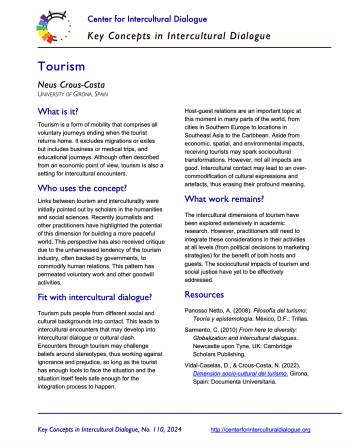
Key Concept 110: Tourism

Key Concepts in ICD

The next issue of Key Concepts in intercultural Dialogue is now available. This is KC110: Tourism by Neus Crous-Costa. As always, all Key Concepts are available as free PDFs; just click on the thumbnail to download. Lists organized chronologically by publication date and numberalphabetically by concept in English, and by languages into which they have been translated, are available, as is a page of acknowledgments with the names of all authors, translators, and reviewers.

KC110 TourismCrous-Costa, N. (2024). Tourism. Key Concepts in Intercultural Dialogue, 110. Available from: https://centerforinterculturaldialogue.org/wp-content/uploads/2024/02/kc110-tourism.pdf

The Center for Intercultural Dialogue publishes a series of short briefs describing Key Concepts in Intercultural Dialogue. Different people, working in different countries and disciplines, use different vocabulary to describe their interests, yet these terms overlap. Our goal is to provide some of the assumptions and history attached to each concept for those unfamiliar with it. As there are other concepts you would like to see included, send an email. If there are concepts you would like to prepare, provide a brief explanation of why you think the concept is central to the study of intercultural dialogue, and why you are the obvious person to write up that concept.


Creative Commons License
This work is licensed under a Creative Commons Attribution-NonCommercial-NoDerivatives 4.0 International License.

Queens U Belfast: International Relations (Northern Ireland)

“Job

Professor of International Relations, Queens University Belfast, Northern Ireland. Deadline: 22 April 2024.

The School of History, Anthropology, Philosophy and Politics (HAPP) at Queen’s University Belfast, is currently seeking to recruit a talented Professor of International Relations. They conceive of IR as a dynamic intellectual space that is transforming itself in the face of global challenges that both trouble and exceed familiar disciplinary conventions. These challenges include, but are not limited to: irreversible climate breakdown; the rise of global pandemics; new forms of capitalist extraction; increased reliance on technological and algorithmic governance; the collapse and remaking of global financial institutions; the imperatives of decolonialisation; the interlocking dilemmas of security, mobility, and liberty; transforming contexts for protest and resistance; the messy aftermath of entrenched conflict; and the blurring of war, policing, and occupation, all within a context of faltering global governance and multilateral cooperation.

Vienna School of International Studies: Postdoc in International Studies (Austria)

PostdocsPostdoctoral Fellowship in International Studies, Vienna School of International Studies, Vienna, Austria. Deadline: 2 April 2024.

The Vienna School of International Studies (Diplomatische Akademie Wien) is proposing the appointment of a Postdoctoral Fellow in International Studies for three years, starting October 2024. Upon successful evaluation at the end of the second year, the position can be extended for another two years. Geared towards promoting the professional development of the appointee, he/she will focus on his/her own research and do a limited amount of graduate teaching.

The successful candidate must hold – or have evidence of the imminent completion of – a doctorate in Cultural Studies, History, Law or Political Science. A record of research achievement at the international level, a strong agenda for future research and previous teaching experience – preferably at graduate level – are essential.

The Vienna School of International Studies is a professional school, specialized in the interdisciplinary education of graduate students, and an associate member of APSIA. The presence of international organizations in Vienna makes for excellent research opportunities, in particular for research dealing with diplomacy, governance and multilateralism broadly defined.

John Cabot U: International Relations &/or International Law (Italy)

“Job

Visiting faculty member in International Relations and/or International Law, John Cabot University, Rome, Italy. Deadline: 4 May 2024.

John Cabot University (JCU) invites applications for a full-time visiting faculty position in International Relations and/or International Law. The appointment is for one year, beginning August 2024, and with possibility of renewal. They seek candidates with a Ph.D. in International Relations or International Law, demonstrated excellence in teaching and research, and commitment to academic service. The area of specialization is open, but preference will be given to applicants with an interdisciplinary expertise in the two above-mentioned areas. Special consideration will be given to candidates with expertise in Cybersecurity, Environmental Politics, Transatlantic Relations and US Politics, Food Security and International Development.

The ideal candidate should have familiarity and experience with the American liberal arts educational tradition, and be prepared to teach introductory courses (e.g., World Politics, International Organizations, International Law) as well as courses in their area of expertise. The teaching load is three courses per semester. Candidates are expected to be fluent in English, which is the language of instruction, and to have permission to work in the EU.

CFP IICD of NCA 2024

ConferencesCall for submissions: International & Intercultural Communication Division, National Communication Association, 21-24 November 2024, New Orleans, LA, USA. Deadline: 5 April 2024.

The International and Intercultural Communication Division (IICD) of the National Communication Association invites scholarly submissions that examine, question, and/or critique communication in and across cultural, intercultural, and international contexts. Four kinds of submissions will be considered this year: (1) individual papers, (2) paper sessions, (3) panel discussions, and (4) performance sessions.

National Communication Association’s 110th annual convention theme is “Communication for Greater Regard.” The convention theme encourages scholars, teachers, practitioners, and performers in the field of international and intercultural communication to share new ideas, pursue new lines of inquiry, engage diverse theoretical and methodological approaches, foster interdisciplinary collaborations, and produce transformative scholarship. Explore communication for greater regard in three ways: 1) greater regard for what has been done before us, (2) greater regard for what is presently around us, and (3) greater regard for what will be beyond us. Specific questions to address: What does it seem the discipline has regarded for 100+ years? How does communication function in today’s climate to enrich greater regard, how has this shifted over the years, or does it need to shift in the future? How is greater regard currently exhibited in communication research, teaching, service, and practice? How are priorities and power structures shaped in the discipline and/or in human communication endeavors through greater regard or to create greater regard? What intentional contributions should we be actively undertaking to foster greater regard?

The division also encourage submitters to consider the following: How do international and intercultural communication scholars explore the past, the present, and the future of our field? What issues have been ignored/dismissed in our field and should be given attention/consideration? What are the new trends within international and intercultural communication? How can we reconcile past, present, and future trends to help our field move forward? How do we think about intercultural and international communication in the current political climate and crisis of wars? How do we move forward with international and intercultural communication while thinking about social justice? How is intercultural communication responding to racial justice movements, anti-Blackness, indigeneity, and hate crimes against Asian communities? How is technology influencing culture and politics? How do we develop critical intercultural ethics in the face of global pandemics and health crises?

Heriot-Watt U PhD Studentships: Languages & Intercultural Studies 2024 (Scotland)

“Studentships“
PhD Studentships 2024-5 in Languages and Intercultural Studies, School of Social Sciences, Heriot-Watt University, Edinburgh, Scotland, UK. Deadline: 2 April 2024.

Heriot-Watt University’s School of Social Sciences is offering a number of full-time PhD studentships to start in September 2024. Studentships include a tuition fee waiver and an annual stipend currently set at £18,622. The duration of the studentships is 3.5 years. The School of Social Sciences also offers a research support allowance of £2,250 over the registered period of study. In addition, full-time scholarship holders are normally offered an opportunity to undertake paid teaching support each academic year.

Projects in areas related to language and intercultural studies include The use of new language technologies for translation purposes by non-language professionals in higher education settings, and also Decolonising research and research methodologies