King’s College London: International Relations (UK)

“Job

Reader in International Relations, Department of War Studies, King’s College London, England. Deadline: 30 January 2024.

The Department of War Studies seeks to appoint a Reader in International Relations in order to contribute to the Department’s teaching and research capacity. The Department is looking for a candidate with a strong research and teaching background in International Relations theory, broadly defined. The successful candidate will have a track record of high-quality publications, research funding and innovative teaching in the field of International Relations. The successful candidate will be expected to contribute to both compulsory and optional teaching in the department at both BA and MA levels. In particular, the successful candidate will be expected to contribute to the leadership and teaching of the Department’s MA degree in International Relations and should have the background and research interests commensurate with leading a large post-graduate programme that explores International Relations from a variety of theoretical and methodological perspectives.

The Department has a large, diverse IR faculty, with particular research focus on security, technology, violence, ethics, gender, migration and borders. They are a theoretically and methodologically diverse Department, including key strengths in critical approaches and methodologies. They welcome applications from candidates whose research contributes to or expands these research areas from a range of perspectives. In addition, applicants must have experience in supervising doctoral research students.

CFP Journal of Communication: Communication & Constitution: Exploring Classical & Emerging Topics Relationally

“Publication

Call for submissions: Journal of Communication Special issue: Communication and Constitution: Exploring Classical and Emerging Topics Relationally. Deadline: 1 November 2024.

Guest Editors: Mariaelena Bartesaghi (University of South Florida, USA), François Cooren (Université de Montréal, Canada), Jimmie Manning (University of Nevada, Reno, USA); Thomas Martine (Audencia Business School, France) and Cynthia Stohl (University of California, Santa Barbara, USA).

In his landmark 1999 article, Communication Theory as a Field, Robert T. Craig called for more dialogue between what he then identified as the seven traditions of communication (rhetoric, semiotics, phenomenology, cybernetic, socio-psychology, sociocultural theory and critical theory). This call was based on two principles: (1) the constitutive model of communication as a metamodel and (2) communication theory as metadiscourse. With his first principle, Craig invited us to acknowledge that each of these different traditions has its own way of thinking the world communicatively and that there is a real payoff in studying various phenomena as being communicatively constituted. With his second principle, he proposed that the communication discipline could be envisaged as a sort of metadiscourse, that is, a discourse about discourse by which we pursue the study of one of the most basic phenomena of our human condition: the act of communicating.

Almost 25 years later, this article can be said to have had a key influence on our field, as illustrated by the numerous research agendas that have implicitly or explicitly responded to Craig’s call. Consider for example, the Communication as Constitutive of Organization (CCO) approach, which positions communicative acts as the basic building blocks of organizational processes. There is also the constitutive approach to interpersonal and family communication studies, which shows that we co-create not only our relationships, but also our very selves in social interaction, as well as the communicative constitution of collective action, which demonstrates how online and offline political activities are first and foremost enacted through a logic of connective action.

All these approaches claim, in spite of their differences, that we should not only think of communication as something that happens in, say, organizations, families, or communities, but that these collectives should also be apprehended as constituted in communication. Each of these approaches indeed illustrates how thinking relationally about the world amounts to acknowledging that any being or phenomenon is literally made of/constituted by relations, a stance that obviously positions communication as the ideal discipline to address this type of ontological claim.

Against this background, this special issue of Communication Theory aims to address the following questions:

(1) What does a constitutive understanding of communication mean for the study of classical and emergent topics, as are identities, ecosystems, sustainability, technology, gender, ethnicity, organizations, relationships, coalitions, power, authority, creativity, discrimination, domination, disability, among others?

(2) How can a relational/constitutive perspective enable scholars to see empirical and theoretical linkages among the various subfields of communication. What do these linkages mean in practice?

(3) How are worlds communicatively constituted? That is, how is a phenomenon or even any state of being made of or constituted by communication?

(4) How might constitutive approaches place communication as a central action or activity by which topics/phenomena can be analyzed and explained?

(5) How can we make connections across theoretical traditions via embracing communication theory as a metadiscourse? And how might this shape how we think through our scholarship, especially in terms of theory/theorizing?

(6) How, in an increasingly globalized world, might scholars nurture and/or deconstruct the relations that constitute the various phenomena that we as communication scholars study?

If you’re interested in meeting the guest editors to discuss your submissions ideas, there is a Meet the Guest Editors online session on Wednesday, March 13 at 2:00pm (Eastern Time).

Microsoft Teams meeting: Join on your computer, mobile app or room device
Click here to join the meeting
Meeting ID: 225 762 371 891
Passcode: NQ7YNH


CFP Multilingual & Multicultural Learning 2024 (Armenia)

Conferences

Call for papers: Multilingual and Multicultural Learning: Policies and Practices 3, 24-25 May 2024, Yerevan, Armenia. Deadline: 31 January 2024.

The conference considers all aspects of the linguistic and sociolinguistic competences and practices of bi-/multilingual speakers who cross existing social, cultural and linguistic boundaries, adopting or adapting themselves to new and overlapping linguistic spaces. Organizers invite papers in all areas of research in bi-/multilingualism, whether or not linked directly to the overarching conference theme, including, but not limited to, linguistics, sociolinguistics, psycholinguistics, neurolinguistics, clinical linguistics, education, bi-/multilingual societies and multiculturalism.

The language of the conference is English.

Eisenhower Fellowships 2024 (USA & International)

Fellowships

Eisenhower Fellowships (both for USA and international), Philadelphia, PA, USA,  Deadline: varies by program.

Eisenhower Fellowships identify, empower and connect innovative leaders through a transformative fellowship experience and lifelong engagement in a global network of dynamic change agents committed to creating a world more peaceful, prosperous and just.

There are 3 different programs:

International Programs: Annually, between 40 and 50 mid-career leaders from all fields around the world are selected as International Eisenhower Fellows to travel to the United States for an intensive four-to-six-week fellowship. EF empowers these trailblazers, typically ages between 32 and 45, to tackle bigger challenges as they better the world and their own societies.

USA Programs: The USA Program sends 10-12 outstanding mid-career American leaders abroad each year for a similar program of meetings with leaders and experts in their respective fields in a relevant region of the world. These ascendant American leaders from all fields travel to one or two nations for four- or five-week programs with both in-person and virtual components. Fellows will develop a project, foster professional relationships and launch dynamic, concrete collaborations with their international counterparts, their cohort and the prestigious EF network of more than 1,600 active Fellows on six continents.

Global Scholars: The Eisenhower Global Scholars Program sends four American university graduates abroad annually for an academic year of postgraduate studies at two prestigious European universities, the University of Oxford, UK, and IE University in Madrid, Spain, leading to a master’s degree and immersion in the EF global network of Fellows.

CFP From Empirical Research to Foreign Language Classroom Practice and Vice-Versa (Switzerland)

Conferences

Call for papers: From empirical research to foreign language classroom practice and vice-versa, 6-7 September 2024, Fribourg, Switzerland. Deadline: 18 February 2024.

The conference aims to open a space of discourse that permits exchange and transfer of knowledge between teacher education, classroom practice, and research. Both second and foreign language education have developed in a dynamic environment that allows a certain flexibility when confronted with new challenges while, at the same time, the reception and diffusion of knowledge gained from research frequently progresses relatively slowly. Similarly, the questions and challenges teachers must face in their everyday practice take a long time to be investigated in research projects and, once this is achieved, the studies that are conducted often seem to be somewhat disconnected from local environments. In addition, empirical research must meet certain criteria if it is to become relevant for classroom practice. Nevertheless, the dialogue between the two domains remains extremely relevant in view of continuing efforts to improve second and foreign language education. Initiatives that encourage the building of networks between research knowledge and knowledge arising from classroom practice may contribute to such a dialogue.

Abstracts for contributions and posters may be submitted in German, English, French, or Italian.

New CID Competition/Publication: Student Voices

“Student Voices

This is a reminder the Center for Intercultural Dialogue has invited students to apply for the opportunity to be published in a new publication, titled Student Voices.

Students (at any level, high school to doctoral students) may submit entries at any time; they will be judged four times/year. All entries submitted will be reviewed, and the best ones prepared for publication. This is not a competition with just a few winners; all entries passing review will be published. The students whose work is accepted for publication will be given profiles on the website. The first winner’s essay was published in September: Rohak Jain, a high school student at Interlake High School in Belleview, wrote The Virtues of an Open Mind: Making Room for Flexibility in Intercultural Dialogue.

The goal of the competition is to invite a wide range of students to tell the story of their own experience with intercultural dialogue, or what they have learned about intercultural dialogue, or what they want to share with others. As made clear on our website, intercultural dialogue is jointly constructed by participants, requiring cooperation to engage in new and different ways of interacting. This series is designed to publicly amplify the voices of students who have engaged in intercultural dialogues. Those dialogues do not have to have been successful; we can learn as much from things that go wrong as when things go right.

There will be several deadlines per year, to accommodate different schedules. The next deadline is February 29, 2024. Details about Student Voices can be found by reading the original post.

Baruch College: Communication Studies (USA)

“Job

Assistant Professor, Communication Studies, Baruch College, New York, NY, USA. Deadline: 10 January 2024.

The Department of Communication Studies at Baruch College invites applications for an assistant professor position beginning in August of 2024. The ideal candidate will possess a deep and comprehensive knowledge of the discipline of communication studies and have an understanding of Intercultural and International Communication (broadly defined). The ideal candidate will also have the ability to direct theses and capstone projects in the department’s Master’s program in Corporate Communication, and to enhance the department’s ongoing commitment to diversity and inclusion.

Loughborough U: International Student Experience Officer (UK)

“Job

International Student Experience Officer, Student Services,
Loughborough University, England, UK. Deadline: 21 January 2024.

Loughborough University is looking for an international student experience officer to join their growing International Student Experience team, whose focus is to ensure a sector-leading experience for international students at Loughborough University. This role will provide innovative and creative project support to the team and will work with colleagues across the University to ensure a positive transition and experience for international students.

This is a fantastic opportunity for an individual with a strong background in project and events management and a passion to support the international student experience and help them to feel at home. Applicants should have an understanding of working interculturally as well experience of working with a wide range of stakeholders to ensure successful outcomes of projects.

Taking Our Interconnected World for Granted

“Intercultural Dialogue Quotes”

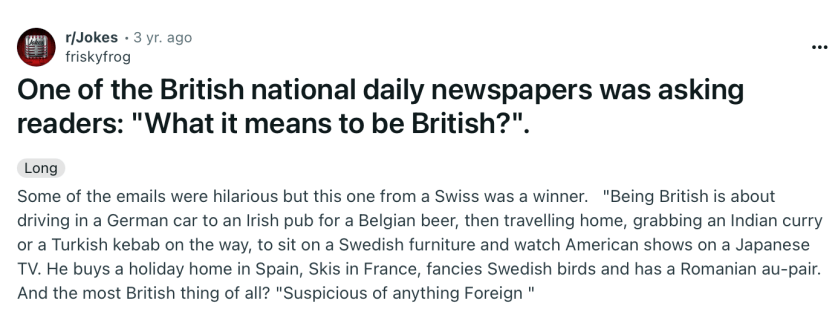
A quote from a Reddit post which is getting a lot of attention turns out to have actually been posted 3 years ago. I have not been able to locate the original, assuming there actually was such a newspaper story – if you know of such a thing, please send a note. But it doesn’t really matter: the point is still the same. We now live in a world that is so thoroughly interconnected and interdependent we often do not even consider the origin of things we take for granted. Obviously this received many comments. This one seemed worth repeating.

U Coimbra: PHD Research Scholarship: Emotional Dynamics of Protective Policies in an Age of Insecurity (Portugal)

Fellowships

Call for applications: First stage researcher (PHD fellowship), Centre for Social Studies, University of Coimbra, Portugal. Deadline: 15 February 2024.

The Centre for Social Studies (CES) – Associate Laboratory – University of Coimbra (Portugal), opens a call for applications for 1 research scholarship in the project “PROTEMO – Emotional dynamics of protective policies in an age of insecurity,” funded by the European Commission, coordinated by Cristiano Gianolla. The project is part of the research line Democracy, Justice and Human Rights. Engaging with the centrality of the democratization of knowledge with the importance of the struggles and experiences of historically oppressed groups, the main objectives of the line are twofold. On the one hand, aims to analyse the persistence of systems of oppression that are intertwined in the structures of racism, heteropatriarchy and capitalism. On the other hand, examine the socio-legal, socio-political and socio-cultural resistances that, in the framework of the modern State and beyond, mark the present of anti-discrimination policies and the constitution of alternative grammars of dignity.

The selected candidates are expected to have the following responsibilities:

– Develop PhD research (already in progress or to begin in 2024) in the framework of the research line: Investigate social representations of protection and the entangled emotions of Ukrainian refugees and also of people mobilising against the war in Ukraine;

– Support the implementation of the scientific tasks foreseen in the project application, namely, literature review, document research, databases and website maintenance, drafting and editing of reports and publications, field work, data analysis and dissemination activities;

– Support the administrative activities of the project, including the organisation of events, management of communication, review and translation of documents and data, and support of the tasks necessary to implement the project.