CFP CCCC International Researchers Consortium Workshop 2022 (USA)

ConferencesCall for papers: International Researchers Consortium Workshop, Conference on College Composition and Communication, March 9-12, 2022, Chicago, IL (or online if need be). Deadline: proposal, May 25, 2021; draft text: December 2021.

The International Researchers Consortium is working on a proposal for a 14th annual day-long international research workshop, at the 2022 College Conference on Composition and Communication (CCCC) conference located in the U.S. Though your research is not required to connect to conference themes, this year’s theme is diversity, equity, and linguistic justice.

Organizers invite proposals for up to 24 researcher-participant roles, focused on studies that promote insights into international research and negotiation of conditions beyond national contexts for writing in higher education around the world. By research, they mean a project with a focused research question, an identified methodology (qualitative, quantitative, ethnographic, historical, discourse analysis, corpus, etc.), and the collection of data in some form. This research can be at any stage and does not need to be final. The goal would be to provide a draft text about the research by the end of December 2021, to read the other workshop facilitators’ texts before attending the CCCC conference, and to participate in the day-long workshop by leading a discussion about your own project and participating in discussions of a subset of others’ projects.

KC102 Inclusive Communication

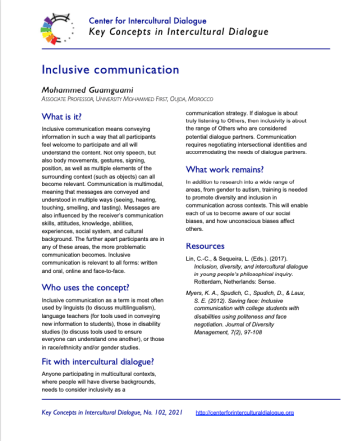
Key Concepts in ICDThe next issue of Key Concepts in intercultural Dialogue is now available. This is KC#102: Inclusive Communication, by Mohammed Guamguami. Click on the thumbnail to download the PDF. Lists organized chronologically by publication date and numberalphabetically by concept in English, and by languages into which they have been translated, are available, as is a page of acknowledgments with the names of all authors, translators, and reviewers.

KC102 Inclusive communication

Guamguami, M. (2021). Inclusive communication. Key Concepts in Intercultural Dialogue, 102. Available from: https://centerforinterculturaldialogue.org/wp-content/uploads/2021/04/kc102-inclusive-communication.pdf

The Center for Intercultural Dialogue publishes a series of short briefs describing Key Concepts in Intercultural Dialogue. Different people, working in different countries and disciplines, use different vocabulary to describe their interests, yet these terms overlap. Our goal is to provide some of the assumptions and history attached to each concept for those unfamiliar with it. As there are other concepts you would like to see included, send an email to the series editor, Wendy Leeds-Hurwitz. If there are concepts you would like to prepare, provide a brief explanation of why you think the concept is central to the study of intercultural dialogue, and why you are the obvious person to write up that concept.


Creative Commons License
This work is licensed under a Creative Commons Attribution-NonCommercial-NoDerivatives 4.0 International License.

MIT: Postdoc in Linguistic Anthropology (USA)

PostdocsPostdoctoral Associate in Linguistic Anthropology, Anthropology Program, Massachusetts Institute of Technology, Cambridge, MA. Deadline: May 15, 2021.

Postdoctoral Associate in Linguistic Anthropology, Anthropology Program, to teach the twelve-unit course “Language, Culture, and Communication” each year. In addition, will devote three to five hours each week to the Language and Technology Lab, coordinating a recurring workshop, updating the website, and mentoring graduate and undergraduate research partners.

REQUIRED: a Ph.D. in linguistic anthropology or a closely related field by the time of appointment. The area of geographic expertise is open, though we encourage scholars whose work engages with global languages and cultures.
PREFERRED: research interest in the relationship between language and technology, broadly conceived; experience with both qualitative and quantitative research, including computational methods; and experience with collaborative research and a desire to work as part of an interdisciplinary team in a leadership capacity.

This is a one-year appointment with the possibility for renewal, beginning September 9, 2021.

KAIICD: Consultancy on Countering Hate Speech in Europe (Austria)

“JobConsultancy for Research on Countering Hate Speech Initiatives in Europe, King Abdullah bin Abdulaziz International Centre for Interreligious and Intercultural Dialogue(KAICIID), Vienna, Austria. Deadline: May 4, 2021.

KAICIID’s Europe Region Programme started in 2021 a Social Cohesion Initiative, which includes a pillar on Countering Hate Speech (CHS). This CHS project acknowledges that hate speech is becoming an increasingly serious problem in Europe with serious consequences for well-being, intergroup trust, integration and democracy. It also focusses on the important role which religious leaders continue to play in creating and implementing the initiatives and frameworks which stop hate speech and promote respectful dialogue, outreach, trust and community resilience. The project’s aim will be to draw upon the existing expertise and resources available, as well as the needs and priorities of religious leaders, and create training materials which will empower religious leaders to counter hate speech even better.

A crucial part of this process is mapping and analysing the many existing initiatives to counter hate speech, with an emphasis on those which engage religious leaders, which are currently taking place in Europe at national to international level. The point is to identify the strengths and weaknesses of initiatives in this field from the perspective of the organizations and of the religious leaders who both implement some of them and observe the results, and to identify the most pressing calls and recommendations for future action. This research will inform KAICIID’s outreach to potential partners and ensure the relevance of its programmatic work.

The Consultant will carry out desk research in order to create an analytical report on the status of countering hate speech initiatives in Europe. It will map and discuss the most important initiatives and resources to counter hate speech of the last five years across four regions of Europe (Norther, Eastern, Western and Southern Europe) as well as the nature of their involvement of religion and religious actors. It will consider which initiatives have shaped public policy on this topic and how they have (or have not) managed to do so. It will analyze the initiatives’ successes from the perspectives of their organizations, including a number of religious institutions, and explore the strengths, weaknesses of these initiatives.