U Penn ASC job ad

The University of Pennsylvania‘s Annenberg School for Communication is seeking to fill a tenured or tenure track faculty position (open rank) in “digital culture” to begin fall semester 2014.  Preference will be given to early and mid-career scholars whose research and teaching contribute to field, interpretive, and/or critical approaches to the study of culture and its intersection with digital media such as the internet, social media, mobile media, virtual reality, online games, user-generated sites, and/or location-aware media. The specific cultural practices or objects of study are open and could include cultural production, digital design, technoculture, global culture and transnational flows, gender, race and ethnicity, surveillance studies, and/or intellectual property.

Applicants must hold a Ph.D. (in Communication or a related field or discipline) and have a strong record of teaching and research. Responsibilities include conducting a program of research and publication, teaching at the undergraduate and graduate levels (including supervising doctoral dissertations), and contributing service to the school and university.

The Annenberg School for Communication at the University of Pennsylvania is a graduate school of communication theory and research, with 18 full-time faculty and approximately 80 doctoral students representing a wide range of disciplinary backgrounds and interests. The faculty also has primary responsibility for an undergraduate communication major within the School of Arts and Sciences.

Submit letter of interest, curriculum vitae, three names of references, and up to three articles, chapters or other research to Professor Michael X. Delli Carpini, Dean, Annenberg School for Communication, University of Pennsylvania via http://facultysearches.provost.upenn.edu/postings/8. To receive full consideration, applications should be received by September 16, 2013.

The University of Pennsylvania is an affirmative action/equal opportunity employer.

Save

Santoi Wagner-microgrant report

NCA Micro Grant Report
Santoi Wagner, University of Pennsylvania

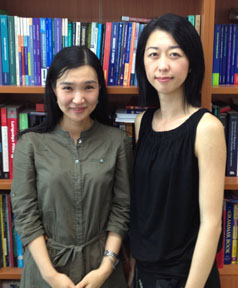
Dr. Eun Sung Park and Dr. Santoi Wagner
Drs. Eun Sung Park and Santoi Wagner

In May 2013, with support from a Center for Intercultural Dialogue micro grant funded by the National Communication Association, I traveled to Seoul, South Korea, to meet with Dr. Eun Sung Park of Sogang University. We are both applied linguists, though we have different research concerns: my interests lie at the interface of language and social interaction while Dr. Park’s work has centered on cognitive aspects of second language acquisition. However, given our professional roles in working with TESOL (Teaching English to Speakers of Other Languages) teachers, we share common interests in second language teaching and learning, and how to effectively educate teachers in both theory and practice. I am currently the Acting Director of TESOL at the University of Pennsylvania’s Graduate School of Education. Dr. Park is an Associate Professor of TESOL/Applied Linguistics and Director of the General English Education Program at Sogang. Although we had corresponded briefly via email about the possibility of working together, we had not previously had the opportunity to engage in an extended discussion. I envisaged our conversation to be an exploratory step to examine an issue that has been of particular interest to me over the past few years: how well do Master’s TESOL (Teaching English as a Second Language) programs prepare international students to teach in classrooms in their home countries that may be very different from those experienced via study and fieldwork in their graduate programs?

My preparations for the trip were fairly smooth. While the micro grant did not quite cover the entire airfare to Seoul, I was fortunate to able to fund the remainder through my faculty conference/travel fund. One of the more difficult aspects of preparation was to find a suitable time to travel given my teaching responsibilities and the fact that I wanted to be able to meet with Dr. Park while her university was still in session. By planning several months in advance, I was able to schedule my summer teaching to fit in with my plans to travel as soon as my spring semester had finished. This also gave me time to track airfares to ensure I found the best price possible (I used a tracking and notification tool available on Kayak).

Dr. Park was very generous with her time while I was visiting. We had broad and informative discussions, ranging from the teacher training and credentialing process in South Korea and the changing environment of English teaching there in terms of a greater emphasis on oral skills, to the career paths of graduates who have studied overseas and returned to Korea. Very interestingly, Dr. Park described how, in her experience, native English speaking teachers are perceived by students at her university to be better teachers than non-native English speaking teachers, but how more often than not, it is the non-native English speaking teachers who receive better student evaluations. This particular theme was not one that I had initially considered, but we brainstormed on the various ways we might go forward with this idea, including accessing and analyzing the available data, and we will follow up our discussion on email and hopefully arrange a meeting at a conference in the United States next year.

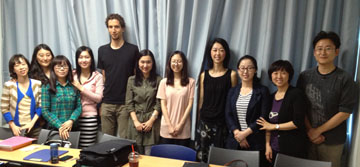
During my time in Seoul, two opportunities arose that I had not originally planned for. Firstly, Dr. Park arranged for me to observe a graduate class she was teaching, ENG 6217: Second Language Acquisition. The class was conducted in English as the program has a number of overseas students. Dr. Park asked me to speak to the students about studying in the United States and to answer questions about applying to doctoral programs there. I enjoyed this experience as it enabled me to engaged directly with the students (and to do some promotion of my home institution’s program!)

Dr. Wagner with students

Secondly, I was also able to meet with a former graduate student from my home institution who was teaching English at Sogang. Our conversation was particularly beneficial as we talked about her experience of a TESOL Master’s program in the US and how it had prepared her for teaching in Korea. Two rather surprising issues arose. One was the unrealistic expectation held by international students on entering the Masters program with regards to the ease of finding a good teaching position in their home country after they complete their degree. The other related issue was the perception of the most significant benefit from obtaining the degree. Rather than improving one’s pedagogy or knowledge about teaching, as I might have posited, the former student pointed to the increase in her authority that stemmed from her students’ knowledge of her educational background. Although my methodology in my original project proposal is centered on the micro-analytic examination of classroom interaction, this meeting underlined the usefulness of such conversations in generating ideas and developing possible themes for further inquiry.

I am deeply appreciative of the time I spent in Seoul, and for the NCA micro grant that enabled me to make such a trip. Although I initially had formulated quite firm proposal ideas, the conversations I had were extremely valuable in opening up my perspective about the possible and effective ways to further my research goals, and possibly expand them to encompass new directions for my work. I feel that the grant’s support of “participation in intercultural dialogue through academic interactions” is especially important in the exploratory stage of research. Dr. Park and I are not in the same sub-fields of our discipline, and so this type of in-depth conversation might be less likely to happen through regular conference or peer contacts. Phone, email, or even video-conferencing would have been poor substitutes for this type of exploratory discussion: I am grateful for the opportunity to meet potential collaborators in person, engage in face-to-face interaction, and establish productive professional relationships.

[NOTE: Santoi Wagner’s original project proposal is available here.]

Internet policy post-doc

Internet Policy Observatory Post-Doctoral Fellowship or Scholar in Residence
Center for Global Communication Studies
ANNENBERG SCHOOL FOR COMMUNICATION
UNIVERSITY OF PENNSYLVANIA

The Annenberg School for Communication at the University of Pennsylvania is currently soliciting applications for the Internet Policy Observatory Post Doctoral Fellowship or Scholar in Residence at the Center for Global Communication Studies.  The Post Doctoral Fellow will help develop and manage existing research programs surrounding the Internet Policy Observatory, and develop his/her own independent related research agenda in the area of global internet policy.

Annenberg’s Center for Global Communication Studies (CGCS) is a leader in international education and training in comparative media law and policy. The Center’s research and policy work addresses issues of media regulation, media and democracy, measuring and evaluation of media development programs, public service broadcasting, and the media’s role in conflict and post-conflict environments.

The Internet Policy Observatory is a multi-component project with a collaborative network and the goal of assessing incipient Internet policy and governance shifts in key national fora where restrictive approaches are being considered. The project will examine trends and efforts where national decisions have significance for the formation of global Internet policy. In addition to sponsoring research and collaborations with key global research and academic organizations, the Internet Policy Observatory will undertake its own research initiatives to establish data on the social and political context of online communications within targeted countries. Some topics the Internet Policy Observatory will engage in include:
•       The evolution of mechanisms and processes that affect domestic Internet policy;
•       The legal, political, economic, and social factors (domestic and international) that influence the implementation or non-implementation of such policies;
•       The relationship between national efforts and international policy formations;
•       The role of civil society in domestic Internet policy processes and control; and
•       The role of public opinion as a mode of determining a “demand side” for useful Internet policy developments.

Applicants should hold postgraduate qualifications at PhD level or equivalent in a field related to internet policy studies, law or policy, communication,  media/cultural studies.  Applicants should possess a track record of publishing in high quality international journals or other appropriate refereed publications, as well as teaching experience.  Experience in research proposal development and implementation of research projects involving both quantitative and qualitative methodologies is an required. This one-year position comes with a stipend of $40,000 to $50,000 (depending on years of prior experience), health insurance, $2,000 in travel and research support, office space with computer and telephone, and full access to the Penn library system. Annenberg welcomes domestic and international applicants.  If applicant has not completed graduate studies in English, the University of Pennsylvania’s TOEFL standards apply.  The fellowship is a one year term. To apply, please send an application package with CV, statement of interest, and a brief (2-3 page) proposal for a research project related to the study of global internet policy to bsmith AT asc.upenn.edu.  Research projects may expand existing research or propose new lines of inquiry. Please contact the same email address if you have any questions.  Application deadline: June 21, 2013 with a start date tentatively (flexible) August  15, 2013.

Save

Santoi Wagner – micro grant

Santoi WagnerDr. Santoi Wagner, Associate Director of TESOL at the University of Pennsylvania’s Graduate School of Education, received one of the National Communication Association’s micro grants in Fall 2012 in order to work with Dr. Eun Sung Park, Assistant Professor of TESOL/Applied Linguistics and Director of the General English Education Program at Sogang University, Korea. They share research and professional interests in issues surrounding second language teaching and learning. Through this international and intercultural collaboration, the project will contribute to a deeper understanding of the interactional competencies and expectations of appropriate communicative behaviors for the classroom that non-native English speaking teachers bring to their training, and take home with them. The collaboration will also help ensure that the question of how to best support international students will receive balanced consideration from the perspectives of training in TESOL programs in the United States and teaching in students’ home countries.

Project background: With the spread of English around the globe, and the growing use of English as a lingua franca, there is an increasing demand for English language teachers. A significant proportion of students in many TESOL graduate programs in the United States are non-native English speaking (NNES) international students. While the experience for these students is often a positive one, an under-examined aspect of their training is how well the programs prepare students to teach in their home countries. For researchers interested in the interface of language and social interaction in the classroom, an issue of concern is the potential diversity in culturally appropriate norms of classroom communicative behavior. Although the impact of teacher education on actual teaching practices is an established field of inquiry, there has been much less research with respect to NNES teachers. Much of the work relating to NNES teachers of English has only been completed in the past fifteen years, and is predominantly centered around teacher self-accounts through narratives, interviews, and surveys, rather than investigations of actual teaching practices. This project seeks to explore two related questions: (a) How are NNES teachers’ communicative behaviors in the classroom altered by undergoing a training program outside of their home country? (b) How is this communicative behavior affected when NNES teachers return home to classroom and educational contexts that may be significantly different? Because the focus is the interactional practices of NNES teachers as they engage in their teaching, the study will primarily employ a qualitative micro-analytic approach to analyze the data collected from classroom observations.

U Pennsylvania digital media positions

The Annenberg School for Communication at the University of Pennsylvania is seeking to fill up to three tenured or tenure track faculty positions (open rank) in the area of digital media to begin fall semester 2013.  Preference will be given to scholars whose innovative research and teaching falls in one of the following three areas.

*       Theory-driven use of archival, depth observational, and/or field methods to understand digital media, including but not limited to topics such as cultural production, location-aware and other social media, virtual reality, digital design, technoculture, gaming, transnational flows, surveillance, and/or intellectual property.
*       The use of communication theories and quantitative methods to illuminate the social, cultural, political, economic and/or psychological uses, effects, and policy implications of evolving digital technologies.
*       The application and development of communication theories using “web science” approaches and/or the analysis of “big data” generated through various online or mobile information and communication technologies. Specific research methods could include social network analysis, web and mobile analytics, data aggregation and analysis, computational social science, computer facilitated content analysis, behavioral prediction, data visualization, and/or related modes of inquiry.

Applicants must hold a Ph.D. (in Communication or a related discipline) and have a strong record of teaching and research. Responsibilities include conducting a program of research and publication, teaching at the graduate and undergraduate levels including supervising doctoral dissertations, and contributing service to the school and university.

The Annenberg School for Communication at the University of Pennsylvania is a graduate school of communication theory and research, with 18 full-time faculty and approximately 80 doctoral students representing a wide range of disciplinary backgrounds and interests. The faculty also has primary responsibility for an undergraduate communication major within the School of Arts and Sciences.

Submit letter of interest, curriculum vitae, three names of references, and up to three articles, chapters or other research to Professor Michael X. Delli Carpini, Dean, Annenberg School for Communication, University of Pennsylvania, 3620 Walnut Street, Philadelphia, PA 19104-6220 via facultysearches.provost.upenn.edu/applicants/Central?quickFind=51067. To receive full consideration, applications should be received by September 15, 2012.

The University of Pennsylvania is an Equal Opportunity Employer.  Minorities, females, individuals with disabilities, and veterans are encouraged to apply.

Annenberg-Oxford Media Policy Summer Institute

Call for Applications: 2012 Annenberg-Oxford Media Policy Summer Institute

The Center for Global Communication Studies at the Annenberg School for Communication, University of Pennsylvania and the Programme of Communication Law and Policy at the University of Oxford (PCMLP) are pleased to announce that we are currently accepting applications for the 14th annual Media Policy Summer School, to be held from June 18 – 29, 2012 at the University of Oxford.

The annual summer institute brings together young scholars and regulators to discuss important recent trends in technology, international politics and development and its influence on media policy. Participants come from around the world; countries represented at previous summer institutes include Thailand, Kenya, China, Brazil, Egypt, Nigeria, Jordan, Italy and Bosnia, among others.

This year the summer institute seeks, as part of the cohort, researchers and academics (PhD candidates and early career academics, for example), who will come with a research project related to the general subject of the seminar. Research generally related to the work of the Center for Global Communication Studies and the Programme for Comparative Media Law and Policy is especially welcome, and some participants will be asked to present their research. Applications are also welcome from those working as lawyers and those employed by NGOs, government bodies, and regulatory agencies.

The seminars this year will focus on several key areas, including media governance in India and China and strategic communication in conflict and post-conflict and transitional environments, particularly in the Middle East and Africa. At the same time, the successful curriculum that has been the foundation of the program over the years will continue, with sessions covering global media policy issues such as media and economic/social development, freedom of information, internet regulation and convergence. Part of the course will be devoted to new developments in comparative approaches to regulation, looking at Ofcom in the UK and other agencies, including examples from the Middle East, Africa and Asia.

The seminar brings together a wide range of participants from around the globe and provides them with an environment in which significant policy issues are seriously discussed. The richness of the experience comes from exposure to a variety of speakers and from the discussions among participants themselves.

This year, Internews Network will again be offering twelve Media Policy Fellowships that cover tuition, housing, travel, and per diem for exceptional applicants who are engaged in research on media advocacy, reform, and implementation in post-conflict societies. For more information about the Internews Fellowships, please contact CGCS.

Applications for the 2012 program will be accepted via our online application form on a rolling basis through March 31, 2012.  Please feel free to forward this email to anyone who you think might be interested.

For more information about the program, application instructions, and a link to the online application please visit: http://global.asc.upenn.edu/cgi-bin/projects-partner.cgi?id=98

If you need any further information please do not hesitate to contact us at lsh@asc.upenn.edu.

DC Internships available

CALL FOR APPLICATIONS
Washington D.C. Summer Fellowship Program
Consortium for Media Policy Studies (COMPASS)

The Annenberg Schools for Communication at the Universities of Pennsylvania and Southern California, and the Departments of Communication at the Universities of Illinois and Michigan are pleased to announce a new collaborative summer fellowship program, designed to provide Ph.D. students in Communication and Media Studies with hands on experience in the development and implementation of communication policy. Fellows would intern (8-weeks from mid-June to mid-August) in DC-based government offices or agencies, think tanks, political party or advocacy organizations, or other communication-related public or private sector institutions. All Fellows would also participate in an orientation prior to beginning their internship, and a follow-up retreat at which they will share their experiences and how these experiences might be connected to their research and teaching with a small group of scholars and practitioners.

Fellowships include assistance in locating an appropriate internship placement, a stipend of $5,000, and travel expenses for attending the follow-up retreat. Students’ home graduate institutions are expected to provide support for housing/expenses in DC ($2,000), though a limited number of scholarships are available if home institutions are unable to provide support.

Up to eight fellowships are available for the summer 2011. Candidates for these fellowships must Ph.D. students in Communication or Media Studies, and must be nominated by their home department or school (applicants must be US citizens, or international students enrolled in US institutions and holding student visas).  Applications should include: (1) a brief nomination letter from the department/school indicating whether or not you would be able to provide $2,000 in housing support and living expenses; (2) a letter of recommendation from the student’s advisor or another faculty member familiar with the student’s work/ability: and (3) a letter from the student indicating how a summer internship would connect to/enhance his or her research and/or teaching, and what kind of placement would be most useful in this regard.

Completed applications are due no later than Monday, February 28, 2011 and should be sent Larry Gross [lpgross@usc.edu]. Students who have been accepted will be notified by Monday, March 14, at which point the placement process would begin.

The Washington D.C. Summer Fellowship Program is a project of the Consortium for Media Policy Studies (COMPASS) and is made possible through the generous support of the Annenberg Foundation Trust at Sunnylands.

COMPASS Co-Directors:
Michael X. Delli Carpini, Annenberg School for Communication, University of Pennsylvania
Susan Douglas, Depart of Communication Studies, University of Michigan
Larry Gross, Annenberg School for Communication & Journalism, University of Southern California
Robert McChesney, Department of Communication, University of Illinois Urbana-Champaign

Essay contest for Austria

Milton Wolf Seminar 2011 Essay Contest:
Picking up the Pieces: Fragmented Sovereignties and Emerging Information Flows

“The Diplomatic Academy Vienna in partnership with the Center for Global Communication Studies at the Annenberg School for Communication at the University of Pennsylvania will host a seminar from March 23-25, 2011 in Vienna, Austria, organized by the American Austrian Foundation. The seminar will bring together a diverse group of invited individuals representing multiple perspectives and nationalities.Panelists include distinguished print and television journalists, media development practitioners, diplomats, and academics.

The organizers have launched an essay competition to identify motivated and thoughtful students of international relations, development studies, communication, journalism, law, and related fields who will enrich the seminar proceedings. Essays should be approximately 1500 words long and address the following question: Under what conditions and with what methods should a country or multilateral organization intervene in the media and communications space of another?

Seven winning essay writers will receive a stipend of up to $1,500 each to cover travel to and participation in the 2011 Milton Wolf Seminar in Vienna. Vienna, Austria’s historic capital city provides an ideal location for the seminar because it is also home to a broad array of media actors, multilateral organizations, and international NGOs.”

More information about the seminar and essay contest can be found on the seminar site.