CID Poster #14: 10 Ideas

CID Posters

This is a bonus poster, designed by Linda J. de Wit who was the CID intern in 2017, and who has now returned as an occasional graphic design consultant.

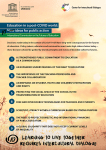
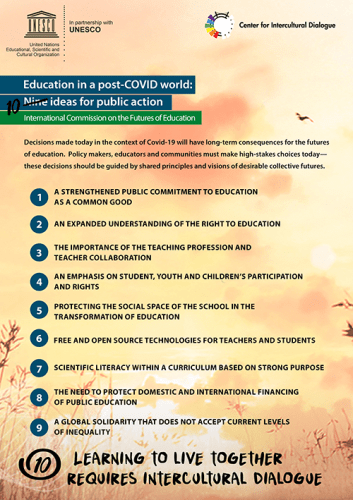
This poster illustrates the recommendations of the CID Focus Groups Report for UNESCO’s Futures of Education Initiative to add a 10th idea to their list of 9 ideas, as described in their report, Education in a post-COVID world: Nine ideas for public action.

CID Poster 14: 10 Ideas

In the report, we ask that they consider intercultural dialogue as essential to learning to live together.

Intercultural dialogue permits not merely living together with a wide range of other people but living together with (and despite) our differences, taking empathy, compassion, and respect for all as a given.

Just in case anyone wants to cite this poster, the following would be the recommended format:

Center for Intercultural Dialogue. (2020). Ten ideas. CID Posters, 14. Available from:

As with other series, CID Posters are available for free on the site; just click on the thumbnail to download a printable PDF. This may be downloaded, printed, and shared as is, without changes, without cost, so long as there is acknowledgment of the source.

As with other series, if you wish to contribute an original contribution, please send an email before starting any work to receive approval, to minimize inadvertent duplication, and to learn about technical requirements. As is the case with other CID Publications, posters should be created initially in English. If you want to volunteer to translate a poster into a language in which you are fluent, send in a note before starting, to receive approval.

Wendy Leeds-Hurwitz
Director, Center for Intercultural Dialogue
intercult.dialogue AT gmail.com


Creative Commons License
This work is licensed under a Creative Commons Attribution-NonCommercial-NoDerivatives 4.0 International License.

CID Report for UNESCO Futures of Education

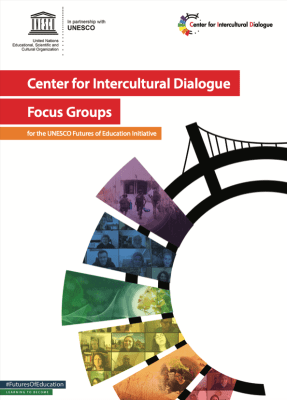
“UNESCO”UNESCO invited CID to host focus groups as part of the Futures of Education Initiative. Three focus groups held discussions in January. The report has now been completed, and submitted to UNESCO.

We are delighted that UNESCO invited our participation, and hopeful that they will incorporate our recommendations into their final conclusions. A copy of the report may be had by clicking on the image below.

CID Focus Groups report for UNESCO

Thanks to Linda de Wit, former CID intern and skilled graphic designer, for taking on the project of turning the written report into a polished final document. Thanks to Nazan Haydari, Advisory Board member, for moderating one of the focus groups, and managing the technology for all of them. Thanks to all of the participants, who are named in the report, for their ideas, their time, and their energy for this project.

Wendy Leeds-Hurwitz
Director, Center for Intercultural Dialogue
intercult.dialogue AT gmail.com


Creative Commons License
This work is licensed under a Creative Commons Attribution-NonCommercial-NoDerivatives 4.0 International License.

UNESCO Futures of Education Focus Groups Completed

“UNESCO”

The Center for Intercultural Dialogue held 3 focus groups as part of the UNESCO Futures of Education Initiative, January 28, 29, and 30, 2021.

UNESCO Futures of EducationThanks first to Nazan Haydari, member of the CID Advisory Board, who who served as moderator of one of the groups, and organized the technology through Istanbul Bilgi University.

Thanks next to all of the participants for all of their ideas. They included: Evangelos Afendras (Greece), Chukwuemeka Amajo (Nigeria), Diana Bebenova-Nikolova (Bulgaria), Giovanna Carloni (Italy), Ivett Rita Guntersdorfer (Germany), Mohammed Guamguami (Morocco), Maria Hussain (UK), Teresa Joseph (India), Emilija Jovanovska (USA/Macedonia), Lasana Kazembe (USA), Sergei Kladko (Russia), Maura Di Mauro (Italy), Katrien Mertens (Belgium), Isabel Mohedano Sohm (Spain), M. L. Papusa Molina (Mexico), Maja Nenadovic (Netherlands), Sushil Oswal (USA), Chris Peltier (France), Anne-Nelly Perret-Clermont (Switzerland), Yehuda Silverman (Canada/USA), and Arianna Vettorazzi (Netherlands/Italy).

The report synthesizing our discussions will be completed, submitted to UNESCO, and posted to this site shortly. [update: now posted here]

For everyone else with an interest in the topic but who was unable to respond quickly enough to participate, in addition to the relevant publications posted previously, UNESCO has now offered several additional possibilities:

Passive participation: you may follow the developments on their website, as they post updates.

Active engagement: there are several possibilities:

  • Take the 1-minute survey on the top 3 challenges and purposes of education
  • Write your thoughts on what they see as the one major issue for the futures of education (max 1000 words).
  • Submit an original artwork of what education might look like in 2050.

Update: UNESCO Futures of Education Focus Groups

“UNESCO”

Update, UNESCO Futures of Education focus groups organized by the Center for Intercultural Dialogue.


UNESCO Futures of EducationFirst, thanks to all those who immediately responded to last week’s invitation by saying they want to participate in a focus group on this topic, and contribute ideas to the UNESCO Commission. Participation is now closed, and we’re actively organizing to hold multiple focus groups, as a way to include as many people as possible. (UNESCO requested one focus group; we’ll be giving them three.)

Second, thanks to Nazan Haydari, member of the CID Advisory Board, who has agreed to serve as one of the focus group leaders. The other two will be led by Wendy Leeds-Hurwitz, CID Director. [update: final report now posted here]

For everyone else with an interest in the topic but who was unable to respond quickly enough to participate, the following are relevant materials to read.

Publications on education produced by prior UNESCO Commissions, which serve as the background for this one:

Faure, E., et al. (1972). Learning to be: The world of education today and tomorrow. Paris: UNESCO.

Delors, J. (1996). Learning: The treasure within; report to UNESCO of the International Commission on Education for the Twenty-first Century. Paris: UNESCO.

Elfert, M. (2015). Learning to live together: Revisiting the humanism of the Delors report. Education Research and Foresight Working Papers, 12.

UNESCO. (2015). Rethinking education: Towards a global common good? Paris: UNESCO.

Materials already produced by the current Commission:

UNESCO. (2020). Visioning and framing the Futures of Education. Paris: UNESCO.

UNESCO. (2020). Education in a post-COVID world: Nine ideas for public action. Paris: UNESCO.

UNESCO: Associate Editor (France)

“Job

Editor, International Institute for Educational Planning (IIEP), UNESCO, Paris, France. Deadline: 21 January 2021.


This position is located in the Information Services Unit of the UNESCO International Institute for Educational Planning (IIEP) in Paris and reports to the Information Services Team Leader. Under the supervision of the Team leader and in close collaboration with other team members, the incumbent is in charge of reviewing, revising and editing IIEP documents, such as manuscripts, concept notes, web news, institutional documents, etc. The incumbent supports in particular IIEP move towards e-publications, including through the provision of advise and assistance in this regard to IIEP staff. Because of the public nature IIEP content, the incumbent must demonstrate very good editorial skills and sound judgement in order to maintain IIEP’s excellent reputation.

UNESCO Invites Contributions to Futures of Education initiative

“UNESCO”If you are interested in participating in a cooperative CID-UNESCO focus group on the role of intercultural dialogue in the futures of education, then please read the following and send an email immediately as this event will be scheduled for late January at a mutually convenient day/time. We cannot guarantee participation, as this will be a small group, but you will also be able to organize your own event if so desired. There will only be one meeting, and then a report of the discussion sent in to UNESCO. 

UPDATE: Several focus groups are now full, thanks to the many responses – more details to be posted shortly as there are results to report. [Second update: the final report is now posted here]

UNESCO Futures of Education

UNESCO’s Futures of Education initiative is an ambitious attempt to rethink education and help shape the future. The initiative is catalyzing a global debate on how education, learning and knowledge need to be re-imagined in a world of increasing complexity, uncertainty, and precarity.

As part of this initiative, UNESCO has appointed a high-level International Commission of thought leaders with diverse expertise and perspectives from the worlds of politics, academia, the arts, science and business. The International Commission will prepare a report, to be released in November 2021, that will provide an agenda for action and discussion by policymakers and practitioners.

The report of the International Commission will emerge out of a range of work modalities that emphasize co-creation, a broad participatory and partnership structure, the inclusion of diverse perspectives, and the absence of pre-specified conclusions. Towards this end, UNESCO is encouraging individuals, organizations and networks to organize focus group discussions with their constituencies, inputs from which will feed into to the Commission’s work.

The objective of these consultations is to generate a set of diverse perspectives on the challenges and opportunities for education and learning that can be both anticipated/predicted and imagined/envisioned when looking towards the year 2050. Rethinking as well as fully reimagining the way we live together are key dimensions explored by UNESCO; this is why the Center for Intercultural Dialogue has been approached to mobilize its members in the organization of a focus group discussion. Please send an email asap if you wish to participate!

UNESCO: Advisor for Communication/Information (Morocco)

“JobAdvisor for Communication and Information, Communication and Information Sector, UNESCO, Rabat, Morocco. Deadline: December 26, 2020.

The Advisor for Communication and Information, under the direct supervision of the Director of UNESCO Office in Rabat and the overall authority of the Assistant Director-General, Communication and Information (ADG/CI) as well as in close cooperation with staff of CI Sector at Headquarters (Directors, Chiefs of Section, Programme Specialists) and in Field Offices of the region, is responsible for developing, planning and managing a programme of work and as a team leader may manage, supervise and guide a team of staff to ensure the delivery of programme initiatives and project activities, from funding proposals to project design to evaluation and reporting.

Youth’s Voice for the Future of Media & Information Literacy in Asia & the Pacific (Online)

EventsYouth’s Voice for the Future of Media and Information Literacy in Asia and the Pacific, Asian Media Information and Communication Centre, Jakarta, November 18, 2020, 12:00-2:00 PM Jakarta Time, online.

Asian Media Information and Communication Centre, Inc. (AMIC) will be conducting an online discussion with youth entitled, Youth’s Voice for the Future of Media and Information Literacy in Asia and the Pacific. This event has the support of UNESCO Offices in Jakarta, Bangkok and New Delhi. The event will be on Wednesday, November 18, 2020, 12:00PM – 2:00 PM Jakarta Time.

The main objective is to understand how to better integrate media and information literacy (MIL) into education from the perspective of youth in Asia and the Pacific region, taking into consideration specific challenges faced by young women, as well as youth with disabilities, such as internet connectivity and accessibility. Another objective of this exercise is to build and strengthen the network of youth who could be the advocates for developing and expanding MIL in the Asia and the Pacific region.

CID can nominate up to five (5) representatives age 15-24 who are based in Asia and the Pacific to participate in the invite-only online discussion with MIL experts. If you are a CID follower and wish to be nominated, send an email with your name and age as well as the city and country in which you are based. English will be the working language for the event. Be sure to note the time zone, especially if you are physically based in the USA.

UNESCO: Programme Specialist (Uruguay)

“JobProgramme Specialist (Culture), UNESCO, Montevideo, Uruguay. Deadline: 14 November 2020.

The Programme Specialist (Culture), under the direct supervision of the Director of the UNESCO Regional Office in Montevideo and the overall authority of the Assistant Director-General for Culture, coordinates the programme and projects in the field of Culture to ensure the design, development, planning, monitoring, implementation and coordination of activities carried out under Major Programme IV – Culture in the countries covered by the Regional Office. He/She is also responsible for preparing inputs for the UNESCO Medium-Term Strategy (C/4), the Programme and Budget (C/5) and related work plans, as well as for developing partnerships and fundraising activities and ensuring UNESCO’s contribution to the ‘Delivering as One’ exercise in the field of Culture in the countries covered by the Office. He/She also leads and supervises the staff of the Culture Unit of the Office.

UNESCO: Culture & COVID-19

Resources in ICD“ width=

Culture & COVID-19: Impact and Response Tracker, UNESCO, Paris, France.

Culture & Covid Issue 10

To address the profound impact the COVID-19 pandemic will have on the culture sector, UNESCO has launched a weekly “Culture & COVID-19: Impact and Response Tracker” to provide an overview of the rapidly evolving situation. It explores both the immediate impact of the health crisis and examples of how countries around the world are adapting to the situation. This is one of several initiatives by the Organization to respond to the impact of the pandemic on the cultural sector worldwide.

Ten issues have already appeared, examining such issues as the impact on world heritage sites, tourism, museums, archaeological sites, and indigenous peoples.