Study abroad-Italy, Turkey, France

Undergraduate and Graduate global communication opportunities this summer in Florence, Cagli and Urbino, Italy; Istanbul, Turkey; and Perpignan, France.

For the 10th year we will be taking students from around the country to Europe to participate in Backpack Journalism and Leadership courses.

Florence, Italy (Grad. students only):
Renaissance Rhetoric – May 27 – June 10
Renaissance Leadership – May 27 – June 10
Project Management Italy – June 10 – June 24

Cagli Project Italy – Grad. and Graduating Seniors only
Intercultural and Global story writing and Multimedia June 23 – July 9

Urbino, Italy:
Multimedia Journalism and Magazine Publishing June 9 – July 7

Perpignan, France:
Multimedia Journalism June 23 – July 23

Istanbul, Turkey:
Multimedia Journalism June 23 – July 21

For details of Graduate Communication and Leadership courses.
For the Gonzaga-in-Cagli Project.
For Graduate internship opportunities in each site.
For full program descriptions and undergraduate applications to Istanbul, Turkey; Urbino, Italy; or Perpignan, France.

Student participants come from many universities. The Department of Communication and Leadership Studies at Gonzaga is the host University for all graduate credits.

Email caputo@gonzaga.edu for more information.
John S. Caputo, Ph. D.
Professor of Communication and Leadership Studies
Distinguished Walter Ong, S.J. Scholar
Department of Communication and Leadership Studies
Gonzaga University
Spokane, WA. 99258-0001
Tel: 509-313-6656

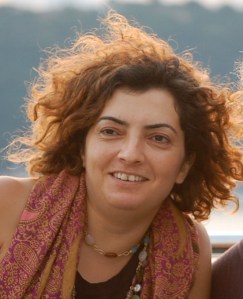
Nazan Haydari Profile

ProfilesNazan Haydari is Associate Professor of Media School at Istanbul Bilgi University, Turkey. Her research and teaching areas consist of alternative media, feminist media, critical pedagogy, intercultural communication, and radio studies.

Nazan HaydariDuring her work years at Maltepe University, she was involved in the organization of NCA Summer Conference on Intercultural Dialogue with Wendy Leeds-Hurwitz. Among many outcomes of that Conference was the establishment of this Center for Intercultural Dialogue in 2010. Since the founding, she has served on the CID Advisory Board. In addition, she served as co-editor, with Prue Holmes, of the collection, Case Studies in Intercultural Dialogue published by Kendall Hunt in 2014. She is particularly interested in collaborative research on the practices of critical media pedagogy in various contexts and  the relationship between radio, gender and identity, has participated in the development of various media projects with street-involved children and youngsters, and serves as a Board Member of the Research and Implementation Center on Street Children (SOYAÇ) at Maltepe University as well as a member of Women’s Radio in Europe Network (WREN).

Currently, she has been working towards the completion of an oral history project with women radio producers of TRT (Turkish Radio and Television) from 1960s to 1990s. Her recent publications appear in Transnationalizing Radio Research: New Approaches to Old Media (edited by Golo Föllmer and Alexander Badenoch, Transcript Verlag Publications, 2018), The Wiley Blackwell-ICA International Encyclopedia of Intercultural Communication and Feminist Media Histories Journal. Haydari holds a Ph.D. in Communications and MAIA in Communication and Development from Ohio University, USA.

Contact her by email if you share interests.


Work for CID:

Nazan Haydari served on the Organizing Committee, and then was the Local Arrangements Chair for the National Communication Association’s Summer Conference on Intercultural Dialogue in Istanbul, Turkey, which led to the creation of CID. She co-edited the book resulting from that event, Case Studies in Intercultural Dialogue. She is a member of the CID Advisory Board.

In addition, she served as a reviewer of micro-grants distributed by CID (funded by the National Communication Association), and has been a reviewer for translations into Turkish. She also helped to organize and moderate the CID/UNESCO focus groups for the Futures of Education Initiative.

German Turkish University established

“On 22 October 2010 [Germany’s] Federal President Christian Wulff and [Turkey’s] President Abdullah Gül jointly laid the foundation stone for the new University. The Turkish President had previously appointed Prof. Ziya Şanal its first President, thereby officially founding the University. During his visit to Ankara in January 2010, Foreign Minister Guido Westerwelle had emphasized that the German-Turkish University was something in which he took a keen personal interest, adding: “We believe it is important the University embarks on teaching activities as soon as possible.”

Courses are due to begin at the University’s initially five faculties in autumn 2011. The planned faculties are: law, natural science, engineering, humanities and cultural studies, economics and social science. The University will offer Bachelor, Master and PhD degrees. These qualifications, as well as the curricula and associated quality assurance, are to be based on European education standards (the Bologna Process). German-Turkish courses aimed at fostering intercultural cooperation will be the University’s special hallmark. Students will also have the option of earning German degrees and learning the German language.

The German-Turkish University hopes to cooperate closely with Turkish and German companies. It aims to meet the growing need for well-trained specialists in Turkey, whose economy is experiencing dynamic growth.

The Turkish side will provide land, buildings and infrastructure and assume the recurring costs. The University hopes to cater for up to 5000 students in the medium term.

German contributions include, among other things, the secondment of senior and junior lecturers, the development of curricula and the provision of equipment and materials for the planned new language centre.

The Federal Ministry of Education and Research is providing major support to help make the German-Turkish University a reality. The German Academic Exchange Service (DAAD) is responsible for coordination among the participating German universities.”

For further information, see the original posting on the German Foreign Office site. This university is one result of the Ernst Reuter Initiative for Intercultural Dialogue and Understanding, between Turkey and Germany.

Photos!

Oops – apparently some people are having trouble locating the photos taken at the NCA Summer Conference on Intercultural Dialogue. Sorry about that!

Go to “home” on the top menu, then choose “history”, and they’re at the bottom of the page. Or just use this link.

If anyone took photos at the ICA Preconference on Intercultural Dialogue in Singapore, you can upload them as part of a comment in response to that post. I don’t have any or I would do it.