Penman Guest Post: Dialogue in the Interests of Justice

Guest Posts
Dialogue in the interests of justice. Guest post by Robyn Penman.

I propose that the dialogic form can act as an aspirational model: it is an orientation to a way of communicating, a commitment to doing it better and, only occasionally, an accomplishment.

In one way, the link between dialogue and justice seems obvious, at least as far as social justice is concerned. As Kathryn Sorrells (2015) noted in her discussion of social justice Key Concepts on Social Justice, intercultural dialogue is critical to both the process and goal of social justice because it enables us to reach across difference to creatively engage with others. Yet, even appreciating how critical that link is, there is so much more that needs to be considered. In particular, as Sorrell sums up, there is a critical need for more interdisciplinary work on understanding the importance of communication in building relationships and systems based on social justice.

The critical need for taking communication into account is reflected in such questions as: How exactly does the key role of dialogue for meeting social justice goals get played out in practice? How is it possible to even create the conditions for dialogue in unjust circumstances? And what does dialogue have to do with the common idea of social justice as the equitable distribution of resources and rights? These questions open up a whole new vista of possibilities, even to a re-consideration of what justice itself can mean.

Download the entire guest post as a PDF.

ACLS: Leading Edge Fellowships 2025-26 (USA)

FellowshipsLeading Edge Fellowships, American Council of Learned Societies (ACLS is based in New York, but the fellowships are across the USA). Deadline: 12 March 2025.

The American Council of Learned Societies is pleased to announce the seventh competition of the Leading Edge Fellowship program, which demonstrates the potential of humanistic knowledge and methods to solve problems, build organizational capacity, and advance justice and equity in society. Leading Edge Fellowships place recent humanities PhDs with nonprofit organizations promoting social justice in their communities. Fellows take on substantive roles that draw on the skills and capacities honed in the course of earning the humanities PhD, including advanced communication, research, project management, and creative problem solving. This initiative is made possible through the generous support of the Mellon Foundation.

The fellowships are designed to foster mutually beneficial partnerships between fellows and their hosting organizations. Each applicant may apply for up to two of the available Leading Edge Fellowship opportunities listed below. There is a separate selection process for each fellowship opportunity.

U Edinburgh: PHD Scholarship in Peace & Conflict Resolution 2025 (UK)

“Studentships“

Chrystal Macmillan PhD Scholarship, School of Social & Political Science, University of Edinburgh, Edinburgh, Scotland. Deadline: 3 February 2025.

Applications are invited for the Chrystal Macmillan PhD Scholarship, which is offered by the School of Social and Political Science to a new PhD student studying a field relevant to Chrystal Macmillan. This is open only to new PhD pursuing a PhD topic in one of the following fields:

  • social justice
  • gender and equality
  • human rights
  • peace and conflict resolution

The scholarship I s available either as a three-year full-time or six-year part-time option.

This scholarship supports students who aspire to influence social change. It offers the opportunity to follow in the footsteps of Chrystal Macmillan, the University of Edinburgh’s first woman to graduate with a science degree and a lifelong campaigner for social justice.

King’s College London: Social Justice (UK)

“Job

Lecturer in Social Justice, Department of Education, Communication & Society, King’s College London, England. Deadline: 19 May 2024.

The Department of Education, Communication & Society is seeking to recruit a social science scholar with teaching and research interests in anthropology, sociology, social policy or a closely allied field to teach on our BA Social Sciences and other programmes as appropriate and to conduct high quality research. They will have interests and a track record that enable them to convene Political Activism and Social Change and Rethinking Work, which are optional modules on the BA Social Sciences. They will be a member of the friendly and vibrant Centre for Public Policy Research (CPPR) within the School of Education, Communication and Society, which is a School in the Faculty of Social Science and Public Policy. Ideally, they will have interests that strengthen the existing programmes of work in CPPR. For example, candidates may have particular expertise in race and racism, decoloniality, or inequalities of gender, class, sexuality or disability.

U Edinburgh: PHD Scholarship in Peace & Conflict Resolution 2024 (UK)

“Studentships“

Chrystal Macmillan PhD Scholarship, School of Social & Political Science, University of Edinburgh, Edinburgh, Scotland. Deadline: 1 February 2024.

Applications are invited for the Chrystal Macmillan PhD Scholarship, which is offered by the School of Social and Political Science to a new PhD student studying a field relevant to Chrystal Macmillan. This is open only to new PhD pursuing a PhD topic in one of the following fields:

  • social justice
  • gender and equality
  • human rights
  • peace and conflict resolution

Chrystal Macmillan was a pioneering campaigner for social justice. In 1896, she was the first woman to graduate from the University of Edinburgh in science, later converting to law, and becoming one of the first group of women to be called to the English bar in 1924. She was a leading suffragist, campaigning for votes for women and equality of opportunity in other spheres. She was a prominent figure in the international women’s movement, campaigning for peace and conflict resolution during the First World War, and was a delegate to the Paris Peace Conference in 1919.

ACLS: Leading Edge Fellowships (USA)

FellowshipsLeading Edge Fellowships, American Council of Learned Societies (ACLS is based in New York, but the fellowships are across the USA). Deadline: 15 March 2023.

The American Council of Learned Societies is pleased to announce the fifth competition of the Leading Edge Fellowship program, which demonstrates the potential of humanistic knowledge and methods to solve problems, build capacity, and advance justice and equity in society. Leading Edge Fellowships place recent humanities PhDs with nonprofit organizations promoting social justice in their communities. Fellows take on substantive roles that draw on the skills and capacities honed in the course of earning the humanities PhD, including advanced communication, research, project management, and creative problem solving. This initiative is made possible through the support of the Mellon Foundation.

The fellowships are designed to foster mutually beneficial partnerships between fellows and their hosting organizations. Each applicant may apply for up to two of the available Leading Edge Fellowship opportunities. Eligible organizations include:

  • Asian Americans for Advancing Justice
  • American Friends Service Committee
  • Children’s Defense Fund
  • Campaign for Southern Equality
  • The Center for Cultural Power
  • Destiny Arts Center
  • Gender Justice
  • Justice Action Center
  • and more

Syracuse U: Communications & Social Difference/Social Justice (USA)

“JobAssociate / Full Professor of Communications and Social Difference / Social Justice, Syracuse University, Syracuse, NY, USA. Deadline: 11 November 2022.

The Communications Department at Syracuse University’s S.I. Newhouse School of Public Communications is offering a full-time, tenured position at the associate or full professor rank beginning in fall 2023. They seek a multidisciplinary scholar who has a significant, established track record of published research, extramural grant acquisition, and thought leadership in the area of Media and Diversity Issues, broadly defined. This recruitment is part of an ambitious Invest Syracuse Cluster Hire Initiative in the broad area of Social Difference/Social Justice. As an integral part of this investment, Syracuse University will recruit multiple candidates for faculty positions across departments for this cluster. Faculty hired into these positions will build on our existing strengths in the focus area and will participate in an organized research cluster that spans multiple departments in the Newhouse School, the College of Arts and Sciences, the Maxwell School of Citizenship and Public Affairs, and the Law School.

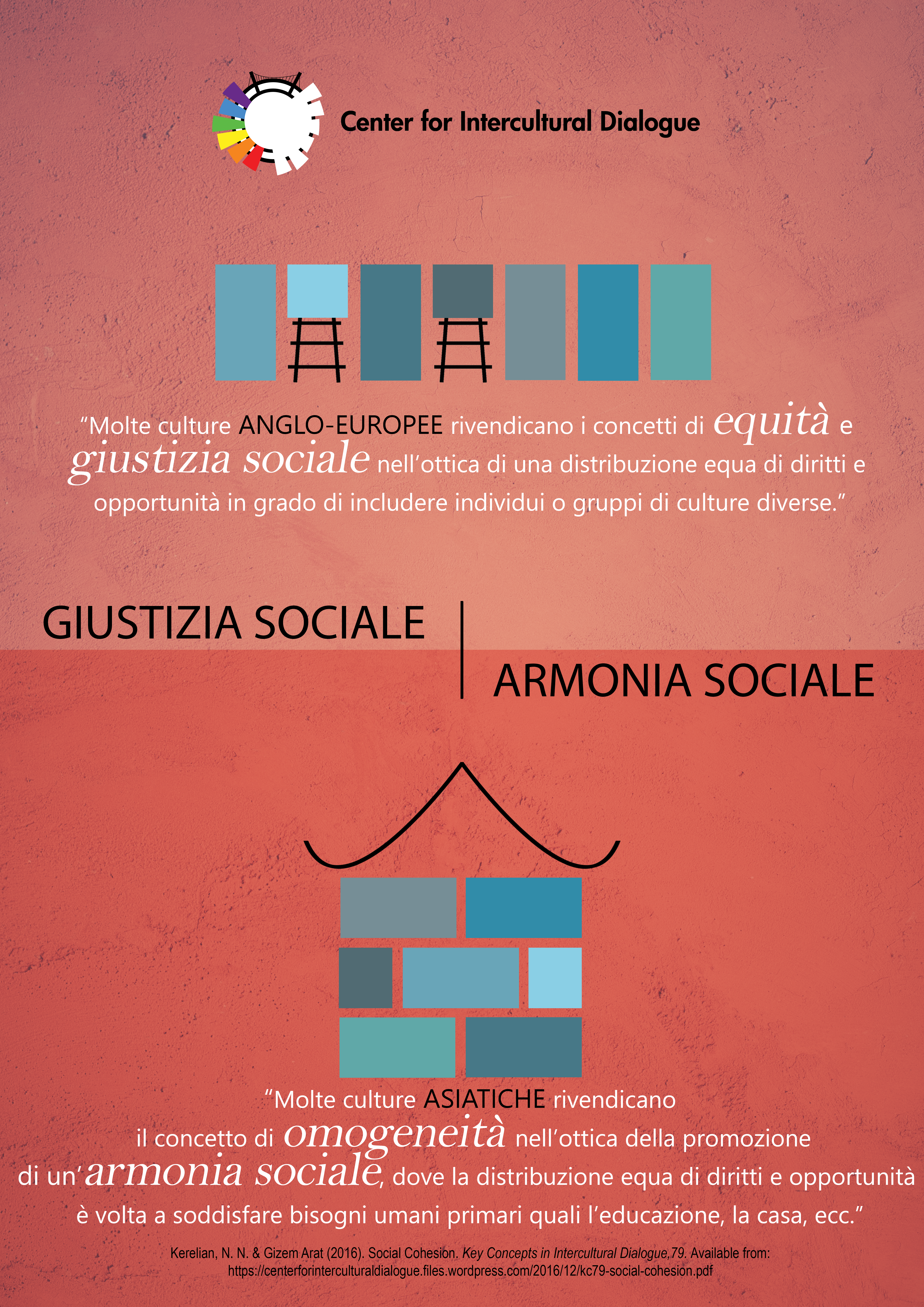
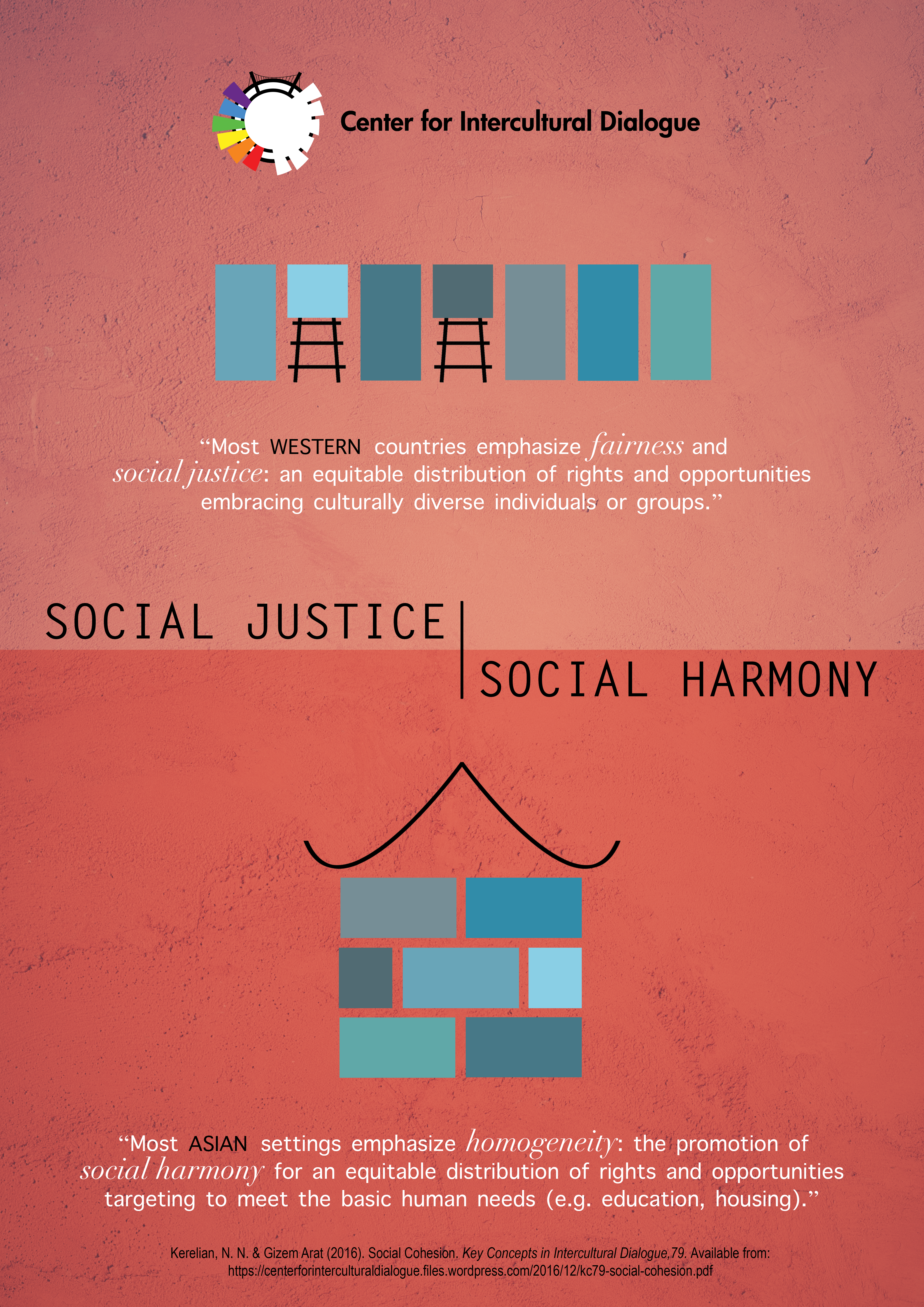
CID Poster #7: Social Justice/Social Harmony (reprise)

CID Posters(We are reprising the series of posters, because it has been several years since they were originally created, and they are much too wonderful to let them not be noticed by newcomers to the site!)

This is the next of the posters designed by Linda J. de Wit, then in her role as CID intern. This is the first poster to use one of the Key Concepts in Intercultural Dialogue as the source. The content here comes from KC79: Social Cohesion, written by Narine Nora Kerelian & Gizem Arat.

Social Justice/Social HarmonyJust in case anyone wants to cite this poster, the following would be the recommended format:

Center for Intercultural Dialogue. (2017). Social justice/social harmony. CID Posters, 7. Available from:
https://centerforinterculturaldialogue.org/wp-content/uploads/2017/08/social-justice-harmony.png

As with other series, CID Posters are available for free on the site; just click on the thumbnail to download a printable PDF. They may be downloaded, printed, and shared as is, without changes, without cost, so long as there is acknowledgment of the source.

As with other series, if you wish to contribute an original contribution, please send an email before starting any work to receive approval, to minimize inadvertent duplication, and to learn about technical requirements. As is the case with other CID Publications, posters should be created initially in English. Given that translations of the Key Concepts in Intercultural Dialogue have received so many views, anyone who wishes to translate their own poster into another language (or two) is invited to provide that as well. If you want to volunteer to translate someone else’s poster into a language in which you are fluent, send in a note before starting, to receive approval and to confirm no one else is working on the same one.

Wendy Leeds-Hurwitz
Director, Center for Intercultural Dialogue
intercult.dialogue AT gmail.com


Creative Commons License
This work is licensed under a Creative Commons Attribution-NonCommercial-NoDerivatives 4.0 International License.

KC68 Social Justice Translated into Turkish

Key Concepts in ICDContinuing translations of Key Concepts in Intercultural Dialogue, today I am posting KC#68: Social Justice, which Kathryn Sorrells wrote for publication in English in 2015, and which Candost Aydın has now translated into Turkish.

As always, all Key Concepts are available as free PDFs; just click on the thumbnail to download. Lists of Key Concepts organized alphabetically by conceptchronologically by publication date and number, and by languages into which they have been translated, are available, as is a page of acknowledgments with the names of all authors, translators, and reviewers.

KC68 Social Justice_TurkishSorrells, K. (2022). Social justice [Turkish]. (C. Aydın, Trans.). Key Concepts in Intercultural Dialogue, 68. Available from: https://centerforinterculturaldialogue.org/wp-content/uploads/2021/12/kc68-social-justice_turkish.pdf

If you are interested in translating one of the Key Concepts, please contact me for approval first because dozens are currently in process. As always, if there is a concept you think should be written up as one of the Key Concepts, whether in English or any other language, propose it. If you are new to CID, please provide a brief resume. This opportunity is open to masters students and above, on the assumption that some familiarity with academic conventions generally, and discussion of intercultural dialogue specifically, are useful.

Wendy Leeds-Hurwitz, Director
Center for Intercultural Dialogue


Creative Commons License
This work is licensed under a Creative Commons Attribution-NonCommercial-NoDerivatives 4.0 International License.

CFP NAMLE: Media Literacy & Social Justice (Online)

ConferencesCall for Proposals, National Association for Media Literacy Education (NAMLE): Media Literacy and Social Justice, Online,  July 16 – 18, 2021. Deadline: March 14, 2021.

CFP NAMLE 2021

Media literacy has many connections with social justice; in fact, many would say that media literacy is social justice. Specifically, media literacy helps us to understand the relationships between media, information, and power; this is often referred to as critical media literacy. The process of developing media literacy skills helps us to decipher what a piece of media wants you to believe and why, who benefits from you believing it, whose perspectives are valued in mainstream media, whose perspectives are marginalized or missing, and how we might elevate them. It helps us to unpack stereotypes and circulate ideas about various groups. Media literacy promotes inquiry into the effects that propaganda and mis/dis-information have on our politics and how they perpetuate injustices against marginalized groups, the environment, and our sociopolitical climate. In sum, media literacy helps us to understand issues of systemic inequity and who benefits from their maintenance, while also inspiring action, critical change, and the democratization of media industries. Given all of these connections, NAMLE finds it extremely salient to organize a conference around the topic of Media Literacy + Social Justice.

Proposals will be given special consideration if they (1) articulate concrete connections to social justice, and (2) offer a fresh point of view of an issue within the field of media literacy education.