The CMMi Press: A New Initiative

“Publication

The CMMi Press will become the publishing arm of the CMM Institute for Personal and Social Evolution.

CMMi Press

The Institute is committed to making better social worlds through paying particular attention to the quality of the communication patterns in which we participate. The CMMi Press will publish books that promote this approach with the intent of inspiring better communication practices for making social worlds we would all want to live in.

Their first publication, Making Better Social Worlds: Inspirations from the Theory of the Coordinated Management of Meaning, has just been published. Robyn Penman and Arthur Jensen have written this book as a companion volume to the Cosmopolis2045 website and it serves as a fitting flagship for the new press promoting the making of better social worlds. Penman and Jensen are also planning a second volume on A Cosmopolitan Sensibility.

If you have a publishing idea or a manuscript in preparation that you think will fit the aims of the Press, please contact Robyn Penman, commissioning editor.

CMMI CosmoKidz Expansion to 8-15 Year Olds

Collaborative OpportunitiesThe Coordinated Management of Meaning Institute (CMMI) is asking for help:

“We created CosmoKidz as one way to help young children develop relational awareness and skills. By now, we have more than four years’ worth of research to confirm what we thought: It works!

CosmoKidz only covers the age group from 4-7 year olds and now we want to go beyond. We imagine creating something for the 8-11 year olds—CosmoTweenz—and for the 12-15 year olds— CosmoTeenz. The social challenges for each of these age groups will most probably vary, and we need their own words, stories, experiences to describe what they are struggling with in their social world. This is where we need your help!

If you are close to children/young people in these age groups, either as a parent, friend, relative, or in a professional manner, and you’d like to offer ideas we’d love to hear from you. If you see this as an opportunity to work collaboratively with us we’d also love to hear from you. Our next steps offer some exciting research opportunities as well as significant opportunities for developing new teaching aids.

Continue reading “CMMI CosmoKidz Expansion to 8-15 Year Olds”

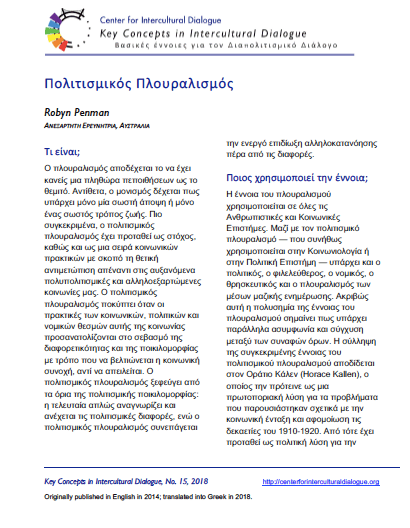
KC15 Cultural Pluralism Translated into Greek

Key Concepts in ICDContinuing translations of Key Concepts in Intercultural Dialogue, today I am posting KC#15: Cultural Pluralism, which Robyn Penman wrote for publication in English in 2014, and which Anastasia Karakitsou has now translated into Greek.

As always, all Key Concepts are available as free PDFs; just click on the thumbnail to download. Lists of Key Concepts organized chronologically by publication date and number, alphabetically by concept, and by languages into which they have been translated, are available, as is a page of acknowledgments with the names of all authors, translators, and reviewers.

KC15 Cultural Pluralism_GreekPenman, R. (2018). Cultural pluralism [Greek]. (A. Karakitsou, trans). Key Concepts in Intercultural Dialogue, 15. Available from:
https://centerforinterculturaldialogue.org/wp-content/uploads/2018/01/kc-15-cultural-pluralism_greek.pdf

If you are interested in translating one of the Key Concepts, please contact me for approval first because dozens are currently in process. As always, if there is a concept you think should be written up as one of the Key Concepts, whether in English or any other language, propose it. If you are new to CID, please provide a brief resume. This opportunity is open to masters students and above, on the assumption that some familiarity with academic conventions generally, and discussion of intercultural dialogue specifically, are useful.

Wendy Leeds-Hurwitz, Director
Center for Intercultural Dialogue


Creative Commons License
This work is licensed under a Creative Commons Attribution-NonCommercial-NoDerivatives 4.0 International License.

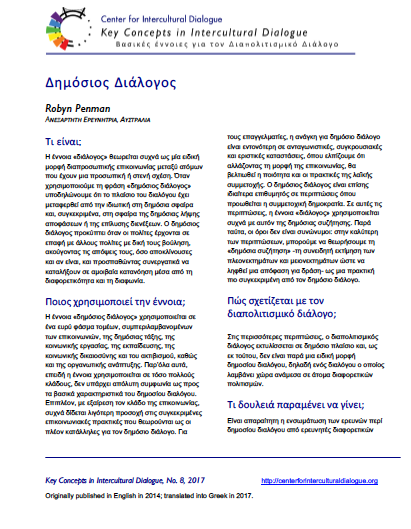
KC8 Public Dialogue Translated into Greek

Key Concepts in ICDContinuing translations of Key Concepts in Intercultural Dialogue, today I am posting KC#8: Public Dialogue, which Robyn Penman wrote for publication in English in 2014, and which Anastasia Karakitsou has now translated into Greek.

As always, all Key Concepts are available as free PDFs; just click on the thumbnail to download. Lists of Key Concepts organized chronologically by publication date and number, alphabetically by concept, and by languages into which they have been translated, are available, as is a page of acknowledgments with the names of all authors, translators, and reviewers.

KC8 Public Dialogue_GreekPenman, R. (2017). Public Dialogue [Greek]. (A. Karakitsou, trans). Key Concepts in Intercultural Dialogue, 8. Available from:
https://centerforinterculturaldialogue.org/wp-content/uploads/2014/03/key-concept-public-dialogue.pdf

If you are interested in translating one of the Key Concepts, please contact me for approval first because dozens are currently in process. As always, if there is a concept you think should be written up as one of the Key Concepts, whether in English or any other language, propose it. If you are new to CID, please provide a brief resume. This opportunity is open to masters students and above, on the assumption that some familiarity with academic conventions generally, and discussion of intercultural dialogue specifically, are useful.

Wendy Leeds-Hurwitz, Director
Center for Intercultural Dialogue


Creative Commons License
This work is licensed under a Creative Commons Attribution-NonCommercial-NoDerivatives 4.0 International License.

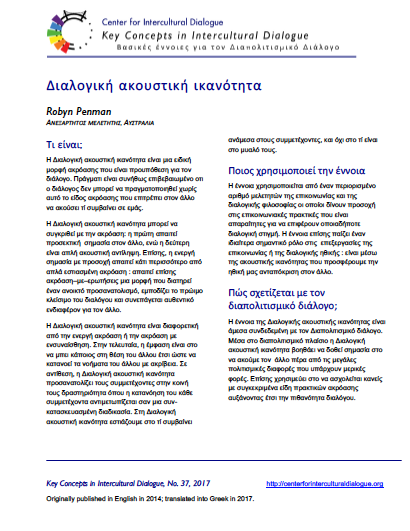
KC37 Dialogic Listening Translated into Greek

Key Concepts in ICDContinuing translations of Key Concepts in Intercultural Dialogue, today I am posting KC#37: Dialogic Listening, which Robyn Penman wrote for publication in English in 2014, and which Rania Spiridakou has now translated into Greek.

As always, all Key Concepts are available as free PDFs; just click on the thumbnail to download. Lists of Key Concepts organized chronologically by publication date and number, alphabetically by concept, and by languages into which they have been translated, are available, as is a page of acknowledgments with the names of all authors, translators, and reviewers.

KC37 Dialogic Listening_GreekPenman, R. (2017). Dialogic listening [Greek]. (R. Spiridakou, trans). Key Concepts in Intercultural Dialogue, 37. Available from:
https://centerforinterculturaldialogue.org/wp-content/uploads/2017/10/kc37-dialogic-listening_greek.pdf

If you are interested in translating one of the Key Concepts, please contact me for approval first because dozens are currently in process. As always, if there is a concept you think should be written up as one of the Key Concepts, whether in English or any other language, propose it. If you are new to CID, please provide a brief resume. This opportunity is open to masters students and above, on the assumption that some familiarity with academic conventions generally, and discussion of intercultural dialogue specifically, are useful.

Wendy Leeds-Hurwitz, Director
Center for Intercultural Dialogue


Creative Commons License
This work is licensed under a Creative Commons Attribution-NonCommercial-NoDerivatives 4.0 International License.

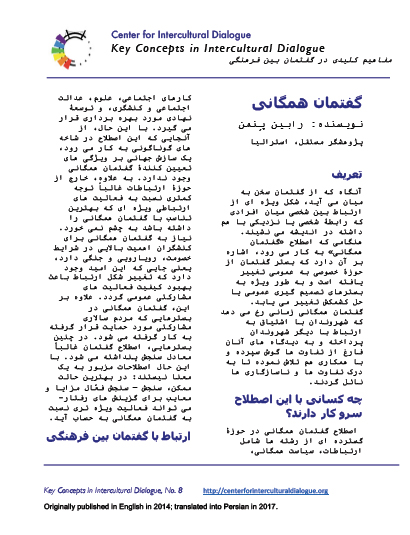
Key Concept #8: Public Dialogue Translated into Persian

Key Concepts in ICDContinuing translations of Key Concepts in Intercultural Dialogue, today I am posting KC8: Public Dialogue, written by Robyn Penman in English in 2014, and which Ramin Hajianfard has now translated into Persian.

As always, all Key Concepts are available as free PDFs; just click on the thumbnail to download. Lists of Key Concepts organized chronologically by publication date and number, alphabetically by concept, and by languages into which they have been translated, are available, as is a page of acknowledgments with the names of all authors, translators, and reviewers.

KC8 Public Dialogue_PersianPenman, R. (2017). Public dialogue [Persian]. (R. Hajianfard, Trans). Key Concepts in Intercultural Dialogue, 8. Available from:
https://centerforinterculturaldialogue.org/wp-content/uploads/2018/08/kc8-public-dialogue_persian-revised.pdf

If you are interested in translating one of the Key Concepts, please contact me for approval first because dozens are currently in process. As always, if there is a concept you think should be written up as one of the Key Concepts, whether in English or any other language, propose it. If you are new to CID, please provide a brief resume. This opportunity is open to masters students and above, on the assumption that some familiarity with academic conventions generally, and discussion of intercultural dialogue specifically, are useful.

Wendy Leeds-Hurwitz, Director
Center for Intercultural Dialogue


Creative Commons License
This work is licensed under a Creative Commons Attribution-NonCommercial-NoDerivatives 4.0 International License.

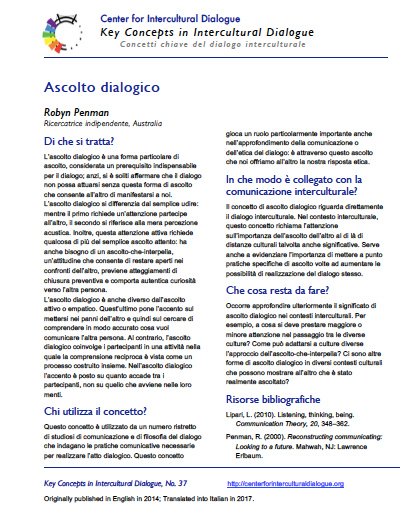
Key Concept #37: Dialogic Listening Translated into Italian

Key Concepts in ICDContinuing translations of Key Concepts in Intercultural Dialogue, today I am posting KC37: Dialogic Listening, which Robyn Penman wrote in English in 2014 and which Maria Flora Mangano has translated into Italian, with the help of Paola Giorgis.

As always, all Key Concepts are available as free PDFs; just click on the thumbnail to download. Lists of Key Concepts organized chronologically by publication date and number, alphabetically by concept, and by languages into which they have been translated, are available, as is a page of acknowledgments with the names of all authors, translators, and reviewers.

KC37 Dialogic Listening_ItalianPenman, R. (2017). Ascolto dialogico. (M. F. Mangano with P. Giorgis, Trans.). Key Concepts in Intercultural Dialogue, 37. Available from: https://centerforinterculturaldialogue.org/wp-content/uploads/2017/03/kc37-dialogic-listening_italian.pdf

If you are interested in translating one of the Key Concepts, please contact me for approval first because dozens are currently in process. As always, if there is a concept you think should be written up as one of the Key Concepts, whether in English or any other language, propose it. If you are new to CID, please provide a brief resume. This opportunity is open to masters students and above, on the assumption that some familiarity with academic conventions generally, and discussion of intercultural dialogue specifically, are useful.

Wendy Leeds-Hurwitz, Director
Center for Intercultural Dialogue


Creative Commons License
This work is licensed under a Creative Commons Attribution-NonCommercial-NoDerivatives 4.0 International License.

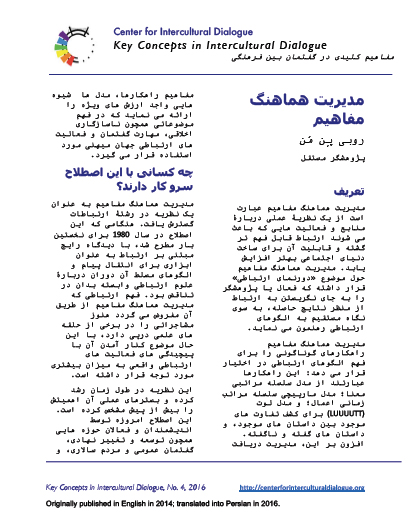
Key Concept #4: Coordinated Management of Meaning Translated into Persian

Key Concepts in ICDContinuing translations of Key Concepts in Intercultural Dialogue, today I am posting KC4: Coordinated Management of Meaning, which Robyn Penman wrote and first published in English in 2014, which Ramin Hajianfard has now translated into Persian.

As always, all Key Concepts are available as free PDFs; just click on the thumbnail to download. Lists of Key Concepts organized chronologically by publication date and number, alphabetically by concept, and by languages into which they have been translated, are available, as is a page of acknowledgments with the names of all authors, translators, and reviewers.

KC4 CMM_PersianPenman, R. (2016). Coordinated Management of Meaning [Persian]. (R. Hajianfard, Trans). Key Concepts in Intercultural Dialogue, 4. Available from:
https://centerforinterculturaldialogue.org/wp-content/uploads/2018/08/kc4-cmm_persian-revised.pdf

If you are interested in translating one of the Key Concepts, please contact me for approval first because dozens are currently in process. As always, if there is a concept you think should be written up as one of the Key Concepts, whether in English or any other language, propose it. If you are new to CID, please provide a brief resume. This opportunity is open to masters students and above, on the assumption that some familiarity with academic conventions generally, and discussion of intercultural dialogue specifically, are useful.

Wendy Leeds-Hurwitz, Director
Center for Intercultural Dialogue


Creative Commons License
This work is licensed under a Creative Commons Attribution-NonCommercial-NoDerivatives 4.0 International License.

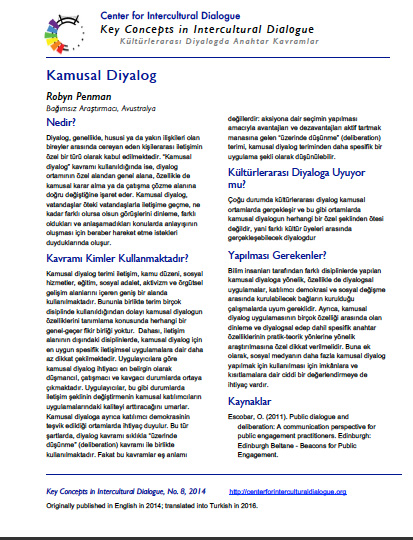
Key Concept #8 Public Dialogue Translated into Turkish

Key Concepts in ICDContinuing translations of Key Concepts in Intercultural Dialogue, today I am posting KC8: Public Dialogue, which Robyn Penman wrote in English in 2014, now translated into Turkish by Kenan Çetinkaya.

As always, all Key Concepts are available as free PDFs; just click on the thumbnail of the translation to read it. Lists of Key Concepts organized chronologically by publication date and number, alphabetically by concept, and by languages into which they have been translated, are available, as is a page of acknowledgments with the names of all authors, translators, and reviewers.

KC8 Public Dialogue_TurkishPenman, R. (2016). Kamusal Diyalog. Key Concepts in Intercultural Dialogue, 8. (K. Çetinkaya, Trans.). Available from:
https://centerforinterculturaldialogue.org/wp-content/uploads/2016/07/kc8-public-dialogue_turkish.pdf

If you are interested in translating one of the Key Concepts, please contact me for approval first because dozens are currently in process. As always, if there is a concept you think should be written up as one of the Key Concepts, whether in English or any other language, propose it. If you are new to CID, please provide a brief resume. This opportunity is open to masters students and above, on the assumption that some familiarity with academic conventions generally, and discussion of intercultural dialogue specifically, are useful.

Wendy Leeds-Hurwitz, Director
Center for Intercultural Dialogue


Creative Commons License
This work is licensed under a Creative Commons Attribution-NonCommercial-NoDerivatives 4.0 International License.

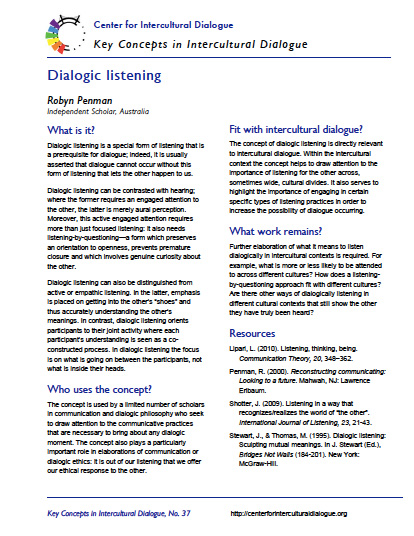
Key Concept #37: Dialogic Listening by Robyn Penman

Key Concepts in ICDThe next issue of Key Concepts in intercultural Dialogue is now available. This is KC37: Dialogic Listening by Robyn Penman. As always, all Key Concepts are available as free PDFs; just click on the thumbnail to download. Lists organized  chronologically by publication date and numberalphabetically by concept in English, and by languages into which they have been translated, are available, as is a page of acknowledgments with the names of all authors, translators, and reviewers.

kc37-smPenman, R. (2014). Dialogic listening. Key Concepts in Intercultural Dialogue, 37. Available from:
https://centerforinterculturaldialogue.org/wp-content/uploads/2014/10/key-concept-dialogic-listening.pdf

The Center for Intercultural Dialogue publishes a series of short briefs describing Key Concepts in intercultural Dialogue. Different people, working in different countries and disciplines, use different vocabulary to describe their interests, yet these terms overlap. Our goal is to provide some of the assumptions and history attached to each concept for those unfamiliar with it. As there are other concepts you would like to see included, send an email to the series editor, Wendy Leeds-Hurwitz. If there are concepts you would like to prepare, provide a brief explanation of why you think the concept is central to the study of intercultural dialogue, and why you are the obvious person to write up that concept.


Creative Commons License
This work is licensed under a Creative Commons Attribution-NonCommercial-NoDerivatives 4.0 International License.